Commercial Raw Dog Food: Frozen, Freeze-Dried, and Dehydrated
Commercial raw food is one of the most contested categories in dog feeding because it combines three emotionally powerful ideas at once: biological authenticity, visible whole ingredients, and distrust of industrial processing. Those ideas are compelling enough that many families hear "raw" and think "closer to nature," then stop asking harder questions. The harder questions are exactly where the evidence lives. Commercial raw food is a real category with real manufacturing differences, real nutrient-retention arguments, and real documented pathogen risk. A fair review has to hold all three truths at once. Mixed Evidence
What It Means
Commercial raw food includes several formats that families often blend together even though they are not identical. Frozen raw products are usually sold as patties, nuggets, bars, or chubs kept frozen until feeding. Freeze-dried raw begins as raw material and then removes water through sublimation under vacuum after freezing. Dehydrated raw products remove moisture through low-heat drying while still being marketed as fundamentally raw. Some commercial raw products also undergo high-pressure processing, or HPP, to reduce microbial load without heat. Mixed Evidence
These formats differ in convenience, storage, and microbial control, but they share one important fact: unless the product undergoes a true kill step, it remains a raw product from a pathogen perspective. Freezing does not reliably eliminate most relevant bacterial hazards. Freeze-drying does not reliably eliminate them either. That is one of the central evidence points families need to understand before they are persuaded by packaging language about purity or ancestral feeding.
Why Families Choose Commercial Raw
Families are drawn to commercial raw for several reasons. Many believe raw food is more species-appropriate because dogs descended from wolves. Many dislike extrusion and assume less heat must mean better nutrition. Many report improved stool quality, coat appearance, enthusiasm at mealtime, or a sense that the dog seems more vibrant. Some also prefer the category because it feels less artificial than kibble and more controlled than home-prepared raw.
Those motivations are not irrational. Raw food often is highly palatable. It may reduce some processing burden. Some dogs do seem to digest certain raw products well. The problem is not that families notice good things. The problem is that the category's strongest emotional story can outrun the best-supported scientific claims very quickly.
Pathogen Risk Is the Central Documented Burden
The clearest evidence in the commercial raw category concerns microbiological contamination. Documented Multiple peer-reviewed surveys and FDA-associated surveillance efforts have identified Salmonella, Listeria monocytogenes, pathogenic or toxigenic E. coli, Campylobacter, and antimicrobial-resistant organisms in raw pet-food products. These findings are not rare anecdote. They are repeated observations across countries and product samples.
That matters on two levels. First, it matters for the dog. A healthy adult dog may eat contaminated raw food and show no obvious illness, or may show only transient GI signs, but illness does occur and exposure is still biologically real. Second, it matters for the household. A dog can shed organisms into the home environment even when the dog seems normal. Bowls, thawing surfaces, human hands, dog saliva, stool, and the dog's coat can all become part of the hygiene problem.
This is why commercial raw food has to be discussed not only as a nutrition choice but also as a household biosecurity choice. The risk is especially relevant in homes with young children, elderly adults, pregnant women, immunocompromised people, or therapy-dog exposure contexts.
The day-to-day handling burden is part of that same reality. Commercial raw food requires freezer management, controlled thawing, dedicated bowls or carefully sanitized shared bowls, thoughtful cleanup of preparation surfaces, and more caution around saliva and leftovers than many families expect. Mixed Evidence A family that is already stretched on time often underestimates how much of raw feeding happens after the bag or box is purchased. This is one reason enthusiasm at the point of sale is not enough. The category asks more of the household than many other feeding formats do.
What HPP Does and Does Not Do
High-pressure processing is often presented as the answer to raw-food safety concerns. HPP typically exposes the packaged food to extremely high pressure, often around 600 megapascals, which can reduce bacterial load without conventional heat. Estimated That is a meaningful advantage. It is fair to say that HPP products may be safer than non-HPP raw products from a contamination standpoint.
What HPP does not justify is the claim that pathogen risk has therefore vanished. Risk reduction is not the same thing as guaranteed elimination, especially when upstream contamination burden and downstream handling still matter. HPP also does not solve the full adequacy question. A raw product can be lower risk microbiologically than another raw product and still be nutritionally inconsistent if formulation and quality control are weak.
Nutrient Retention and Adequacy
Commercial raw-food advocates often make two related arguments. The first is that low-heat handling preserves more nutrients. The second is that raw products therefore provide superior nutrition. The first claim has some support. A lower-heat or no-heat process can preserve certain heat-sensitive nutrients more effectively than high-heat extrusion. The second claim is much more conditional.
Commercial raw products show substantial variability in nutrient adequacy. Studies evaluating products labeled as complete have found frequent mineral imbalances, sometimes severe ones, including calcium, phosphorus, selenium, zinc, copper, and iodine problems depending on the market and sample. Documented This does not mean every raw product is deficient. It means the category is not protected from adequacy problems simply because the food is less processed.
This is a key correction to the ancestral-diet story. Nutritional adequacy does not emerge automatically from rawness. It depends on formulation, ingredient consistency, mineral balance, and manufacturer quality control. "Raw" is a format. It is not a guarantee.
This adequacy issue also explains why the substantiation picture in commercial raw deserves scrutiny. Many products are profile formulated rather than supported by stronger feeding-trial evidence, and some products lean heavily on category identity without making it especially easy for families to understand what the company has actually validated. Families attracted to raw feeding often want certainty that they have chosen a cleaner, more biologically respectful food. The category does not always provide that certainty simply because the food is visibly raw.
The "Ancestral Diet" Claim
The ancestral argument carries emotional force because it sounds evolutionarily grounded. But the modern commercial raw category is not the same thing as a wolf diet. The dog is not a wolf, the modern pet-food supply chain is not a hunted carcass ecology, and the household setting is certainly not a wild canid environment. Even if one wanted to argue from ancestry, modern dogs are domesticated facultative carnivores living in human homes, not unmanaged predators.
That does not mean the ancestral language is entirely useless. It does mean it should not be treated as biology's last word. The stronger scientific case for commercial raw, when it exists, comes from process and digestibility questions, not from romantic wolf comparison.
Why It Matters for Your Dog
Commercial raw matters because it is a category many thoughtful families genuinely consider, especially after hearing persuasive stories about coat quality, stool quality, or reduced processing burden. A dismissive review would not help those families. They need a page that takes the category seriously enough to explain its actual strengths and actual risks.
For some dogs, a commercial raw diet may appear to work well in the short term. Appetite is often excellent. Stools may be smaller. Families may appreciate the ingredient simplicity of some formulations. Those observations are not imaginary. The question is whether they outweigh the household hygiene burden, the adequacy uncertainty in some products, and the fact that many of the category's largest health claims remain under-supported.
For Golden Retriever families, the safety question is especially important because Goldens often live in busy family homes. They are around children, visitors, floors shared with toddlers, and multi-person feeding routines. That environment magnifies the relevance of handling discipline. A raw plan that is executed sloppily is not only a dog-food choice. It is a contamination-management failure.
If a feeding method introduces avoidable pathogen exposure into the dog's body and the family's living space, that is a preventive question as much as it is a nutrition question. The burden is not only "can the dog eat this." It is "what risk are we choosing to bring into the home."
Commercial raw also matters because it teaches an adult lesson about evidence balance. The category's documented risks do not justify saying every raw-fed dog is doomed or every raw brand is incompetent. But those same risks are too well established to be brushed aside by anecdote. Many families are not served well by either extreme. They are served by a framework that says: yes, nutrient-retention arguments exist; yes, palatability and digestibility may be attractive; yes, pathogen risk is documented and real; yes, manufacturer quality variation matters enormously.
That is also why the category is not ideal for families who want low-management feeding. Raw feeding done commercially still requires thoughtful thawing, bowl hygiene, surface cleaning, travel planning, and honest risk tolerance. If a family wants the least complicated, least contamination-sensitive routine, commercial raw is usually not that category.
Cost belongs in this picture too. Commercial raw is often expensive, sometimes dramatically so on a per-calorie basis. That does not make it irrational. It does mean the family should be sure they are paying for a plan they can sustain and understand, not for a reassuring story they have not actually pressure-tested against their own home routines, travel patterns, and tolerance for hygiene management.
This practical burden is worth emphasizing because it is where many family experiences diverge from the category fantasy. Commercial raw can look cleaner and easier than it actually is once it enters a busy household. The family is not simply choosing a protein source. They are choosing a storage and sanitation routine, a tolerance for biosecurity discipline, and a willingness to pay ongoing attention to risks that do not disappear just because the dog seems to enjoy the food. Families who still prefer the category after understanding that burden are making a more adult and defensible choice than families who imagine raw as a purity upgrade without operational cost.
Commercial raw also deserves a company-transparency lens. Families considering the category should ask how the company tests for pathogens, whether it uses HPP, whether the product is complete and balanced or only intended for supplemental use, and how clear the company is about safe handling. In other words, families should not let the raw identity of the food replace the ordinary due diligence every serious feeding plan still requires.
The strongest commercial-raw decisions therefore come from families who are choosing the category with full awareness rather than symbolic certainty. That awareness is what keeps the choice serious instead of fashionable.
Without that seriousness, the category becomes much easier to admire than to manage well.
That operational reality is what separates a carefully considered raw decision from a symbolic one. If the family is unwilling to own the full handling and safety burden, the category is usually being admired more than it is being responsibly chosen.
That is a much more honest standard than calling the category safe simply because it feels natural.
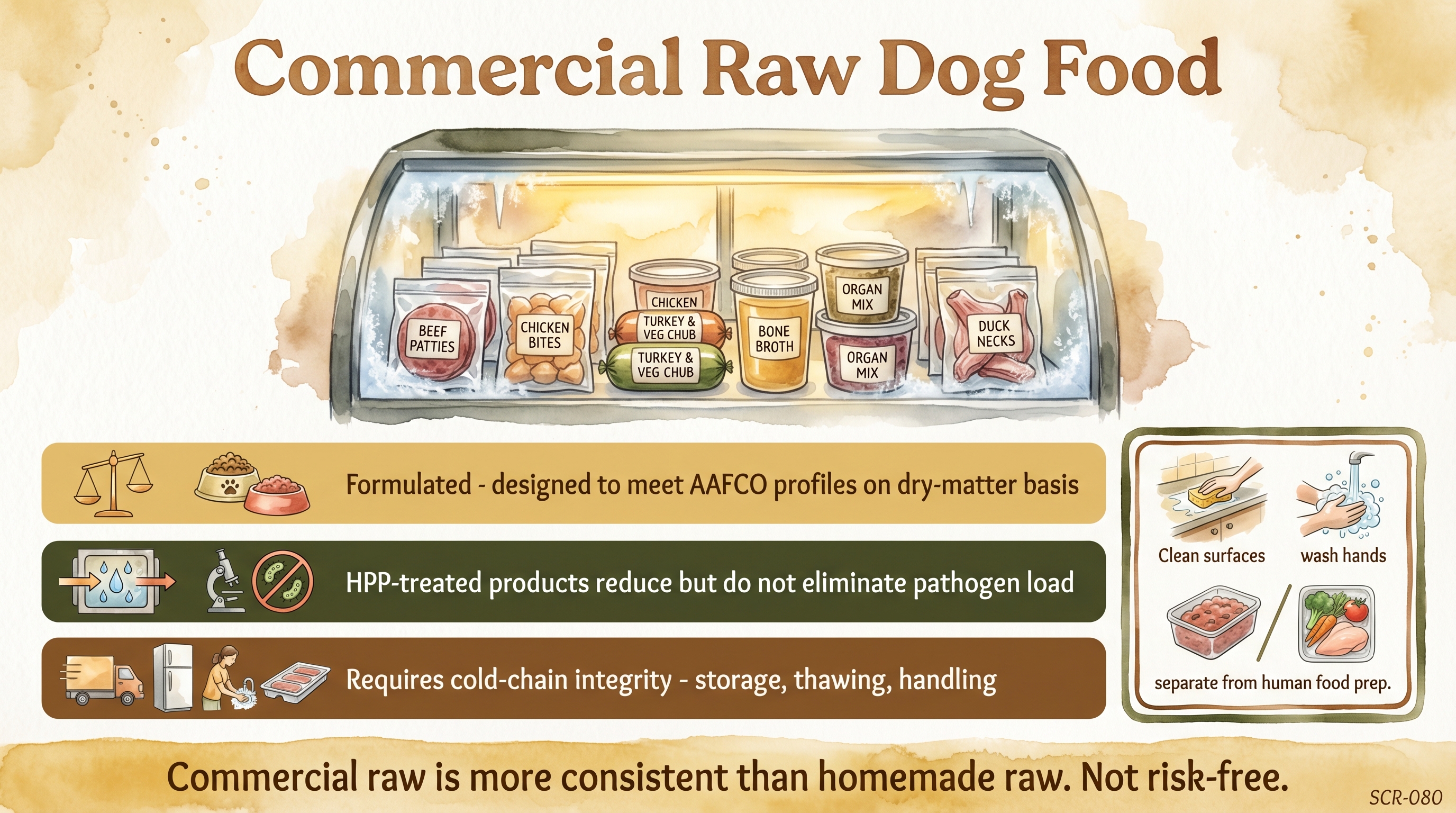
Commercial raw is more consistent than homemade raw - not risk-free.
Key Takeaways
- Commercial raw food is a real category with meaningful process differences, but its strongest documented feature is not superiority, it is safety burden.
- Frozen, freeze-dried, and dehydrated raw products remain raw from a pathogen perspective unless a true kill step has been applied.
- High-pressure processing can reduce bacterial load, but it does not eliminate all safety or adequacy concerns.
- Families considering commercial raw should evaluate it as both a nutrition choice and a household hygiene choice.
The Evidence
This entry uses estimated claim-level tags beyond the dedicated EvidenceBlocks below. These tags mark approximate ranges or timing claims that should remain bounded by the cited sources.
The commercial raw evidence base is one of the clearest examples of uneven evidence tiers. Pathogen risk is documented. Nutritional variability is documented. HPP as a risk-reduction strategy is documented. Broad superiority claims in healthy dogs are much less secure. Some raw products may show high digestibility or favorable short-term fecal outcomes. That still does not prove the stronger claim that commercial raw is categorically healthier than well-formulated cooked diets.
The contamination literature is especially important because it is repeated across different datasets and does not depend on one charismatic study. This includes both direct product contamination and the wider issue of zoonotic and antimicrobial-resistance relevance. Those findings are sturdy enough that several professional organizations discourage raw feeding.
The adequacy literature matters just as much. Products labeled complete have still failed mineral balance evaluation in multiple assessments. This is one of the easiest places for families to be misled by the appearance of the food. A raw nugget can look clean, meaty, and biologically plausible while still being badly unbalanced on paper.
The most honest conclusion is therefore a disciplined one. Commercial raw can be attractive for reasons that are not imaginary. It can also ask families to absorb a safety burden that many premium buyers are not fully acknowledging at purchase. Good decision-making in this category depends on whether the family can hold both truths at once without turning one of them into ideology.
- SCR-080 synthesisdog-food and household exposure context
Commercial raw diets carry documented pathogen risk and greater nutrient-variability risk than many extruded diets. - van Bree et al. (2018)commercial raw pet-food products
Commercial frozen raw products have tested positive for zoonotic bacteria and parasites, including resistant organisms. - Nemser et al. and related surveillancepet-food products
Raw products show markedly higher pathogen detection rates than dry or semi-moist pet-food formats.
- Comparative digestibility literaturedogs
Some raw products may show favorable digestibility or fecal outcomes, but these findings do not yet establish broad long-term superiority over well-formulated cooked diets. - Evolutionary framing synthesisdogs
The ancestral-diet argument is rhetorically powerful but biologically weaker than many advocates imply for modern household dogs.
No published study directly tests the practical implications of commercial raw dog food: frozen, freeze-dried, and dehydrated for domestic dog raising programs. The application to household dog raising remains an interpretive synthesis rather than a directly tested intervention finding.
SCR References
Sources
- National Research Council. (2006). Nutrient Requirements of Dogs and Cats. Washington, DC: The National Academies Press.
- AAFCO. (2024). Official Publication. Association of American Feed Control Officials.
- Davies, R. H., Lawes, J. R., & Wales, A. D. (2019). Raw diets for dogs and cats: a review, with particular reference to microbiological hazards. Veterinary Record, 185(15), 472.
- Hellgren, J., et al. (2019). Occurrence of Salmonella, Campylobacter, Clostridium and Enterobacteriaceae in raw meat-based diets for dogs. Veterinary Record, 184(10), 306.
- Nemser, S. M., et al. (2014). Investigation of Listeria, Salmonella, and toxigenic Escherichia coli in various pet foods. Foodborne Pathogens and Disease, 11(9), 706-709. https://doi.org/10.1089/fpd.2014.1748
- van Bree, F. P. J., et al. (2018). Zoonotic bacteria and parasites found in raw meat-based diets for cats and dogs. Veterinary Record, 183(13), 424.