Dog Diet Types: A Complete Overview
Dog families are often forced to make food decisions in the middle of a marketing war. One side says kibble is industrial junk. Another says raw is reckless. Another says fresh food is obviously best if you really love your dog. In practice, the feeding question is less theatrical and more disciplined. A useful diet is the one that is complete, balanced, safe, sustainable for the household, and appropriate for the dog's life stage and medical context. Processing method matters, but it is only one variable in a bigger nutrition picture. Documented
What It Means
The modern dog-food landscape is broad enough that families can lose the plot before they even compare nutrients. The first task is not to decide which tribe sounds most pure. It is to understand what category each food actually belongs to, how it is made, what its practical tradeoffs are, and how strong the evidence is for adequacy and safety within that category.
The dominant category by sales volume is still extruded dry food, usually called kibble. Kibble is made by grinding ingredients, mixing them into a dough or slurry, conditioning them with heat and moisture, extruding them under pressure, drying them, coating them with fats or palatants, cooling them, and packaging them for shelf stability. Kibble became dominant because it is convenient, calorie dense, comparatively affordable, and easy to formulate toward AAFCO nutrient profiles. It is also the category most likely to attract criticism for being "ultra-processed." The honest evidence summary is that extrusion does change nutrients and creates processing byproducts, but current dog-specific evidence does not prove that a well-formulated kibble is inherently harmful simply because it is extruded.
Canned or wet food is the second major category. Wet diets are mixed, sealed into cans or pouches, and retort processed to commercial sterility. Their biggest difference from kibble is water. A typical canned food may contain 70 to 80 percent moisture, while kibble may contain 8 to 10 percent. That means wet food is usually less calorie dense by volume, more aromatic, and sometimes easier to use in dogs with poor appetite, dental pain, or low voluntary water intake. It is also usually more expensive per calorie and less convenient after opening because it must be refrigerated and used quickly.
Fresh cooked food has grown rapidly in the last several years. In this category, ingredients are cooked at lower temperatures than extrusion, usually gently cooked, refrigerated, or frozen, then portioned for direct feeding. Commercial subscription brands sit here, along with veterinary nutritionist-designed home-cooked plans. Fresh food appeals to families because it looks more like recognizable food. The science supports some of the process-level claims: lower thermal load can preserve more heat-sensitive nutrients and reduce some Maillard reaction burden compared with extrusion. Documented What the science does not yet support strongly is the bigger claim that fresh food reliably produces superior long-term health outcomes in ordinary family dogs across the board.
Raw food is not one thing, which is why this overview has to separate commercial raw from home-prepared raw later in the dispatch. Commercial raw includes frozen patties, nuggets, freeze-dried raw, dehydrated raw, and some high-pressure-processed products. Home-prepared raw includes BARF-style plans, prey-model approaches, and a wide range of kitchen-built rations. The strongest dog-specific evidence in this space concerns pathogen risk and nutritional variability. Documented Commercial and home-prepared raw diets can contain Salmonella, Listeria, toxigenic E. coli, and other contaminants at rates higher than heat-processed foods, and inadequately formulated raw diets can be markedly unbalanced. That does not mean every raw product is nutritionally poor or every raw-fed dog becomes ill. It does mean raw feeding carries documented safety burdens that families should understand clearly before choosing it.
Dehydrated and air-dried foods sit somewhere between fresh and dry in the public imagination, though they are not interchangeable. Dehydration removes water with gentle heat and airflow. Air-dried products do something similar with controlled low-temperature drying. These foods are shelf-stable, lighter than wet or frozen diets, and often marketed as less processed than kibble. Freeze-dried foods remove water through sublimation from a frozen state. That process preserves texture and some heat-sensitive compounds more effectively than cooking, but it does not act as a kill step for pathogens if the starting material is raw. For that reason, freeze-dried raw has to be understood as a raw product from a safety perspective, even if the texture feels more convenient than a frozen raw patty.
Home-cooked diets form another important category because families often want more control over ingredients than commercial foods allow. Observed-JB There are legitimate reasons for this choice: managing food sensitivities, supporting appetite in recovering dogs, avoiding a protein source, or simply preferring to cook for the dog as a family member. The evidence here is unusually clear. A properly formulated home-cooked diet can be nutritionally adequate and can support a healthy dog over the long term. An improvised home-cooked diet built from internet recipes, random substitutions, or "balanced by instinct" planning frequently is not. The difference between those two scenarios is not small. It is the difference between a legitimate nutrition plan and a deficiency risk.
Prescription therapeutic diets are their own category, though many families mistake them for a brand tier rather than a clinical tool. These diets are designed to manage medical conditions such as chronic kidney disease, food-responsive enteropathy, urinary stone risk, obesity, diabetes, and hepatic disease. They operate within the same broad regulatory environment as ordinary pet foods, but the practical point is different. Their value lies in targeted nutrient manipulation for a disease state. In many conditions, they are among the strongest evidence-based nutritional interventions available in small-animal medicine. Documented
Families also encounter hybrid or less common categories. Baked kibble is processed differently from extruded kibble but still belongs to the dry-food family. Freeze-dried toppers or broths may be sold near complete diets even when they are only intended for intermittent or supplemental feeding. Mix-and-match feeding is common too: kibble plus canned food, kibble plus fresh topper, therapeutic base diet plus measured canned support, or home-cooked meals integrated with commercial feeding. In real homes, diet categories are often blended. Label literacy matters just as much as category familiarity.
One useful framework for describing this landscape is the NOVA classification used in human nutrition, especially the distinction between minimally processed foods and ultra-processed foods. Kibble often maps most closely to the ultra-processed end of that framework because it is industrially formulated, heavily processed, and reliant on fortification. Fresh cooked diets sit closer to the lightly processed end. Raw and freeze-dried raw complicate the picture because low thermal processing does not automatically equal high safety. The reason JB treats NOVA cautiously is that dog food is not a perfect match to the human category system. A fortified complete dog food is designed to be the dog's entire diet, not a discretionary snack layered onto an already varied human diet. Processing language can be useful, but it should not be treated as a complete verdict.
That is the most important discipline in this category overview. No diet type wins by slogan alone. Kibble cannot be judged by processing label alone. Raw cannot be judged by ancestry language alone. Fresh food cannot be judged by visual appeal alone. Home cooking cannot be judged by good intentions alone. The right comparison has to include four practical questions every time: is it nutritionally complete and balanced for the intended life stage, is it microbiologically and operationally safe, is it sustainable for the family's budget, storage, travel, and routine, and does it work for the actual dog in front of the family. Those questions sound boring compared with internet food arguments, but they are the questions that actually protect dogs.
Why It Matters for Your Dog
Food decisions are daily decisions. That alone makes this topic one of the most consequential parts of family stewardship. Most dogs do not get harmed by one dramatic meal. They are shaped by the same bowl, repeated over months and years, interacting with growth, body condition, appetite, disease risk, and family consistency.
For Golden Retriever families, the stakes are practical rather than ideological. Goldens need life-stage-appropriate nutrition, careful body-condition management, and a feeding routine that can survive real family life. Documented A food that is technically admirable but impossible for the household to afford, store, portion, or travel with is not a good long-term plan. A food that sounds premium but is not complete and balanced is also not a good plan. Sustainability is not a secondary issue. It is part of nutritional competence.
This is also the point where category confusion causes real mistakes. Families may assume that anything sold in the refrigerated aisle must be nutritionally superior. They may assume anything labeled raw must be biologically natural and therefore better. They may assume a freeze-dried product can serve as a full diet when it is actually labeled for intermittent feeding only. They may assume a canned food is too rich or too indulgent to feed daily when, in fact, some canned foods are entirely appropriate complete diets. Category literacy prevents these ordinary errors.
The dog's medical context matters too. A healthy young adult Golden with excellent stool quality and stable weight may thrive on more than one diet type if the food is complete and balanced and the family uses it well. A dog with food allergy suspicion, chronic kidney disease, urinary stone history, severe pickiness during recovery, or repeated GI instability may need a much more specific dietary tool. That is why this overview includes prescription diets as part of the same map. The goal is not only to help families compare commercial preferences. It is to help them understand when nutrition becomes part of medical management.
Choosing a food is one of the quietest preventive acts a family performs. Good food choices prevent not only deficiency, but also avoidable instability: chaotic diet switching, repeated GI upset, unsafe raw handling, inappropriate life-stage feeding, and the slow drift into overweight body condition.
This overview also protects families from overreacting to the wrong variable. The pet-food debate often elevates one lens above all others. Processing becomes the only lens. Ingredient list becomes the only lens. Cost becomes the only lens. "Looks like real food" becomes the only lens. In reality, dogs are nourished by the whole system. A well-made kibble from a transparent manufacturer may be a better family choice than an inconsistently formulated boutique fresh food. A veterinary nutritionist-designed home-cooked plan may be better than a random commercial raw diet chosen for marketing language. The point is not that one category always beats another. The point is that category alone is not enough.
Another reason this page matters is that many families change diets too quickly in pursuit of a hypothetical best food. A dog eats a food reasonably well and looks good on it, but the family sees a new social-media claim and decides they must switch immediately because their current food is "toxic," "dead food," or "not species appropriate." Sometimes the new food works. Sometimes it causes expense, stress, stool disruption, or long-term inconsistency. Constant diet anxiety can become its own problem. A steady, evidence-aware framework is healthier for both dog and family than a permanent state of dietary FOMO.
The most useful attitude for families is calm stewardship. Know the categories. Know the common claims. Know which risks are genuinely documented and which ones are more interpretive. Then choose a food strategy the household can execute with confidence. That is a more protective posture than either blind trust in the pet-food aisle or permanent suspicion of every commercial option.
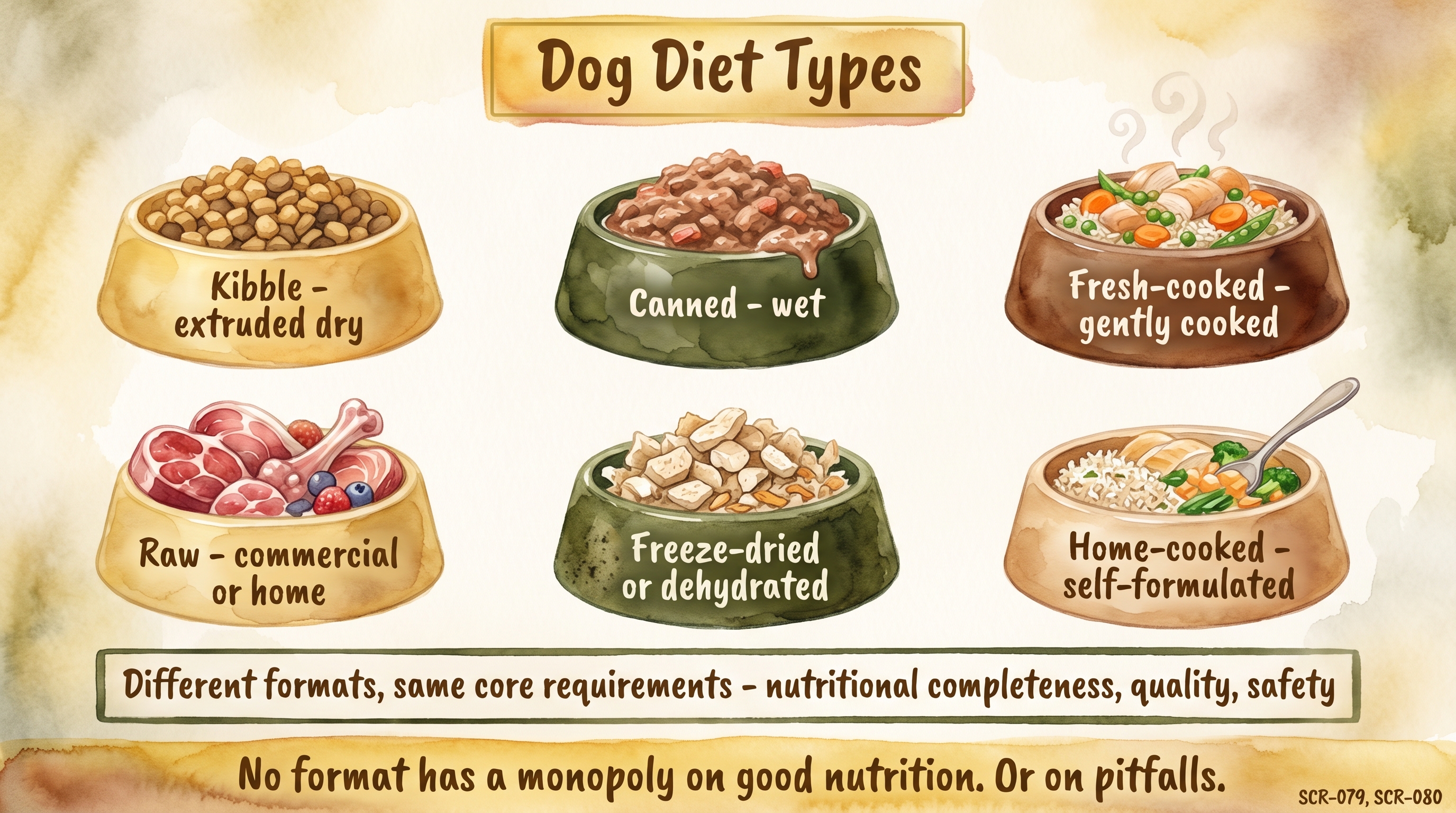
No format has a monopoly on good nutrition - or on pitfalls.
Key Takeaways
- Dog diet types differ meaningfully in processing, safety profile, shelf life, cost, and convenience, so category literacy matters before brand comparison.
- The best diet is not the one with the loudest marketing story but the one that is complete, balanced, safe, and sustainable for the family and dog.
- Raw feeding carries the clearest documented safety burden, while broad superiority claims for fresh or minimally processed diets remain more limited than marketing often suggests.
- Category choice should always be filtered through life stage, medical context, body condition, and what the household can actually sustain long term.
The Evidence
This entry uses observed claim-level tags beyond the dedicated EvidenceBlocks below. These tags mark JB program observation or practice-derived claims that need dedicated EvidenceBlock coverage in a later content pass.
The evidence is strongest when it stays at the level of specific claims rather than food ideology. It is documented that raw diets carry higher pathogen risk and greater adequacy variability than most heat-processed commercial diets. It is documented that extrusion changes nutrient chemistry and that some vitamins and amino acids are affected by processing. It is documented that fresh and lightly processed diets can show higher digestibility in some controlled trials. It is also documented that complete and balanced commercial foods, including extruded and canned formats, have supported long healthy lives in enormous numbers of dogs. The evidence becomes thinner when people jump from those findings to sweeping conclusions such as "fresh is always healthier," "kibble is poison," or "raw is what dogs were meant to eat so it must be superior."
The category evidence is therefore asymmetric. Safety concerns in raw feeding are better documented than broad health superiority claims in any one premium format. Processing effects are better documented than long-term processing-outcome disease claims. Nutritional inadequacy in improvised home-prepared diets is better documented than most of the emotional claims attached to home-prepared feeding. That asymmetry matters because it tells families where to be firm and where to stay humble.
There is also an important evidence boundary around comparison studies. Many diet-format trials compare foods that differ in more than processing alone. Macronutrient profile, moisture, fiber load, ingredient sourcing, palatability, and manufacturer quality control can all move with the format. So when a fresh diet shows better digestibility or a different fecal metabolite profile than kibble, it does not always prove that processing alone caused the difference. It proves that the whole food package differed in meaningful ways. That is still useful evidence, but it is narrower than many marketing summaries imply.
- SCR-079 synthesisdog-food regulatory context
AAFCO complete-and-balanced status is a meaningful adequacy floor across commercial diet formats, even though it is not proof of optimality. - SCR-080 synthesisdog-food and household exposure context
Raw diets carry documented pathogen risk and greater nutritional variability than many commercial extruded diets. - Comparative format source synthesisdogs
Extruded, canned, fresh, and raw diet formats differ in moisture, digestibility, safety profile, shelf stability, and manufacturing burden, but no single format has a universal health-outcome victory across all dogs.
- Fresh versus kibble comparative literaturedogs
Fresh and lightly processed diets may improve digestibility and some biomarker outcomes, but strong long-term superiority claims remain underpowered and often conflict-of-interest sensitive. - UPF classification debatehumans and dogs
The NOVA concept is useful for describing processing intensity, but its direct translation into dog-health predictions remains unsettled.
No published study directly tests the practical implications of dog diet types: a complete overview for domestic dog raising programs. The application to household dog raising remains an interpretive synthesis rather than a directly tested intervention finding.
SCR References
Sources
-
National Research Council. (2006). Nutrient Requirements of Dogs and Cats. Washington, DC: The National Academies Press.
-
AAFCO. (2024). Official Publication. Association of American Feed Control Officials.
-
Algya, K. M., Zicker, S. C., Burgess, J. R., Cave, N. J., & Wolko, D. A. (2018). Apparent total-tract digestibility and fecal outcomes in dogs fed extruded, mildly cooked, and raw diets. Veterinary Medicine and Science, 4(3), 180-187.
-
Moravszki, L., Bercier, A., Lejeune, B., et al. (2025). Assessment of mineral adequacy in preprepared raw dog foods labeled as complete. Journal of the American Veterinary Medical Association, 266(1), 45-53.
-
Stockman, J., Fascetti, A. J., Kass, P. H., & Larsen, J. A. (2013). Evaluation of recipes of home-prepared maintenance diets for dogs. Journal of the American Veterinary Medical Association, 242(11), 1500-1505.
-
Vecchiato, C. G., Carciofi, A. C., De Oliveira, M. C., et al. (2022). Detailed assessment of commercial raw pet food for dogs and cats. Journal of Animal Physiology and Animal Nutrition, 106(2), 432-439.
-
WSAVA Global Nutrition Committee. (2021). Global nutrition guidelines for companion animals. Journal of the American Veterinary Medical Association, 259(11), 1200-1224.