Home-Cooked Dog Diets: Doing It Safely
Compound evidence detail1 SCR / 2 parts
- Documentedcanine nutrient-profile and toxicity evidence showing defined vitamin and trace-mineral requirements, narrow safety margins for selected micronutrients, and clinically important deficiency-or-excess consequences
- Observed-JBthe recipe-survey pattern that unformulated home-prepared diets commonly miss mineral or vitamin targets and require veterinary-nutrition formulation review
Home-cooked diets sit in a very human part of dog care. Families cook because they want control, clarity, and closeness. They want to know what is in the bowl. They may be managing a suspected food sensitivity, a recovering appetite, a dog that turns away from commercial foods, or simply their own discomfort with industrial-feeding language. All of those motivations are understandable. The science does not tell families never to cook for their dogs. It tells them something narrower and more demanding: home cooking is a legitimate option only when the caregiver treats formulation with the same seriousness they would give a medical plan. Documented
What It Means
A home-cooked dog diet is not defined by the fact that it was made in a home kitchen. It is defined by whether the ingredients, amounts, supplementation, and calorie targets add up to a complete feeding plan for that dog. This is the distinction many families miss at the start. Cooking chicken, rice, and vegetables for a dog is easy. Building a diet that meets long-term calcium, phosphorus, amino acid, trace mineral, fat-soluble vitamin, essential fatty acid, and energy requirements is much harder. Documented
That difficulty is the central scientific fact in this category. Most informal home-cooked recipes are not nutritionally complete. That finding has been repeated enough times that it should not be treated as a minor warning label. It is the baseline. The default home recipe found online, in a casual blog post, or passed between families is much more likely to be incomplete than complete. Documented The reason is simple. Nutritional adequacy is mathematically demanding, while internet recipe culture rewards what looks approachable and wholesome.
Families usually arrive at home cooking for three broad reasons. Some want ingredient control. They may distrust commercial formulas, want to avoid a specific protein, or feel calmer when they can see every ingredient going into the pot. Some want better appetite support. Dogs recovering from illness, dental pain, GI upset, or medication-related nausea sometimes respond better to warm, aromatic home-cooked meals than to dry commercial food. Some families are motivated by relationship and meaning. Cooking feels like care in a direct way that scooping from a bag does not. All three reasons are emotionally real. None of them exempt the diet from nutritional math.
The safest version of home cooking usually starts with professional formulation. That may mean working directly with a board-certified veterinary nutritionist. It may mean using formulation services such as BalanceIT or PetDiets when those services are appropriate for the dog's needs. In both cases the principle is the same. The family is not guessing. The family is executing a recipe that has already been balanced for nutrients, ingredients, calories, and supplementation.
Why So Many Home-Cooked Diets Fail
The reason most home-cooked diets fail is not that families are careless. It is that the problem is deceptively complex. Chicken is not just protein. Liver is not just "healthy organ meat." Eggshell powder is not the same thing as a fully balanced mineral plan. A recipe that seems rich in meat can still be deficient in calcium, zinc, copper, choline, vitamin D, or vitamin E. A recipe that seems beautifully varied can still miss targets because the ingredients do not provide the right nutrients in the right proportions at the calories the dog actually eats.
This is why the Stockman paper matters so much in family education. The finding that the overwhelming majority of reviewed home-prepared diets had one or more deficiencies, and that most had multiple deficiencies, is not an attack on home cooking as a concept. It is evidence that intuition alone is not enough. Even veterinary-authored recipes in those analyses were not always perfectly complete, which shows how unforgiving the category can be.
Another major failure point is drift. A family may begin with a balanced plan and then slowly modify it. They swap turkey for beef, stop adding the premix because it seems expensive, change the oil source, reduce organ inclusion because the dog dislikes it, or add a pile of treats that change the calorie balance. Documented Each change feels small. Over time, the recipe stops being the recipe that was actually formulated. That is one of the most common ways a legitimate home-cooked plan becomes nutritionally shaky.
The Correct Workflow
The correct workflow for home cooking is straightforward, even if it is not glamorous. First, identify why home cooking is being considered. If the reason is medical, the veterinarian and sometimes a veterinary nutritionist should be part of the decision early. Second, obtain a properly formulated recipe designed either for a healthy dog in a known life stage or for the specific condition being managed. Third, source ingredients consistently and use the supplements exactly as written. Fourth, portion the finished food according to the plan rather than estimating casually. Fifth, reassess the dog over time based on body condition, stool quality, appetite, and follow-up veterinary guidance.
That workflow sounds almost procedural, and that is because it is. Home cooking becomes safe when it stops being improvisational and becomes operational. Owners often want the romance of feeding from the stove. The dog benefits more from the discipline of repetition.
Ingredient sourcing matters more than families sometimes realize. A recipe balanced around lean turkey and white rice is not identical to one executed with dark turkey meat, frequent unmeasured fat additions, and inconsistent starch portions. In a home system, the caregiver is part of the manufacturing chain. That means the caregiver is also part of the quality-control system. Variation that would be corrected or standardized in a commercial plant has to be corrected by the household.
Cooking method matters too, though usually less than formulation itself. Overboiling can change texture and reduce palatability. Under-cooking can create food-safety problems depending on the ingredients. Repeated thawing and refreezing can affect handling quality and caregiver consistency. None of these are the biggest risks in the category, but they are part of the reason home cooking is not automatically simple just because it is personal.
Portioning and storage deserve more attention than they usually get in family discussions. Once a batch is cooked, the family still has to divide it accurately, freeze or refrigerate it safely, and remember that the calorie target matters just as much as the ingredient list. A nutritionally well-formulated food can still become a poor feeding plan if the household portions it loosely and lets body condition drift. This is especially important in large dogs, where small per-meal overestimates become meaningful daily calorie errors very quickly.
Cost and Sustainability
Home-cooked diets often land between kibble and premium commercial fresh food in cost, but the range is wide. Costs depend on protein source, whether the dog is small or large, whether supplements are specialty products, and how much professional input is required. Documented Many families underestimate the labor cost too. Shopping, weighing, cooking, portioning, freezing, thawing, and dishwashing all become part of the feeding routine.
That burden is not necessarily a reason not to home cook. It is simply part of the truth. A plan that works for three enthusiastic weeks but collapses under schedule pressure is not a strong plan. One of the deepest acts of nutritional stewardship is choosing the feeding method the family can actually maintain when life is ordinary, not just when motivation is high.
Why It Matters for Your Dog
Home-cooked diets matter because they can be either one of the safest custom-feeding tools or one of the most common routes to long-term nutritional drift. The difference between those two outcomes is usually not the family's love. It is the family's method.
For some dogs, home cooking is genuinely useful. Dogs with difficult food histories may benefit from a deliberately simplified recipe. Dogs in recovery may eat better when meals are warm and aromatic. Some dogs with chronic medical issues need a very specific formulation that a veterinary nutritionist can design. In these cases, home cooking is not an indulgence. It is a legitimate clinical or practical strategy.
For healthy dogs, home cooking can also work well when the caregiver is organized, formula-faithful, and willing to use the full recipe as designed. There is nothing scientifically unserious about feeding a home-cooked diet when it is properly built and monitored. The problem is that many families hear this point and then substitute it with a looser one: "homemade food is better because it is homemade." That is not the same claim.
The dog is not fed by intentions. The dog is fed by what goes into the bowl every day. Consistency is part of nutritional leadership, especially when the caregiver has chosen a method that depends heavily on their own accuracy.
This page matters for Golden Retriever families because Goldens are large enough that deficiencies or calorie drift scale quickly. A seventy-pound dog on a home-cooked plan is moving a lot of food, and small inaccuracies repeated over time become meaningful. Goldens are also often embedded in highly social households where one person formulates the plan and another person feeds, which can create portion inconsistency if the routine is not written down clearly.
Home cooking also matters because it can calm some families and destabilize others. For some families, the ability to see and control ingredients reduces anxiety and improves compliance beautifully. For others, the daily labor becomes exhausting and they begin skipping steps, estimating amounts, or replacing full meals with loosely similar substitutes. The feeding method is only protective if the household can stay accurate under ordinary stress.
Another important reason this page matters is that it prevents the false comparison between a professionally designed home-cooked plan and an internet "vet approved" recipe with no real nutrient audit behind it. These are not the same category in practice, even if both are homemade. The first is a nutrition plan. The second is often only a cooking suggestion.
The emotional value of home cooking should also be acknowledged honestly. For some families, preparing meals creates a feeling of care and connection that genuinely helps them stay engaged with the dog's routine. That can be a strength. It only becomes a weakness when the emotional satisfaction of cooking starts to substitute for checking whether the diet is still complete, still properly supplemented, and still fitting the dog's changing body and medical needs over time.
There is also an important long-term dignity point in this category. A carefully executed home-cooked diet can let a family participate actively in their dog's care without surrendering scientific discipline. That combination is rare and valuable. But it only works when the caregiver is willing to let expertise structure the plan. The better the caregiver understands that home cooking is compatible with rigor rather than an alternative to it, the safer and more sustainable the whole method becomes.
The strongest home-cooked plans therefore look less like improvised wellness culture and more like disciplined household medicine. Ingredients are bought consistently. Supplements are not optional. Portions are tracked. Follow-up happens when the dog's needs change. Documented That level of seriousness may sound less romantic than casual homemade feeding, but it is what turns home cooking from a heartfelt gesture into a genuinely safe daily diet.
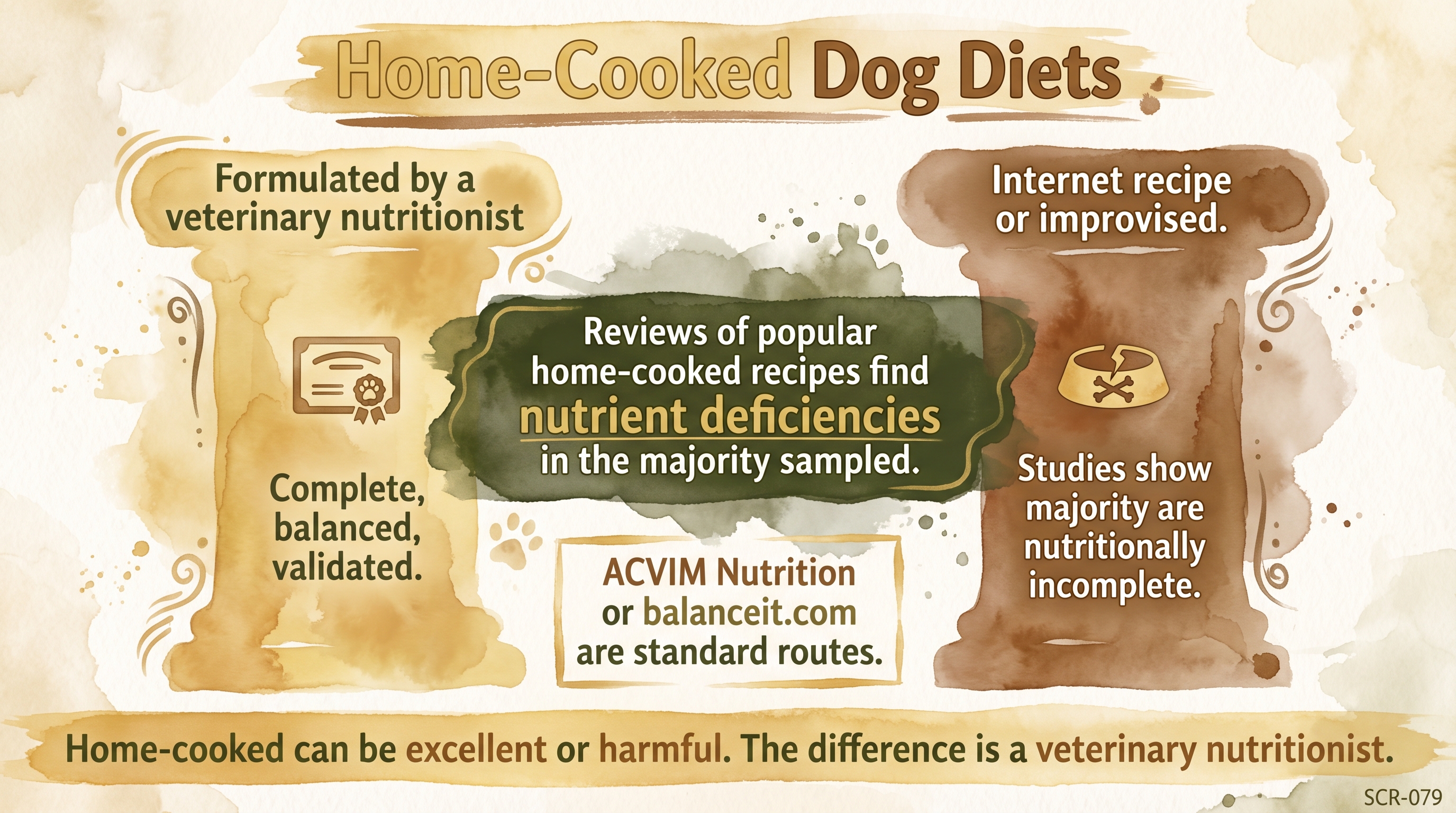
Home-cooked can be excellent or harmful - the difference is a veterinary nutritionist.
Key Takeaways
- Home cooking is a legitimate feeding option only when the caregiver treats formulation as nutrition science rather than recipe intuition.
- Most casual homemade recipes are not complete and balanced, even when they look wholesome and meat-rich.
- The safest route is a veterinary nutritionist-formulated plan or a reputable formulation service used exactly as written.
- The long-term success of home cooking depends as much on household consistency and supplement compliance as on ingredient quality.
The Evidence
The evidence on home-cooked diets is unusually decisive about one thing: most unformulated or informally formulated recipes fail adequacy standards. This is one of the least romantic but most useful findings in the entire nutrition category. Families do not need to guess whether homemade recipes are commonly incomplete. They are.
The evidence also supports the opposite conclusion when the method changes. A properly formulated home-cooked diet can support a healthy dog over time. The key is not the kitchen itself. It is the presence of formulation discipline, appropriate supplementation, and faithful execution. This is why the clinical consensus is not "never home cook." It is "home cook correctly or do not home cook as the sole diet."
The gap between those two realities is where most family confusion lives. A home-cooked diet is not validated by wholesomeness language, visible ingredients, or the family's confidence. It is validated by whether it meets the dog's nutritional requirements consistently across real feeding conditions. That is a stricter standard than many owners expect, but it is the only standard that protects the dog.
That final point is why home cooking can be such a strong option when done well. It allows customization, ingredient control, and family buy-in without forcing the dog into a nutritionally vague experiment. The method is entirely viable. It is simply much less forgiving than families often hope, which is exactly why evidence-aware planning has to come first.
- Stockman et al. (2013)dogs
Most evaluated home-prepared maintenance diets contained one or more essential nutrient deficiencies, with multiple deficiencies common. - Pedrinelli et al. (2019)dogs
Laboratory analysis of home-prepared diets found widespread inadequacy across evaluated nutrients. - SCR-079 synthesisdog-food adequacy context
Home-cooked diets still require full adequacy discipline; being homemade does not exempt them from minimum nutrient standards.
- Veterinary nutrition formulation practicedogs
Professionally formulated recipes with specified supplements and portions can produce nutritionally adequate home-cooked diets. - Home-cooking compliance synthesisdogs
The most common failure mode is owner drift from the original recipe rather than an inherent impossibility of home preparation.
No published study directly tests the practical implications of home-cooked dog diets: doing it safely for domestic dog raising programs. The application to household dog raising remains an interpretive synthesis rather than a directly tested intervention finding.
SCR References
Sources
-
National Research Council. (2006). Nutrient Requirements of Dogs and Cats. Washington, DC: The National Academies Press.
-
AAFCO. (2024). Official Publication. Association of American Feed Control Officials.
-
Pedrinelli, V., Zafalon, R. V., Teixeira, F. A., et al. (2019). Concentrations of macronutrients, minerals and heavy metals in home-prepared diets for adult dogs and cats. Scientific Reports, 9(1), 7648.
-
Stockman, J., Fascetti, A. J., Kass, P. H., & Larsen, J. A. (2013). Evaluation of recipes of home-prepared maintenance diets for dogs. Journal of the American Veterinary Medical Association, 242(11), 1500-1505.
-
WSAVA Global Nutrition Committee. (2021). Global nutrition guidelines for companion animals: Nutrient requirements and environmental issues. Journal of the American Veterinary Medical Association, 259(11), 1200-1224.