Dehydrated and Freeze-Dried Dog Food
Dehydrated and freeze-dried dog foods are often grouped together because they are shelf-stable, lightweight, and marketed as premium alternatives to kibble. But from a safety and evidence standpoint, they are not the same thing. One is usually a cooked or at least heat-treated moisture-removal format. The other is often still functionally raw, just without the water. Families need to understand that distinction clearly because these foods are purchased for convenience, while their risks and strengths depend heavily on how that convenience was created. Documented
What It Means
Dehydrated dog food is typically made by removing moisture with low, controlled heat and airflow. The resulting product is dry and shelf-stable, but it often begins from ingredients that have been cooked or meaningfully heat-treated. Families usually rehydrate it with warm water before feeding, which restores bulk and often improves aroma. Observed-JB
Freeze-dried food is made very differently. The food is frozen and then exposed to vacuum conditions that allow water to leave by sublimation. This preserves shape and avoids the higher cooking temperatures used in dehydration or extrusion. Because of that, freeze-dried products often retain more of the structure and nutrient profile of the starting material. It is also why many freeze-dried foods are marketed as raw. In many cases that marketing is fair. The product may be dry, but it is still raw from a microbiological perspective if no kill step has been applied.
That distinction is the first thing families should learn. Dehydrated cooked food and freeze-dried raw food are neighbors on a shelf, but not equivalents in the evidence. Dehydrated cooked foods usually carry the safety advantages of a heat-treated product. Freeze-dried raw foods still require the risk framework of raw feeding, even though the texture is clean and the bag is easy to store.
Why Families Like These Formats
These formats solve real practical problems. They are lighter than canned food, easier to travel with than frozen fresh food, and more visually appealing to some families than kibble. Rehydration gives families a meal that looks more substantial than dry pellets without requiring freezer space. The products are often used for camping, boarding, emergency storage, selective eaters, or mixed-feeding applications where a small amount of premium food is used as a topper or motivator. Observed-JB
That portability is not trivial. A feeding method that works well at home but collapses during travel creates a real compliance problem. Dehydrated and freeze-dried formats often exist in the market because they bridge that gap. Heuristic They offer more convenience than frozen raw and more perceived premium value than kibble.
Nutrient Retention and the Premium Story
The nutrient-retention argument in this category is partly legitimate. Freeze-drying, because it avoids major heat exposure, can preserve more heat-sensitive nutrients than extrusion. Dehydration usually sits somewhere between extrusion and freeze-drying in processing burden. That means the category's process story is not invented. The food can differ meaningfully from kibble in ways that matter biochemically.
The evidence boundary is similar to what we see in fresh-food marketing. Better nutrient retention does not automatically prove better lifelong health. It shows that the manufacturing process is different and that some nutrient damage may be lower. Long-term clinical superiority still remains a stronger claim than the current dog-specific evidence can support.
The Complete-and-Balanced Question
Another place families get tripped up is the difference between a true complete diet and a premium accessory food. Dehydrated and freeze-dried categories contain both. Some products are intended to be fed as the sole diet and are substantiated accordingly. Others are formulated only for intermittent or supplemental feeding, often as toppers, mixers, broths, or treat-style enhancements.
Because the packaging is often beautiful and the food looks rich, families sometimes assume that a premium-looking product must also be nutritionally complete. That is not a safe assumption. This is a category where the "complete and balanced" statement matters enormously, because there are many products in the space that are designed to be used alongside another complete diet rather than as a sole ration.
Pathogen Reality
Freeze-dried raw deserves a direct warning because the packaging can make it feel safer than it is. Dryness is not the same thing as microbial elimination. If the starting material is contaminated and the process did not include a true kill step, the final product can still carry pathogen risk. The convenience of a shelf-stable bag can lull families into handling the food with less caution than they would use with frozen raw patties, even though the underlying raw-food issue is still present.
Dehydrated cooked products do not carry that same raw-food hazard when they have been properly heat-treated. That is one reason the category should be split conceptually rather than discussed as one blended premium format. Families deciding between dehydration and freeze-drying are often deciding between very different safety profiles even when the product marketing sounds similar.
Why It Matters for Your Dog
This category matters because it often fits real family life very well. A dog that travels, boards, hikes, camps, or splits time between households may benefit from a feeding format that is shelf-stable but more substantial than dry kibble. Families with small freezers or no desire to manage frozen-food shipping often find dehydration especially attractive for this reason.
For Goldens and other larger dogs, the format can also be useful in specific situations where portability matters more than daily cost efficiency. Emergency-preparedness kits, weekend travel, training trips, and temporary diet support all make more sense when the food does not require refrigeration. These are the moments where the category's practical strengths show up clearly.
Portable feeding formats can be protective when they reduce diet disruption during travel or stressful transitions. The goal is not novelty. The goal is maintaining the dog's routine without creating unnecessary digestive chaos.
The category also matters because it tempts families to overpay for unclear benefit. Ambiguous Freeze-dried and dehydrated foods are often among the most expensive products in pet retail on a per-calorie basis. Sometimes that cost is justified by portability, ingredient sourcing, or owner preference. Sometimes the family is effectively paying luxury pricing for a topper they could not practically use as a sole food. Understanding that distinction helps owners spend intentionally rather than aspirationally.
Another reason this page matters is that many owners use these foods as bridges rather than foundations. A small amount added to a complete diet may improve meal acceptance or travel compliance. That use can be perfectly reasonable. It only becomes risky when the family gradually turns a supplemental product into the main diet without noticing that the label never promised sole-diet adequacy.
The healthiest way to think about this category is as a format with excellent use cases rather than a built-in superiority badge. It can be highly useful, especially for portability and rehydration flexibility. It also carries category-specific questions about completeness, raw-food safety, and price.
Reconstitution practices matter more than the marketing sometimes suggests. Some dehydrated foods are meant to be thoroughly rehydrated before feeding to restore moisture and volume, while others are fed more flexibly. Families who use them dry out of convenience may inadvertently change how filling the meal feels to the dog or how the food sits in the stomach. Documented This is not always dangerous, but it is another reminder that convenience products still need to be used in the way the manufacturer actually intended.
These formats also deserve a boarding and caregiving note. One reason owners love them is that they can be handed to a sitter, boarding facility, or traveling family member more easily than frozen fresh food. That can be a real welfare advantage because routine disruption is smaller. At the same time, if the product is a raw freeze-dried formula, the family needs to be sure the caregiver understands that the bag may still require raw-food hygiene thinking even though it looks like an easy shelf-stable dry product.
Cost per calorie deserves one last direct note because it is where many families underestimate the category. These foods often feel efficient because the bag is light and the portions are small. But once rehydration, calorie density, and premium pricing are all accounted for, they can be among the most expensive ways to feed a dog. That does not invalidate them. It simply means the format should usually be chosen for a real use case, such as portability, emergency storage, or mixed-feeding convenience, rather than on the assumption that lighter packaging automatically means better value.
The complete-diet question also deserves repetition because it is the most common consumer mistake here. Some dehydrated and freeze-dried products are built as full diets and labeled accordingly. Others are closer to toppers, mixers, or specialty add-ons. Families who use the category heavily should read that label language every time rather than assuming that a shelf-stable premium product is nutritionally comprehensive by default.
Another reason these formats need careful reading is that their apparent simplicity can blur very different intended uses. Some are best thought of as travel tools, some as complete everyday diets, some as toppers, and some as raw-food variants in convenient packaging. Families who decide that before buying usually get much more value out of the category than families who buy the bag first and only later ask what role the product was really meant to play.
That role clarity is especially useful in multi-home or high-travel dogs. A product that can move cleanly between home, boarding, and travel may prevent repeated transition stress and stool disruption. In those cases, the category's practical strengths can be genuinely important. They simply become strongest when the family is clear-eyed about cost, completeness, and raw-versus-cooked safety rather than relying only on premium aesthetics.
For many households, that realism is the difference between buying a helpful tool and buying a costly illusion.
The category also rewards owners who think in routines instead of in moments. A family deciding whether to use these foods should ask where the food will live, who will prepare it, whether it will be rehydrated consistently, whether the product is complete or supplemental, and whether the same handling rules can realistically be followed during travel and boarding. Those questions may sound logistical, but they are exactly what determine whether a convenient format actually stays convenient once real life begins pressing on it.
That is usually the difference between using the category wisely and simply being impressed by it.
That realistic role definition is often what turns these products from expensive curiosities into genuinely helpful feeding tools.
In that sense, these foods are often at their best when the family is precise about the problem being solved. If the problem is portability, rehydration convenience, or temporary routine support, the category can shine. If the family is hoping the format itself will answer every nutrition question, disappointment and overpayment become much more likely.
Precision about purpose is what keeps the category useful.
The category therefore rewards families who stay concrete. If the product is solving a real logistical or feeding problem, it can be worth its price and complexity. If the product is being bought mainly for the feeling that it must be more advanced than ordinary food, the family is usually at greater risk of overpaying than of feeding more wisely.
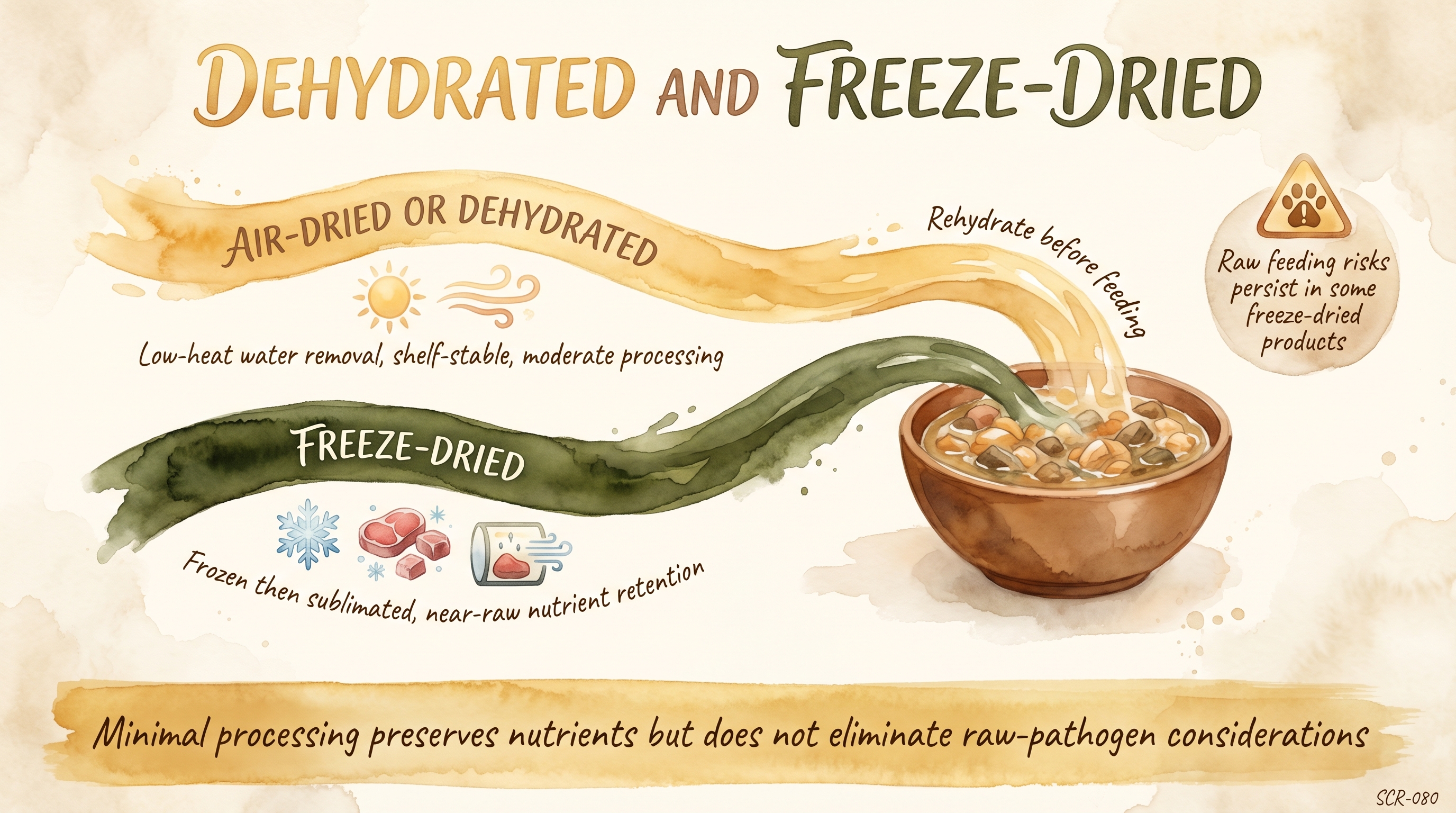
Minimal processing preserves nutrients but does not eliminate raw-pathogen considerations.
Key Takeaways
- Dehydrated food and freeze-dried food should not be treated as identical categories because freeze-dried raw still carries raw-food safety concerns.
- The biggest strengths of these formats are portability, shelf stability, and in some cases lower processing burden than extrusion.
- The biggest owner mistake is assuming every premium-looking dehydrated or freeze-dried product is complete and balanced for sole feeding.
- These foods often make the most sense when a family specifically needs travel flexibility, emergency storage, or a controlled mixed-feeding tool.
The Evidence
This entry uses observed claim-level tags beyond the dedicated EvidenceBlocks below. These tags mark JB program observation or practice-derived claims that need dedicated EvidenceBlock coverage in a later content pass.
This entry uses ambiguous claim-level tags beyond the dedicated EvidenceBlocks below. These tags mark claims where the literature remains unsettled or multiple interpretations coexist.
The strongest evidence in this category is mostly indirect but clear. Dehydration and freeze-drying are genuinely different processes from extrusion. Freeze-drying preserves more of the original raw structure because it avoids conventional cooking heat. Dehydration usually imposes less processing burden than extrusion when done gently. Those are real process-level differences.
The main caution is that these process differences do not resolve the whole food question by themselves. A freeze-dried raw food can preserve heat-sensitive nutrients and still carry pathogen risk. A dehydrated product can be convenient and still be labeled for supplemental feeding only. A premium ingredient list can still coexist with poor value if the family is paying for a use case they do not actually need.
This is why the most honest evidence summary sounds less exciting than the marketing. The category has clear strengths in portability, storage, and in some cases nutrient retention. The raw versions inherit raw-food pathogen concerns. The complete-diet question must be checked product by product. Long-term superiority claims remain much less certain than the sales language suggests.
That measured conclusion is not anti-category. It is the category used responsibly. Dehydrated and freeze-dried foods can be excellent tools in the right place. They simply work best when families know exactly what problem they are solving by using them and do not ask the format to prove more than the current evidence can support.
- Comparative format source synthesisdogs
Dehydration and freeze-drying differ from extrusion in moisture removal method, storage profile, and processing burden. - SCR-080 synthesisdog-food and household exposure context
Freeze-dried raw products inherit the pathogen concerns of raw feeding when no true kill step is used. - SCR-079 synthesisdog-food adequacy context
Premium appearance does not replace the need for a complete-and-balanced adequacy statement when these products are used as a sole diet.
- Travel and compliance synthesisdogs
These formats are especially useful where portability, rapid rehydration, and shelf stability matter more than lowest cost per calorie. - Family-practical interpretationdogs
The category often works best as an intentional routine-support tool rather than as an automatic full-time upgrade from every other feeding method.
No published study directly tests the practical implications of dehydrated and freeze-dried dog food for domestic dog raising programs. The application to household dog raising remains an interpretive synthesis rather than a directly tested intervention finding.
SCR References
Sources
- National Research Council. (2006). Nutrient Requirements of Dogs and Cats. Washington, DC: The National Academies Press.
- Association of American Feed Control Officials (AAFCO). (2024). Official Publication. Association of American Feed Control Officials.
- World Small Animal Veterinary Association (WSAVA). (2021). Global nutrition committee resources. Retrieved from www.wsava.org
- U.S. Food and Drug Administration. (2015). FDA's actions on pet food recall. FDA Center for Veterinary Medicine.
- Bopp, C. B., Altekruse, S. F., Eissenberg, D., et al. (2005). Pathogens associated with live animal markets. Emerging Infectious Diseases, 11(12), 1941-1949.