Raw Diet Pathogen Risk in Dogs and Households
The raw-feeding debate often gets trapped in philosophy, but the pathogen question is much less philosophical than people wish it were. Raw diets can be discussed as digestibility questions, ancestral-diet questions, or processing questions. The contamination question is simpler. Raw products carry a higher microbiological burden than heat-processed foods, and that burden does not stay politely inside the bowl. It enters the dog's mouth, stool, saliva, environment, and household routine. This is why raw-pathogen risk should be read not only as a dog-food page but as a household-safety page. Documented
What It Means
Raw diet pathogen risk refers to the documented contamination of raw meat-based pet foods with organisms such as Salmonella, Listeria monocytogenes, pathogenic or toxigenic Escherichia coli, Campylobacter, and other bacteria of zoonotic concern, including antimicrobial-resistant strains. The issue is not limited to home-prepared raw food. Commercial raw products have repeatedly tested positive in surveillance and peer-reviewed studies.
This matters because families often imagine risk in narrow terms. Observed-JB They ask whether the dog will get sick from the food. That is an important question, but it is not the only one. A healthy adult dog may remain clinically normal while still shedding pathogens into the home. A child crawling on the floor, an elderly family member with diminished immunity, a pregnant person, or an immunocompromised adult may be at risk even when the dog never vomits once.
The Main Organisms of Concern
Salmonella is the best-known raw diet pathogen, but it is not the only one. Listeria monocytogenes is especially important because of its severity in vulnerable humans. Pathogenic E. coli, including shiga toxin-producing strains, matters as well. Campylobacter can also be present. Some surveillance work has additionally identified extended-spectrum beta-lactamase producing organisms, which brings antimicrobial resistance into the picture.
This is why the raw debate should not be reduced to one yes-or-no conversation about Salmonella. The broader concern is that raw diets can function as a microbial delivery system into household spaces not designed for food-animal handling.
What the Surveillance Data Shows
The surveillance picture is consistent enough to support strong language. FDA-related sampling and peer-reviewed studies such as Nemser, van Bree, Morelli, Hellgren, and others repeatedly found raw products contaminated at rates far above ordinary heat-processed foods. Documented The exact percentages vary across country, brand sample, and study design, but the direction does not. Raw products carry a distinctly higher contamination burden.
This is one of the most important discipline points in the entire raw conversation. Families can still choose raw in full possession of that information. What they should not do is pretend the contamination literature is a niche concern created by opponents. It is a recurrent finding.
Why the Dog May Look Fine Anyway
One reason raw feeding remains attractive despite the contamination evidence is that many adult dogs tolerate bacterial exposure without dramatic immediate illness. That is real. It is also exactly why the household risk can be underestimated. A dog that looks fine may still be shedding organisms in stool or saliva. The absence of obvious vomiting does not equal absence of exposure.
Puppies, geriatric dogs, and immunocompromised dogs have less margin for error. They are more likely to become clinically affected themselves. But even a robust adult dog can become part of a transmission chain without ever teaching the family the lesson through visible sickness first.
HPP and the Limits of Risk Reduction
High-pressure processing, or HPP, deserves a careful place in this discussion. It can reduce microbial burden without conventional heat and is therefore often marketed as the safety answer for raw food. HPP likely does reduce risk meaningfully. It does not eliminate risk. The product remains part of a raw-handling ecosystem, and families should not hear "HPP" as a synonym for sterile.
The same applies to freezing and freeze-drying. These processes may change convenience and shelf life. Documented They do not function as guaranteed kill steps for the pathogen set families worry about most.
Why the Household Context Matters So Much
Risk is not only about the food. It is about the home the food enters. A meticulous two-adult household with separate prep surfaces, strict sanitation, no high-risk members, and consistent hygiene practices does not carry the same exposure profile as a busy family home with children, aging relatives, inconsistent cleanup, and shared floor-level contact. Goldens often live in exactly those socially rich, physically close homes where microbial sloppiness matters most.
This is why professional bodies such as the CDC, FDA, AVMA, and WSAVA have remained cautious to openly discouraging about raw feeding, especially in homes with high-risk people. These positions are not about aesthetics. They are about burden of proof and household safety.
Why It Matters for Your Dog
This page matters because raw feeding decisions are often made on behalf of the household without the household fully realizing it. The dog is not the only one eating the consequences. The family is touching bowls, thawing food, cleaning saliva, picking up stool, and sharing living space with an animal that may now be a shedding vector.
For the dog, the most practical lesson is that subclinical tolerance is not the same thing as harmlessness. A dog can eat contaminated raw food and appear well while still placing itself and others at risk. That is the central corrective to the romantic claim that dogs are simply built for raw and therefore the concern is overblown.
Providing food is also providing a microbial environment. If a feeding method predictably increases household pathogen burden, the family has to count that burden honestly as part of the decision rather than treating it as somebody else's problem.
This page also matters because it helps families distinguish between a rights argument and a risk argument. A family may decide that the perceived benefits of raw feeding are worth the effort. That is a values decision. The pathogen evidence still deserves to remain intact in the conversation. Choosing raw despite risk is one thing. Pretending the risk is not documented is another.
Another reason this page matters is that it creates room for harm reduction without pretending harm is gone. If a family insists on raw, the practical minimums are strict handwashing, separate prep surfaces, careful bowl sanitation, thawing discipline, rapid cleanup of leftovers, and keeping raw-fed dogs away from high-risk human contact situations when appropriate. Documented That is not an endorsement. It is a floor for more honest risk ownership.
The study-level details matter because they show that the concern is not built on one dramatic anecdote. Documented FDA-associated sampling and the Nemser surveillance work found markedly higher pathogen detection in raw products than in dry or semi-moist foods. van Bree reported commercial frozen raw products with high rates of resistant organisms and meaningful Salmonella and Listeria detection. Hellgren documented the same basic pattern in Scandinavian commercial raw sampling. Different markets, different brands, and different labs keep landing on the same directional conclusion. That repetition is what makes the page's tone firm.
It is also important to say what these findings do not mean. They do not mean every raw-fed dog becomes septic, every raw-fed household becomes sick, or every manufacturer is acting recklessly. They mean the baseline burden of exposure is meaningfully higher than in cooked commercial feeding. That is enough to change how a responsible family should think, even before any visible illness occurs.
The asymptomatic shedding point deserves even more emphasis because it is the part most families miss. Dogs groom themselves, lick their people, lick floors, and move through the home after eating. They shed organisms in stool and may carry contamination on bowls, preparation surfaces, and even nearby feeding areas. A household can therefore be participating in a raw-feeding pathogen cycle without ever feeling it dramatically through the dog first. This is why therapy-dog settings, visits with vulnerable relatives, and homes with toddlers become especially relevant contexts rather than side notes.
Professional guidance uses strong language for that reason. The Delta Society and similar therapy-animal frameworks historically excluded raw-fed animals because a clinically normal dog can still be an unacceptable risk around vulnerable humans. That same logic is useful for families even outside therapy work. If your dog regularly visits elderly relatives, participates in hospital- or school-adjacent work, or lives with someone medically fragile, raw feeding is not just a private nutrition preference anymore.
Harm reduction also requires more than ordinary kitchen cleanliness. It usually means dedicated thawing containers, no counter-contact assumption, immediate disposal of leftovers, careful handling of dish sponges and cloths, diligent stool pickup, and a realistic willingness to prevent face licking or bed-sharing right after meals in some homes. Families who imagine raw feeding as mostly a bowl-level decision are underestimating the actual management burden.
This is also why HPP should be treated as a relative improvement rather than a permission slip. If a family says they use HPP raw, the more mature response is "that may lower part of the microbial burden; what is your handling plan," not "then the risk must be gone." Process improvements matter, but they do not transform raw food into a risk-free category.
Puppies deserve a special note here because they combine two vulnerabilities at once. They are less immunologically robust than healthy mature adults, and they live in the most hands-on stage of family life. People carry them, clean them, sit on the floor with them, and tolerate more face and hand contact. A raw-fed puppy therefore magnifies both dog-side and household-side exposure concerns.
Human illness investigation also deserves clearer framing than it usually gets. If someone in the home develops compatible gastroenteritis and the household handles raw dog food regularly, that exposure belongs in the medical history just as much as undercooked poultry or restaurant food. Families do not need to accuse the dog food immediately, but they do need to resist the instinct to rule it out emotionally before anyone has asked the question properly.
This is why the page's most mature conclusion is not simply "raw is risky." It is that raw feeding transfers part of the food-safety burden from the manufacturer into the household. Some families accept that knowingly. Many do not realize how much burden has moved until a near miss or real illness makes it visible.
That transfer of burden is ultimately the most practical way to understand the issue. With cooked commercial food, much of the pathogen-control burden sits upstream in manufacturing. With raw feeding, much more of that burden now lives in thawing habits, surface cleaning, bowl hygiene, stool handling, and family behavior. Whether a household wants to carry that burden is a legitimate decision. Pretending the burden does not exist is not.
That clarity is what separates an informed raw decision from a romantic one.
Once the family sees the choice that way, the safety discussion becomes much more honest and much less ideological.
That honesty is exactly what responsible risk ownership looks like in this category.
Once families accept that, the rest of the decision becomes much clearer.
They can then decide with their eyes open, which is the minimum standard this evidence really asks for.
That is the whole point of laying the evidence out this plainly.
When to See a Veterinarian
Veterinary evaluation is appropriate if a raw-fed dog develops vomiting, diarrhea, fever, lethargy, poor appetite, or any sign of systemic illness. It is especially important for puppies, immunocompromised dogs, and dogs with other chronic disease because they are less likely to tolerate pathogen exposure quietly.
Families should also contact their veterinarian if a raw-fed dog is part of a household in which a human has developed compatible foodborne illness and no other exposure source is obvious. This is particularly important when stool testing or public-health follow-up may matter.
The page also needs one unusual sentence because the risk genuinely crosses species lines: if a human household member becomes ill in the context of raw feeding, physician consultation matters too. The responsible response is not to decide in advance that the raw food could not possibly be relevant.
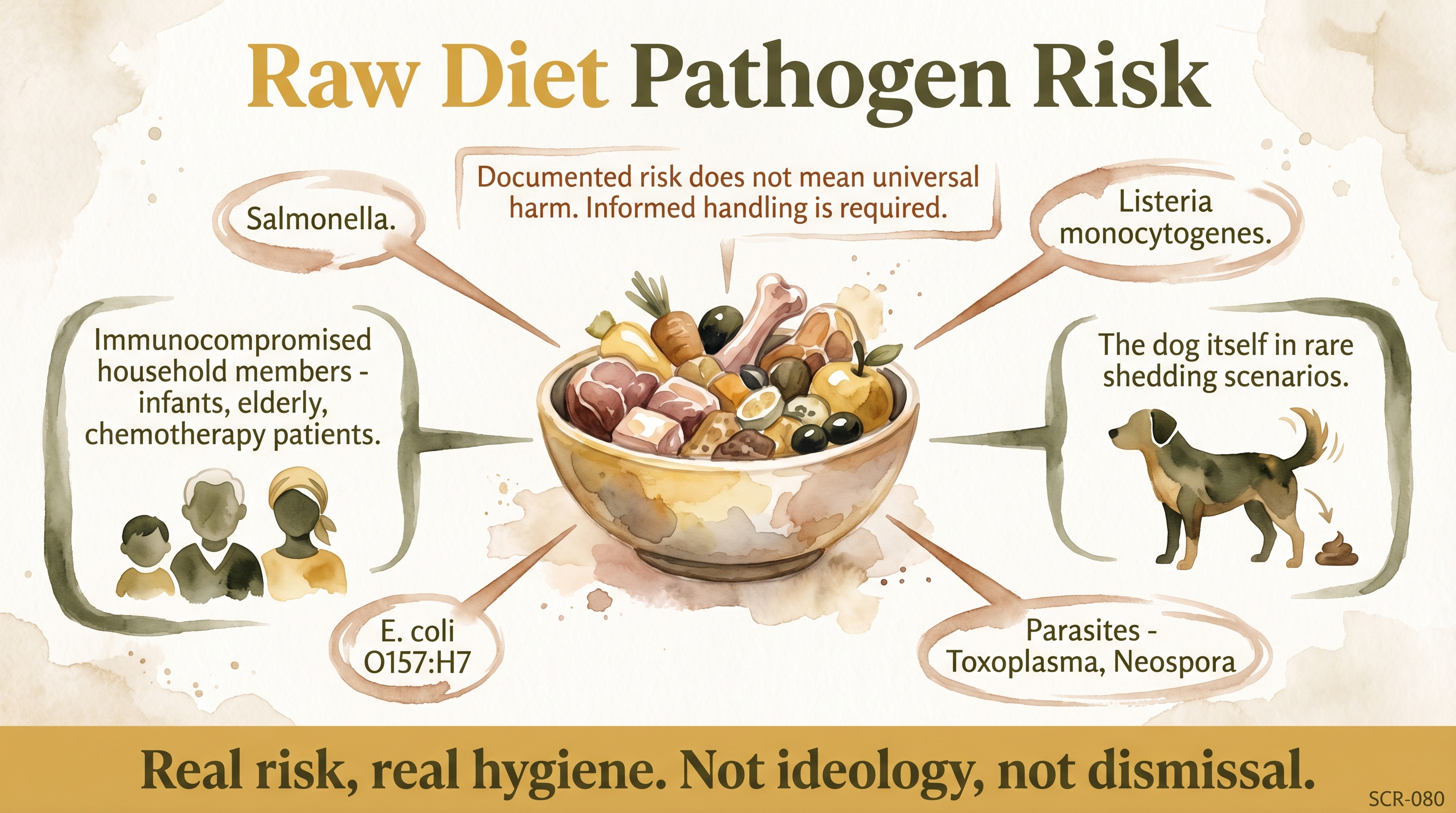
Real risk, real hygiene - not ideology, not dismissal.
Key Takeaways
- Raw diet pathogen risk is not theoretical. It is repeatedly documented in commercial and home-prepared raw feeding contexts.
- The problem is not limited to whether the dog gets sick, because clinically normal dogs can still shed organisms into the household.
- Children, elderly adults, pregnant people, and immunocompromised household members make raw-pathogen decisions much higher stakes.
- If a family chooses raw anyway, the decision should be accompanied by explicit harm-reduction behavior rather than by denial of the contamination evidence.
The Evidence
This entry uses observed claim-level tags beyond the dedicated EvidenceBlocks below. These tags mark JB program observation or practice-derived claims that need dedicated EvidenceBlock coverage in a later content pass.
The evidence here is strong enough to justify firm language. SCR-080 already captures the main conclusion that raw diets carry documented pathogen risk and handling burden. Multiple independent studies across different countries and product sets support that conclusion. The unresolved questions are mostly about exact exposure magnitude in different home contexts, not about whether contamination occurs.
This is why the page stays documented rather than mixed. The benefits side of raw feeding may remain more contested in some domains. The pathogen side does not.
- SCR-080 supportdogs and household exposure context
Raw diets carry documented pathogen risk and handling burdens that matter for both the dog and the home. - Nemser, van Bree, Hellgren, Morelli, and related surveillancecommercial raw pet food
Commercial raw diets repeatedly test positive for Salmonella, Listeria, pathogenic E. coli, Campylobacter, and resistant organisms at rates higher than heat-processed foods. - CDC, FDA, AVMA, and WSAVA position statementsdog-feeding and household-health context
Major public-health and veterinary bodies discourage raw feeding because contamination risk and zoonotic exposure are well documented.
- Raw-feeding household transmission literaturedogs and humans
Asymptomatic dogs can still shed pathogens after raw exposure, which means the household risk does not require the dog to look overtly sick. - HPP and harm-reduction literatureraw pet food context
High-pressure processing can reduce microbial burden, but it should be understood as risk reduction rather than elimination.
No published study directly tests the practical implications of raw diet pathogen risk in dogs and households for domestic dog raising programs. The application to household dog raising remains an interpretive synthesis rather than a directly tested intervention finding.
SCR References
Sources
- National Research Council. (2006). Nutrient Requirements of Dogs and Cats. Washington, DC: The National Academies Press.
- AAFCO. (2024). Official Publication. Association of American Feed Control Officials.
- Nemser, S. M., et al. (2014). Investigation of Listeria, Salmonella, and toxigenic Escherichia coli in various pet foods. Foodborne Pathogens and Disease, 11(9), 706-709. https://doi.org/10.1089/fpd.2014.1748
- van Bree, F. P. J., et al. (2018). Zoonotic bacteria and parasites found in raw meat-based diets for cats and dogs. Veterinary Record, 183(13), 424.
- Hellgren, J., et al. (2019). Occurrence of Salmonella, Campylobacter, Clostridium and Enterobacteriaceae in raw meat-based diets for dogs. Veterinary Record, 184(10), 306.
- Morelli, G., et al. (2019). Raw meat-based diets in companion animals: A critical review. Animals, 9(9), 627.