Gastrointestinal Disease in Dogs
Gastrointestinal disease in dogs is both extremely common and unusually broad. Some episodes are simple dietary indiscretion and resolve with supportive care. Others are chronic inflammatory conditions that require a structured workup. Still others, like foreign-body obstruction or severe pancreatitis, can become urgent very quickly. The challenge for families is that many GI diseases begin with the same small handful of signs: vomiting, diarrhea, appetite change, abdominal discomfort, and lethargy. The job is not to guess the exact diagnosis at home. The job is to know when a common problem is staying common and when it is turning into something more serious. Mixed Evidence
What It Means
The Main GI Buckets Families Encounter
The most common real-world categories are acute gastroenteritis; dietary indiscretion; parasitic or infectious diarrhea; chronic enteropathy; food-responsive disease; pancreatitis; and foreign-body obstruction.
These categories overlap in presentation, but they do not all carry the same urgency or treatment logic.
Acute Vomiting and Diarrhea
Acute GI upset is one of the most common reasons dogs visit veterinarians. Many cases are self-limited. Dogs eat something unusual, react to a diet change, or experience a short-lived inflammatory episode and recover with time and supportive care.
The important evidence boundary here is antimicrobial stewardship. The SCR supports that empiric antibiotics do not improve uncomplicated acute canine diarrhea outcomes. That matters because GI upset is one of the classic situations where antibiotics are prescribed "just in case" even when the evidence is weak.
The same register also supports that metronidazole can measurably disrupt the canine gut microbiome. Documented That does not mean the drug has no use. It does mean it should not be treated like harmless reflex medicine.
Chronic Enteropathy
When GI signs keep recurring or persist beyond the expected acute window, veterinarians begin thinking about chronic enteropathy. This umbrella increasingly replaces the older habit of labeling many cases simply as "IBD."
Common chronic-enteropathy buckets include food-responsive enteropathy, antibiotic-responsive patterns in selected cases, immunosuppressant-responsive disease, and protein-losing enteropathy. Documented
The modern workup is usually staged rather than chaotic. It starts with history, fecal assessment, baseline lab work, and dietary review, then escalates to imaging, cobalamin testing, endoscopy, or biopsy if needed. Documented
The Food Trial Matters
In chronic GI workups, diet trials are not a soft option. They are part of the science.
Some dogs with chronic vomiting, soft stool, or intermittent diarrhea improve dramatically with a properly structured elimination or hydrolyzed-protein diet trial. Documented Families sometimes abandon this step too early because it feels less decisive than imaging or medication. In reality, it is one of the core diagnostic tools for chronic-enteropathy work.
Pancreatitis
Pancreatitis deserves its own mention because it can look like "just stomach upset" at the beginning while actually carrying systemic risk. Common signs include vomiting, abdominal pain, lethargy, and reduced appetite. Severity ranges from mild and supportive-care responsive to severe inflammatory disease with dehydration and hospitalization needs. Documented
Goldens are not the single archetypal pancreatitis breed, but like many retrievers they can still encounter it, especially where diet and body condition increase metabolic burden.
Why It Matters for Your Dog
Foreign Bodies
No GI overview is complete without the obstruction warning.
Dogs, especially young ones, eat things they should not. Socks, toys, corn cobs, stones, fabric, string, and other objects can obstruct the gastrointestinal tract. Persistent vomiting, inability to keep water down, abdominal pain, repeated unproductive retching, or marked lethargy should push foreign body much higher on the concern list.
This is one of the clearest situations where waiting too long can make the difference between straightforward intervention and much more serious complications.
Microbiome and Over-Treatment
The gut microbiome matters, but it also gets marketed badly.
The register supports two useful boundaries metronidazole can create real dysbiosis; and probiotic effects are strain-specific rather than generic.
Together those points push toward a more precise GI style. Do not casually disrupt the microbiome with unnecessary antibiotics. Do not talk about "a probiotic" as if all products are interchangeable. Precision matters on both sides.
The Golden Retriever Context
Goldens matter here in two ways.
First, they are a common family breed, which means GI problems simply show up frequently at scale.
Second, the breed sits in the wider retriever population where food sensitivity conversations, chronic enteropathy workups, and weight-related metabolic strain are common. Not every Golden with diarrhea has a breed-specific disease. But many Golden families will need a clear framework for thinking about GI symptoms at some point.
What Families Should Watch For
The best home question is not "what exact diagnosis is this?" It is "is this getting better on the timeline I would expect for a simple stomach upset?"
Concerning clues include repeated vomiting, blood in stool, marked lethargy, refusing water, abdominal pain, progressive weight loss, chronic soft stool over weeks, and recurrence that keeps coming back after temporary improvement.
Those are the signs that move the case from ordinary to worthier of real workup.
When to See a Veterinarian
Veterinary evaluation is warranted for repeated vomiting, bloody diarrhea, lethargy with GI signs, inability to keep water down, abdominal pain, vomiting plus suspected foreign-body ingestion, and chronic or recurrent diarrhea over days to weeks.
The threshold should be lower in puppies, seniors, and dogs who dehydrate quickly.
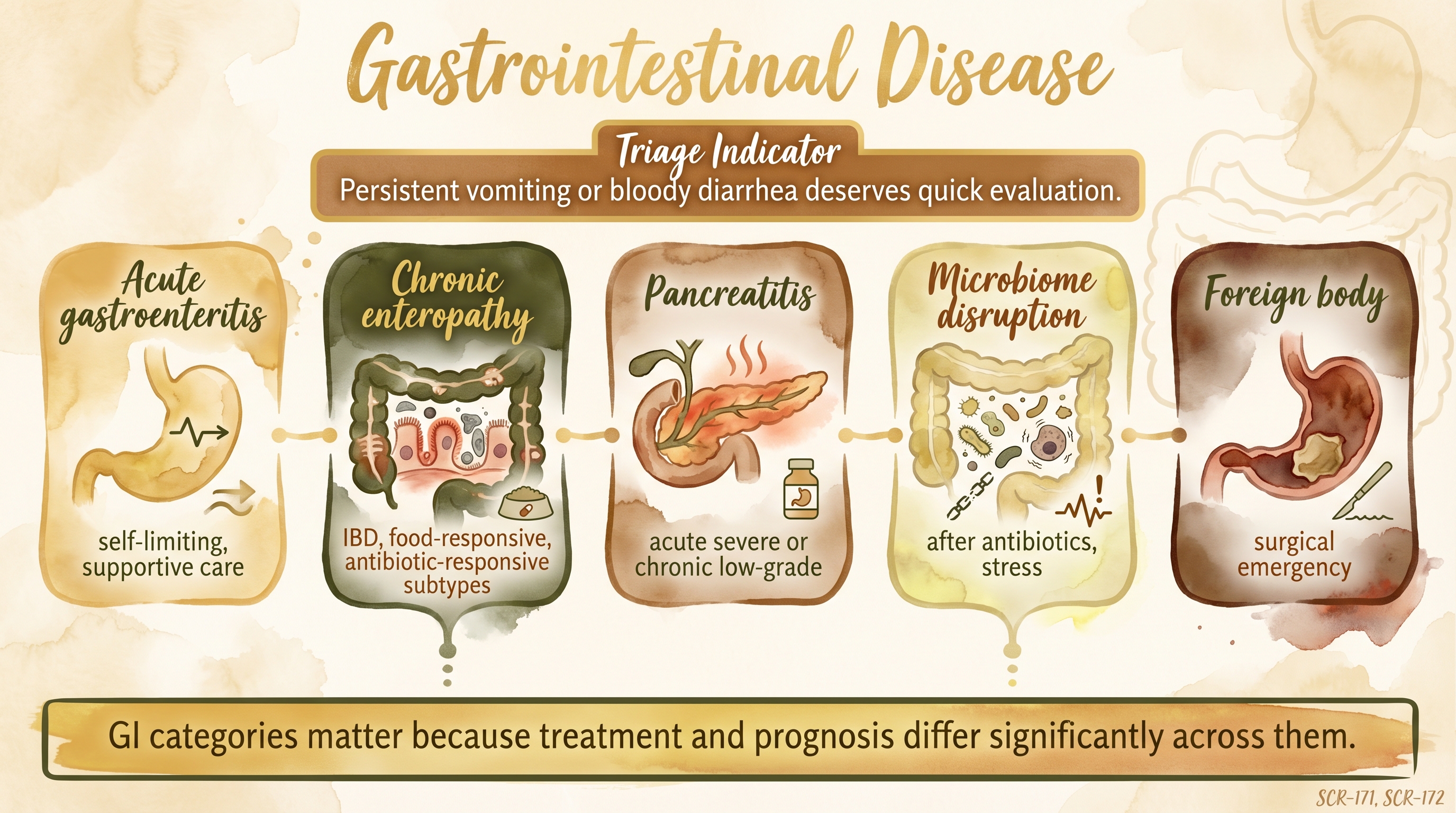
GI categories matter because treatment and prognosis differ significantly across them.
Key Takeaways
- Many canine GI problems begin with the same small set of signs, so the key question is often severity and trajectory rather than instant exact diagnosis.
- Uncomplicated acute diarrhea usually does not benefit from routine empiric antibiotics, and unnecessary metronidazole can disrupt the microbiome.
- Chronic enteropathy workups depend on structured diagnostics and properly run diet trials, not only symptomatic treatment.
- Repeated vomiting, bloody stool, dehydration, or suspected foreign-body ingestion are the red flags families should take seriously right away.
The Evidence
This entry uses mixed-evidence claim-level tags beyond the dedicated EvidenceBlocks below. These tags mark claims that combine documented findings with observed practice, heuristic application, or unresolved gaps.
- SCR-072 supportdogs
Empiric antibiotics do not improve uncomplicated acute canine diarrhea outcomes. - SCR-073 supportdogs
Metronidazole can cause measurable dysbiosis in the canine gut microbiome. - SCR-074 supportdogs
Probiotic effects in dogs are strain-specific rather than interchangeable class effects.
- ACVIM chronic enteropathy guidancedogs
Chronic GI disease requires staged workup rather than reflex medication, with diet trials and structured diagnostics central to care. - Veterinary emergency medicinedogs
Foreign-body obstruction and severe pancreatitis can begin with ordinary GI signs but become urgent rapidly.
- domestic dogs
No published study directly compares the most effective long-term management paths for gastrointestinal disease in dogs in dogs across breeds and ordinary home settings.
SCR References
Sources
- Dandrieux, J. R. S., & Mansfield, C. S. (2019). Chronic enteropathy in canines: Prevalence, impact and management strategies. Veterinary Medicine: Research and Reports, 10, 203-214. https://doi.org/10.2147/VMRR.S162774
- Heilmann, R. M., et al. (2026). ACVIM-endorsed consensus statement on diagnosing chronic inflammatory enteropathy in dogs. Journal of Veterinary Internal Medicine. https://doi.org/10.1111/jvim.17292
- Pilla, R., Gaschen, F. P., Barr, J. W., Olson, E., Honneffer, J., Guard, B. C., Blake, A. B., Villanueva, D., Khattab, M. R., Alshawaqfeh, M. K., Lidbury, J. A., Steiner, J. M., & Suchodolski, J. S. (2020). Effects of metronidazole on the fecal microbiome and metabolome in healthy dogs. Journal of Veterinary Internal Medicine, 34(5), 1853-1866. https://doi.org/10.1111/jvim.15871
- Werner, M., Suchodolski, J. S., Straubinger, R. K., Wolf, G., Steiner, J. M., Lidbury, J. A., Neuerer, F., Hartmann, K., Unterer, S., & Busch, K. (2020). Effect of amoxicillin-clavulanic acid on clinical scores, intestinal microbiome, and amoxicillin-resistant Escherichia coli in dogs with uncomplicated acute diarrhea. Journal of Veterinary Internal Medicine, 34(3), 1166-1176. https://doi.org/10.1111/jvim.15775