Body Condition Scoring in Growing Puppies
Compound evidence detail1 SCR / 3 parts
- Documentedpuppy physiology and condition-scoring evidence supporting multiple smaller meals in young dogs and adjustment by growth, appetite, stool quality, and observed condition
- Heuristicthe conventional four-to-three-to-two meal-count progression, treated as practical scheduling rather than a trial-validated developmental protocol
- Observed-JBJB program observation that predictable mealtimes support elimination rhythm and household regulation during the transition-home period
Body condition scoring is the practical reality check on every feeding plan. A growth chart, calorie estimate, and feeding cup all matter, but none of them can tell you what the puppy's body is actually doing as clearly as your hands and eyes can. For large-breed puppies, that is especially important because lean condition is not cosmetic. It is a real orthopedic protection strategy. Documented
What It Means
Body condition scoring asks a simple question: how much fat coverage is sitting on the dog's frame right now?
In practice, the common clinical tool is the 9-point system. For growing puppies, the target is usually around 4 to 5 out of 9: ribs easily felt with a slight fat covering, visible waist from above, and abdominal tuck from the side. Estimated
That combination describes lean growth, not deprivation.
The WSAVA 9-point system matters because it gives families and veterinarians a shared language. Documented A 4 to 5 is the target. A 6 is already drifting upward. A 7 to 9 is clearly overweight to obese. The usefulness of the scale is not that it removes judgment. It makes judgment more consistent.
That consistency matters because weight alone can be deeply misleading in growing puppies. Documented A Golden puppy can be adding height, frame, muscle, and fat at the same time. The scale cannot tell the family which one is driving the change. Body condition scoring can.
Why Families Misread Puppies
Puppies are cute, round-faced, soft-coated animals, which makes visual assessment harder than people expect. Many families normalize excess condition because the coat hides definition, baby proportions look different from adult proportions, appetite is read as proof the puppy needs more food, and growth is mistaken for an excuse to ignore body fat. Documented
This is why hands-on assessment matters. You need to feel the ribs, not just admire the silhouette.
The hands-on sequence is simple and worth rehearsing: place light pressure over the ribs and ask whether they are easy to feel without digging, look from above for a visible waist behind the ribcage, and look from the side for an abdominal tuck rather than a straight or sagging underline.
This is especially important in Goldens because coat volume can hide early weight gain surprisingly well.
Breed temperament also matters here. Retrievers are expressive eaters and often make families feel as though every meal was inadequate. Families who interpret enthusiasm as deficiency can drift upward in portions long before the puppy actually looks heavy.
Lean Growth Is the Goal
In a growing Golden Retriever, extra fat is not innocent padding. It adds load to a developing musculoskeletal system and can speed the transition from steady growth into excessive growth pressure.
This is why the large-breed literature and the long-term restricted-feeding data point in the same direction: lean condition is protective.
Lean condition protects because it lowers unnecessary load on tissues that are still organizing themselves. Cartilage, growth plates, tendons, and joint surfaces all live under whatever body mass the puppy is carrying. Extra fat is not inert padding. It is additional work for an unfinished structure.
The Kealy Lesson
The landmark Labrador feeding work matters here because it tied calorie restriction and leaner condition to better long-term outcomes, including delayed osteoarthritis and longer lifespan. That does not mean every puppy should be fed austerely. It means that "a little extra" is not a neutral habit.
Kealy's work is worth naming more directly because it remains one of the clearest long-term demonstrations that lean feeding matters. The 1995 and 2002 Labrador studies showed that lean-fed dogs had delayed osteoarthritis and longer median lifespan than their more liberally fed littermates. Documented The exact 1.8-year figure belongs to Labradors and should be treated that way, but the broader lesson is very relevant to Goldens: lean condition is protective.
That distinction about species and breed application is important. The Kealy data are Labrador data, not Golden Retriever data. We should not erase that. What we can say is that Goldens are a similar large retriever population living inside the same broad orthopedic and obesity logic. The protective lesson travels better than the exact number.
Weekly Assessment Works Better Than Occasional Panic
The most useful pattern for a puppy is regular low-drama monitoring: feel the ribs weekly, look at the waist weekly, compare photos over time, and adjust portions in small increments.
This is far more effective than waiting until a puppy obviously looks heavy and then making a dramatic change.
Regular photo comparison can help families because day-to-day familiarity hides slow change. A weekly photo from above and from the side often shows drift more clearly than memory does.
The other advantage of frequent low-drama checks is that they reduce overcorrection. When families wait until they are alarmed, they are more likely to slash portions aggressively. Small adjustments made early are usually kinder and more physiologically appropriate than dramatic restriction later.
Underfeeding Matters Too
This page is not permission to underfeed. A puppy that is consistently too thin, lacking energy, or failing to grow appropriately also needs attention. The correct target is lean and well-muscled, not gaunt.
That is why body condition scoring works best alongside growth tracking, appetite observation, stool quality, and veterinary oversight when something seems off.
Body condition scoring is not meant to replace veterinary assessment. It is meant to make the family a better early observer.
It also works best when families understand that a puppy can be lean without looking gaunt. You should not see every rib sharply through the coat. The ribs should be easy to feel with a light fat covering. The waist should be present, not dramatic. The abdominal tuck should be visible, not extreme. This is one reason hands-on scoring is better than photographs alone.
Why It Matters for Your Dog
For Golden families, body condition scoring is one of the best ways to turn a feeding philosophy into something measurable. It protects against the very common habit of overfeeding a friendly, food-motivated breed and then noticing only after extra weight is established.
It also protects against the opposite error. Some families become so afraid of fast growth that they underfeed and then mistake a poorly muscled or underdeveloped puppy for a correctly lean one. The goal is not spareness. The goal is lean, athletic development with steady growth and good energy.
This matters emotionally because families often need permission to trust a lean target. Many people have been taught to equate roundness with health in babies and puppies. In large-breed growth, that instinct can work against the dog's long-term orthopedic interests. A puppy does not need to look stuffed to be thriving.
For Golden Retriever families, body condition scoring becomes one of the clearest ways to replace vague reassurance with evidence-guided observation. Instead of asking whether the puppy "looks hungry," ask whether the ribs are easy to feel, the waist is present, and the growth trend remains steady.
Body condition scoring is prevention in practice. It catches feeding drift early, when a small portion adjustment can still protect joints, growth rate, and long-term weight trajectory.
When to See a Veterinarian
Talk with your veterinarian if a puppy is rapidly gaining visible fat despite measured feeding, persistently too thin despite eating, losing weight, showing poor growth or low energy, or displaying abnormal stool for more than a brief transition period. Also reach out if the puppy seems painful or reluctant to move in a way that seems out of proportion to normal puppy awkwardness.
It is also worth checking in if the puppy's body condition is drifting despite careful measurement and repeated portion adjustments. Sometimes the issue is simply calorie math. Sometimes there is a digestive, endocrine, or husbandry variable the family is not seeing clearly.
What makes body condition scoring so powerful is that it gives families feedback early enough to matter. A puppy does not become clearly overweight in one day. Condition drifts. When adults learn to feel ribs, check waist shape, and compare weekly trend instead of waiting for obvious heaviness, they can correct small errors while the correction is still small.
This matters even more in Golden Retriever puppies because appetite performance can be dramatic. A puppy can look eager, persuasive, and ready for more food while the body is already telling a different story. Families who rely only on the puppy's enthusiasm will often miss that drift. Families who combine eyes, hands, and regular photos are much more likely to notice when intake has quietly outpaced what lean growth actually requires.
The page is also trying to protect families from a false binary between overfeeding and underfeeding. A correctly lean puppy is not being deprived. A slightly heavy puppy is not automatically thriving. The real target is a puppy whose condition, growth pace, structure, and energy all line up. That is what turns BCS from a cosmetic score into one of the most useful daily tools in the entire puppy-nutrition group.
BCS is therefore one of the best ways to trust the puppy's structure more than the puppy's performance at the bowl. A retriever puppy may always look interested in more food. The frame, ribs, waist, and tuck are better guides to what the body actually needs.
This is also why the method works so well with measured feeding. The family can make a small adjustment, watch condition over the next week or two, and learn from the result instead of feeding by constant emotion.
Body condition scoring tells the truth sooner than the scale usually does. Weight may still look plausible while a puppy is quietly adding more fat than is useful for growth. The hands often reveal that change first. That is why a family trained to feel ribs and shape can intervene much earlier than a family waiting for a number to look obviously wrong.
This is also what makes BCS so good at lowering anxiety. Instead of guessing whether the puppy is too heavy or too thin, the family has a repeatable way to check. The method does not remove judgment, but it makes judgment more grounded, which usually means fewer dramatic portion swings and better long-term growth management.
Condition often changes quietly before it changes visibly. That is why weekly hands-on checks matter so much more than waiting for an obvious visual shift.
For Golden puppies especially, coat and charm can hide excess condition for longer than many families expect. Hands usually tell the story sooner.
Hands usually tell the story before the scale does, which is exactly why BCS is so useful during growth. It lets families notice trend early enough to respond with small, sane changes instead of late, anxious ones.
The body usually reveals drift before the household story does, and that is why BCS is so protective in a growing puppy.
A family that checks condition regularly usually makes smaller, calmer, and more effective adjustments than a family waiting for an obvious problem.
Small corrections are usually the best corrections, and BCS is how families catch the need for them in time.
Better monitoring usually means gentler correction, which is one of the practical gifts of body condition scoring.
Body condition turns feeding from a hope into a feedback loop, which is why it belongs so close to the center of puppy nutrition.
That is what makes this tool so preventive for growing puppies.
That is why it matters so early.
It gives the family something steadier than appetite theatrics to trust.
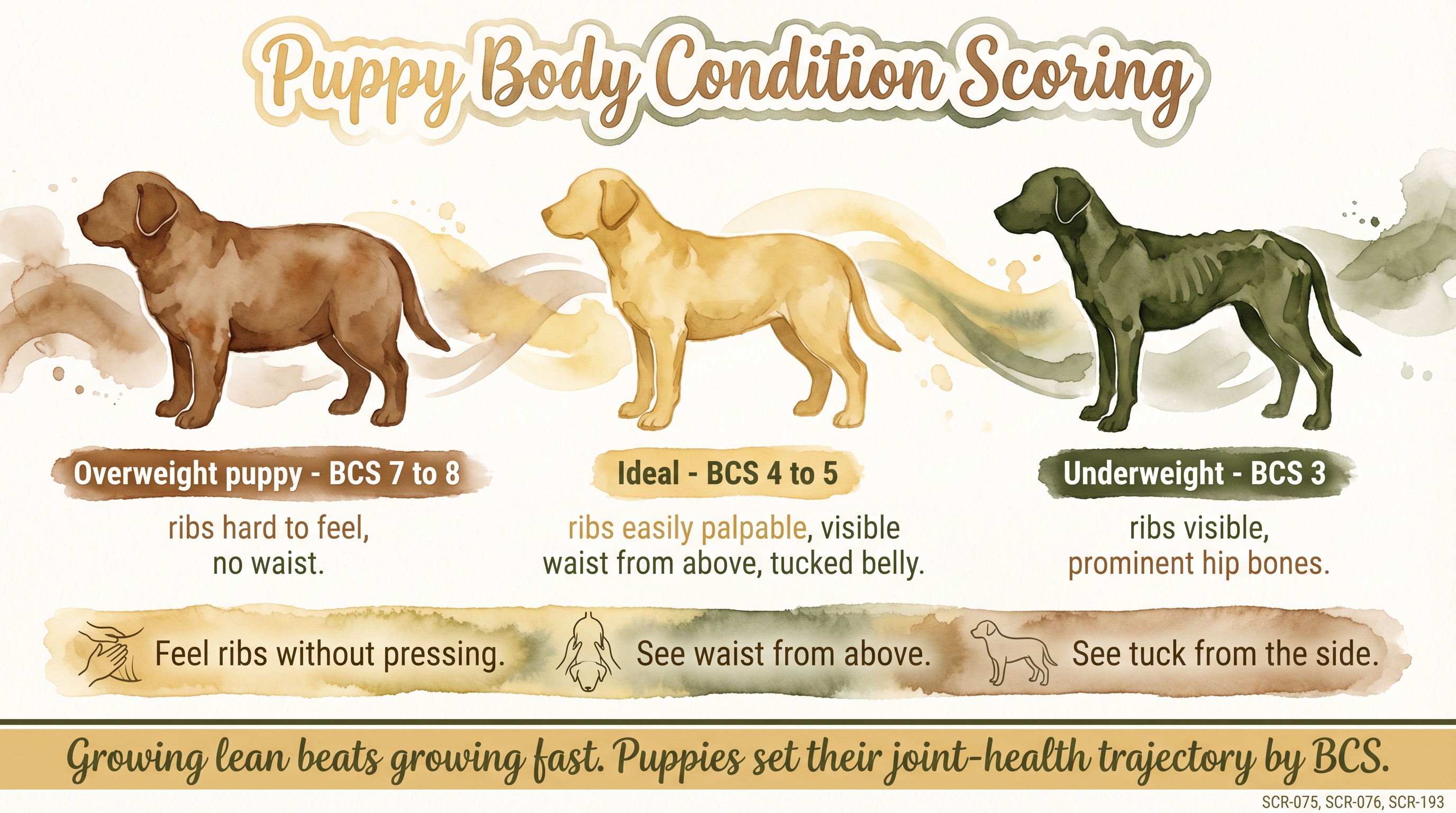
Growing lean beats growing fast - puppies set their joint-health trajectory by BCS.
Key Takeaways
- For growing puppies, the goal is lean condition with easily felt ribs, a visible waist, and an abdominal tuck.
- Body condition scoring is more useful than body weight alone because weight cannot tell you how much of the gain is appropriate versus excessive fat.
- In Golden puppies, over-conditioning is not harmless puppy softness. It adds avoidable load to a developing orthopedic system.
- Regular calm monitoring catches feeding drift early and usually prevents the need for large corrective changes later.
The Evidence
This entry uses estimated claim-level tags beyond the dedicated EvidenceBlocks below. These tags mark approximate ranges or timing claims that should remain bounded by the cited sources.
The evidence here is practical and strong. The WSAVA 9-point BCS system gives clinicians and families a consistent framework. Kealy's Labrador work demonstrates that lean feeding has real long-term musculoskeletal and longevity implications. Large-breed orthopedic logic explains why over-conditioning in puppyhood matters before obvious obesity ever appears. Put together, that makes body-condition scoring one of the most useful family tools in the entire nutrition category.
What makes the page so useful is that it bridges abstract nutrition and daily life. Families cannot measure digestibility at home. They cannot calculate orthopedic risk directly from a bag. They can feel ribs, look for a waist, take photos, and adjust meals accordingly. In other words, body condition scoring turns nutrition stewardship into an observable household practice.
The evidence also supports its role as an early-warning system rather than a cosmetic grading exercise. By the time overt obesity is obvious, a puppy may have spent weeks or months carrying more load than necessary. BCS helps catch that drift while the fix is still small.
- WSAVA-style body-condition frameworkdogs
Body condition scoring is the practical clinical tool used to assess whether intake is producing appropriate fat coverage rather than relying on weight alone. - SCR-075 supportdogs
Lean body condition is associated with longer lifespan and delayed chronic disease, which gives body-condition monitoring long-term relevance rather than making it a cosmetic exercise. - Puppy orthopedic literaturelarge-breed puppies
Over-conditioning during growth increases concern for excessive loading on developing joints and bones.
- Practical growth stewardshippuppies
Weekly hands-on body-condition checks and periodic photos are a useful household monitoring rhythm even though that exact frequency is a management recommendation rather than a trial-derived optimum.
No published study directly tests the practical implications of body condition scoring in growing puppies for domestic dog raising programs. The application to household dog raising remains an interpretive synthesis rather than a directly tested intervention finding.
SCR References
Sources
- National Research Council. (2006). Nutrient Requirements of Dogs and Cats. Washington, DC: The National Academies Press.
- AAFCO. (2024). Official Publication. Association of American Feed Control Officials.
- Laflamme, D. P. (1997). Development and validation of a body condition score system for dogs. Canine Practice, 22(4), 10-15.
- Kealy, R. D., Lawler, D. F., Ballam, J. M., Mantz, S. L., Biery, D. N., Greeley, E. H., Lust, G., Segre, M., Smith, G. K., & Stowe, H. D. (2002). Effects of diet restriction on life span and age-related changes in dogs. Journal of the American Veterinary Medical Association, 220(9), 1315-1320.
- Nap, R. C., & Hazewinkel, H. A. W. (1994). Growth and skeletal development in the dog in relation to nutrition; a review. Veterinary Quarterly, 16(1), 50-59.