Developmental Orthopedic Disease and Nutrition
Developmental orthopedic disease, often shortened to DOD, is not one single diagnosis. It is a cluster of growth-phase skeletal problems that arise while a puppy is still building its frame. Genetics matter, but nutrition matters too, and that is exactly why this page exists. Food cannot erase genetic predisposition, yet it can meaningfully change how much developmental stress the growing skeleton is asked to carry. Documented
What It Means
DOD is an umbrella term that can include hip dysplasia expression, elbow dysplasia expression, osteochondrosis and osteochondritis dissecans, panosteitis, hypertrophic osteodystrophy, and retained cartilage core abnormalities.
These are not all nutritionally caused. But nutrition can influence the developmental environment in which they express.
It is worth being explicit about the umbrella because families often use one diagnosis name to stand in for the whole growth-phase risk picture. Hip dysplasia and elbow dysplasia may be the most familiar names, but osteochondrosis, osteochondritis dissecans, panosteitis, hypertrophic osteodystrophy, and retained cartilage-core abnormalities all belong in the wider developmental orthopedic conversation.
That wider umbrella matters because the feeding mistakes that increase one kind of developmental strain often increase others too. Observed-JB A puppy that is pushed into rapid growth by excess calories is not just carrying more body weight. The cartilage, growth plates, and supporting tissues are all being asked to mature under a higher mechanical and metabolic burden. That is why DOD is best understood as a growth-environment problem layered onto genetic risk, not as a collection of isolated orthopedic accidents.
Families also benefit from hearing that orthopedic disease is not synonymous with blame. A well-bred puppy can still develop orthopedic problems. A carefully fed puppy can still inherit risk. The value of nutrition is not that it guarantees immunity. The value is that it lets families remove some of the preventable pressure from a skeleton that is still under construction.
The Main Nutritional Drivers
The best-supported nutritional drivers are excess caloric intake, rapid growth rate, excess dietary calcium, and poorly controlled mineral balance.
Excess vitamin D has also been discussed as a possible contributor in some contexts, but calories and calcium are the major practical issues families actually control. Documented
Excess calories matter because they accelerate mass gain and can distort portion control when families are feeding by appetite theater rather than by measured intake. Puppies often behave hungry. That is not a reliable signal that they should be allowed to grow maximally. Large-breed growth stewardship aims for steady growth and lean condition, not the biggest possible puppy at every monthly photo.
Excess calcium matters for a different reason. Unlike calories, which mainly change the load the body is carrying, calcium can directly alter skeletal development. Growing puppies absorb calcium less selectively than adults do. When a complete diet is already formulated near the appropriate range, adding calcium through supplements, dairy, or heavy bone inclusion can push total intake well above what the puppy can safely regulate.
Poor mineral balance matters because calcium cannot be evaluated in isolation. The calcium-to-phosphorus relationship influences how the growing skeleton mineralizes. The goal is not just "more bone nutrients." The goal is appropriately balanced bone nutrients delivered in a way the puppy can use safely.
Genetics and Nutrition Are Not Opposites
Families sometimes want a simple either-or answer. Either the puppy has "bad genetics" or the food caused the problem. Real life is not that clean.
Hip and elbow outcomes are influenced by heritable predisposition, but a genetically borderline puppy can still be pushed toward worse expression if the growth environment is too rich. Nutrition is not destiny, and genetics is not total inevitability. They interact.
The heritability framing helps here. Hip dysplasia is often discussed in a moderate heritability range around 0.2 to 0.5, depending on dataset and method. Estimated That does not make the problem simple or fully predictable. It does mean genes matter, while still leaving room for environment to influence expression. Nutrition cannot eliminate predisposition, but it can change how much strain a borderline skeleton carries during growth.
That framing is especially useful for Golden Retriever families because Goldens are large-breed dogs living in exactly the growth window where nutritional stewardship matters. If a puppy inherits a clearly excellent orthopedic structure, nutrition still matters because it can protect that advantage. If a puppy inherits a more borderline structure, nutrition matters because it may reduce the load that turns borderline anatomy into earlier clinical expression.
This is why breeder selection and family nutrition are partners rather than substitutes. Screening parents, tracking family lines, and understanding orthopedic history remain essential. But once the puppy is in the home, food and body condition become the family's direct leverage point.
Why Growth Rate Matters
Rapid growth increases mechanical load on joints and developing cartilage. The body has to mineralize and stabilize structure while also carrying more weight each week. That is why the goal is controlled growth, not maximum growth.
Controlled growth does not mean stunting. It means avoiding the common large-breed error of rewarding visible size gain as though bigger automatically means healthier. Families often praise a puppy for "growing like a weed" when the more useful compliment would be "growing steadily while staying lean." That difference in mindset changes feeding behavior.
Rapid growth is also one reason measured meals matter. A free-fed or loosely estimated feeding pattern can make it hard to recognize that the puppy is steadily drifting above a lean body condition. By the time obvious heaviness shows up, the joints have already spent weeks carrying more force than necessary.
Why Calcium Matters So Much
Large-breed puppies cannot regulate calcium excess as safely as adult dogs can. Documented If a puppy is overexposed to calcium during critical growth windows, the developing skeleton can be injured directly. This is one of the clearest and strongest nutrition-to-orthopedic links in the entire literature.
That is also why the 2016 AAFCO Large Breed Growth profile matters. The lower calcium ceiling was not decorative. It reflected the recognition that developmental orthopedic risk was influenced by the way large-breed puppies handle excess calcium during active growth.
The classic Hazewinkel Great Dane work is foundational here because it showed that calcium excess was associated with concrete developmental problems, including osteochondrosis, retained cartilage cores, and radius curvus deformity. Those findings changed the way large-breed puppy nutrition was discussed. Before that body of work, families and even some professionals could treat calcium as a simple "more is better" bone nutrient. The evidence showed that in growing large-breed puppies, excess calcium could be directly harmful.
This remains one of the easiest mistakes for well-meaning families to make. If a complete large-breed puppy food already contains the right mineral balance, adding cottage cheese, bone meal, calcium powder, or other calcium-heavy extras is not supportive. It is more likely to move the total intake away from the safe zone.
What Nutrition Can and Cannot Do
Nutrition can reduce avoidable developmental strain, lower the chance of nutrition-driven skeletal insult, help keep the puppy lean, and support a better growth trajectory.
Nutrition cannot erase severe genetic predisposition, guarantee perfectly normal hips or elbows, or substitute for breeder selection and orthopedic screening. Documented
That honest boundary matters. Good feeding is powerful, but it is not omnipotent.
Families need that honesty because this topic attracts both fatalism and magical thinking. Fatalism says food does not matter because genetics rules everything. Magical thinking says the right food can override weak genetics entirely. Neither position is good enough. The real answer is gene-environment interaction.
Another limit is timing. Nutrition works best preventively. Once a clinically important orthopedic problem is already expressing, food still matters for body condition and strain reduction, but it does not replace imaging, diagnosis, rehabilitation planning, or surgical decision-making when those are needed. This page is about shaping the growth environment early enough that avoidable stress never becomes part of the puppy's story.
That is also why under-feeding is not the answer. Some families become so worried about joints that they drift into chronic underfeeding. A growing puppy still needs enough energy, protein, minerals, and essential nutrients to build tissue correctly. The target is not "smallest possible puppy." The target is "appropriately nourished, steadily growing, visibly lean puppy."
The Practical Golden Retriever Rule
For Golden Retriever families, the single most useful nutrition summary is: feed a complete large-breed puppy food, do not supplement calcium, keep the puppy lean, measure meals, and adjust portions based on body condition, not appetite theater.
That rule set captures most of the orthopedic-protective value families can realistically control. Documented
Monthly body-condition review is what makes that rule operational. Families should not keep feeding the same cup amount just because the bag once suggested it. Growth is dynamic. Activity changes. body condition changes. The correct portion in early adolescence may not be the correct portion six weeks later. Lean stewardship is a living process, not a one-time label choice.
This is also the place to connect the page back to the broader nutrition series. Large-breed formulas, calcium-phosphorus control, protein myths, and body-condition scoring are not separate topics because the wiki happened to divide them into separate entries. They are all different angles on the same orthopedic-prevention project.
Why It Matters for Your Dog
This page matters because DOD is one of the growth-phase outcomes families fear most, and it is also one of the areas where families are most vulnerable to confused or overly simplistic feeding advice.
It matters emotionally because families often discover orthopedic information only after they are already worried. Observed-JB A puppy starts bunny hopping, hesitates on stairs, or seems stiff after play, and suddenly every food choice feels loaded with regret. A clear page like this helps move the conversation out of guilt and into stewardship. What matters most is to understand the controllable variables early and use them well.
It matters medically because developmental orthopedic disease is not just an x-ray problem. It affects comfort, movement, exercise tolerance, and sometimes long-term joint health. Nutrition is not the whole answer, but it is one of the earliest answers available to families.
Nutrition cannot guarantee orthopedic perfection, but it can prevent some of the avoidable loading and mineral insults that make a vulnerable skeleton work harder than it should during development.
When to See a Veterinarian
See a veterinarian promptly if a growing puppy develops persistent or recurrent lameness, stiffness after rest, reluctance to rise or climb, visible pain on limb or joint handling, abnormal gait or bunny hopping, or fever and marked lethargy with limb swelling.
Early assessment matters because not every orthopedic problem can be identified or managed the same way, and delay can complicate the picture.
These are the signs families most need to take seriously: persistent lameness, stiffness after rest, reluctance to jump, limb pain on handling, and abnormal gait. Those patterns deserve professional evaluation because not every orthopedic problem is handled the same way, and some problems worsen when families wait too long.
It is also worth calling a veterinarian if the puppy seems unwilling to keep up on normal walks, resists sitting squarely, repeatedly unloads one limb after exercise, or cries out during otherwise ordinary handling. Families do not need to diagnose the exact cause at home. Their job is to notice change early.
Prompt evaluation matters because the differential diagnosis is broad. The same limp could reflect panosteitis, osteochondrosis, soft-tissue strain, trauma, hip pain, elbow disease, or something unrelated to nutrition entirely. Nutrition remains part of the larger stewardship plan, but it should not delay diagnostic work when a puppy is clearly uncomfortable.
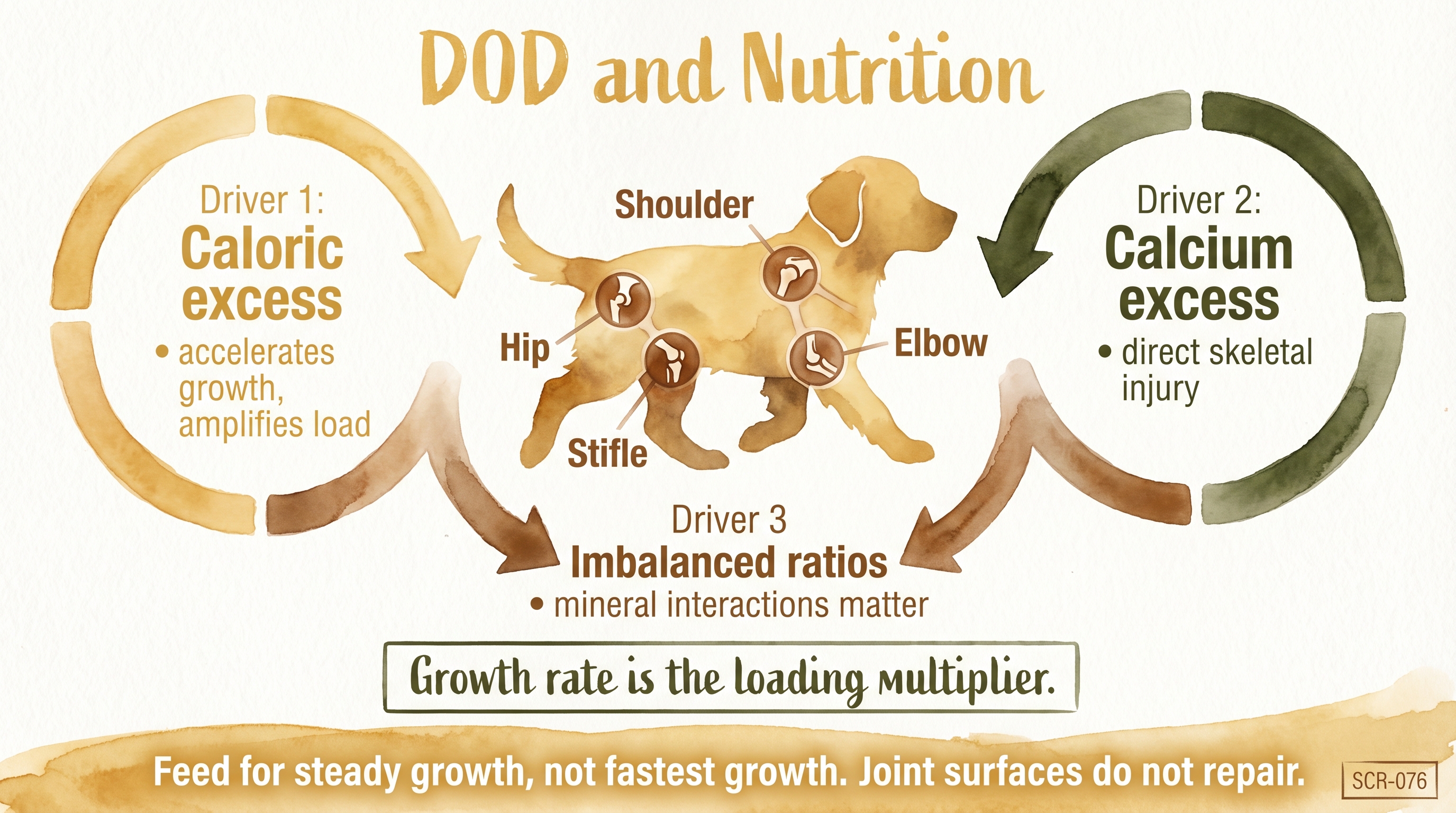
Feed for steady growth, not fastest growth - joint surfaces do not repair.
Key Takeaways
- Developmental orthopedic disease is a cluster of growth-phase skeletal problems, not one single diagnosis.
- The most important nutrition variables families control are calories, growth rate, calcium exposure, and body condition.
- Good feeding can lower developmental strain, but it cannot replace genetics, screening, or veterinary care.
- For Golden puppies, a lean body condition and a properly formulated large-breed growth diet are the most practical orthopedic-protective nutrition tools.
The Evidence
This entry uses observed claim-level tags beyond the dedicated EvidenceBlocks below. These tags mark JB program observation or practice-derived claims that need dedicated EvidenceBlock coverage in a later content pass.
This entry uses estimated claim-level tags beyond the dedicated EvidenceBlocks below. These tags mark approximate ranges or timing claims that should remain bounded by the cited sources.
The evidence here is strong enough to support a disciplined but honest message. Developmental orthopedic disease is an umbrella, not one diagnosis. Heritable predisposition matters, with hip dysplasia often discussed in a moderate heritability range around 0.2 to 0.5. Nutrition cannot erase that predisposition, but it can materially change how much developmental strain the puppy carries, especially through calorie load, growth rate, and calcium exposure. That is exactly why this is such an important family-facing nutrition page.
The evidence base is unusually practical because the core interventions are not exotic. Feed a properly formulated large-breed puppy diet. Avoid excess calcium. Keep the puppy lean. Measure intake. Reassess portions as growth changes. Those recommendations are not speculative wellness culture. They are the direct behavioral consequences of the orthopedic nutrition literature.
The 2016 adoption of the AAFCO Large Breed Growth profile matters in this context because it operationalized what the earlier growth studies had shown. Nutritional stewardship for large-breed puppies needed a more explicit calcium ceiling because "growth food" alone was not a sufficient safety guarantee. The formal profile gave industry and clinicians a clearer benchmark for safer formulation.
The gene-environment framing also protects against an important communication error. It prevents us from overstating nutrition as though food can rewrite a pedigree, but it also prevents us from understating nutrition as though orthopedic outcome is fixed from birth. The correct message is that growth environment can meaningfully change expression risk in genetically susceptible dogs, especially those living near the borderline between normal development and clinical disease.
- Hazewinkel, Lauten, Hedhammar, and related literaturelarge-breed puppies
Developmental orthopedic risk is materially influenced by rapid growth, caloric excess, and excess calcium during active skeletal development. - SCR-076 supportlarge-breed puppies
Excess calcium is a direct developmental injury mechanism rather than a minor formulation detail. - SCR-075 supportdogs
Lean body condition supports better long-term musculoskeletal and lifespan outcomes, reinforcing its relevance during growth.
- Orthopedic stewardship interpretationlarge-breed puppies
Nutrition cannot erase severe genetic predisposition, but it can meaningfully alter expression risk in dogs that are genetically susceptible or borderline.
No published study directly tests the practical implications of developmental orthopedic disease and nutrition for domestic dog raising programs. The application to household dog raising remains an interpretive synthesis rather than a directly tested intervention finding.
SCR References
Sources
- National Research Council. (2006). Nutrient Requirements of Dogs and Cats. Washington, DC: The National Academies Press.
- Association of American Feed Control Officials (AAFCO). (2024). Official Publication. Association of American Feed Control Officials.
- Hazewinkel, H. A., van den Brom, W. E., Theyse, L. F., Karssenberg, D., Lloyd, M. H., Bennett, R. A., & Schoenmakers, I. (2000). Calcium metabolism in Great Dane dogs and the influence of vitamin D status. Journal of Small Animal Practice, 41(12), 571-577.
- Schoenmakers, I., Tryfonidou, M. A., van den Broek, J., & Hazewinkel, H. A. (2003). Nutritional factors in the development and prevention of orthopedic disease in growing dogs. The Veterinary Journal, 166(3), 221-232.
- Kealy, R. D., Lawler, D. F., Ballam, J. M., Mantz, S. L., Biery, D. N., Greeley, E. H., Lust, G., Segre, M., Smith, G. K., & Stowe, H. M. (2000). Effects of diet restriction on life span and age-related changes in dogs. Journal of the American Veterinary Medical Association, 220(9), 1315-1320.