Large-Breed Puppy Nutrition and Growth Rate
Compound evidence detail1 SCR / 3 parts
- Documentedpuppy physiology and condition-scoring evidence supporting multiple smaller meals in young dogs and adjustment by growth, appetite, stool quality, and observed condition
- Heuristicthe conventional four-to-three-to-two meal-count progression, treated as practical scheduling rather than a trial-validated developmental protocol
- Observed-JBJB program observation that predictable mealtimes support elimination rhythm and household regulation during the transition-home period
If a Golden Retriever family learns only one nutrition lesson for puppyhood, it should be this: large-breed puppies should be fed for steady, lean growth, not maximal growth. That is not a philosophical preference. It is one of the most directly consequential evidence-based feeding principles in the whole puppy category. Documented
What It Means
Large-breed puppy nutrition is different because rapid growth creates a mechanical and developmental load the skeleton has to absorb in real time. Bone, cartilage, and joint surfaces are developing while the body mass sitting on them is increasing every week.
That means nutrition can either support orderly development or push the system faster than it can safely organize.
Growth Rate Is the Central Variable
Families often focus first on protein percent, but the orthopedic literature points harder at growth rate, total caloric intake, and mineral exposure. Observed-JB A large-breed puppy that is fed too aggressively carries more body mass through a still-forming joint system.
This is why "big for age" should not automatically be read as thriving.
Large-breed growth is one of those areas where the visible cue humans like most can be the least biologically helpful. Rapid size gain looks impressive in photographs and can make families feel successful. The skeleton, however, has to live under that mass while it is still organizing cartilage, growth plates, and joint alignment.
The Landmark Orthopedic Pattern
The classic large-breed literature, including Great Dane work and long-term Labrador data, converges on a practical message: excess calories accelerate growth rate, excess calcium worsens skeletal risk, and lean feeding improves orthopedic and lifespan outcomes.
That is the foundation under modern large-breed-puppy advice.
The named studies matter because they did more than create vague caution. Documented Hazewinkel and related Great Dane work showed that excess calcium and inappropriate growth feeding could produce osteochondrosis and retained cartilage-core abnormalities during development. Lauten and related large-breed work helped clarify that absolute calcium load and growth pace matter, not just the broad idea of "good puppy food." Hedhammar and the later Labrador literature reinforced the same larger lesson from a different angle: feeding to a lean condition protects the skeleton better than feeding for size.
Kealy's restricted-feeding Labrador work belongs in the same cluster because it showed the long tail of these early decisions. Lean-fed dogs not only stayed lighter. They experienced delayed osteoarthritis and longer median lifespan. That is why the advice in this page is not merely about getting through puppyhood without a limp. It is about shaping long-term orthopedic load from the beginning.
Large-Breed Growth Profile
The modern regulatory response to this evidence is the AAFCO Large Breed Growth profile, which adds tighter calcium control than the broader growth standard. That matters because large-breed puppies are not simply puppies who eat more. They are puppies whose margin for mineral overexposure is smaller.
The numbers make that point much clearer. The Large Breed Growth profile was adopted in 2016 and capped calcium at 1.8 percent dry matter maximum, compared with 2.5 percent in the broader standard growth framework. Documented That is not a minor technical tweak. It is the regulatory system acknowledging that large-breed puppies needed a more protective ceiling.
For families, the practical rule is simple: choose a large-breed puppy food, or choose an all-life-stages food that specifically meets large-breed growth requirements.
That wording matters because not every "all life stages" food is automatically a large-breed growth food in the sense this page needs. Families should be looking for evidence that the formula is suitable for growth including the tighter calcium control expected for large-breed puppies, not merely assuming that a broad life-stage label answers the whole question.
Lean Condition Is a Health Target
A lean body condition is not underfeeding. It is the right target.
For large-breed puppies, that usually means ribs are easy to feel, waist is visible from above, abdominal tuck is present, and the puppy looks athletic rather than padded.
On the standard 9-point body-condition system, the practical target is about 4 to 5 out of 9. Estimated That means lean and easy to feel, not thin and deprived.
This can feel emotionally strange for families used to rounder puppies being praised as robust. But the science points the other way.
The target of 4 to 5 on the 9-point scale is therefore not a compromise or a lesser version of thriving. It is the intended condition. A puppy who looks lightly athletic rather than padded is usually closer to the orthopedic goal than the puppy everyone calls "solid."
Why Goldens Need This Approach
Golden Retrievers sit directly inside this large-breed growth logic. They are not theoretical edge cases. The practical implications are direct: growth should be moderated, not pushed, meals should be measured, free-feeding is usually a poor fit, calcium supplements should be avoided, and body condition should be checked regularly.
This is especially important because Goldens are a breed many families instinctively want to "fill out." Their fluff and easy appetite make a rounded puppy look appealing. The problem is that the skeleton does not care what humans think looks cute. It responds to load.
This is also why free-feeding is usually a poor fit. Goldens tend to be willing eaters. Leaving the bowl down all day removes one of the family's best tools for managing intake, monitoring appetite, and keeping condition aligned with growth goals.
A Practical Example
A 20-week-old Golden Retriever puppy is in a stage where rapid growth is still active but orthopedic stress can also begin to express more clearly if feeding is too rich.
A sensible workflow looks like this: feed a large-breed puppy food or qualified all-life-stages formula, calculate a starting daily calorie intake using manufacturer guidance and body weight, divide into measured meals, reassess body condition and growth curve regularly, and reduce or increase by small increments rather than chasing appetite signals.
The key is that the body condition and growth trend decide whether the amount is right.
Putting numbers on that example helps. A 20-week-old Golden Retriever puppy weighing about 35 lb is roughly 15.9 kg. Estimated Using the RER formula, 70 x kg^0.75 gives a baseline in the high-500-kilocalorie range. A growth-phase multiplier can push that daily need roughly into the 1,050 to 1,300 kcal range depending on body condition, activity, and the exact growth phase. If a large-breed puppy food provides 420 kcal per cup, that would translate to a rough starting range of about 2.5 to 3.1 cups per day, divided into measured meals. The exact number is not the point. The point is that the family should start with math and then adjust against body condition rather than free-feeding or guessing.
That walkthrough is most useful when families see it as a starting framework rather than a promise. One 20-week-old Golden may hold a beautiful 4 out of 9 on 2.6 cups. Another may need 2.9 cups because activity, metabolism, and formulation energy density differ. The numbers get the family close. The puppy's body condition decides whether the number is correct.
This is also why weighing food can be more reliable than using a cup alone. Kibble shape and settling can create real variation in volume measurement. A kitchen scale lowers that noise and makes small adjustments more precise.
What Families Commonly Get Wrong
The common mistakes are very consistent: feeding by appetite alone, celebrating rapid size gain, adding calcium to an already complete food, leaving food down all day, and assuming a chunky puppy is a healthier puppy.
All of these move in the wrong direction for a large-breed developmental plan.
The Kealy restricted-feeding Labrador work remains one of the most useful long-view correctives here. Lean-fed dogs not only stayed leaner. They also experienced delayed osteoarthritis and longer median lifespan. That study was not a Golden Retriever trial, so the exact lifespan number should not be carelessly universalized. Documented But it does support the broader principle that lean feeding is protective rather than punitive.
Families need that reminder because the emotional pressure to "feed up" a puppy can be strong. A puppy begging, growing, and eating enthusiastically can make restriction feel mean. The evidence points the other way. Lean feeding in a large-breed context is not stinginess. It is orthopedic stewardship.
Why It Matters for Your Dog
This is the page most Golden Retriever families actually need. Hip dysplasia, elbow dysplasia, panosteitis, osteochondrosis, and other growth-phase problems are not purely "genetics versus fate." Genetics matter, but nutrition can change how much load the developing system has to carry.
That is why this page is really about pacing. The family is not trying to starve growth or overcontrol nature. The family is trying to pace development so the puppy's tissues have a fair chance to keep up with the weight they are being asked to bear.
It matters because this is one of the few powerful orthopedic decisions families truly control. They cannot rewrite the pedigree. They cannot redesign the puppy's conformation. They can choose the food, measure the meals, monitor body condition, and refuse to supplement calcium casually.
Large-breed puppy feeding is prevention in one of its clearest forms. You do not wait to see whether the joints struggle and then try to undo it. You feed in a way that lowers the developmental strain before the problem expresses itself.
When to See a Veterinarian
Talk with your veterinarian promptly if a growing puppy shows persistent lameness, stiffness after rest, reluctance to jump or climb, pain when handled around the limbs, or abnormal gait, knuckling, or repeated shifting off a limb. These signs do not automatically mean nutrition caused the problem, but they do mean the puppy deserves professional evaluation while growth is still active.
It is also worth contacting the veterinarian if the puppy's body condition is climbing despite measured portions, or if the family cannot keep the puppy lean without the dog seeming constantly uncomfortable on the food. Sometimes the issue is simple portion adjustment. Sometimes the calorie density or management plan needs reconsideration.
Large-breed puppy nutrition is ultimately a pace-setting practice. The family's job is not to produce the most visibly impressive puppy. The family's job is to remove avoidable strain from a skeleton that is still developing under load. Once that framing clicks, many of the page's recommendations stop feeling restrictive and start feeling simply protective.
This also explains why the page keeps returning to ordinary habits rather than exotic solutions. Measured meals, lean-condition targets, large-breed growth formulas, and calcium restraint are not glamorous. They are effective because they keep growth from outrunning structure. Families do not need a heroic intervention when they can maintain a disciplined daily pattern.
For Golden Retriever families, that discipline can feel emotionally awkward because a slightly chunky retriever puppy often gets rewarded with social approval. The literature pulls the other way. The more orthopedic-friendly puppy is often the one being raised with a calmer respect for developmental pacing rather than for visual abundance.
Developmental pacing is the real success metric here. A puppy who grows steadily, stays lean, and stays inside a large-breed-safe mineral pattern is being supported more intelligently than a puppy whose size is being pushed for visual reassurance.
Large-breed puppy feeding is one of the best examples of a plan that succeeds by staying ordinary on purpose. Measured meals, lean condition, and large-breed-safe mineral control do not look dramatic, but they match the developmental reality better than any more exciting alternative.
In large-breed growth, ordinary discipline is often the most protective choice.
Steady is not a lesser outcome in a large-breed puppy. It is often the healthiest one.
That is really what this page is advocating: feeding for the skeleton rather than for the photo.
Protective feeding can look very ordinary from the outside, and that is one of the strengths of this approach.
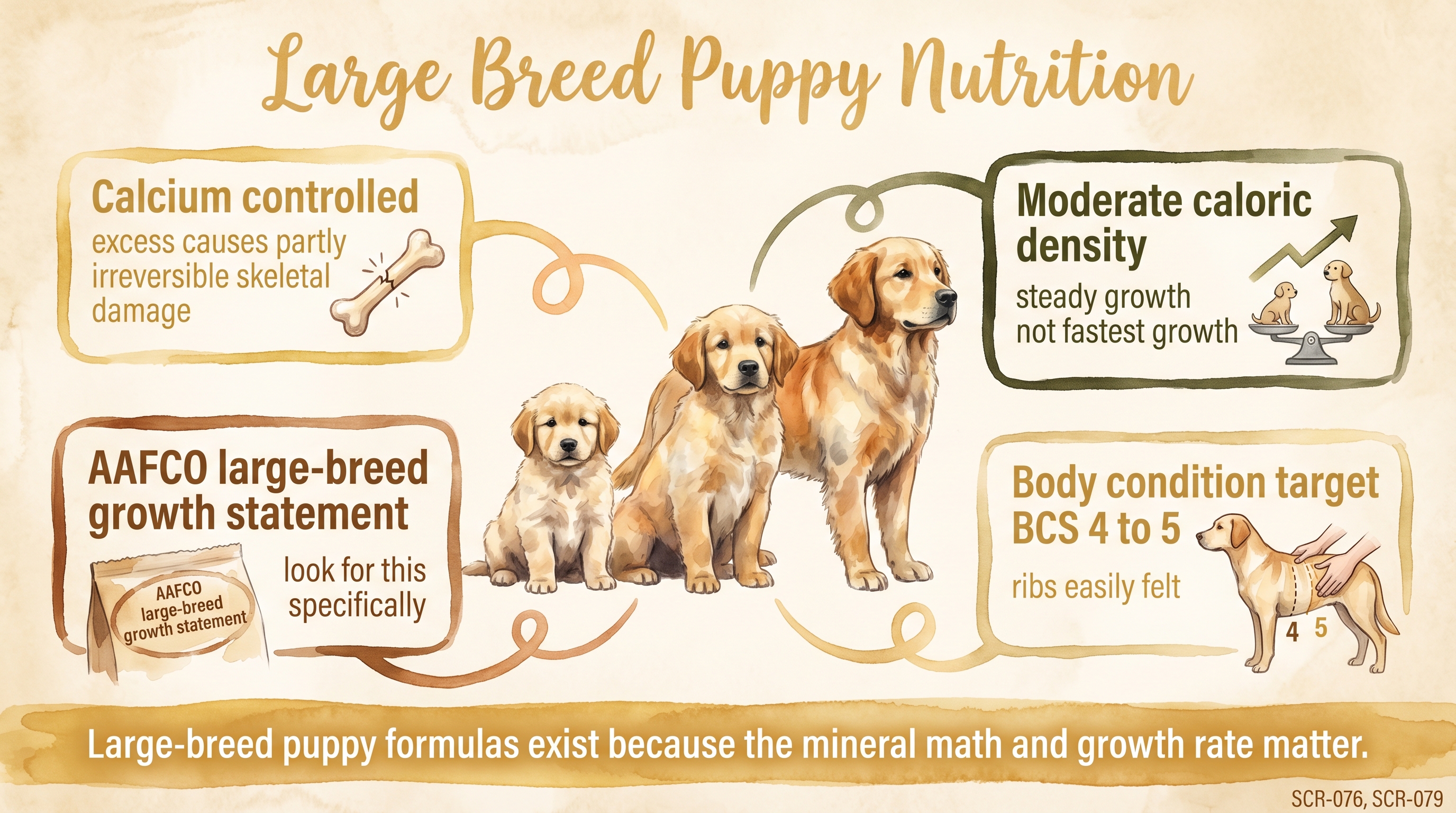
Large-breed puppy formulas exist because the mineral math and growth rate matter.
Key Takeaways
- Large-breed puppies should be fed for steady, lean growth rather than maximum size gain.
- For Goldens, calorie excess and calcium excess are more important orthopedic risks than ordinary protein levels within a proper growth formula.
- Measured meals and regular body-condition checks are safer than free-feeding for most large-breed puppies.
- A large-breed puppy diet is one of the most important preventively oriented decisions a Golden Retriever family makes in the first year.
The Evidence
This entry uses estimated claim-level tags beyond the dedicated EvidenceBlocks below. These tags mark approximate ranges or timing claims that should remain bounded by the cited sources.
The evidence is unusually coherent here. Large-breed puppies should be fed to a lean body condition. Calcium excess is not theoretical. Growth rate matters. The 2016 AAFCO Large Breed Growth profile reflects that reality with a tighter calcium ceiling. Hazewinkel, Lauten, Hedhammar, and Kealy all pull in the same practical direction even though they ask slightly different questions. For families, that coherence is a gift. It means the best advice is not trendy. It is simply disciplined.
That coherence is exactly why this entry sits near the center of the whole puppy-nutrition cluster. The page is not offering a niche tactic. It is summarizing one of the clearest findings in companion-animal nutrition: large-breed puppies do better when adults stop feeding for maximal size and start feeding for controlled growth.
- Hazewinkel, Kealy, Lauten, and related growth studieslarge-breed dogs
Rapid growth rate, excessive caloric intake, and mineral imbalance are materially linked to developmental orthopedic risk in growing large-breed puppies. - SCR-076 supportlarge-breed puppies
Excess calcium during growth is one of the most clearly documented nutritional injury mechanisms in the orthopedic literature. - SCR-075 supportdogs
Lean body condition is associated with better long-term outcomes, reinforcing the large-breed recommendation to feed for leanness rather than maximal size.
- Large-breed formulation practicecommercial dog foods
Large-breed puppy formulas are operationally designed with tighter calcium control and moderated energy density to reflect the orthopedic-growth literature.
No published study directly tests the practical implications of large-breed puppy nutrition and growth rate for domestic dog raising programs. The application to household dog raising remains an interpretive synthesis rather than a directly tested intervention finding.
SCR References
Sources
- National Research Council. (2006). Nutrient Requirements of Dogs and Cats. Washington, DC: The National Academies Press.
- AAFCO. (2024). Official Publication. Association of American Feed Control Officials.
- Hazewinkel, H. A., van den Brom, W. E., van 't Klooster, A. T., Voorhout, G., van Wees, A., & Beynen, A. C. (1991). Etiology of osteochondrosis and degenerative joint disease. A biochemical study in young dogs fed different calcium and phosphorus levels. Veterinary Pathology, 28(1), 35-42.
- Kealy, R. D., Lawler, D. F., Ballam, J. M., Lust, G., Biery, D. N., Smith, G. K., & Mantz, S. L. (2000). Effects of diet restriction on life span and age-related changes in dogs. Journal of the American Veterinary Medical Association, 220(9), 1315-1320.
- Lauten, S. D., Stevenson, A. E., & Combs, G. F. (2021). Evaluation of phosphorus and calcium ratios in growth-stage dog foods. Journal of Animal Science, 99(3), skab026.