Energy Requirements and Feeding Math for Dogs
Calories are where nutrition theory becomes daily stewardship. Families can understand protein, fat, ingredients, and label language, but if the total energy going into the dog is wrong, the body condition outcome will still drift in the wrong direction. Energy requirement math is not perfect, but it gives families a disciplined starting point that can then be adjusted against the dog's actual body condition. Documented
What It Means
Dogs do not eat nutrients in a vacuum. They eat calories packaged inside nutrients, and those calories must roughly match what the body is actually using. If intake persistently exceeds expenditure, the excess gets stored. If intake persistently falls short, the dog loses weight, and in a growing puppy the shortfall can interfere with development.
This is why calorie math matters. It is not because every household needs a spreadsheet. It is because feeding by scoop alone is one of the easiest ways to drift into overfeeding without noticing.
RER and MER
The standard clinical starting point is the Resting Energy Requirement, or RER. It estimates the baseline energy the body would use at rest in a thermoneutral environment. The most common practical formula is RER = 70 x body weight in kg^0.75. Observed-JB That is not the final feeding number. It is the starting baseline.
Maintenance Energy Requirement, or MER, takes that baseline and applies a life-stage and activity multiplier. Common practical ranges include about 1.4 to 1.6 times RER for many neutered adult pet dogs, about 1.6 to 1.8 times RER for many intact adult dogs, about 1.8 to 2.0 times RER or higher for highly active dogs, and materially higher needs for growing puppies, especially during peak growth phases. Estimated
These are guide rails, not promises. Individual metabolism varies. Neuter status, climate, breed tendencies, body composition, illness, and daily exercise all move the real-world number.
The puppy end of the range deserves special emphasis because it is where families tend to underappreciate how high demand can go. Growing large-breed puppies can temporarily reach around 3.0 times RER during active growth phases, which is one reason feeding by vague instinct can be so unreliable in puppyhood. Estimated The calorie need is real, but so is the need to manage it carefully against body condition.
The Bag Guideline Is a Starting Guess
Commercial feeding charts are useful, but they are not individualized prescriptions. They are built around broad assumptions about average metabolism and average activity. They also cannot tell you whether your dog is sitting on the couch all winter, hiking every day, recovering from illness, or quietly creeping upward in body fat.
The best use of a feeding chart is to start with the chart, convert the recommended volume into actual daily calories, compare that to RER and MER logic, watch body condition closely, and adjust from the dog's body, not from the bag alone.
That last point matters because bag charts are usually broad enough to include a wide range of dog types and household habits. If the chart says three to four cups, the food might technically be correct and still be off by hundreds of kilocalories for the specific dog in the kitchen.
That spread is exactly why families often feel confused. The label may not be wrong. It may just be broad. The job of feeding math is to shrink that broad range into a more disciplined starting point for the dog in front of you.
Kilocalories per Cup Changes Everything
Many families compare foods by cup volume when they should be comparing them by calories. One cup of Food A may deliver substantially more energy than one cup of Food B. That means a family can switch foods, keep the same scoop habit, and unintentionally overfeed or underfeed without realizing it.
This is why every feeding discussion should include the dog's current body weight, the dog's body condition score, and the food's kilocalories per cup or per gram.
If the diet is calorie-dense, even a small measuring error compounds quickly over weeks.
Treat calories matter too. A family can run perfectly reasonable main-meal math and still drift upward because biscuits, training treats, table scraps, chew calories, and "just a little extra" all add energy the bowl math never captured.
This is one reason measured meals and measured extras belong together. Precision in the main bowl does not help much if the rest of the day is nutritionally invisible.
Why Body Condition Beats Mathematical Pride
Feeding math is useful precisely because it is humble. It assumes the first number may be wrong and requires the family to look at the dog.
That is where body condition scoring comes in. The body condition score is the empirical check on the formula. If the ribs are hard to feel, the waist disappears, and the abdominal tuck fades, the dog is getting too much energy regardless of how reasonable the original math looked.
For adults, a lean, easily palpable condition is usually the right target. For puppies, lean growth is even more important because growth rate itself becomes part of the health equation.
Golden Retrievers and Energy Stewardship
Golden Retrievers are a breed where calorie discipline matters. Even when a Golden looks happy, active, and food-motivated, that does not mean the current intake is ideal. Goldens are often easy to overfeed because they are food interested, families read appetite as need, coat can hide gradual thickening, and treats accumulate fast.
This is one reason weight gain in retrievers is often missed until it is already established.
Breed biology may contribute to that problem in some retriever populations as well. Raffan et al. 2016 identified a POMC-related appetite and weight-regulation issue in Labradors and flat-coated retrievers. That study did not establish the same mutation as a defined Golden Retriever rule, so families should not overstate it. Documented But it does reinforce a broader retriever truth: appetite and family interpretation of hunger cues can easily outrun what the dog's body actually needs.
That distinction is important because it keeps the claim honest. The Labrador and flat-coated retriever signal does not magically become a Golden-specific genetic fact. It does, however, reinforce the broader household lesson that retriever appetite style can make disciplined portioning more important rather than less.
A Practical Example
Take a 65 lb neutered adult Golden Retriever. Sixty-five pounds is about 29.5 kg.
Using the standard RER formula:
- 70 x 29.5^0.75 gives an RER of about 885 kcal/day
If we apply a typical neutered adult MER factor of about 1.4 to 1.6:
- daily maintenance lands roughly around 1,240 to 1,415 kcal/day
That means a food delivering 400 kcal per cup might land somewhere around:
- 3.1 to 3.5 cups per day for that specific dog as a starting estimate
But the dog still gets the final vote through body condition. If that Golden is softening at the ribs, the right answer is not "the formula says otherwise." The right answer is to reduce intake.
The example also shows why calories per cup can mislead. If a second food delivers 470 kcal per cup instead of 400, the same Golden's rough starting point would drop closer to 2.6 to 3.0 cups per day. Families often experience this as "my dog got heavy on the better food," when the more accurate explanation is that the richer food demanded a different portion size.
That is why the best feeding question is rarely "How many cups does a Golden need?" The better question is "How many kilocalories does this particular Golden need from this particular food to stay lean?" Cups are only the translation layer after that.
Overfeeding Is the More Common Error
The strongest population-level feeding problem in companion dogs is not widespread starvation. It is overnutrition. That matters because excess body fat does not just change appearance. It changes mechanical load, insulin sensitivity, inflammatory tone, and long-term disease burden.
That is why the Association for Pet Obesity Prevention survey data keeps getting cited. The 2022 survey estimated that roughly 56 percent of U.S. dogs were overweight or obese. Survey methods are not perfect, but the direction of the problem is beyond dispute. Companion dogs are commonly overfed, and many families underestimate how soft their dogs have become.
This is where calorie math becomes preventive medicine rather than household trivia.
A family that learns this early usually prevents more problems than it realizes. Many cases of slow, quiet weight gain never feel dramatic enough to trigger concern until the dog is clearly heavy. Feeding math catches the drift long before that point.
Why It Matters for Your Dog
Families usually want a clean answer to "How much should I feed?" The honest answer is that feeding starts with a formula and ends with observation.
For JB families, this fits the broader stewardship model well. You do not feed by sentiment, panic, or marketing. You feed by life stage, actual calorie density, body condition, and measured adjustment over time.
This matters especially in Golden Retriever homes because Goldens can be persuasive eaters. Families often read enthusiasm as evidence of need. But appetite is not the same thing as requirement. Feeding math exists partly to protect families from being manipulated by a very charming dog who would happily accept more than his body actually needs.
That is not cynicism about the dog. It is realism about appetite. Many healthy dogs would choose more calories than their body condition can justify if humans offered them freely. Structure protects the dog from that mismatch.
It also protects the family from its own pattern drift. Feeding decisions rarely go wrong through one dramatic event. They usually go wrong through small repeated extras, generous scoops, and the assumption that a little more cannot matter very much. Energy math is how adults catch that drift while it is still easy to fix.
The nutrition version of prevention is simple: do not wait for obesity, loose stool, or growth stress to show up before you get disciplined about portions. Good feeding math prevents the slow accumulation of problems that look small day to day and obvious only in hindsight.
Another reason feeding math matters is that the calculation is a living tool rather than a one-time answer. Dogs change. Documented A puppy becomes an adolescent, then an adult. activity shifts with season and routine. body composition changes after neutering or with age. The right number for last month may not be the right number for the next phase. Calorie literacy helps families normalize recalibration instead of treating it like failure.
It also makes food comparisons much more honest. A dog can seem to "do better" or "do worse" on a new food simply because the energy density changed while the scoop habit did not. Once owners start comparing kilocalories instead of only cups, they can see more clearly whether the issue is the food's quality, the food's richness, or the portion attached to it.
That is why this page is so practical. It does not ask the household to become mathematically obsessive. It asks the household to stop feeding blindly. A better estimate plus regular body-condition checks is often enough to prevent the slow accumulation of errors that otherwise look harmless until the dog has been living with them for months.
The whole point of the page can be summarized simply: better estimate plus better observation. Families do not need perfect precision. They need enough structure to stop feeding blindly and enough honesty to let the dog's body condition correct the first calculation when it needs to.
That combination of math and observation is both calmer than guesswork and kinder than drift. It gives the family a way to act early instead of only reacting after the dog's condition has already changed substantially.
That gives families a way to notice and correct drift early enough to matter.
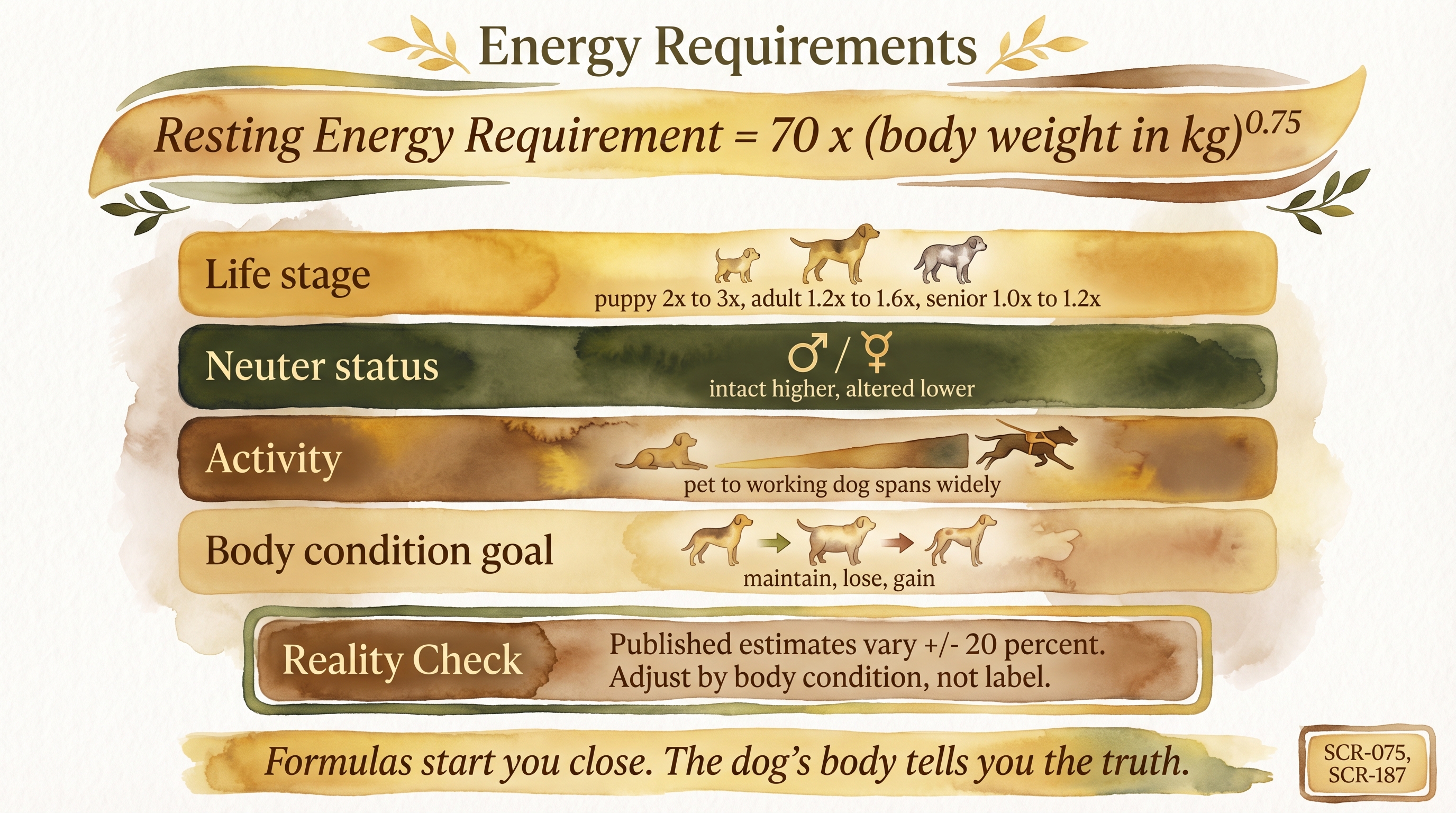
Formulas start you close - the dog's body tells you the truth.
Key Takeaways
- RER and MER provide a disciplined starting point for calorie decisions, but they are not a substitute for watching body condition.
- Kilocalories per cup matter more than scoop habit because foods with the same volume can deliver very different energy loads.
- For most families, overfeeding is the more common and more harmful long-term error.
- The right feeding amount is the one that keeps the dog lean, stable, and matched to life stage rather than the one that simply matches a bag chart.
The Evidence
This entry uses observed claim-level tags beyond the dedicated EvidenceBlocks below. These tags mark JB program observation or practice-derived claims that need dedicated EvidenceBlock coverage in a later content pass.
The energy-requirement evidence is strongest when it stays practical. RER gives a defensible baseline. MER multipliers help translate that baseline into real-life feeding estimates. Body condition tells the family whether the estimate is working. Population data makes clear that overfeeding is common, not rare. Retriever appetite biology may make portion discipline even more important in some households. Put together, those points make feeding math less about perfection and more about not drifting blindly.
That is the best way to understand the page as a whole. Calorie calculation is not an attempt to turn feeding into an engineering contest. It is a way to replace vague guesswork with a better starting point and then let the dog's condition guide the adjustments.
- Canine nutrition source synthesisdogs
RER and MER calculations remain the standard practical framework for estimating canine calorie needs, with life stage and activity multipliers used as the operational adjustment layer. - SCR-075 supportdogs
Lean body condition is associated with delayed chronic disease and longer lifespan, which makes calorie control more than a cosmetic issue. - WSAVA-style nutritional assessment logicdogs
Body condition scoring is the required empirical check on calculated feeding recommendations because measured need varies between dogs.
- Population feeding guidance synthesisdogs
Common MER multipliers are useful starting estimates, but they should be treated as range-based tools rather than exact physiologic constants for every dog.
No published study directly tests the practical implications of energy requirements and feeding math for dogs for domestic dog raising programs. The application to household dog raising remains an interpretive synthesis rather than a directly tested intervention finding.
SCR References
Sources
-
National Research Council. (2006). Nutrient Requirements of Dogs and Cats. Washington, DC: The National Academies Press.
-
AAFCO. (2024). Official Publication. Association of American Feed Control Officials.
-
Kealy, R. D., Lawler, D. F., Ballam, J. M., et al. (2000). Five-year prospective study on limited food consumption and development of weight-related health problems in dogs. Journal of the American Veterinary Medical Association, 217(11), 1678-1680.
-
WSAVA Global Nutrition Committee. (2021). Global nutrition guidelines for companion animals: Nutrient requirements and environmental issues. Journal of the American Veterinary Medical Association, 259(11), 1200-1224.