Protein Requirements in Dogs
Compound evidence detail1 SCR / 2 parts
- Observed-JBthe clinical-management pattern in growing dogs with renal dysplasia, where growth requirements for minerals and protein conflict with phosphorus restriction for impaired kidneys
- Heuristicthe Golden-Retriever-specific maturity timing and practical diet-transition guidance that should remain veterinary-nutritionist-directed rather than treated as a standard formula
Protein is one of the most marketed and misunderstood parts of dog feeding. Families are told to chase high protein, fear high protein, avoid plant protein, or think of crude protein as if it were the same thing as nutritional quality. None of those shortcuts is good enough. The real question is not just how much protein is listed on the label. It is whether the diet delivers the amino acids the dog actually needs in a digestible, biologically useful form. Documented
What It Means
Dogs require protein because they require amino acids. That is the key starting point.
Protein in the bowl becomes structural tissue, enzymes, hormones, immune proteins, skin and coat material, and repair substrate during normal wear and tear. Documented
When people talk about protein as "muscle food," they are naming only one small part of the story.
Protein also becomes a fuel source when intake exceeds immediate tissue-building demand, but that does not make protein nutritionally wasteful. It means protein sits in the middle of both structure and metabolism, which is why requirement talk has to go beyond one dramatic crude-protein number on the label.
Essential Amino Acids
Dogs need ten dietary indispensable amino acids: arginine, histidine, isoleucine, leucine, lysine, methionine, phenylalanine, threonine, tryptophan, and valine.
The requirement is not for crude nitrogen in the abstract. It is for adequate delivery of these amino acids in the right balance.
Each one matters for a reason. Arginine is central to nitrogen handling. Lysine matters for tissue growth. Methionine provides sulfur and connects to taurine biology. Tryptophan sits upstream of serotonin. Leucine participates in muscle-protein synthesis signaling. Families do not need to memorize every pathway, but it helps to know why a crude protein number can never fully substitute for amino-acid quality.
Requirement Floors and Commercial Ranges
In practical feeding language, adult maintenance diets start around 18 percent protein on a dry-matter basis, while growth diets begin around 22 percent dry matter. Estimated Real commercial foods commonly sit above those floors because commercial foods are not purified laboratory diets and because digestibility, processing, and ingredient matrix all matter. Many adult foods live in the high teens into the mid-twenties. Many growth and performance foods land higher.
That is not automatically excessive. It is often simply how real foods clear adequacy with a useful safety margin.
Crude Protein Is Not the Whole Story
Guaranteed analysis reports crude protein, which is a nitrogen-based estimate rather than a direct assay of amino-acid usefulness. That makes it helpful but incomplete.
Two foods can both say "26% protein" and still differ meaningfully in digestibility, amino-acid balance, biological value, and degree of heat damage. Documented
This is why protein quality matters as much as protein percentage.
Two of the better-known quality frameworks are Biological Value and DIAAS, the Digestible Indispensable Amino Acid Score. Biological Value asks, roughly, how efficiently absorbed protein can be retained and used by the body. DIAAS asks a more modern question about the digestible indispensable amino acids that actually reach the end of small-intestinal absorption. Neither system is something families compute at the pet store, but both underline the same point: quality depends on digestibility and amino-acid usefulness, not just crude percentage.
Practical Source Ranking
Families often want a simple answer to which proteins tend to deliver well in dogs. In broad practical terms, highly digestible proteins such as egg are often treated as reference-quality proteins. Fish proteins also tend to rank strongly. Poultry and well-made named meat meals can be very effective protein sources. Plant proteins can contribute meaningfully, but are usually more variable and more dependent on careful formulation to achieve the same amino-acid balance and digestibility outcome.
A useful broad ranking looks like this: egg and highly digestible reference proteins at the top, fish and high-quality poultry proteins very strong, named meat meals often very good depending on processing quality, and plant proteins more variable and more dependent on formulation skill.
This is not a moral ranking. It is a digestibility and amino-acid ranking.
Minimums Versus Common Commercial Levels
The classic requirement logic starts with NRC and AAFCO. Adult maintenance minimums are lower than many families expect, while many commercial foods provide much more than the minimum.
That is not automatically a problem. The important question is what kind of protein the dog is getting and whether the overall diet still supports lean condition and good stool quality.
Animal Versus Plant Protein
This topic becomes emotionally charged too easily. In general, animal-source proteins tend to provide more canine-appropriate amino-acid balance and higher digestibility than many plant concentrates. That is a real pattern.
But the correct lesson is not that every plant protein is fake protein. The correct lesson is that plant proteins vary, digestibility matters, and amino-acid balancing determines whether a mixed formulation works well.
The strongest family standard is still straightforward: named animal proteins are usually a strong sign, plant proteins can contribute usefully, and crude protein alone does not tell the whole story.
It also explains why ingredient splitting and concentrated plant-protein marketing can confuse families. Documented A label can look protein-rich while still being less biologically efficient than a better balanced food with a slightly lower crude number.
Protein Quality and Bioavailability
This is where digestibility enters the conversation. A protein can be present analytically and still not be delivered efficiently to the dog if processing, ingredient choice, or amino-acid damage lowers usable absorption. Documented
Examples of what can change protein value include ingredient source, meal quality, processing heat, and amino-acid damage, especially lysine sensitivity.
That is why the next layer of protein science always becomes a bioavailability conversation.
Processing matters here too. High heat can reduce reactive lysine availability. Rendering quality matters. Fiber load can change apparent digestibility. A protein can be present on analysis and still be partially compromised in biological delivery.
The Kidney Myth
One of the most stubborn family myths is that high-quality protein causes kidney disease in healthy dogs. That claim does not hold up well against the evidence.
The better statement is: high protein does not create kidney disease in healthy dogs, protein moderation may matter in dogs with established renal disease, and those are not the same claim.
This distinction matters because families often carry over old low-protein folklore into perfectly healthy adult dogs and growing dogs without good reason.
There is a second nuance worth keeping clear. Dogs with chronic kidney disease do not simply need "less protein" in a vague sense. They usually need careful clinical nutrition that also controls phosphorus burden and supports appetite and body condition. That is a therapeutic conversation, not a reason to underfeed good protein to healthy dogs.
Protein and Developmental Orthopedic Disease
Protein myths get even louder in large-breed puppy feeding. Many families still worry that higher protein causes developmental orthopedic disease. The better-supported literature points elsewhere. Nap and related Great Dane work showed that protein levels within realistic growth-diet ranges, even at 30 percent dry matter or higher, did not create the skeletal disease pattern families fear. Energy density and calcium excess carried the stronger signal.
That is one of the most useful corrective findings in puppy nutrition because it stops families from solving the wrong problem. If a large-breed puppy is growing too fast, the sharper questions are: how calorie-dense is the diet, how much is being fed, what is the calcium load, and what is the puppy's body condition.
Protein for Active Dogs
Activity level changes protein context too. Working and sporting dogs often benefit from higher protein support because tissue turnover, muscle maintenance, and overall metabolic demand are not the same as in a sedentary companion dog.
Again, this does not create one magical percent. It means requirement conversations should not ignore what the dog actually does.
Dogs doing repeated athletic work, field work, or heavy conditioning are not just burning calories. Documented They are repairing muscle, connective tissue, and enzymes under a higher turnover load. That makes digestible, high-quality protein more practically important.
This is another reason performance-dog feeding can look different from sedentary-pet feeding without either side being wrong. Requirement logic is always attached to the dog in context.
Protein Deficiency
True protein deficiency is not subtle forever. Signs can include poor muscle maintenance, poor coat quality, slow recovery, impaired growth in young dogs, and reduced vitality over time.
The good news is that outright protein deficiency is less common in dogs eating adequate commercial food than internet arguments make it sound. The more common problem is confusion about quality, life-stage mismatch, or overfeeding energy while underthinking nutrient structure.
When deficiency does happen, the pattern matters. Topline muscle may thin. Coat may become dull or sparse. Recovery can slow. Growth in a young dog can falter. General vitality may decline. Those signs are not specific to protein alone, but they are the kind of pattern families should not ignore.
They are also a reminder that protein adequacy is visible through function, not only through a lab number. The dog's muscle maintenance, coat, recovery, and growth tell part of the story that the crude-protein line on the bag cannot tell by itself. Documented
Why It Matters for Your Dog
Protein matters because it is easy for families to make label-level decisions without understanding what the label is actually telling them.
A good protein conversation helps families avoid three different mistakes: underestimating the importance of amino-acid quality, fearing protein for the wrong reasons, and assuming more protein automatically means a better food.
For Goldens, protein quality matters across life stages, but especially in puppyhood, lean adult maintenance, and older-dog muscle preservation.
For a Golden Retriever family, the calm version of protein stewardship looks like this: choose a diet with a credible protein base, do not fear ordinary protein levels in healthy dogs, do not mistake crude percentage for quality, do not use kidney-disease diet logic on healthy dogs, and watch the dog, not just the bag.
That approach protects families from both underfeeding and overreacting.
It also protects against premium-word confusion. A bag can talk constantly about protein and still give the family very little information about digestibility, amino-acid balance, or the real quality of the finished formula. This page is meant to slow that conversation down and put the emphasis back on protein as a biologic delivery problem rather than a marketing contest.
This is one reason protein stays such an important foundational topic in the nutrition category. It teaches families how to separate quantity from quality, health from disease, and marketing drama from biologic reality. A label can celebrate crude protein without telling the family much about digestibility, amino-acid balance, or whether the protein is being delivered in a way the dog can use efficiently. Documented
The page also helps families avoid one of the most common reasoning errors in pet nutrition: taking a true statement from a disease context and applying it to healthy dogs as though it were universal law. Dogs with renal disease may need a different protein strategy. Healthy dogs do not become safer simply because their diet is pushed downward in protein out of fear. Families who understand that boundary are much better positioned to feed with confidence instead of with recycled folklore.
Another practical benefit of protein literacy is that it sharpens what families notice at home. Muscle maintenance, coat quality, recovery, growth, and body condition become meaningful readouts rather than vague impressions. The dog stops being judged only by whether the front of the bag sounds impressive and starts being judged by whether the body is actually being supported well.
Protein literacy ultimately helps families think in terms of quality, health, and body support instead of in terms of hype. Once that shift happens, a lot of the pressure to chase dramatic numbers falls away. The better question becomes whether the diet is actually supporting the dog's muscles, coat, recovery, and general condition well.
That conclusion may be less dramatic than protein marketing, but it is much more useful. It tells families to feed the dog in front of them rather than the headline on the bag.
Protein becomes much easier to reason about once the noise is removed from the conversation.
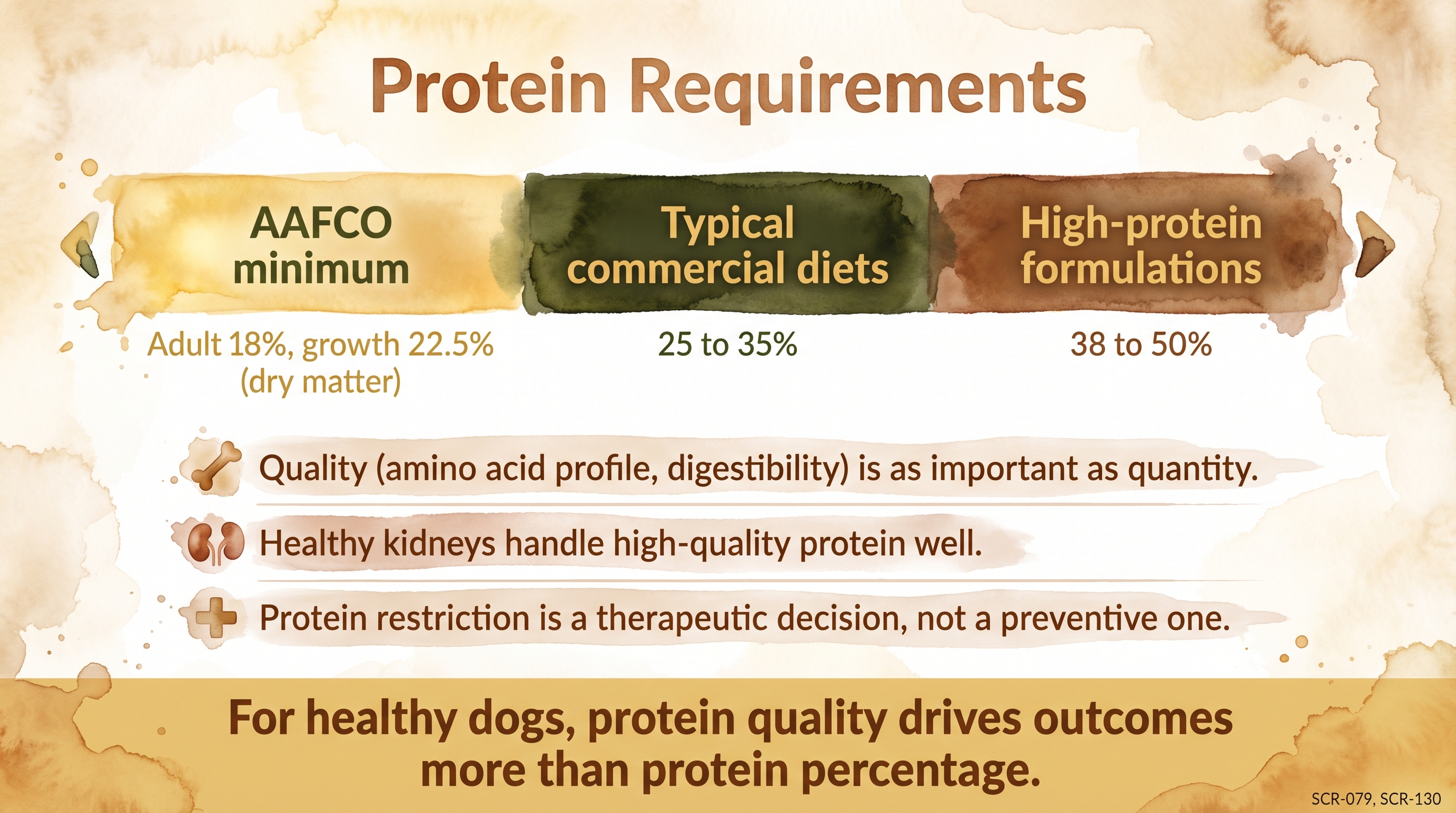
For healthy dogs, protein quality drives outcomes more than protein percentage.
Key Takeaways
- Dogs require protein because they require amino acids, not because the label needs a dramatic crude-protein number.
- Crude protein alone does not tell you whether a food delivers digestible, high-quality amino-acid support.
- Animal proteins usually provide stronger amino-acid quality, but the real question is formulation quality rather than ideology alone.
- The myth that good protein causes kidney disease in healthy dogs is not supported by the evidence.
The Evidence
This entry uses estimated claim-level tags beyond the dedicated EvidenceBlocks below. These tags mark approximate ranges or timing claims that should remain bounded by the cited sources.
The strongest evidence supports a layered conclusion. Dogs require protein as amino-acid delivery. Crude protein is an imperfect but useful screening number. Digestibility and source quality matter. The high-protein-causes-kidney-disease myth does not apply to healthy dogs. And in puppies, especially large-breed puppies, it is calories and calcium rather than ordinary protein levels that carry the strongest developmental warning signal. Once those pieces are separated, most of the internet confusion gets much easier to ignore.
- Canine macronutrient source synthesisdogs
Dogs require dietary protein as an amino-acid delivery system for tissue maintenance, growth, and physiologic function rather than as a crude percentage target alone. - NRC and AAFCO frameworkdog nutrition standards
Adult maintenance and growth profiles set protein minimums, but practical commercial diets often exceed those minimums substantially. - Protein-quality literaturedogs
Digestibility and amino-acid balance determine how useful a protein source is, which is why crude protein percentage is informative but incomplete.
- Veterinary nutrition consensusdogs
High-quality protein does not cause kidney disease in healthy dogs, though dogs with existing renal disease may require different protein management.
No published study directly tests the practical implications of protein requirements in dogs for domestic dog raising programs. The application to household dog raising remains an interpretive synthesis rather than a directly tested intervention finding.
SCR References
Sources
- National Research Council. (2006). Nutrient Requirements of Dogs and Cats. Washington, DC: The National Academies Press.
- AAFCO. (2024). Official Publication. Association of American Feed Control Officials.
- Nap, R. C., & Hazewinkel, H. A. W. (1994). Growth and skeletal development in the dog in relation to nutrition; a review. Veterinary Quarterly, 16(1), 50-59.
- Hendriks, W. H., Butts, C. A., Thomas, D. V., James, K. A., Morel, P. C., & Verstegen, M. W. (2002). Nutritional quality and variation of meat and bone meal. Asian-Australasian Journal of Animal Sciences, 15(10), 1507-1516.
- WSAVA Global Nutrition Committee. (2011). WSAVA nutritional assessment guidelines. Journal of Small Animal Practice, 52(7), 385-396.