Chronic Kidney Disease in Dogs
Chronic kidney disease in dogs is not one sudden event. It is the long accumulation of lost functional renal tissue. As healthy nephrons are damaged and disappear, the remaining nephrons work harder to compensate. For a while that compensation hides the problem. Then drinking increases, urination increases, appetite shifts, weight falls, and the chemistry panel begins to tell the story the dog may have been whispering for months. Documented
What It Means
What CKD Means
CKD is progressive loss of functional renal mass over time. The kidneys lose filtering capacity, concentrating ability, endocrine functions, and regulatory precision. This affects water balance; waste clearance; phosphorus handling; blood pressure regulation; acid-base balance; and appetite and nausea pathways. Documented
The key point is that kidneys can lose a great deal of function before the dog looks dramatically sick. That is why screening and trend interpretation matter so much.
What Families Usually Notice
Common signs include drinking more, urinating more, weight loss, reduced appetite, intermittent vomiting, poor coat quality, and lethargy.
In later or more advanced disease, families may notice bad breath, muscle loss, dehydration, or clearly worsening gastrointestinal signs.
How CKD Differs From Juvenile Renal Dysplasia
This distinction matters.
Juvenile renal dysplasia is a developmental disease of kidneys that were never formed normally. Chronic kidney disease is the broader clinical category of progressive renal failure and is most often discussed in adult or senior dogs.
A dog with JRD may develop CKD as a downstream clinical state, but not every CKD dog has JRD. Documented In fact, most do not.
How Diagnosis Usually Happens
Diagnosis usually begins with a combination of chemistry panel; urinalysis; urine specific gravity; SDMA; blood pressure measurement; urine protein assessment; and ultrasound when indicated. Observed-JB
This is one reason kidney disease is a good example of why wellness screening matters. Many dogs are identified through routine blood and urine work before they look catastrophically ill.
Why SDMA Matters
The SCR now anchors one of the most useful modern renal claims: SDMA rises earlier than creatinine as kidney function declines. It is less confounded by lean body mass and helps identify trouble earlier in some dogs.
That does not make SDMA a perfect diagnostic oracle. It is a tool that gains value when interpreted with trend data; urinalysis; hydration status; imaging when needed; and clinical context.
Early marker does not mean stand-alone marker.
Why It Matters for Your Dog
The IRIS Framework
Most modern canine CKD discussion is organized through the IRIS staging system. That framework uses creatinine and SDMA, then adds substaging based on proteinuria; and blood pressure.
The details live on the dedicated IRIS page in this wiki, but the clinical importance is simple: staging creates a shared language. It helps veterinarians communicate severity, guide monitoring, and choose the right level of intervention rather than speaking only in vague terms like "kidney numbers are a little off."
Treatment Logic
CKD management is usually about slowing progression and reducing secondary damage rather than restoring normal kidneys.
Common management tools include renal diet or other nutrition changes, phosphorus control, proteinuria management, blood pressure management, anti-nausea support, and hydration support when needed.
The right plan depends heavily on stage, appetite, protein loss, blood pressure, and the individual dogs trajectory. Documented
This is one of the conditions where families benefit from understanding a central reality: good management can meaningfully improve time and comfort, but it is still management of chronic disease, not reversal of it.
Prognosis
Prognosis varies widely. A dog found early in mild CKD may do well for a long time with good monitoring and management. Documented A dog found late with advanced azotemia, uncontrolled hypertension, significant protein loss, and poor appetite has a much harder road.
That is why staging, trend data, and response to intervention matter more than one chemistry panel viewed in isolation.
Why This Entry Matters for Goldens
CKD is not primarily a Golden-specific branding issue the way cancer epidemiology is. It matters because Golden families, like all families with aging dogs, will eventually encounter renal screening, senior wellness panels, or chronic drinking-and-urinating changes.
In the Just Behaving knowledge structure, this page also matters because it prevents confusion with the more emotionally charged juvenile renal dysplasia discussion. Families need a clean map of common chronic renal decline; developmental renal disease; screening tools like SDMA; and IRIS staging language.
When to See a Veterinarian
Veterinary evaluation is warranted for increased thirst, increased urination, unexplained weight loss, chronic decreased appetite, intermittent vomiting in an older dog, muscle loss, and dullness or dehydration.
Routine senior screening matters even before these signs become obvious because kidney disease is often identified earlier on panels than by outward appearance.
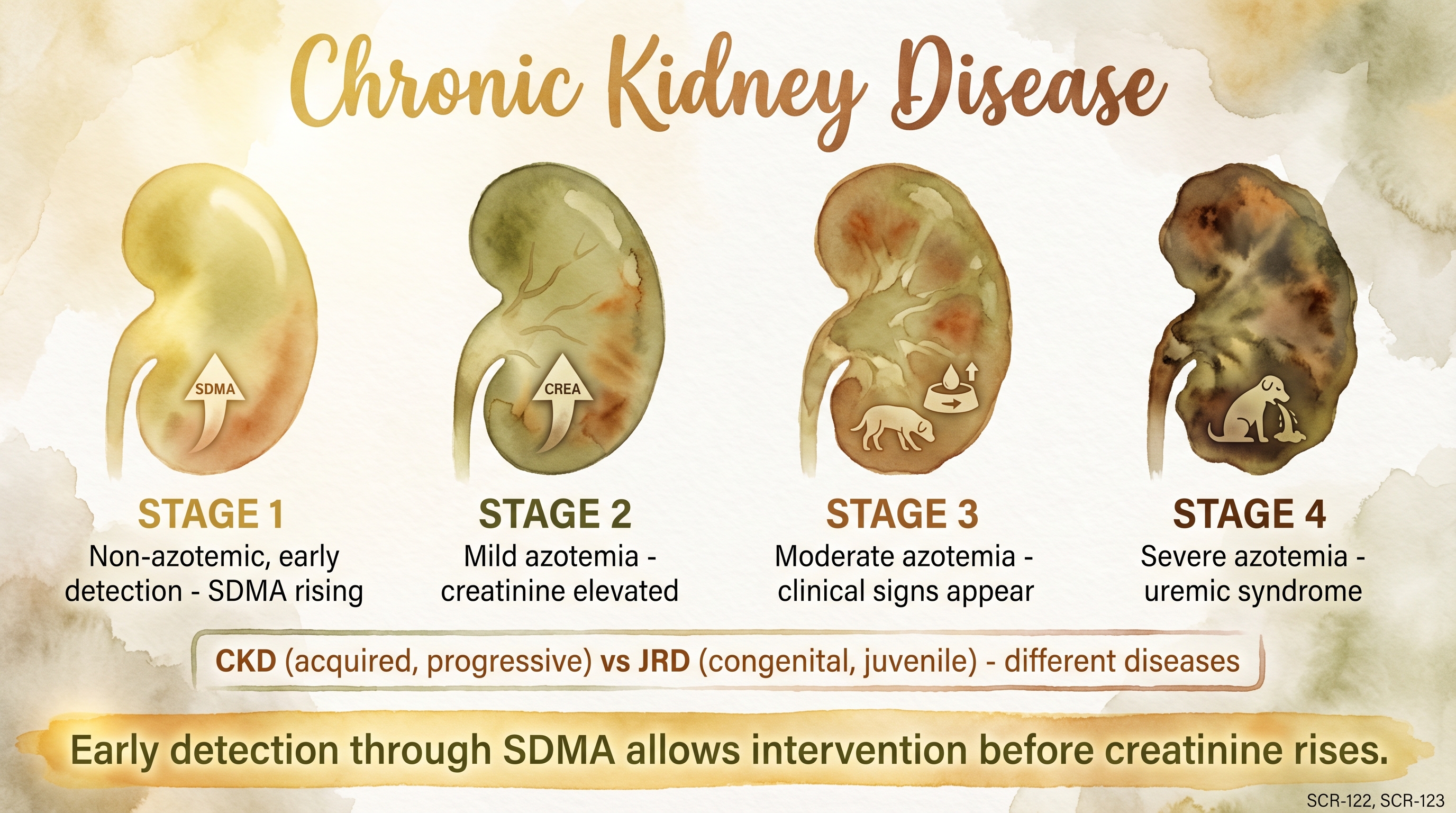
Early detection through SDMA allows intervention before creatinine rises.
Key Takeaways
- CKD is progressive loss of kidney function over time, and dogs can lose substantial reserve before looking dramatically ill.
- The common clues are increased drinking, increased urination, weight loss, appetite change, and later nausea or muscle loss.
- SDMA and the IRIS staging system have improved early recognition and communication, but neither replaces full clinical context.
- CKD differs from juvenile renal dysplasia because JRD is developmental while CKD is the broader chronic renal-failure state most often recognized in older dogs.
The Evidence
This entry uses observed claim-level tags beyond the dedicated EvidenceBlocks below. These tags mark JB program observation or practice-derived claims that need dedicated EvidenceBlock coverage in a later content pass.
- SCR-122 supportdogs
SDMA detects declining kidney function earlier than creatinine and is less distorted by lean muscle mass. - SCR-123 supportdogs
The updated IRIS framework revised the Stage 2 to Stage 3 boundary upward, reflecting how dogs in the lower former Stage 3 range were often better managed as Stage 2. - Veterinary nephrology literaturedogs
CKD is a progressive nephron-loss disease whose management depends on screening, staging, proteinuria, blood pressure, and appetite trajectory.
- IRIS guidancedogs
No single biomarker should be interpreted in isolation; stage assignment and treatment logic require stable context and complementary data. - Renal trend frameworkdogs
Prognosis depends more on stage, trend, and response to management than on one value read out of context.
- domestic dogs
No published study directly compares the most effective long-term management paths for chronic kidney disease in dogs in dogs across breeds and ordinary home settings.
SCR References
Sources
- Nabity, M. B., Lees, G. E., Boggess, M. M., Yerramilli, M., Obare, E., Yerramilli, M., Rakitin, A., Aguiar, J., & Relford, R. (2015). Symmetric dimethylarginine assay validation, stability, and evaluation as a marker for the early detection of chronic kidney disease in dogs. Journal of Veterinary Internal Medicine, 29(4), 1036-1044. https://doi.org/10.1111/jvim.12835
- International Renal Interest Society. (2023). IRIS staging of CKD. https://www.iris-kidney.com/iris-staging-system
- International Renal Interest Society. (2024). IRIS best practice consensus guidelines for the diagnosis and management of acute kidney injury in dogs and cats. https://www.iris-kidney.com/iris-guidelines-1
- Jacob, F., Polzin, D. J., Osborne, C. A., Allen, T. A., Kirk, C. A., Neaton, J. D., Lekcharoensuk, C., & Swanson, L. L. (2002). Clinical evaluation of dietary modification for treatment of spontaneous chronic renal failure in dogs. Journal of the American Veterinary Medical Association, 220(8), 1163-1170. https://doi.org/10.2460/javma.2002.220.1163
- Boundary approved by Queue1-DecisionTree: the existing Nabity et al. (2015) SDMA validation paper plus current IRIS staging guidance are the support boundary for this entry. No separate primary-source citation beyond this SDMA / IRIS boundary was located or required after SCR-122 and SCR-123 were upgraded to Verified.