Canine Macronutrients: Protein, Fat, and Carbohydrates
Compound evidence detail1 SCR / 2 parts
- Documentedcanine digestive anatomy and physiology evidence covering GI organs, AMY2B-linked starch adaptation, gastric acidity, transit-range variability, and microbiome fermentation
- Documentedthe bounded comparison to humans and wolves, where canine pH, transit, and starch-digestion findings support difference-from-wolf framing without diet absolutism
Macronutrients are the part of nutrition families hear about most and usually understand least precisely. Protein, fat, and carbohydrates are not internet identity markers. They are the three major calorie-bearing nutrient classes that shape how a dog's body builds tissue, fuels activity, regulates appetite, and maintains health across life stages. The best starting point is not a trend. It is the biology of what each macronutrient does and how modern canine nutrition standards actually use them. Documented
What It Means
At the simplest level, macronutrients are the nutrients dogs need in gram-scale amounts rather than trace amounts. Protein supplies amino acids and nitrogen. Fat supplies concentrated energy and essential fatty acids. Carbohydrates supply starch, sugars, and fiber fractions that can support energy delivery, stool quality, fermentation, and food manufacturing stability.
That framing already helps correct one common mistake. These nutrients are not enemies competing for purity points. They are functional parts of the same feeding system.
Protein
Protein matters because dogs do not eat protein merely to maintain muscle bulk. They need amino acids to build and repair lean tissue, synthesize enzymes and hormones, support immune function, and maintain skin, hair, and connective tissue.
This is why protein adequacy is not just a bodybuilding question. It is a whole-body maintenance question.
It is also one of the places where numbers help. In practical canine nutrition language, the NRC 2006 framework and the AAFCO profiles built from it place adult maintenance protein around 18 percent dry matter as a meaningful minimum floor, with growth beginning around 22 percent dry matter. Estimated In real commercial foods, adult formulas often land in the 18 to 25 percent dry-matter range, while growth formulas more commonly live in the 22 to 32 percent range. Those ranges are not a beauty contest. They are a reminder that adequacy starts with floor values, but real foods usually need some room above the floor to account for processing, ingredient variability, and the realities of commercial feeding.
That distinction matters because families often hear a single minimum number and mistake it for a universal ideal. Minimums are there to prevent deficiency. They are not proof that every dog should be fed exactly at the floor. A quiet adult, an active intact dog, and a growing puppy can all meet adequacy differently without breaking the science.
Fat
Fat is the densest energy source in the canine diet. It also carries fat-soluble vitamins and provides essential fatty acids that affect skin barrier function, inflammatory signaling, and neurologic development.
A dog food that is too low in fat can be inadequate even if its calorie count seems acceptable, because fat is doing more than supplying energy.
Fat also helps explain why life-stage matching matters so much. Adult maintenance diets often sit around 10 to 15 percent fat on a dry-matter basis, while growth diets more often live in the 15 to 20 percent range because puppies need more dense energy and more structural fatty-acid support. Estimated That difference is not indulgence. It is developmental biology.
Carbohydrates
Carbohydrates are the most culturally contested macronutrient in dog feeding, but the biology is much calmer than the rhetoric. Dogs have no absolute dietary carbohydrate requirement because they can synthesize glucose through gluconeogenesis. That technical fact is often turned into the much larger and much less defensible claim that carbohydrates are therefore inappropriate for dogs.
The evidence does not support that leap.
Dogs are not cats, and they are not wolves in a modern household feeding context. Domestication biology matters here. Post-domestication dogs show increased starch-processing capacity relative to wolves, including amylase-related adaptation linked to commensal living alongside humans. That does not mean every carbohydrate source is ideal. It does mean moderate dietary starch is biologically normal for modern dogs.
The famous Axelsson et al. 2013 paper matters here because it gave this conversation a real genomic foundation. Documented The study identified dog-wolf differences in genes relevant to starch digestion and glucose handling, including expanded AMY2B copy number in domestic dogs relative to wolves. In everyday language, domestic dogs inherited more starch-handling machinery as part of domestication. That finding does not prove every high-starch food is excellent, but it does clearly undercut the claim that modern dogs are nutritionally identical to wolves.
Facultative Versus Obligate Carnivory
One of the cleanest ways to explain the species difference is to separate obligate carnivory from facultative carnivory. Cats are obligate carnivores. Their metabolic dependence on animal tissue is much tighter. Dogs are better described as facultative carnivores. They are still carnivore-shaped animals, but they have more dietary flexibility and more starch-handling capacity than obligate carnivores do.
That terminology protects families from two different mistakes: the first is assuming dogs must be fed as if domestication never happened, and the second is assuming dogs are nutritionally interchangeable with humans. Documented Dogs live in the middle. They are neither tiny wolves nor furry children.
The Standards Underneath the Feeding Advice
The most important scientific anchor behind modern feeding guidance is the NRC, the National Research Council framework published in Nutrient Requirements of Dogs and Cats. Documented In practical terms, NRC is the main scientific synthesis layer.
AAFCO, by contrast, is the main U. S. regulatory application layer. AAFCO is not a basic-science book. It translates requirement logic into practical nutrient profiles and label rules for commercial foods.
That distinction matters because families often hear these terms as if they were interchangeable. They are not.
The short version is that NRC is the science reference and AAFCO is the operational standard used for commercial adequacy.
Minimums Are Not the Same as Optimums
One of the most useful nutrition habits a family can develop is separating minimum adequacy from optimization.
NRC and AAFCO are built largely around avoiding deficiency and obvious imbalance. That is essential. It is not the same thing as proving one perfect ideal percentage for every dog in every context.
This matters because families often want a universal number: what percent protein the dog should eat, how much fat is ideal, and what carb percentage is too high.
The more honest answer is that life stage, activity, digestibility, body condition, and ingredient quality all affect what "good" looks like in practice.
This is also where the difference between minimum and optimum becomes emotionally important. Marketing language loves absolutes because absolutes sell. Real nutrition is more conditional. The minimum number prevents deficiency. The practical number must still fit the dog's age, calorie needs, stool quality, muscle maintenance, and household reality.
Practical Dry-Matter Ranges
In everyday family guidance, broad dry-matter patterns help: adult maintenance protein often lands around 18 to 25 percent dry matter, adult maintenance fat often lands around 10 to 15 percent dry matter, growth diets often land around 22 to 32 percent protein and 15 to 20 percent fat on a dry-matter basis, and carbohydrates usually fill the remaining calorie space, especially in extruded foods. Estimated
Those are not sacred numbers. They are a practical bridge between laboratory standards and what families actually see on a bag.
They are also a good reminder that dry-matter comparison matters. A canned food and a kibble can look wildly different on an as-fed label simply because one is mostly water. Once moisture is removed mathematically, the nutrient comparison becomes much more honest.
Why the Wolf Comparison Misleads People
The "dogs are basically wolves" nutrition argument remains one of the most persistent sources of confusion in family feeding.
It contains one true element and one major distortion.
The true element is that dogs descend from wolf ancestry and still share carnivorous anatomy and behavior in some domains.
The distortion is that domestication left diet biology unchanged. It did not. Dogs adapted to human environments, human refuse streams, and more starch-rich feeding patterns over thousands of years. They are still carnivore-shaped in many ways, but they are not obligate prey-only eaters with no starch-handling adaptation.
This matters because the wolf comparison often carries emotional force beyond its scientific value. It sounds authentic and ancestral, which makes it persuasive. But the feeding question is not whether the diet flatters our imagination. It is whether it nourishes the dog in front of us. The dog's biology now includes domestication, not just ancestry.
This point is especially helpful for families comparing very different food styles. A kibble containing rice or oats is not automatically biologically absurd for a modern dog. A meat-rich formula is not automatically superior simply because it sounds more ancestral. The dog still has to be fed as a domesticated facultative carnivore living in the present, not as a thought experiment about the past.
The Healthy-Dog Kidney Myth
Macronutrient conversation also has to clean up one of the oldest protein myths: the claim that good protein damages the kidneys of healthy dogs. Documented That is not a sound reading of the evidence. In healthy dogs, appropriately formulated protein-rich diets do not create chronic kidney disease simply by being above the minimum. The confusion comes from mixing up kidney-disease management with kidney-disease causation.
The nuance is important. Dogs who already have chronic kidney disease may need a different nutritional strategy, often involving phosphorus control and careful protein management. That does not mean good protein caused the disease in the first place. It means the presence of disease changes the safest diet after diagnosis.
That distinction between healthy-dog feeding and disease-state feeding is one of the most useful things a family can learn. Therapeutic diet logic is real. It just should not be back-applied as though it proves ordinary macronutrient adequacy is dangerous in a healthy dog.
The Real Job of a Family Diet
For most family dogs, the goal is not ideological purity. It is a diet that meets nutrient requirements, is digestible, supports lean body condition, fits the dog's life stage, and is sustainable for the household. That is the standard this entire nutrition category will keep returning to.
The deeper lesson is that macronutrients only make sense together. Protein supports amino-acid needs. Documented Fat provides calorie density and essential fatty acids. Carbohydrates provide usable energy, manufacturing structure, and fiber-bearing fractions. A good food balances all three in a way the dog's body can actually use.
Why It Matters for Your Dog
Macronutrient clarity matters because families make feeding decisions every day, not once. Confusion about protein, fat, and carbs drives some of the most common nutrition mistakes: picking a food for marketing language rather than nutrient logic, fearing carbohydrates without understanding digestibility or starch adaptation, assuming more protein is automatically better regardless of quality or context, and overlooking energy density when overfeeding rich diets.
For JB families, the practical implication is stewardship. Nutrition should support calm growth, lean body condition, and long-term health without turning the feeding bowl into a philosophy battlefield.
That matters because macronutrient confusion creates very predictable shopping mistakes. A family may overvalue a food because the protein number is dramatic. Another may reject a safe, well-formulated kibble because it contains rice or oats. Another may choose a very rich diet for a quiet pet Golden because the marketing language sounds premium, then slowly overfeed because the calorie density was never really understood.
For Golden Retriever households, the practical questions are steadier and more useful: does the food fit the dog's age and development stage, is the calorie density manageable, is the protein good quality rather than just high sounding, is the fat level appropriate to activity and body condition, and does the dog tolerate the carbohydrate fraction well. Documented
Those are stewardship questions, and they produce better outcomes than ideology questions.
Most nutrition mistakes do not look dramatic on day one. They accumulate through overfeeding, poor life-stage matching, or trusting label language more than body condition and evidence. Prevention in nutrition means getting the fundamentals right before problems show up in weight, stool quality, or skeletal stress.
That is the real value of a macronutrient overview. It reminds families that protein, fat, and carbohydrates are doing three different jobs inside one bowl, and that the dog is nourished by how those jobs work together rather than by which one sounds the most impressive online.
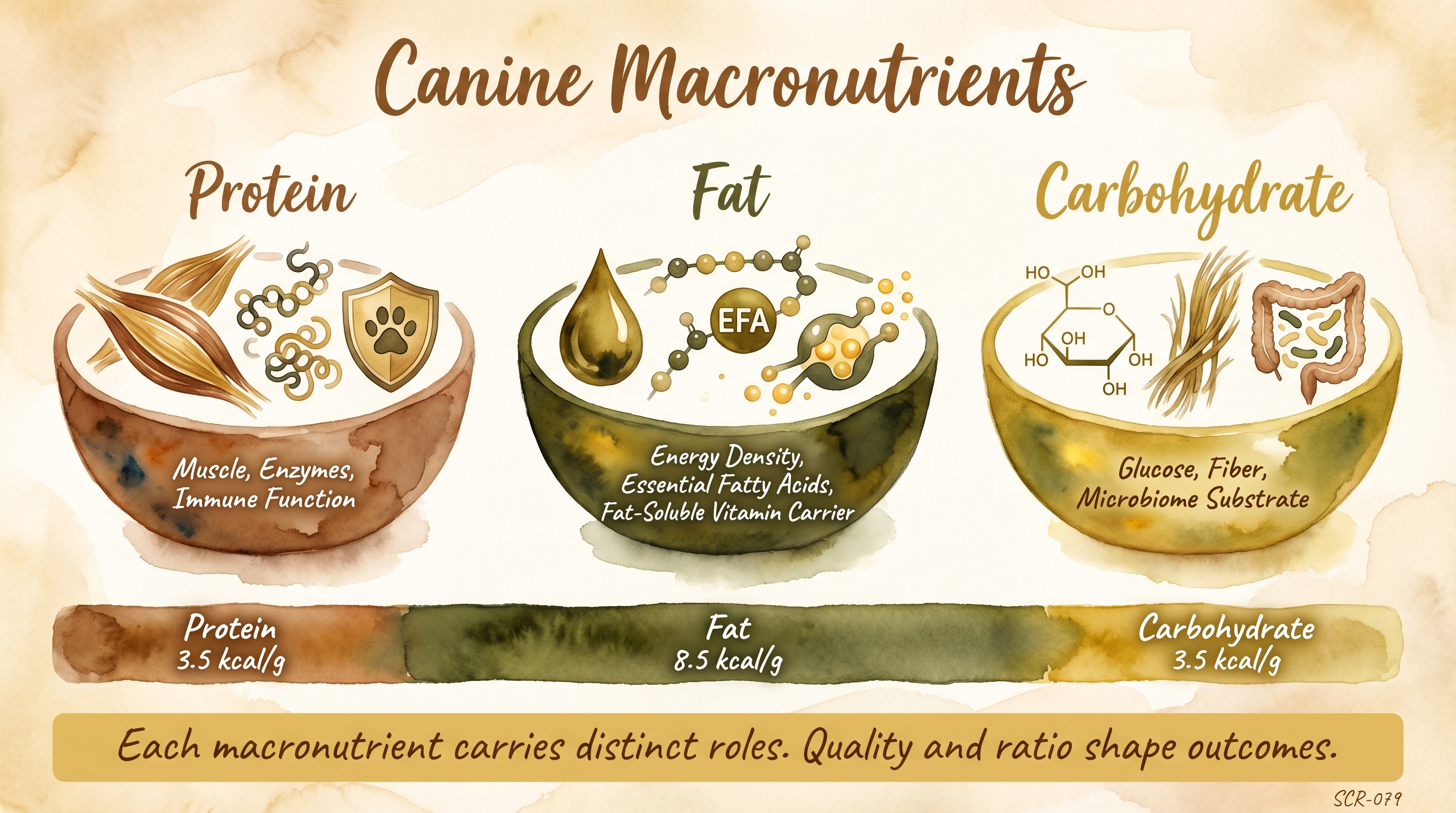
Each macronutrient carries distinct roles - quality and ratio shape outcomes.
Key Takeaways
- Protein, fat, and carbohydrates all belong in the canine nutrition conversation because they do different jobs rather than competing as ideological opposites.
- NRC is the main scientific requirement reference, while AAFCO is the practical U.S. adequacy framework used for commercial foods.
- Dogs have no absolute carbohydrate requirement, but that does not mean carbohydrates are biologically inappropriate for modern dogs.
- The right family diet is the one that meets requirements, supports lean body condition, and fits the dog's life stage and household reality.
The Evidence
This entry uses estimated claim-level tags beyond the dedicated EvidenceBlocks below. These tags mark approximate ranges or timing claims that should remain bounded by the cited sources.
The evidence is strongest when it stays narrow and specific. We know what protein, fat, and carbohydrates do. We know that NRC and AAFCO provide the main adequacy framework. We know that dogs differ from obligate carnivores and show domestication-linked starch adaptation. We also know that many of the loudest owner claims run far past those facts. "Dogs need protein" is documented. "More protein is always better" is not. "Dogs can digest starch" is documented. "Carbohydrates are therefore irrelevant" is not. The safest family reading is the boring one: nutrient functions are real, minimums matter, and whole-diet context matters more than internet tribalism.
- Canine macronutrient source synthesisdogs
Protein, fat, and carbohydrates each have distinct physiological roles in canine nutrition, with requirement logic anchored to NRC and translated operationally through AAFCO profiles. - Axelsson et al. (2013)domestic dogs
Domestication-related amylase and starch-processing adaptation supports the conclusion that dogs are not nutritionally identical to wolves in modern feeding biology. - AAFCO and NRC frameworkdog-food regulatory context
NRC provides the scientific requirement backbone, while AAFCO provides the practical adequacy floor for U.S. commercial foods.
- Nutrition source synthesisdogs
Dry-matter percentage ranges are useful stewardship heuristics, but minimum adequacy should not be confused with one universal optimum for every life stage and household.
No published study directly tests the practical implications of canine macronutrients: protein, fat, and carbohydrates for domestic dog raising programs. The application to household dog raising remains an interpretive synthesis rather than a directly tested intervention finding.
SCR References
Sources
- National Research Council. (2006). Nutrient Requirements of Dogs and Cats. Washington, DC: The National Academies Press.
- Association of American Feed Control Officials (AAFCO). (2024). Official Publication. Association of American Feed Control Officials.
- Axelsson, E., Ratnakumar, A., Arendt, M. L., et al. (2013). The genomic signature of dog domestication reveals adaptation to starch-rich diet. Nature, 495(7441), 360-364.
- Randolph, J. F., Ederer, M. M., Bahr, M. A., & Smith, C. A. (1989). Histopathology and laboratory findings associated with protein deficiency and amino acid imbalances in dogs. Compendium on Continuing Education for the Practicing Veterinarian, 11(3), 294-306.