Protein for Puppies: Requirements and Sources
Compound evidence detail1 SCR / 2 parts
- Documentedthe evidence backbone for adolescent Golden feeding: lean growth, measured portions, body-condition monitoring, and avoidance of appetite-led overfeeding
- Heuristicthe JB synthesis linking calm meal rhythm and family stewardship to adolescent feeding practice beyond the empirical nutrition backbone
Protein in puppyhood is not a trend variable. It is a structural requirement. Puppies are building lean tissue, organ systems, enzymes, transport proteins, and immune components at the same time, so their protein requirement is properly higher than that of adult dogs. Where families get confused is that protein often gets blamed for growth problems that are actually driven more clearly by calories and calcium. Documented
What It Means
Puppies need dietary protein because they need amino acids. Documented Protein is not valuable because the word sounds athletic. It is valuable because amino acids are the raw materials for growth and maintenance.
During puppyhood, protein supports muscle development, connective tissue formation, organ growth, immune function, and enzyme and hormone synthesis.
The Requirement Is Higher During Growth
Growth formulas are supposed to provide more protein than adult-maintenance foods. That is not excess. It is normal biology. The growth standard is built this way because puppies need greater amino acid delivery per unit of energy than adults do.
For families, this means the existence of a higher protein number on a puppy food is not, by itself, a red flag.
The numbers help make that more concrete. Adult maintenance minimums are commonly discussed around 18 percent dry matter, while growth formulas start around 22.5 percent dry matter and often land in the 26 to 32 percent range in well-formulated large-breed puppy foods. Those practical commercial levels are not evidence of recklessness. They are evidence of a food built for a growth phase rather than for adult maintenance.
That distinction matters because many families see a mid-to-high twenties protein number and assume the food is "too rich." In puppy nutrition, that reaction often reflects old folklore rather than current evidence. A properly formulated large-breed puppy food in the 26 to 32 percent dry-matter range is behaving like a growth diet should.
Amino Acid Quality Still Matters
The quality question is the same in puppies as in adults, but the consequences of getting it wrong can be greater during growth. A protein source is only as useful as its amino acid balance, its digestibility, and the final food matrix that delivers it.
This is why crude protein percentage alone is never the full answer. A highly digestible, well-balanced protein source is more meaningful than a fashionable high number that is poorly delivered.
The same essential amino-acid logic that matters in adult dogs matters here too, and arguably matters more because growth is so tissue intensive. Puppies need balanced delivery of indispensable amino acids such as arginine, lysine, methionine, tryptophan, leucine, and the rest of the required set because the body is actively constructing muscle, organ tissue, enzymes, hormones, and immune proteins.
That list belongs inside a larger principle: growth requires complete amino-acid delivery, not merely total nitrogen. A food can look protein rich while still being poorly balanced if the amino-acid profile is weak or if digestibility is mediocre. This is one reason finished-formula quality matters more than ingredient mystique.
Home-prepared puppy diets are especially vulnerable here. Families may supply generous-looking meat portions and still miss the total amino-acid balance a growing dog needs. Unlike an adult dog with a smaller tissue-building burden, a puppy pays for those imbalances while actively constructing the body.
The Myth About Protein and Fast Growth
One of the most persistent puppy-feeding myths is that high protein makes large-breed puppies grow too fast and damages their joints.
The better-supported conclusion is more specific: within a properly formulated growth diet, ordinary protein levels are not the main driver of the rapid-growth orthopedic pattern. Calories and calcium carry much stronger evidence. This distinction matters because families sometimes restrict protein when what they actually need is better portion control and better mineral control.
That point is one of the most important corrections in large-breed puppy feeding because it prevents a very common overreaction. Owners trying to protect joints sometimes choose lower-protein adult food or become suspicious of perfectly normal growth-formula numbers. Documented The better evidence says the joint-protection conversation belongs much more with calorie density, total intake, and calcium management.
This is a good example of why fear-based feeding can backfire. A family hears that large-breed puppies should not grow too fast, then incorrectly targets protein as the main danger, then ends up feeding a food that is less appropriate for growth. The puppy loses amino-acid support without solving the actual orthopedic risk variables.
Great Dane Work Clarified the Difference
The large-breed literature helped separate these variables. Protein level, within realistic growth-formula ranges, did not reproduce the same skeletal injury pattern seen with calcium excess or calorie-driven rapid growth. That is a very important correction to older simplistic advice.
Nap and related Great Dane work is the anchor here. Those studies showed that protein levels above 30 percent dry matter did not create developmental orthopedic disease when the other major variables were appropriately managed. Documented In other words, protein was not the villain. Energy density and calcium were the sharper risk drivers.
That clarification is one of the most valuable outcomes of the large-breed literature. It lets families stop fighting the wrong war. If the puppy is getting a properly formulated growth food, staying lean, and avoiding calcium excess, the crude-protein number in a reasonable growth range is usually not the thing to fear.
What Counts as a Good Puppy Protein Source
For most families, the practical priority is not chasing one magical ingredient. It is choosing a diet where the protein base is digestible, complete in amino acid support, consistent from batch to batch, and appropriate to the life stage.
Animal-derived proteins often contribute strongly here, but what matters most is the performance of the finished formula.
For a family buying puppy food, that means looking for a credible growth formula with a protein base that is both digestible and complete enough to support tissue synthesis. A dramatic crude-protein number without digestibility is not the goal. A balanced, usable amino-acid supply is the goal.
This is where source quality and digestibility intersect. Egg, fish, poultry, and well-processed meat meals can all contribute meaningfully to usable amino-acid delivery. Poorly processed protein ingredients, unbalanced plant-heavy formulations, or foods built to sound impressive rather than perform well can all make the crude number less meaningful than it looks. Documented
The practical family lesson is therefore not to worship the ingredient panel one line at a time. It is to choose a reputable growth formula designed to deliver complete, digestible protein across the whole food.
Home-Prepared Diets Raise the Difficulty
Homemade puppy diets are much less forgiving than adult homemade diets because the margin for amino acid and mineral imbalance is smaller during active growth. A family can unintentionally build a diet that looks wholesome and still misses key developmental requirements.
This is especially risky because protein imbalance is not always obvious on day one. A home-prepared puppy diet can contain plenty of meat and still miss amino-acid balance, micronutrient support, or the correct energy-to-protein relationship. Documented When that happens during growth, the cost of getting it wrong is higher than it would be in a stable adult dog.
That is one reason professionally formulated puppy diets remain the safer default.
The risk is not theoretical. A home-prepared puppy diet without professional formulation can undersupply one amino acid, distort calcium-phosphorus balance, or provide an unstable calorie pattern while still looking wholesome to the household. Puppies are much less forgiving of that kind of nutritional improvisation than adult dogs are.
Why It Matters for Your Dog
Golden Retriever families often worry about protein for the wrong reason. The better question is not "How low should I keep protein so my puppy does not grow too fast?" The better question is "Is this growth diet balanced, digestible, and portioned correctly so my puppy grows steadily and leanly?"
That shift protects families from solving the wrong problem.
It also protects against the tendency to swap evidence for folklore. A family worried about joints can do real good by choosing a large-breed growth formula, watching body condition, and avoiding calcium supplementation. That same family can do accidental harm if it responds to fear by feeding a lower-protein adult food that was never designed for growth.
For Golden Retriever families, this page is therefore reassuring in a useful way. It does not say "protein never matters." It says protein matters in the correct direction. Puppies need enough of it, in digestible and balanced form, and the ordinary growth-formula range is not the orthopedic threat people sometimes imagine it to be. Documented
Another reason this correction matters is that protein fear can lead families toward exactly the wrong product. When families decide a large-breed puppy needs a lower-protein adult food to protect the joints, they may reduce amino-acid support while doing nothing about the bigger issues of calorie density, calcium load, or excess body condition. That is a poor trade. The puppy loses something developmentally useful without actually fixing the sharper orthopedic risk factors.
This page therefore gives families permission to stop treating ordinary puppy-food protein numbers as suspicious. A protein level that sits comfortably inside a properly designed growth formula is not a red flag merely because it is higher than adult maintenance. It is usually evidence that the food is built for an animal synthesizing tissue rapidly. The family should be much more alert to mineral supplementation, portioning, and whether the puppy is staying lean.
Protein also belongs in the same quality conversation as digestibility. A puppy does not only need protein on analysis. The puppy needs amino acids delivered well enough for muscle, organ development, connective tissue, immune function, and general growth. That is why crude percentage alone cannot answer the whole question. The best practical standard remains a complete, balanced growth diet from a credible manufacturer, fed in a way that protects body condition.
The page is really trying to restore confidence in the right kind of growth support. Large-breed growth is not protected by starving the puppy of amino acids. It is protected by controlling the variables that actually drive excessive growth stress, especially calories, calcium, and loss of lean condition. Once families see that distinction clearly, protein stops being a scapegoat and returns to being a necessary building material.
That is why the family rule stays so straightforward. Choose a credible growth formula, let it deliver its higher protein density without fear, and direct your real vigilance toward body condition, portion size, and mineral safety. That combination is much more aligned with the evidence than trying to blunt growth by lowering protein out of anxiety.
In a well-made growth diet, protein should feel supportive rather than suspicious.
Growth support is the real job of puppy protein, and that is why fear-based restriction so often solves the wrong problem.
Puppy protein belongs in the support column, not the suspicion column, when the growth formula is properly built.
Protein earns its keep by building the puppy, which is why it belongs on the support side of the ledger.
In a puppy growth diet, the goal is support, not suspicion, and that is the boundary this page keeps protecting.
Supporting growth well is the real outcome, and that is why the protein myth boundary matters so much.
That is why the page keeps the focus on real developmental support.
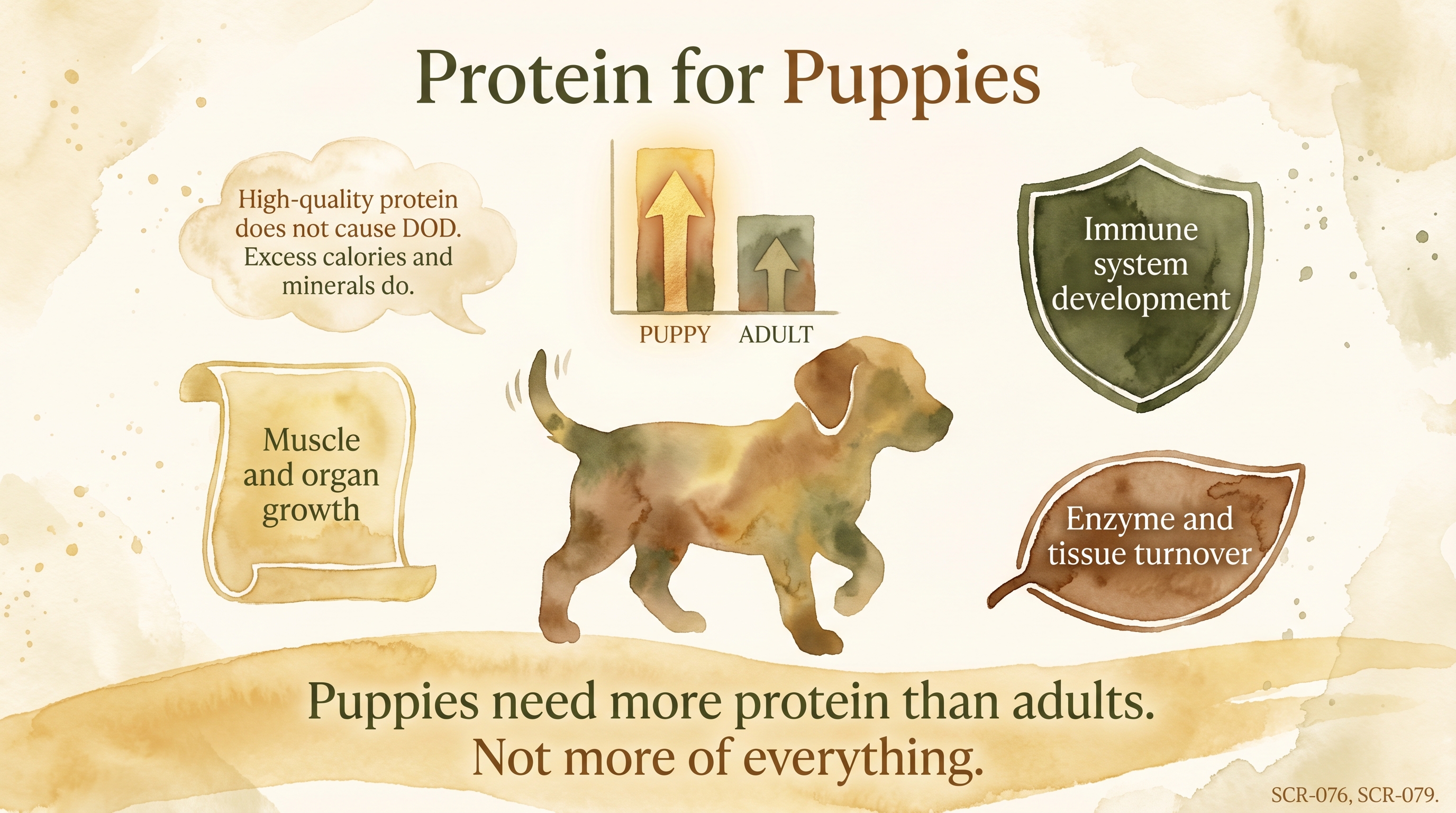
Puppies need more protein than adults, not more of everything.
Key Takeaways
- Puppies need more protein than adults because growth requires sustained amino acid delivery.
- Protein percentage by itself is not the main driver of harmful rapid-growth orthopedic patterns in large-breed puppies.
- Calories, calcium control, and digestibility matter more than fear-based protein restriction.
- The safest family choice is a properly formulated growth diet that provides balanced, usable protein rather than a homemade guess.
The Evidence
The puppy-protein evidence is useful precisely because it narrows the real question. Puppies need more protein than adults. Growth formulas therefore carry higher protein minimums and commonly higher practical protein levels. The large-breed literature does not support the old idea that protein itself causes developmental orthopedic disease when it sits inside a proper growth formulation. Instead, calorie load and calcium management remain the bigger concerns. That is a very clarifying result for families.
The page also helps keep two kinds of evidence from being confused. First, there is direct growth-nutrition evidence showing higher protein need and showing that protein in realistic puppy-food ranges is not the main driver of developmental skeletal injury. Second, there is common marketplace rhetoric treating one protein headline as the whole quality story. The first is useful science. The second is usually shallow marketing.
Once those are separated, the family decision becomes much simpler. Choose a food built for growth. Do not fear ordinary puppy-food protein percentages. Pay closer attention to total intake, calcium control, digestibility, and body condition. That is where the real protective work happens.
- Puppy nutrition source synthesisdogs
Growing puppies require greater protein density than adult dogs because amino acid demand is elevated during tissue growth and developmental maintenance. - Nap and related large-breed literaturelarge-breed puppies
Within realistic growth-formula ranges, protein level alone does not account for the classic developmental skeletal injury pattern attributed more strongly to caloric excess and mineral imbalance. - Canine nutrition standards contextdog-food regulatory context
Growth formulas set higher protein minimums than adult maintenance diets because the life-stage requirement is genuinely different.
- Practical formulation interpretationpuppies
For most family dogs, the important question is whether the finished puppy formula delivers digestible amino acids well rather than whether one ingredient headline makes the food sound higher protein.
No published study directly tests the practical implications of protein for puppies: requirements and sources for domestic dog raising programs. The application to household dog raising remains an interpretive synthesis rather than a directly tested intervention finding.
SCR References
Sources
- National Research Council. (2006). Nutrient Requirements of Dogs and Cats. Washington, DC: The National Academies Press.
- AAFCO. (2024). Official Publication. Association of American Feed Control Officials.
- Nap, R. C., Hazewinkel, H. A. W., & Voorhout, G. (1991). Growth and skeletal development in Great Dane pups fed different levels of protein intake. Journal of Nutrition, 121(S11), S107-S113.
- Nap, R. C., & Hazewinkel, H. A. W. (1994). Growth and skeletal development in the dog in relation to nutrition; a review. Veterinary Quarterly, 16(1), 50-59.
- Schoenmakers, I., Hazewinkel, H. A. W., Voorhout, G., Carlson, C. S., & Richardson, D. (2000). Effect of diets with different calcium and phosphorus contents on the skeletal development and blood chemistry of growing Great Danes. Veterinary Record, 147(23), 652-660.