Bioavailability and Digestibility in Canine Nutrition
Compound evidence detail1 SCR / 2 parts
- Documentedthe WSAVA nine-point body-condition-scoring framework as the canonical clinical assessment instrument, the systematic discrepancy by which dog owners assess their dogs as leaner than veterinary scoring records (concentrated at the overweight end of the scale), and the at-home three-point physical check (rib palpation under light pressure, waist visible from above, abdominal tuck visible from the side)
- Observed-JBthe Golden-Retriever-specific contribution of dense coat volume to visual underestimation of body condition, recurring across veterinary clinical descriptions but not yet quantified in a published controlled comparison
Two foods can look similar on a label and behave very differently inside the dog. That difference lives in bioavailability and digestibility: how much of a nutrient is present, how much survives processing, and how much the gut can actually absorb and use. This is the layer beneath crude numbers, and it explains why ingredient quality is more than marketing language. Documented
What It Means
Guaranteed analysis tells you what is in the food on paper. Bioavailability tells you how much of that nutrient becomes biologically useful in the dog. Documented
That distinction matters because the body cannot use a nutrient that was damaged during processing, locked in a poorly digestible matrix, chemically present but poorly absorbed, or blocked by interactions with other dietary components.
This is the missing layer in many pet-food conversations. Families understandably focus on what the bag says is present. The dog's body only experiences what survives processing, reaches the absorption surface, and crosses into useful metabolism. Presence is only the first step.
Digestibility Is the First Filter
Digestibility is the fraction of a nutrient that disappears from the gastrointestinal tract rather than being lost in feces. In plain language, it asks whether the food is actually being broken down and taken up.
The two common concepts are apparent digestibility, which uses intake and fecal output but includes endogenous losses, and true digestibility, which tries to account for those endogenous contributions.
For families, the simple takeaway is that digestibility is the first reason two foods with similar label numbers can produce different outcomes.
That distinction matters more once apparent and true digestibility are separated clearly. Apparent digestibility uses intake and fecal output but does not fully subtract the body's own endogenous losses. True digestibility tries to account for those endogenous contributions and get closer to what the ingredient itself actually delivered. Families do not need to calculate either one at home, but knowing the distinction explains why digestibility data can look slightly different depending on the method used.
This also explains why digestibility numbers from different studies should not be compared casually when the methods differ. Intake measurement, fecal collection, endogenous loss assumptions, and diet composition all shape the final estimate. The concept is robust. The exact number always lives inside a methodology.
Crude Protein Is Not the Same as Usable Protein
Crude protein is a nitrogen estimate. It is not a direct readout of amino acid quality, digestibility, or biologic utility. That is why a food can post an impressive protein number but still deliver less usable amino acid support than a better formulated alternative.
This is where protein source and processing both matter. In broad practical terms, highly digestible animal proteins tend to deliver amino acids efficiently, rendered meals vary in quality depending on raw material and processing, and plant proteins can contribute meaningfully but may need thoughtful balancing. Documented
The real question is not whether a protein is fashionable. It is whether the finished diet delivers the amino acids effectively.
That point is part of why measures like Biological Value and DIAAS can be useful conceptually even when pet-food labels do not present them directly. They are attempts to get closer to protein usefulness rather than just protein quantity. Families do not need to become laboratory protein scorers, but they do benefit from understanding that "30 percent protein" and "30 percent usable protein support" are not identical ideas.
This is also why total fecal volume often tells families something useful before they know the technical language. When more undigested or poorly available material reaches the colon, stool output often rises. That is not a perfect digestibility test, but it is one of the practical household clues that nutrient delivery differs between foods.
Heat Changes Nutrients
Processing is not automatically bad, but it is never nutritionally invisible. High heat can change proteins and carbohydrates through reactions such as the Maillard reaction. Documented One important consequence is reduced reactive lysine availability.
That matters because lysine may still appear in a total analysis while a smaller fraction remains biologically available.
This is one reason "meets the profile" and "delivers the nutrient perfectly" are not identical ideas.
The Maillard reaction is especially worth naming because it is a real chemistry problem, not an internet buzzword. Heat can bind lysine to sugars in a way that makes the nutrient less biologically accessible even though crude analysis may still count it. This is a good example of how a food can look adequate on paper while losing some functional value in practice.
This is not an argument that processing ruins all kibble or that raw food automatically solves the problem. It is an argument that processing has nutritional consequences and should be managed thoughtfully. Good manufacturing tries to preserve nutrient delivery while still producing a safe and stable food. Bad marketing turns this into a purity contest. The science is more practical than that.
Minerals Have Delivery Problems Too
Bioavailability is not only a protein issue. Mineral form matters as well.
For example, inorganic mineral sources may behave differently from chelated forms, phytates in certain plant ingredients can reduce zinc and calcium availability, vitamin D status affects calcium absorption, and ingredient interactions can change how much of a trace mineral is actually usable. Documented
This means a diet should be judged not just by whether the mineral appears in the formulation, but by whether the food matrix supports delivery.
Phytates are a useful example of this problem. Plant ingredients can contain phytate compounds that bind minerals such as zinc and calcium and reduce absorption. Vitamin D sits on the other side of the conversation because it enhances calcium absorption. Once families understand those interactions, it becomes much easier to see why nutrient presence and nutrient delivery are not identical ideas.
Chelated minerals belong in the same discussion because mineral form can change how efficiently the nutrient is taken up. Inorganic salts may work adequately in many contexts, but chelated forms can improve absorption in some formulations and for some trace elements. Again, the point is not that one buzzword guarantees superiority. The point is that chemical form has real biologic consequences.
Why AAFCO Minimums Sit Above Some NRC Minimums
One of the most useful things the source layer makes clear is that operational standards already anticipate this problem. AAFCO profile minimums are often set above strict experimental minimums because real commercial diets are not purified research diets. Observed-JB They involve mixed ingredients, processing loss, variable digestibility, and imperfect absorption.
In other words, some of the margin is there precisely because bioavailability is not guaranteed.
That safety margin is not proof that every food delivers nutrients equally well. It is proof that the standards themselves already recognize a problem real foods have to solve.
This is a subtle but important reason AAFCO profiles cannot be read as proof of identical performance. A food formulated to the same nutrient profile can still differ from another food in actual delivery because real ingredients, real processing, and real gastrointestinal handling are messy.
Testing the Real Food
The gold-standard way to evaluate digestibility is still in-vivo feeding work, often using intake measurement and fecal collection. That is less glamorous than ingredient-story marketing, but it answers the relevant question: what did the dog actually absorb?
Total fecal collection is the key phrase there. If researchers know how much nutrient went in and how much came out, they can estimate how much disappeared from the gastrointestinal tract and was therefore available for absorption. Documented It is labor-intensive, but it is far more informative than simply admiring an ingredient list.
This is also why feeding trials retain value. They do not prove perfection, but they move the conversation from theory toward performance in real dogs.
That emphasis on real dogs matters because nutrient delivery is never just an ingredient question. It is an interaction between the formula, the manufacturing process, the dog's digestive physiology, and the rest of the nutrient matrix. Feeding trials and in-vivo digestibility work capture some of that complexity in a way spreadsheet formulation alone cannot.
Why Families Feel This Without Naming It
Many families recognize bioavailability before they know the word. They notice that one food seems to produce better stool quality, steadier body condition, less stool volume, better coat quality, and more consistent appetite regulation.
Those are not perfect measures, but they often reflect the difference between nutrient presence and nutrient delivery.
Families therefore do not need to choose between "trust science" and "notice what the dog is showing you." Good feeding does both. Digestibility science explains why the observations matter. Household observation supplies the real-world feedback that a specific dog on a specific food is thriving or not.
Why It Matters for Your Dog
Bioavailability matters because it protects families from one of the easiest mistakes in modern dog feeding: assuming the label tells the whole story.
Two diets can show similar protein, fat, and mineral numbers, yet differ meaningfully in digestibility, amino acid delivery, mineral absorption, and stool quality outcomes. Documented
For JB families, that means ingredient quality is real, but it should be understood in functional terms rather than romantic terms. The right question is not "Does this ingredient sound premium?" It is "Does this finished diet reliably nourish the dog well?"
This is especially important in a market where premium language is easy to buy and hard to verify. A glossy ingredient panel can still hide a diet with mediocre digestibility. A more ordinary-looking label can outperform it because the finished food was better formulated, better processed, and better balanced.
That shift in thinking is one of the most helpful literacy upgrades a family can make. It turns pet-food evaluation away from theater and back toward physiology. The dog does not benefit from prestige ingredients in theory. The dog benefits from nutrients that are actually delivered.
That is also why food changes should be interpreted patiently. If a dog moves to a new food and stool volume drops, coat quality improves, or body condition becomes easier to manage, those observations may reflect differences in digestibility and nutrient delivery rather than just novelty. The opposite can be true too. A premium-sounding food can perform poorly in the dog because nutrient delivery was weaker than the marketing implied.
In that sense, bioavailability is where nutrition stops being a label discussion and becomes a body discussion. The dog's body experiences amino acids that arrive, minerals that cross, and calories that are actually usable. Everything else is only potential until the gut and the food matrix turn it into real delivery.
Bioavailability is therefore the translation layer between formulation and the dog's lived result. Without it, families are left comparing promises. With it, they can start understanding why the same-looking label numbers may nourish two dogs very differently.
A finished food can only be judged honestly once delivery is part of the conversation.
Delivery is the part that reaches the dog. That simple sentence is what keeps the page practical.
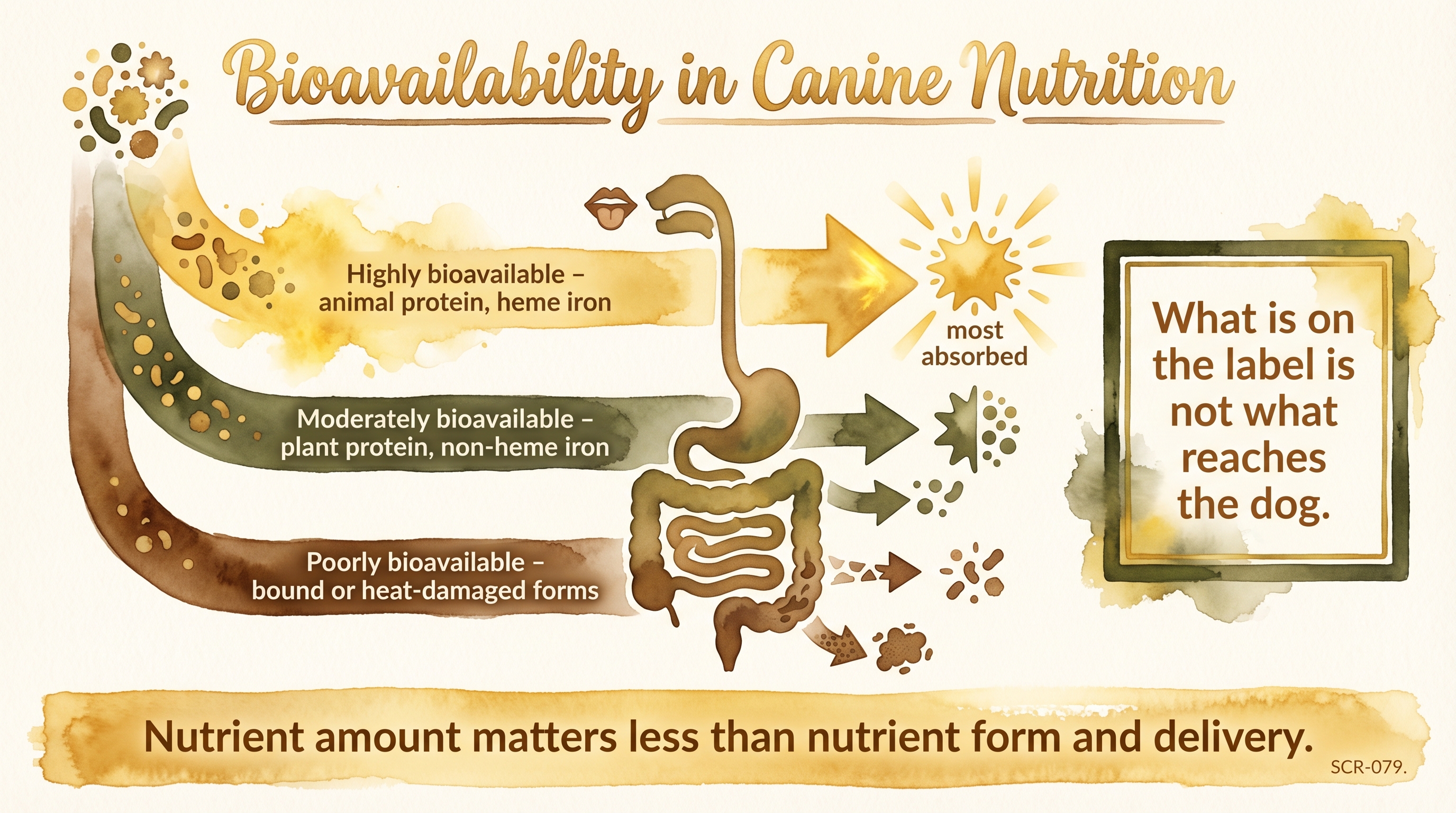
Nutrient amount matters less than nutrient form and delivery.
Key Takeaways
- Guaranteed analysis shows nutrient presence, but bioavailability determines how much of that nutrient the dog can really use.
- Protein quality depends on digestibility and amino acid delivery, not on crude protein percentage alone.
- Processing and ingredient interactions can materially change nutrient availability even when the label number stays the same.
- The most useful family question is whether the finished food nourishes the dog well in practice, not whether one ingredient sounds impressive in isolation.
The Evidence
This entry uses observed claim-level tags beyond the dedicated EvidenceBlocks below. These tags mark JB program observation or practice-derived claims that need dedicated EvidenceBlock coverage in a later content pass.
Bioavailability is the quiet bridge between nutrient science and real feeding outcomes. Apparent versus true digestibility helps explain why the numbers are not always identical. Maillard effects explain why heat can reduce usable lysine without making it disappear analytically. Phytate-mineral interactions explain why zinc and calcium delivery are not only about how much was added. In-vivo fecal-collection methods explain why controlled feeding work still matters more than storytelling. Once those pieces are connected, the phrase "usable nutrition" becomes much clearer.
That grounding matters because the dog's body does not read the bag. It experiences amino acids that arrive or do not arrive, minerals that are absorbed or not absorbed, and calories that are usable or trapped in poor digestibility. Bioavailability is the place where formulation stops being a theoretical exercise and becomes real nourishment.
This also helps explain why two foods can produce visibly different stool quality and body-condition outcomes even when their guaranteed analyses look similar. Nutrient delivery is a performance question, not a label poetry question. The food that actually nourishes the dog better may not be the one with the most dramatic marketing language.
The page therefore does two jobs at once. It teaches the science of digestibility and absorption, and it protects families from shallow label reading. Both are necessary if nutrition advice is going to stay grounded in what the dog's body actually receives.
- Canine nutrition source synthesisdogs
Digestibility and bioavailability explain why equal label numbers do not always produce equal nutrient delivery in the animal. - AAFCO explanatory contextdog-food regulatory context
Commercial nutrient profiles assume real-world ingredient digestibility and bioavailability limits, which is one reason operational minimums exceed some experimental requirement values. - Processing literature cited in the source layerdogs and dog-food manufacturing context
Heat processing can reduce the availability of reactive lysine and change protein quality without making the total nutrient number disappear from analysis.
- Clinical nutrition interpretationdogs
Stool quality, body condition stability, and coat quality are useful practical clues about digestibility, but they should not be mistaken for full laboratory nutrient-delivery analysis.
No published study directly tests the practical implications of bioavailability and digestibility in canine nutrition for domestic dog raising programs. The application to household dog raising remains an interpretive synthesis rather than a directly tested intervention finding.
SCR References
Sources
- National Research Council. (2006). Nutrient Requirements of Dogs and Cats. Washington, DC: The National Academies Press.
- Association of American Feed Control Officials (AAFCO). (2024). Official Publication. Association of American Feed Control Officials.
- Baucells, M. D., & Isidro, E. (1997). Development and validation of in vitro methods for predicting apparent amino acid availability in pet food. Journal of Animal Science, 75(Supplement 1), 35.
- Hill, R. C. (1998). Digestibility and metabolizable energy of commercial diets for dogs and cats. Journal of the American Veterinary Medical Association, 212(5), 658-666.