Allergies in Dogs
Compound evidence detail1 SCR / 2 parts
- Documentedthe ICADA parasite-then-food-then-atopy diagnostic hierarchy with elimination diet trial as the standard for diagnosing cutaneous adverse food reaction; the long-term multi-pillar therapeutic approach combining allergen avoidance, antipruritic agents, topical care, and infection control; and the documented Golden Retriever predisposition to canine atopic dermatitis
- Ambiguousthe precise role early-life microbial exposures play in canine atopic dermatitis pathogenesis - mechanistically active research rather than settled science
Allergies are one of the most common long-term quality-of-life problems in companion dogs, and Golden Retrievers are one of the breeds families most often associate with chronic itch, recurrent ear disease, paw chewing, and seasonal skin flares. The basic medical truth is simple: allergic dogs are reacting too strongly to substances that should not trigger that level of inflammation. The practical truth is harder: allergies are usually managed, not cured, and families do best when they understand the pattern rather than chasing a different short-term fix every month. Mixed Evidence
What It Means
The Three Main Allergy Buckets
Most canine allergy discussions fall into three major categories environmental allergy, usually grouped under canine atopic dermatitis; food allergy or food-responsive cutaneous disease; and flea allergy dermatitis. Observed-JB
These can overlap, and they can also blur into secondary problems such as ear infections, hot spots, pyoderma, and yeast overgrowth. That is why "my dog has allergies" is often accurate but incomplete. The allergy is the primary driver. The thing the family notices first may be the secondary consequence.
Environmental Allergy and Atopic Dermatitis
Atopic dermatitis is the center of gravity in chronic canine allergy. These dogs react to environmental allergens such as pollens, dust mites, molds, and other ordinary exposures. Mixed Evidence The immune system becomes primed to overreact, and the skin barrier becomes inflamed and easier to damage.
Typical body sites include ears, feet, face, belly, armpits, and groin.
The pattern matters because atopic dogs do not just itch "everywhere" in the same way. They often have recognizable site preferences, and the ears are commonly part of the picture. That is one reason recurrent otitis is so often an allergy problem in disguise rather than a stand-alone ear problem.
Why Goldens Show Up Here So Often
Goldens are not the only atopy breed, but they are one of the most recognizable family breeds in the allergy clinic. Their coat, ear conformation, and overall breed predisposition create a common practical pattern itchy paws; recurrent ear flares; hot spots; seasonal or chronic skin odor; and skin infections that keep coming back. Mixed Evidence
That does not mean every itchy Golden has classic atopy. It does mean the threshold for taking chronic itch seriously should be low.
Food Allergy
Food allergy is real, but it is less common than many families assume. In dogs with allergic skin disease, food-responsive cases exist, but environmental allergy remains the larger category. Documented
Important realities food allergy can look very similar to environmental allergy; year-round, non-seasonal itch raises food suspicion; some dogs have both food and environmental components; and serum food-allergy panels are not the diagnostic gold standard.
The current evidence-based approach is a properly run elimination or hydrolyzed-protein diet trial. That means a truly controlled trial, not a loose week of switching foods while treats, flavored medications, and table scraps continue.
Flea Allergy Dermatitis
Flea allergy is the classic example of an outsized immune response to a tiny trigger. A dog does not need a dramatic visible flea infestation to be miserable. Some highly sensitive dogs react intensely to only a small number of bites.
This matters because families sometimes assume "we do not see fleas, so this cannot be flea allergy." That is not always safe logic. Flea control is one of the first rule-outs in chronic itch workups for a reason.
Why It Matters for Your Dog
The Skin Barrier Problem
Modern allergy thinking in dogs is not only about IgE and external triggers. It is also about the skin barrier itself.
Inflamed allergic skin becomes easier to colonize with yeast and bacteria. The dog itches more, scratches more, disrupts the barrier further, and creates the conditions for secondary infection. That is why the cycle often looks like this: itch, self-trauma, secondary infection, more inflammation, and more itch.
If the underlying allergy remains in place, the surface infection may improve while the deeper cycle continues.
How Diagnosis Usually Works
Canine allergy diagnosis is often more clinical and rule-out driven than families expect.
For atopy, veterinarians typically rule out parasites; look for infection; assess body-site pattern; ask whether the itch is seasonal or year-round; and consider food-trial response.
For food allergy, the key tool is the elimination diet.
For flea allergy, the key question is not only "did you see fleas?" but "has reliable flea control truly been in place?"
Allergy testing also needs careful framing. Intradermal or serum allergy testing can help formulate immunotherapy once the dog is already believed to be atopic. These are not magic tests that decide whether the dog has allergies in the first place.
Treatment Landscape
The treatment conversation is best understood as layered management rather than one permanent fix.
Common options include allergen avoidance where realistic, treatment of secondary yeast or bacterial infection, medicated bathing and skin-barrier support, oclacitinib, lokivetmab, cyclosporine, corticosteroids in selected cases, and allergen-specific immunotherapy.
Each tool has trade-offs. The right question is not "which medication is the best?" The right question is "what combination gives this dog the best control with the least collateral burden?"
What Families Often Get Wrong
Two opposite mistakes are common.
The first is underreacting. The dog is always itchy, always chewing feet, and always getting ear infections, but everyone normalizes it because the dog has "sensitive skin."
The second is overreacting to each flare separately without building a plan. Another cream, another ear drop, another shampoo, another diet change, but no stable diagnostic logic underneath it. Documented
The better approach is calm pattern recognition what body sites are involved; what seasonality exists; what secondary infections recur; how strongly diet history matters; and whether the dog ever truly gets to normal.
The Golden Retriever Family Reality
This page matters because many Golden families will encounter some version of it. Chronic itch and allergic skin disease may not dominate mortality statistics, but they dominate ordinary discomfort and repeated veterinary visits.
That makes allergies a serious health topic even when they are not dramatic in the same way cancer or cardiac disease are dramatic. Daily comfort matters too.
When to See a Veterinarian
Veterinary evaluation is warranted for chronic itching, recurrent ear infections, foot chewing or licking, recurrent hot spots, year-round skin odor or redness, repeated skin infections, and itch severe enough to disrupt sleep or ordinary daily life.
Prompt evaluation matters most when the dog is painful, developing large inflamed lesions, or relapsing quickly after each temporary improvement.
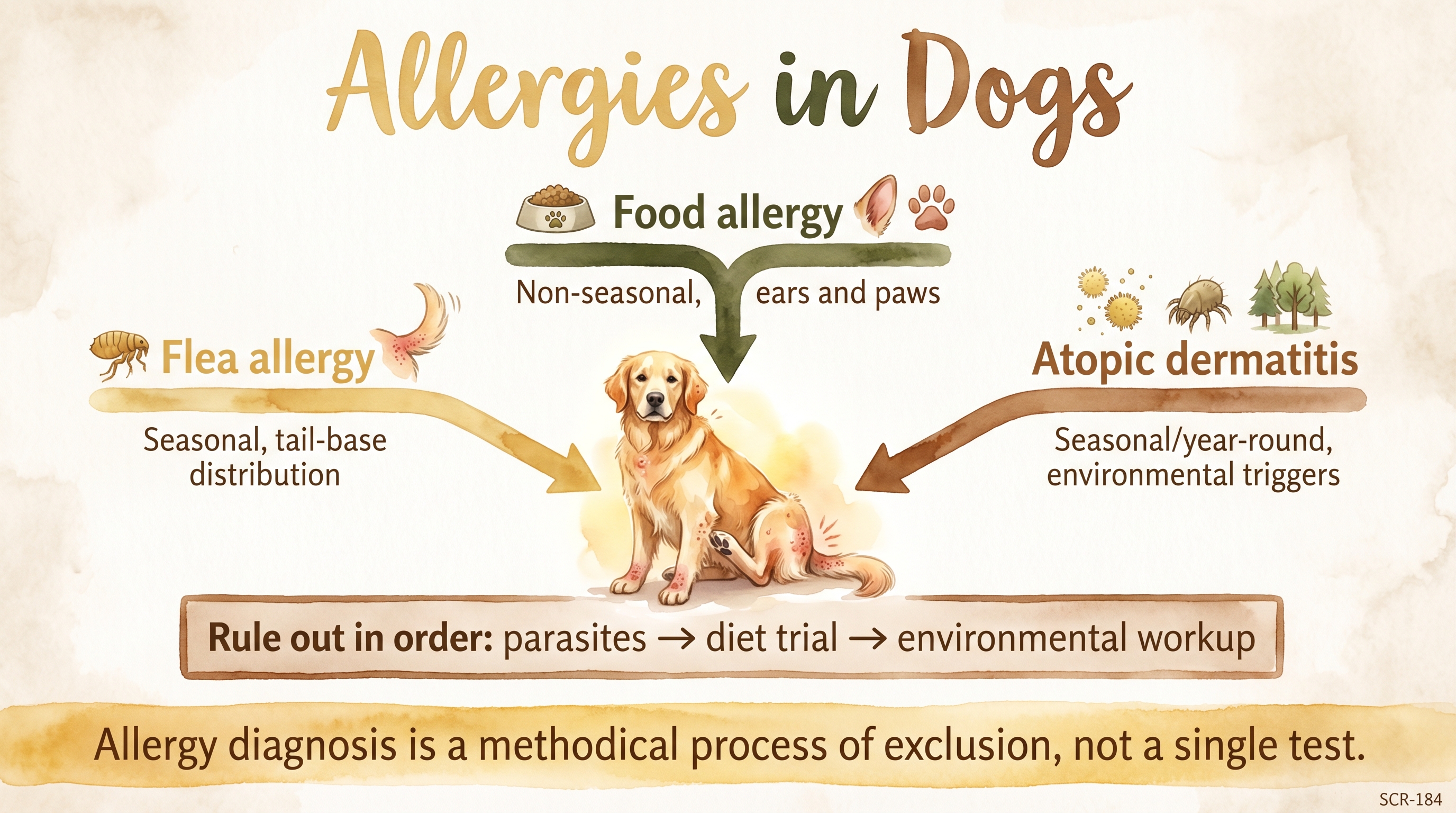
Allergy diagnosis is a methodical process of exclusion, not a single test.
Key Takeaways
- Most canine allergy discussions revolve around environmental atopy, food allergy, and flea allergy, and those categories can overlap.
- Goldens are a common chronic-itch breed, especially for paw chewing, recurrent ear disease, and hot spots.
- Food allergy is real but less common than families often assume, and diagnosis depends on a real diet trial rather than a casual food switch.
- Allergies are usually managed over time, not cured once, so pattern recognition and long-term planning matter more than one-off flare treatment.
The Evidence
This entry uses documented claim-level tags beyond the dedicated EvidenceBlocks below. These claims should remain tied to the entry Sources and SCR references during the next evidence-chain authoring pass.
This entry uses observed claim-level tags beyond the dedicated EvidenceBlocks below. These tags mark JB program observation or practice-derived claims that need dedicated EvidenceBlock coverage in a later content pass.
- Favrot et al. (2010)dogs
Provided a validated clinical framework for diagnosing canine atopic dermatitis based on body-site pattern, age of onset, and recurrence profile. - Canine dermatology consensus literaturedogs
Environmental atopy is the dominant chronic allergic skin condition in dogs and commonly underlies recurrent otitis and pyoderma. - Elimination-diet literaturedogs
Properly structured elimination or hydrolyzed-protein trials remain the gold standard for food-allergy diagnosis rather than serum panel shortcuts.
- Common puppy health source synthesisdogs
Golden Retrievers are a familiar atopy and recurrent-otitis breed in everyday practice, but exact prevalence varies by population and referral pattern. - Gut-immune literaturedogs and mammals
Immune and microbiome development plausibly shape allergy expression, but strong direct puppy-to-adult causal mapping remains more suggestive than settled in dogs.
- domestic dogs
No published study directly compares the most effective long-term management paths for allergies in dogs in dogs across breeds and ordinary home settings.
SCR References
Sources
- Favrot, C., Steffan, J., Seewald, W., & Picco, F. (2010). A prospective study on the clinical features of chronic canine atopic dermatitis and its diagnosis. Veterinary Dermatology, 21(1), 23-31. https://doi.org/10.1111/j.1365-3164.2009.00758.x
- Hensel, P., Santoro, D., Favrot, C., Hill, P., & Griffin, C. (2015). Canine atopic dermatitis: Detailed guidelines for diagnosis and allergen identification. BMC Veterinary Research, 11, 196. https://doi.org/10.1186/s12917-015-0515-5
- Olivry, T., Mueller, R. S., & Prelaud, P. (2015). Critically appraised topic on adverse food reactions of companion animals (1): Duration of elimination diets. BMC Veterinary Research, 11, 225. https://doi.org/10.1186/s12917-015-0541-3
- Mueller, R. S., Olivry, T., & Prelaud, P. (2016). Critically appraised topic on adverse food reactions of companion animals (2): Common food allergen sources in dogs and cats. BMC Veterinary Research, 12, 9. https://doi.org/10.1186/s12917-016-0633-8
- Olivry, T., & Mueller, R. S. (2018). Critically appraised topic on adverse food reactions of companion animals (5): Discrepancies between ingredients and labeling in commercial pet foods. BMC Veterinary Research, 14, 24. https://doi.org/10.1186/s12917-018-1346-y
- 2023 AAHA Management of Allergic Skin Diseases in Dogs and Cats Guidelines Task Force. (2023). 2023 AAHA management of allergic skin diseases in dogs and cats guidelines. Journal of the American Animal Hospital Association, 59(6), 255-284. https://doi.org/10.5326/JAAHA-MS-7396
- O'Neill, D. G., Volk, A. V., Soares, T., Church, D. B., & Brodbelt, D. C. (2021). Frequency and predisposing factors for canine otitis externa in the UK: A primary veterinary care epidemiological view. Canine Medicine and Genetics, 8, 7. https://doi.org/10.1186/s40575-021-00106-1