How to Read a Dog Food Label
Compound evidence detail2 SCRs / 4 parts
- DocumentedAAFCO ingredient definitions, named versus unnamed rendered-meal categories, and the pre-cook label-weight mechanic that separates transparency from simple quality ranking
- Observed-JBindustry-practice evidence that species-named meals can improve traceability for consistency, allergy management, and supply-chain review without proving nutritional superiority
- DocumentedAAFCO and FDA label-order rules plus the legal list effect by which related fractions can distribute one compositional category across multiple entries
- Heuristicthe family-facing label-reading approach that evaluates the first ingredient cluster collectively while avoiding any claim that splitting alone proves poor food quality
Most dog-food bags are designed to be read emotionally from the front and scientifically from the back. Families often stop at the front. That is understandable because the front panel is where the marketing story lives: ranch imagery, ingredient glamour, dramatic claims, and phrases that sound like quality. The back and side panels are where the useful regulatory information lives. Learning to read those sections calmly is one of the most protective skills a family can build. Documented
What It Means
A U.S. pet-food label contains several required elements that each answer a different question. The product name tells you what the brand wants you to notice first. The quantity statement tells you how much food is in the package. The guaranteed analysis provides legal minimum or maximum nutrient guarantees. The ingredient list shows ingredients in descending order by pre-cooking weight. Documented The nutritional adequacy statement tells you whether the food is complete and balanced for a life stage and how that claim was substantiated. The feeding directions suggest a starting portion. The manufacturer information tells you who is responsible for the product. The calorie statement tells you how much energy the food provides.
Once families understand that structure, labels stop feeling like one giant wall of text and start feeling like a sequence of interpretable signals. That matters because each part carries different strengths and weaknesses. Documented The calorie statement is often one of the most practically useful lines on the entire package. The front-panel meat image may be one of the least informative.
The Product Name Rules
The product name is heavily regulated by naming rules that many families have never heard of. Those rules matter because small wording differences can dramatically change how much of a named ingredient the food actually contains. Under common AAFCO naming conventions, a "95 percent rule" product with a simple name like "Beef Dog Food" is very different from a "25 percent rule" product named something like "Beef Dinner for Dogs." Documented The "with" rule lowers the threshold much further, and the "flavor" rule can require only enough ingredient-related material to justify flavor labeling.
This is one of the best examples of why label literacy matters. Families often read the biggest word on the front as though it directly describes the food's dominant composition. The actual naming convention may be far narrower. A product named "with beef" is not being held to the same composition expectation as one named simply "beef."
In practical terms, these naming rules can change the family's interpretation dramatically. A "Beef Dog Food" product is operating under a much stricter ingredient threshold than a "Beef Dinner," "Beef Recipe," or "Beef Entree" product. A "with beef" food can contain far less of the named ingredient than most families intuitively assume, and a "beef flavor" product may rely mainly on flavoring rather than meaningful ingredient presence. Families do not need to memorize every regulatory nuance, but they do benefit from knowing that the product name is not casual language. It is rule-bound language, and the rules are not always aligned with shopper intuition.
The Guaranteed Analysis
The guaranteed analysis is one of the most misunderstood parts of the label because families often treat it as though it were a complete nutritional report. It is not. In dog food, the guaranteed analysis usually includes minimum crude protein, minimum crude fat, maximum crude fiber, and maximum moisture. Observed-JB These numbers are legal guarantees, not a full nutrient profile and not exact measured values for the bag in hand.
The direction of those guarantees matters. Protein and fat are minimums. Fiber and moisture are maximums. That means the actual nutrient profile may differ from the printed figure. A food guaranteed to contain at least 26 percent protein may contain more. A canned food guaranteed at not more than 78 percent moisture may contain slightly less. This legal structure is useful, but it does not tell families everything they often want to know.
The other major limitation is basis of comparison. As-fed percentages cannot be compared fairly between foods with very different moisture levels. This is why canned food can look low in protein when compared directly to kibble, even if its dry-matter protein is respectable. Learning to think in dry-matter terms is one of the easiest ways to become a much better label reader.
The Ingredient List
The ingredient list is required to appear in descending order by weight before cooking. That last clause matters enormously. Fresh meat contains a great deal of water, which can make it appear impressively high on the list even when its dry contribution after processing is much smaller. Meanwhile, meat meals or dry ingredients may look lower despite being nutritionally dense once moisture is accounted for.
This does not make the ingredient list useless. It simply means the list cannot be interpreted naively. It is a helpful transparency tool, but not a direct nutritional ranking system. Families should also know that ingredient splitting can manipulate perception by breaking similar components into separate listed items, which may keep them below a meat ingredient individually even when their combined presence is substantial.
The Nutritional Adequacy Statement
The adequacy statement is usually the most important line on the label for daily-feeding decisions. This is where families learn whether the food is complete and balanced for growth, adult maintenance, all life stages, or intermittent or supplemental feeding only. It is also where the label reveals whether adequacy was substantiated by formulation to an AAFCO profile or by animal feeding tests conducted according to AAFCO procedures.
This single paragraph or sentence matters more than many flashy front-panel claims combined. A food can sound premium and still be intended only as a topper. A food can look plain and still be fully complete and balanced for the intended life stage. Owners who skip this line are often skipping the label's most consequential piece of information.
Manufacturer information deserves more attention too. Families should know who is actually responsible for the product and whether the company is identifiable and reachable. The quantity statement matters less emotionally, but it matters economically and for comparing value across package sizes. Even the feeding directions, which are only starting points, can tell families something about the calorie density and intended use of the food. A good label reader does not treat every line as equal in importance, but they do recognize that every line is there for a reason.
Feeding Directions and Calorie Statement
Feeding directions are starting points rather than perfect prescriptions. They are based on assumptions about body size, energy expenditure, and average need. They can be useful for orientation, but they should never override body condition and real-world monitoring. This is especially true in Goldens, where overfeeding is common and where life-stage energy needs can change quickly.
The calorie statement is often the most underrated line on the bag. It allows families to compare energy density across foods and to understand whether a portion change is actually a calorie change. Documented Without the calorie line, many families end up feeding by cup alone and are surprised when one food causes weight gain despite "the same amount."
Why It Matters for Your Dog
Label reading matters because it protects families from buying food based on the wrong variables. A bag can look beautiful and still be poorly matched to the dog's life stage or to the family's feeding goal. A less glamorous product can be much more appropriate once the adequacy statement, calorie line, and company transparency are taken seriously.
For Golden Retriever households, this skill is especially useful because Goldens are prone to exactly the kinds of feeding mistakes label literacy helps prevent. Puppy families need to spot the right growth language. Adult-dog families need to watch calories. Multi-dog families need to recognize when a topper is not actually a sole diet. Senior-dog families need to understand whether a soft food is complete or only supplemental. The label answers these questions if the family knows where to look.
Many nutrition problems begin in the shopping cart, not in the bowl. Reading the label well is a preventive act because it helps the family avoid buying a food that was never suited to the intended use in the first place.
Label reading also reduces susceptibility to fear-based marketing. When families know how naming rules, ingredient-order rules, and adequacy statements work, they are less likely to be manipulated by isolated front-panel words. They can appreciate ingredient quality without mistaking vocabulary for proof.
This page matters emotionally as well. Many families feel overwhelmed in the pet-food aisle because every bag claims to be premium in its own way. A real framework lowers that stress. The bag does not have to be read as an identity test. It can be read as a document.
The more technical the label becomes, the more helpful it is to slow down rather than skim. Families often want to decide on the basis of one fast impression, but many of the most protective label clues only appear once the bag is read line by line. Product-name rules, adequacy language, calorie density, ingredient-order limitations, and manufacturer information all work together. The better that reading habit becomes, the less often the family has to rely on retail persuasion or internet commentary to understand what they are buying.
There is also a simple order of operations that helps families in the aisle. First, read the adequacy statement and make sure the food is intended for the dog's life stage and role. Second, read the calorie content because cups and cans are not interchangeable units of energy. Third, scan the product name with the naming rules in mind so the front-panel ingredient emphasis is not overtrusted. Fourth, read the ingredient list with humility, remembering that fresh ingredient weight and splitting can distort quick impressions. Finally, ask whether the manufacturer seems like a company you can actually interrogate if needed. That five-step reading habit is far more protective than memorizing a single ingredient taboo.
The label also becomes more useful when the family separates the questions each part can answer. The guaranteed analysis helps with basic nutrient ranges. The adequacy statement answers the role question. The calorie line answers the portion math question. The product name answers the marketing-emphasis question. The ingredient list answers a limited visibility question. Confusion falls dramatically once families stop asking one line to do every job. In practice, this means a food can have an impressive front name and still fail the adequacy test, or have a plain ingredient list and still win the more important role, calorie, and company-transparency tests.
The label is therefore best read as a layered document rather than as one quick verdict. If the family remembers nothing else, they should remember this sequence: name language can mislead, ingredient order has limits, guaranteed analysis is partial, the adequacy statement is central, and calories matter for every feeding decision. That sequence alone is enough to make most families much safer shoppers than they were before.
That practical reading habit is one of the quietest advantages a family can build. It saves money, lowers anxiety, and reduces the odds of buying a food for the wrong reason. The label does not need to feel friendly to be useful. It only needs the family to know which lines deserve the most trust.
Once that reading habit is built, the bag becomes much less intimidating and much more honest.
Once families get used to this sequence, they rarely want to go back to shopping by front-panel emotion alone. The label stops being clutter and starts becoming one of the clearest sources of calm in a category that often feels noisy and manipulative.
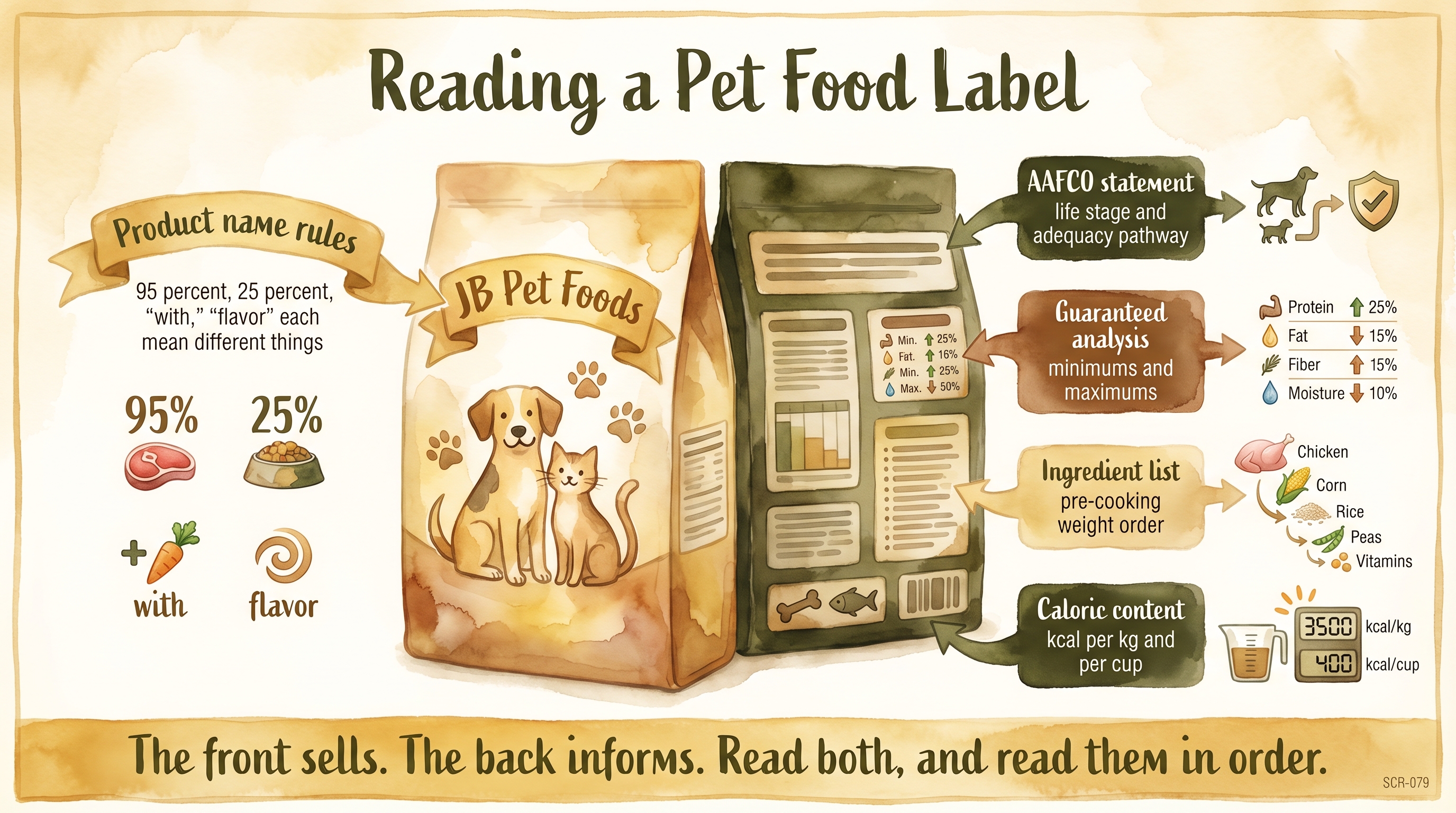
The front sells - the back informs - read both, and read them in order.
Key Takeaways
- The back and side panels of the bag usually contain the most useful information, especially the adequacy statement and calorie line.
- Product-name wording is regulated, so small changes like dinner, with, or flavor can significantly change what the front panel really means.
- The guaranteed analysis is a legal set of minimums and maximums, not a full nutrient report and not a direct dry-matter comparison tool.
- The adequacy statement is one of the most important lines on the package because it tells you whether the food is complete and balanced for the intended life stage.
The Evidence
This entry uses observed claim-level tags beyond the dedicated EvidenceBlocks below. These tags mark JB program observation or practice-derived claims that need dedicated EvidenceBlock coverage in a later content pass.
The label-reading evidence is strong because most of the key claims are regulatory rather than speculative. Naming rules are documented. Required label elements are documented. The ingredient-order rule is documented. The meaning of the adequacy statement is documented. The main challenge is not uncertainty about the rules. It is the gap between what the rules actually say and what families assume the label is saying.
That gap is why interpretation matters. The guaranteed analysis is legally meaningful but incomplete. The ingredient list is transparent but easy to overread. The product name is regulated but still vulnerable to family misunderstanding. The adequacy statement is usually the most useful line, but often the least glamorous one. In this sense, pet-food label reading is partly a science lesson and partly a literacy lesson.
- AAFCO model regulationsdog-food regulatory context
U.S. pet-food labels contain required elements including product name, guaranteed analysis, ingredient list, adequacy statement, feeding directions, manufacturer information, and calorie content statement. - Commercial regulation source synthesisdog-food labeling context
Naming conventions such as the 95 percent, 25 percent, with, and flavor rules shape how ingredient emphasis can appear on the package. - SCR-079 synthesisdog-food adequacy context
The nutritional adequacy statement is a central signal because it identifies life-stage suitability and substantiation pathway.
- Label interpretation synthesisdog-food consumer context
Ingredient order, guaranteed-analysis values, and front-panel emphasis can all be misread when families do not understand the rules behind them. - Calorie and dry-matter comparison practicedogs
Meaningful food comparison usually requires calorie awareness and, where moisture differs greatly, dry-matter conversion.
No published study directly tests the practical implications of how to read a dog food label for domestic dog raising programs. The application to household dog raising remains an interpretive synthesis rather than a directly tested intervention finding.
SCR References
Sources
- National Research Council. (2006). Nutrient Requirements of Dogs and Cats. Washington, DC: The National Academies Press.
- AAFCO. (2024). Official Publication. Association of American Feed Control Officials.
- U.S. Food and Drug Administration. (2014). Pet food labeling guide. FDA Center for Veterinary Medicine.
- WSAVA Global Nutrition Committee. (2011). WSAVA nutritional assessment guidelines. Journal of Small Animal Practice, 52(7), 385-396.
- FEDIAF. (2022). Nutritional Guidelines for Complete and Complementary Pet Food for Cats and Dogs. European Pet Food Industry Federation.