Extruded Kibble: How It Is Made and What the Evidence Says
Kibble is the food format most dog families rely on and the one most often spoken about with either lazy trust or sweeping contempt. Both reactions are too simple. Extruded dry food is an industrial format with real strengths, real compromises, and a quality spectrum wide enough that "kibble" alone tells you much less than people think. The job of this page is to explain how kibble is actually made, what extrusion changes nutritionally, what current dog-specific evidence says about those changes, and why a good kibble can still be a reasonable default food for many households. Documented
What It Means
Extruded kibble is made through a controlled manufacturing sequence designed to create a shelf-stable, calorie-dense, microbiologically safe food that can serve as a dog's complete daily diet. Although formulas differ, the broad process is consistent across manufacturers.
The first stage is ingredient preparation. Protein meals, grains or starch sources, fiber ingredients, fats, vitamin-mineral premixes, and flavor components are sourced, tested, and milled or ground to a consistent particle size. Fine grinding matters because extrusion works best when the mix hydrates and cooks evenly. Large variation in particle size can create inconsistent starch gelatinization, moisture distribution, and kibble shape.
The second stage is mixing and preconditioning. The dry ingredients are blended, then combined with water, steam, and sometimes liquid fats or palatants in a preconditioner. This starts the hydration and heating process before the mix enters the extruder barrel. Preconditioning is not just a convenience step. It helps soften starch granules, begin protein denaturation, and improve the efficiency of the main extrusion process. Documented
The third stage is extrusion itself. The hydrated mixture enters a pressurized barrel with rotating screws. Inside that barrel, heat, pressure, moisture, and shear forces transform the dough. When the mix exits through a die plate, the sudden pressure drop causes expansion and creates the familiar porous kibble structure. This is the decisive moment in kibble manufacture. It helps sterilize the product, gelatinize starches so they are more digestible, and create a dry food that can be stored for long periods. It is also the stage most responsible for the "ultra-processed" critique, because the food is being reshaped under substantial thermal and mechanical stress.
After extrusion, the kibble is dried to reduce moisture to a shelf-stable range, usually around the high single digits. It is then cooled and coated. The coating stage is where many dry foods receive added fats, flavor enhancers, digest palatants, and in some cases nutrients that are better added after heat processing. Packaging then protects the food from moisture, oxidation, and contamination during storage and transport.
This process became dominant in the mid-twentieth century for practical reasons that still matter today. Extruded kibble is efficient to ship, convenient to portion, easy to store, relatively affordable per calorie, and compatible with AAFCO profile-based formulation. It scales well for millions of dogs. That practical success is the main reason kibble became the modern default.
What Extrusion Changes Nutritionally
Extrusion is not nutritionally neutral. That point should be stated plainly. Heat and shear can reduce the availability of some nutrients, particularly certain vitamins and some amino-acid fractions. The Maillard reaction, which occurs when amino groups interact with reducing sugars during heating, is a major part of this story. In pet food, the best-known consequence is reduced reactive lysine availability. Laboratory total lysine may still look adequate while biologically available lysine is lower. That does not mean kibble is automatically deficient, but it does mean formulation has to account for processing losses rather than pretending they do not exist.
Vitamins are also affected. Heat-labile compounds such as some B vitamins and vitamin A can degrade during processing and storage. Manufacturers therefore formulate with anticipated losses in mind and often use premixes to restore the finished diet to target levels. Critics sometimes treat this as proof that kibble is artificial and therefore inferior. A more careful reading is that extrusion imposes a manufacturing burden that competent formulators have to manage. That burden is real. It is also the reason post-processing quality control and manufacturer competence matter so much in the dry-food category.
Taurine is another important point of family concern, especially in Golden Retriever circles because of the breed's place in diet-associated DCM discussions. Extrusion can affect sulfur amino acid handling and reactive amino-acid availability, but the current science does not support the claim that extrusion alone explains every cardiac concern in modern kibble. Diet-associated DCM remains a multifactorial and unresolved issue. Some implicated foods have been dry, some not, and the current evidence points more toward complex interactions involving ingredient profile, pulses, sulfur amino acids, digestibility, and individual dog susceptibility than toward a single simple "extrusion caused it" explanation.
At the same time, extrusion has benefits that families often overlook when reacting only to processing rhetoric. High heat and pressure are highly effective at reducing viable microbial burden. That makes extruded kibble dramatically safer from a foodborne-pathogen perspective than raw products. Extrusion also improves starch gelatinization, which generally increases digestibility of many carbohydrate sources and supports reliable manufacturing of complete diets. In other words, the same process that creates nutritional compromises also creates shelf stability, consistency, and pathogen control.
The Maillard and AGE Question
One of the most important adult discussions around kibble is the difference between "processing creates measurable compounds" and "those compounds are proven to cause disease in dogs at real-world feeding levels." Documented Advanced glycation end products, or AGEs, and Maillard reaction products are measurable in processed foods, including kibble. Some studies show diet-dependent biomarker differences in dogs fed differently processed foods. That makes it reasonable to say processing chemistry matters.
What it does not justify is skipping straight to the claim that kibble is therefore toxic. The long-term canine outcome literature is not strong enough to support that conclusion. Dog-specific evidence has not yet shown that a properly formulated, AAFCO-substantiated kibble predictably causes chronic disease independent of body condition, total diet pattern, or other confounders. The correct evidence posture is neither denial nor panic. It is acknowledgement of the processing effect without inflating it into a settled disease verdict.
Kibble Is a Category, Not a Quality Grade
One reason kibble arguments get muddy is that the category covers an enormous range of quality-control cultures and formulation quality. A budget grocery-store dry food built around aggressive cost control is not identical to a research-backed kibble made by a company with strong nutritional leadership, finished-product testing, feeding trials, and transparent manufacturing oversight. Documented Both are kibble, but they are not the same stewardship choice.
The category includes variation in who formulates the diet, how aggressively the company tests incoming ingredients, whether the food is feeding-trial substantiated or only profile formulated, whether the company owns its manufacturing plants or relies on co-packers, how carefully heat-sensitive nutrients are protected and restored, and how transparent the company is about nutrient analysis beyond the bag. Documented
This matters because people often attack or defend kibble as if every dry food were built to the same standard. They are not. A good kibble is usually good because the company has solved a long list of manufacturing and quality-control problems competently. A poor kibble is often poor because the company has not.
This is also where the family's selection work becomes more practical than ideological. When choosing a kibble, it is usually more useful to ask whether the company employs qualified nutrition leadership, controls its manufacturing carefully, provides meaningful nutrient data, and supports the food with either feeding trials or strong formulation and quality systems than to ask whether the bag uses emotionally attractive language. Observed-JB A kibble with ordinary-looking packaging but strong company answers is often the safer choice than a fashionable bag with beautiful ingredient language and thin technical support.
Families and caregivers also benefit from understanding why kibble remains so common in veterinary and breeder settings. It is not only because it is cheap or familiar. It is because kibble is portionable, stable across large production runs, and easy to integrate with calorie management in a way families can sustain. That does not make it perfect. It does help explain why the format persists even among people who are fully aware of its processing compromises. The practical strengths are not superficial. They are part of the format's real nutritional usefulness in everyday homes.
Why It Matters for Your Dog
For most families, kibble matters because it remains the most practical default. It is easy to measure, easy to store, easy to travel with, and usually the most affordable complete food by calorie. Those advantages are not morally shallow. They are part of what makes a feeding system sustainable over years rather than weeks.
That sustainability is particularly important in Golden Retriever homes. Goldens often need measured portions, stable body-condition management, and life-stage matching more than they need a dramatic feeding identity. A well-chosen kibble can make those jobs easier because calories are predictable, bags are standardized, and feeding routines fit ordinary family life. When families can weigh meals consistently, monitor stool quality, and adjust portions calmly, the food format is serving the dog well.
Kibble also matters because it is the easiest format to misuse through overgeneralization. Some families assume a kibble must be poor because it is dry and processed. Others assume any kibble is automatically safe because it says complete and balanced. The truth lives in between. Extruded dry food deserves more scrutiny than blind trust, but it also deserves more fairness than slogan-level dismissal.
The preventive value of kibble is often logistical. When a food is affordable, measurable, and easy to keep consistent, families are less likely to drift into chaotic switching, uncontrolled portions, or incomplete topper-based feeding that quietly destabilizes the dog's nutrition.
Another practical reason this page matters is that kibble often gets compared to boutique alternatives without a realistic household lens. A fresh subscription diet may be attractive, but if the family cannot sustain the monthly cost, freezer space, and travel complexity, the dog may end up cycling through half-committed feeding experiments. A strong kibble from a transparent manufacturer is often a better long-term answer than a more glamorous plan the household cannot maintain.
It is also worth noticing how often kibble becomes a proxy argument for broader family anxiety. People do not only ask whether kibble is nutritionally acceptable. They ask whether feeding kibble means they are settling, neglecting, or failing to love the dog properly. That emotional layer is what makes the category so charged. A calm evidence-based answer helps. Feeding a well-chosen kibble is not neglect. It is often a reasonable, responsible, and scientifically defensible choice.
Families should still read labels carefully, understand whether a kibble was feeding-trial substantiated or profile formulated, look for manufacturer transparency, and pay attention to the dog's response. Body condition, stool quality, coat, appetite, and clinical history still matter. The point is not that kibble deserves a free pass. The point is that kibble deserves evaluation on actual evidence and company competence, not on an internet purity scale.
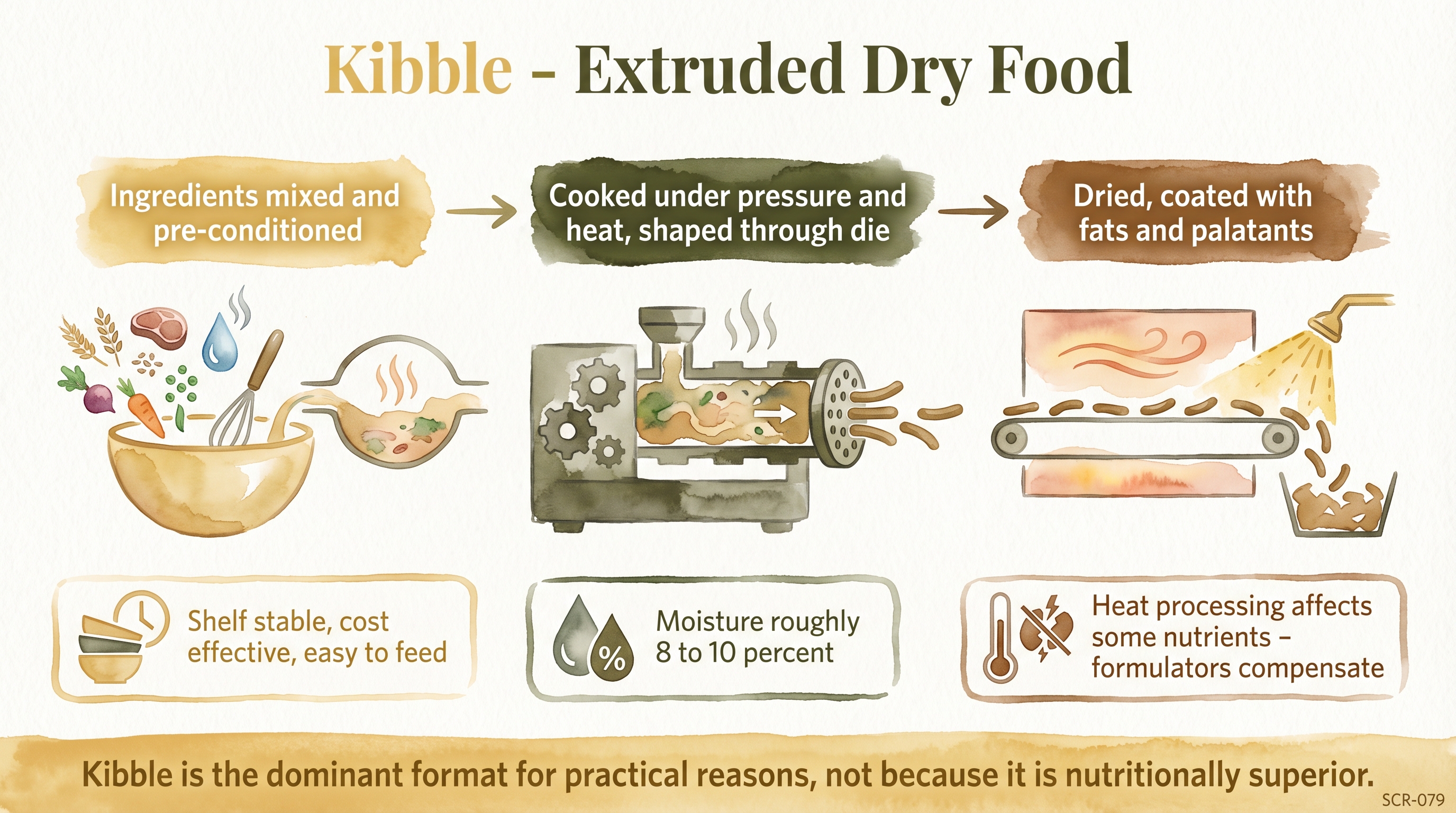
Kibble is the dominant format for practical reasons, not because it is nutritionally superior.
Key Takeaways
- Kibble is an industrial format with real strengths, including convenience, pathogen control, shelf stability, and affordability.
- Extrusion changes nutrients and can reduce the availability of some vitamins and amino acids, which is why competent formulation and quality control matter.
- The strongest evidence supports measured processing effects, not the sweeping claim that all kibble is harmful because it is ultra-processed.
- A good kibble from a transparent, well-run manufacturer can be a perfectly reasonable long-term default for many dogs and families.
The Evidence
This entry uses observed claim-level tags beyond the dedicated EvidenceBlocks below. These tags mark JB program observation or practice-derived claims that need dedicated EvidenceBlock coverage in a later content pass.
The evidence for kibble is best understood as a mixed profile with strong documented manufacturing facts and weaker long-term disease claims. It is documented that extrusion changes starch structure, vitamin stability, and amino-acid availability. It is documented that Maillard reactions can reduce reactive lysine. It is documented that extrusion also provides pathogen control, shelf stability, and high manufacturing consistency. It is documented that AAFCO-compliant kibble has supported the long-term feeding of enormous numbers of dogs.
The more controversial claims are narrower. It is plausible that heavy thermal processing carries biologically relevant costs. Studies of AGEs and other biomarkers justify that concern as a live scientific question. But current canine outcome literature does not establish that a good kibble is inherently harmful by virtue of being extruded. That is why JB's rhetorical ceiling must stay disciplined. We can say the process imposes compromises. We cannot say the process alone condemns the category.
The quality-control question is also supported more strongly than many families realize. Regulatory and recall history show that label compliance and formulation intent do not guarantee flawless finished products. Premix errors, manufacturing drift, storage issues, and nutrient variability can still matter. This does not uniquely indict kibble. It means kibble is safest when made by companies with robust formulation oversight, finished-product testing, and the willingness to answer hard questions.
One of the most useful ways to hold the category honestly is to keep both halves of the evidence in view at the same time. Kibble is industrially processed and therefore should not be romanticized as though the process were biologically invisible. Kibble is also one of the most successful, scalable, and practically manageable ways humans have developed to feed dogs complete diets consistently. The mistake is not in noticing either half. The mistake is in allowing one half to erase the other.
- Tran, Hendriks, & van der Poel (2008)pet-food manufacturing context
Extrusion alters nutrients through heat and shear, affecting starch gelatinization and some heat-sensitive nutrient fractions. - Buff et al. (2013)pet-food processing context
Maillard reaction chemistry in processed pet foods can reduce nutrient availability, especially reactive lysine, while also shaping palatability and color. - SCR-079 synthesisdog-food regulatory context
AAFCO complete-and-balanced status remains a meaningful minimum adequacy floor for kibble, though not proof of superiority or lifelong optimization.
- Comparative processing literaturedogs
Differently processed diets can produce different AGE and metabolite profiles, supporting the idea that processing matters biologically. - UPF boundary synthesisdogs
Dog-specific evidence does not currently prove that extruded kibble is inherently harmful independent of overall formulation quality, calorie management, and other confounders.
No published study directly tests the practical implications of extruded kibble: how it is made and what the evidence says for domestic dog raising programs. The application to household dog raising remains an interpretive synthesis rather than a directly tested intervention finding.
SCR References
Sources
- National Research Council. (2006). Nutrient Requirements of Dogs and Cats. Washington, DC: The National Academies Press.
- AAFCO. (2024). Official Publication. Association of American Feed Control Officials.
- Alvarenga, I. C., Aldrich, C. G., & Fritts, C. A. (2021). Extrusion processing modifications of a dog kibble at large scale alter levels of starch available to enzymatic digestion. Journal of Animal Science, 99(Supplement_2), 155-156.
- Buff, P. R., Carter, R. A., Bauer, J. E., & Kersey, J. H. (2013). The Maillard reaction and pet food processing: Effects on nutritive value and pet health. In Advances in Pet Food Technology (pp. 125-136). Woodhead Publishing Series in Food Science, Technology and Nutrition.
- Tran, Q. D., Hendriks, W. H., & van der Poel, A. F. B. (2008). Effects of extrusion processing on nutrients in dry pet food. Journal of the Science of Food and Agriculture, 88(9), 1495-1512.
- van Rooijen, C., Bosch, G., van der Poel, A. F. B., & Hendriks, W. H. (2013). The Maillard reaction during processing of pet food and its effects on nutrient availability. Nutrients, 4(12), 1936-1951.