Ingredient Splitting in Pet Food Labels
Compound evidence detail1 SCR / 2 parts
- DocumentedAAFCO and FDA label-order rules plus the legal list effect by which related fractions can distribute one compositional category across multiple entries
- Heuristicthe family-facing label-reading approach that evaluates the first ingredient cluster collectively while avoiding any claim that splitting alone proves poor food quality
Ingredient splitting is one of the clearest examples of how a label can follow the rules and still create a misleading first impression. It does not usually involve lying. It involves arranging legally distinct ingredients in a way that changes what the family thinks the formula is built around. Families who understand this tactic stop reading the ingredient list as a simple honesty test and start reading it as something that can be technically accurate while still being optimized for perception. Documented
What It Means
Pet-food ingredient lists are ordered by weight before cooking. That is the rule that makes ingredient splitting possible. If a manufacturer wants chicken to appear first on the list, it helps if any competing carbohydrate or plant-protein contributors are divided into separate named ingredients instead of appearing as one combined category. Documented
Corn is the classic example. A formula might contain ground yellow corn, corn gluten meal, and corn meal as separate listed ingredients. Each one individually may weigh less than the fresh chicken ingredient that sits first on the label. Combined, however, the total corn-derived contribution may exceed the chicken. The same idea applies with peas, where the list may include whole peas, pea protein, pea starch, pea flour, or pea fiber as separate entries. Documented The list is still accurate. The impression it creates is different from the formula's real compositional emphasis.
This matters even more once families realize how often split ingredients travel together in modern premium marketing. Observed-JB A label may present chicken first and then follow with several legume fractions or several grain fractions that look individually modest. The casual reader sees meat-first. The more careful reader sees a formula where plant-derived ingredients may still be carrying a large share of the structure, starch, or protein contribution. Ingredient splitting does not make the formula deceptive in a legal sense. It makes the label easier to overread in the company's preferred direction.
This is why ingredient splitting matters. It does not prove the food is poor. It does reveal that the label is being arranged for family psychology as well as for disclosure. In a category already crowded with front-panel storytelling, that is useful information.
Why It Is Legal
Ingredient splitting is legal because each listed component is, in fact, a distinct ingredient under the relevant definitions. Ground yellow corn and corn gluten meal are not chemically identical products. Pea fiber and pea protein are not the same manufacturing fraction. The label is not inventing ingredients. It is presenting real ingredients separately because they are genuinely separate ingredients.
That legal status matters because families sometimes hear about splitting and conclude the company is committing fraud. Documented That is not the right reading. A more accurate reading is that the company is using the labeling framework in a way that helps a desired marketing impression. The tactic is strategic rather than illegal.
Why Families Notice It So Often in Premium Marketing
Ingredient splitting is especially common in segments of the market where families are reading the first five ingredients as a proxy for quality. If a company knows that shoppers want to see a named meat first and dislike seeing grains or legumes dominate the visible list, splitting becomes an attractive tool. It allows the company to keep a stronger meat-first visual story even when plant ingredients contribute substantially to the formula.
This does not necessarily mean the nutritional profile is bad. A food can still meet adequacy targets and perform well in practice even if the list uses splitting. That is one of the most important discipline points in this page. Ingredient splitting is a transparency signal, not a total quality verdict. It tells you how the company wants you to see the formula. It does not, by itself, tell you whether the dog will thrive on the food. Documented
That is why the best use of ingredient splitting is comparative rather than absolute. If one company offers similarly adequate foods while speaking more plainly about ingredients and another seems to rely heavily on split fractions to protect a marketing impression, families have learned something meaningful about brand culture. Transparency is not the only virtue in pet food, but it is a real one.
Grain-Free and Legume Examples
The ingredient-splitting conversation became even more relevant during the grain-free era because many families wanted to see meat-first formulas and were less attentive to how heavily pulses or related fractions had entered the formula. A list containing peas, pea protein, pea starch, lentils, chickpeas, and similar fractions can create a very different nutritional picture from a list where those components are absent or less heavily emphasized.
This does not mean every formula with peas or lentils is problematic. It means families should not use the visual position of one meat ingredient on the list to conclude the food is obviously meat-dominant. Once a category is split into multiple fractions, the family's first glance becomes a less reliable guide.
What Ingredient Splitting Does and Does Not Tell You
Ingredient splitting does tell you that the company is comfortable optimizing the label for impression. It may also tell you that the company expects the family to read the list in a simplistic way. That is worth noticing, because brand culture matters.
Ingredient splitting does not tell you digestibility. It does not tell you amino-acid quality. It does not tell you manufacturer quality control. It does not tell you whether the food passed feeding trials. It does not tell you whether the dog in front of you will do well on it. Those are separate questions.
This is where families often make a mistake in the opposite direction. Once they learn about splitting, they may begin treating any split ingredient list as proof the food is automatically poor. That is still too simple. The healthiest interpretation is that ingredient splitting is a credibility and transparency signal, not a one-step verdict.
Why It Matters for Your Dog
This page matters because it teaches families not to overtrust ingredient-list theater. A company that relies heavily on splitting may still make an adequate food, but it is also showing the family how much it values label optics. That is useful context when comparing brands.
For Golden Retriever families, this matters especially in the premium-kibble shopping zone, where ingredient-first comparisons often dominate conversation. Owners may compare two dry foods and conclude that one is clearly more meat-based because chicken appears first. If the second or third through sixth ingredients are split plant fractions from the same crop, that conclusion may be far less solid than it first seemed.
Ingredient splitting does not force one answer. It forces a slower question. When the label seems engineered to create a certain impression, the family should look harder at adequacy, calorie density, company transparency, and why that impression had to be engineered in the first place.
This page also matters because it reduces the emotional force of simplistic retail advice. Families often hear "just read the first five ingredients" as though it were enough. Ingredient splitting is one reason that advice is weaker than it sounds. The first five ingredients can be real and still be rhetorically arranged.
It also helps families know what to do next instead of simply feeling tricked. Once splitting is spotted, the right response is usually not outrage. It is better questions. What is the calorie density? Who formulates the food? Is the product feeding-trial substantiated or only profile-formulated? How transparent is the company about nutrient analysis beyond the bag? Those questions move the family toward more reliable signals than ingredient-order theater alone.
Another reason this page matters is that it pushes families toward better metrics. Once ingredient splitting is understood, families tend to care more about WSAVA questions, AAFCO substantiation, calorie density, and the dog's actual response. That is exactly the right direction. The ingredient list is still worth reading, but it stops carrying a burden it was never designed to carry alone.
Families can often spot splitting once they learn the visual pattern. Several versions of peas clustered together, several corn fractions appearing separately, or multiple related starch ingredients sitting close together on the list should all trigger a second look. None of these patterns proves the diet is bad. They simply tell the family that the ingredient list is being shaped in a way that may flatter front-of-bag impression more than it clarifies true ingredient emphasis.
The best response is therefore neither outrage nor naivete. It is better comparison. Families who notice splitting can use that insight to reward companies that speak more plainly and to ask harder questions of those that do not. Over time, this becomes one of the most useful ways to move from ingredient obsession to ingredient literacy. The dog does not benefit from the family feeling scandalized. The dog benefits from the family reading the label more intelligently.
Some of the most trustworthy companies in the market still use ingredients that could be split, but they rely less heavily on the tactic as a way of selling the formula. That is why splitting is ultimately a culture clue as much as a label clue. A brand that assumes the family can handle a more honest ingredient story is often easier to trust than one that seems determined to engineer the first five ingredients into an emotional argument.
The strongest family takeaway is not to memorize every possible split ingredient combination. It is to keep the ingredient list in proportion. Once families know that splitting exists, they can stop using ingredient order as a simplistic scoreboard and start using it as one transparency signal among several. That is a much more stable way to shop.
Families therefore do not need to become suspicious of every ingredient list. They need to become suspicious of overly easy readings of ingredient lists. Once that shift happens, splitting becomes less of a scandal story and more of a maturity marker. The family has learned that the label can be technically true and still rhetorically shaped, and that awareness makes every other part of the buying process stronger.
That is a better outcome than memorizing one more ingredient villain.
That is ultimately why ingredient splitting belongs in the transparency conversation rather than the outrage conversation. It tells the family something about how hard the company is working to manage visual impression. Once that is noticed, the family is free to decide whether the rest of the brand earns trust anyway or whether the label culture itself is a reason to keep looking. Either way, the family is shopping with clearer eyes.
That shift in mindset is often enough to make the whole label far easier to interpret responsibly.
That is often the first step from ingredient anxiety toward actual ingredient judgment.
It is a small literacy gain, but it changes the whole way the ingredient panel gets read.
That single shift in reading posture is often enough to make the family a much harder target for superficial marketing.
That steadier reading style is what gives the concept its real usefulness. It does not tell the family whom to trust automatically. It helps them stop trusting too quickly.
That makes the concept less dramatic than people expect and more useful than they first realize.
And that is usually the real skill gain families were looking for in the first place.
Once they see that, the ingredient panel becomes much less easy to game in their mind.
That alone is a meaningful improvement.
So does skepticism.
That helps.
Awareness matters here.
It gives the family one more reason to compare formulas by what they truly emphasize rather than by what the first line of the panel seems to promise.
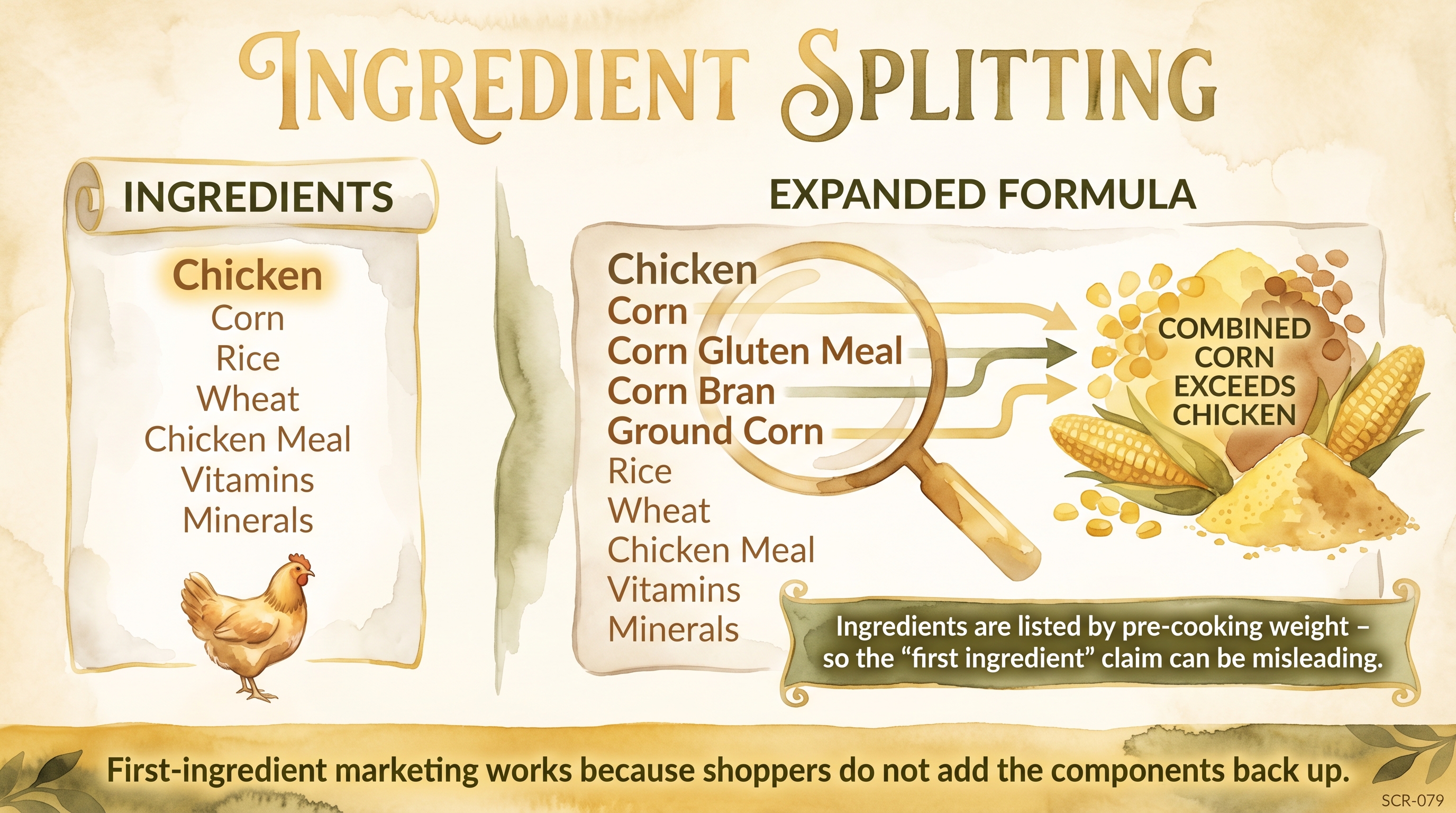
First-ingredient marketing works because shoppers do not add the components back up.
Key Takeaways
- Ingredient splitting works by listing multiple fractions of the same source ingredient separately so they look smaller individually than they are collectively.
- The practice is usually legal because the listed fractions are genuinely distinct ingredients under labeling rules.
- Splitting is best understood as a transparency signal, not automatic proof that the food is poor.
- Once families spot splitting, they should rely less on ingredient-list theater and more on adequacy, company transparency, and real-world feeding results.
The Evidence
This entry uses observed claim-level tags beyond the dedicated EvidenceBlocks below. These tags mark JB program observation or practice-derived claims that need dedicated EvidenceBlock coverage in a later content pass.
The evidence here is mostly regulatory and interpretive. It is documented that ingredients are listed by pre-cooking weight and that legally distinct fractions can appear separately. It is documented in practice that this creates the possibility of splitting. The broader family-facing claim, that splitting should be interpreted as a transparency signal, is a practical judgment built on that documented label structure.
That practical judgment is valuable precisely because it is modest. Ingredient splitting does not tell the family everything. It tells them enough to slow down. In a marketplace built to reward fast impressions, that slowdown is often the difference between being marketed to and actually evaluating the food.
That is why the page's rhetoric should remain measured. Ingredient splitting is real. It is relevant. It is not a magic decoder ring that automatically sorts good foods from bad foods. It is one useful clue inside a larger evaluation process.
- AAFCO-style ingredient-order ruledog-food labeling context
Ingredients are listed in descending order by weight before cooking, which allows separate fractions of the same source ingredient to appear independently. - Commercial regulation source synthesisdog-food consumer context
Manufacturers can legally list distinct fractions such as pea protein, pea fiber, or corn gluten meal separately even when they derive from the same broader source category.
- Label-interpretation synthesisdog-food consumer context
Ingredient splitting can change family perception of formula emphasis without changing the legal truth of the ingredient list. - Family selection frameworkdog-food consumer context
The main value of spotting splitting is as a transparency and marketing signal rather than as a standalone nutrition verdict.
No published study directly tests the practical implications of ingredient splitting in pet food labels for domestic dog raising programs. The application to household dog raising remains an interpretive synthesis rather than a directly tested intervention finding.
SCR References
Sources
- National Research Council. (2006). Nutrient Requirements of Dogs and Cats. Washington, DC: The National Academies Press.
- AAFCO. (2024). Official Publication. Association of American Feed Control Officials.
- U.S. Food and Drug Administration. (2014). Pet food labeling guide. FDA Center for Veterinary Medicine.
- WSAVA Global Nutrition Committee. (2011). WSAVA nutritional assessment guidelines. Journal of Small Animal Practice, 52(7), 385-396.
- FEDIAF. (2022). Nutritional Guidelines for Complete and Complementary Pet Food for Cats and Dogs. European Pet Food Industry Federation.