The Guaranteed Analysis: What Those Percentages Actually Mean
The guaranteed analysis is one of the most quoted parts of a dog-food label and one of the least understood. Owners compare protein percentages, fiber percentages, and fat percentages as though these numbers were a full nutritional truth. They are not. The guaranteed analysis is a legal disclosure tool that tells you certain minimums and maximums. It is useful, but only if you know what problem it is actually solving and what it cannot tell you. Documented
What It Means
On a typical U.S. dog-food label, the guaranteed analysis lists at least four nutrients: minimum crude protein, minimum crude fat, maximum crude fiber, and maximum moisture. Documented Some products also include voluntary guarantees for nutrients such as omega-3 fatty acids, glucosamine, taurine, or selected minerals, but those are not always required.
The first thing families need to understand is that the guaranteed analysis is directional. Protein and fat are minimum guarantees. Fiber and moisture are maximum guarantees. This means the numbers are legal bounds, not exact measured values for the bag in hand. A food guaranteed at minimum 26 percent protein may actually test above that. A canned food guaranteed at maximum 78 percent moisture may contain somewhat less water. The label is describing compliance limits, not precise nutritional reality.
The second major point is that the word crude is a laboratory term, not a quality insult. Crude protein is typically estimated from nitrogen content using a standard conversion factor. Crude fat reflects an extraction method. Crude fiber is a chemical-analysis category. These terms do not directly tell you digestibility, amino-acid balance, fatty-acid quality, or how useful the nutrient is once the dog eats it. They tell you something real, but they do not tell you everything families often assume they do.
This point is especially important with protein because many families treat the crude-protein number as though it were a full measure of biologically useful protein. It is not. Two foods can post similar crude-protein percentages while differing meaningfully in ingredient quality, amino-acid profile, or digestibility. The guaranteed analysis cannot settle those differences on its own. It is a screening tool, not a full nutritional biography of the food.
Why Moisture Changes Everything
The guaranteed analysis becomes especially easy to misuse when families compare foods with very different moisture contents. Kibble and canned food are the classic example. A kibble may list 26 percent protein and 10 percent moisture. Documented A canned food may list 8 percent protein and 78 percent moisture. Read quickly, the kibble looks far more protein-rich. In reality, much of that difference is simply water.
This is why dry-matter basis comparison exists. To compare the foods fairly, you remove the moisture mathematically and compare the nutrient content in the dry remainder. The math is not elegant, but the principle is simple. Nutrient percentage in the dry matter equals the listed nutrient percentage divided by the dry matter fraction of the food. If a kibble is 10 percent moisture, it is 90 percent dry matter. If it has 26 percent protein as-fed, then its dry-matter protein is about 28.9 percent. If a canned food is 78 percent moisture, it is 22 percent dry matter. If it lists 8 percent protein as-fed, its dry-matter protein is about 36.4 percent.
That example shocks many families the first time they see it because it reveals how badly moisture can distort intuitive comparison. It does not prove canned food is automatically better. It proves that as-fed percentages are not fair comparison tools across radically different moisture formats.
The same principle applies to fat and fiber comparisons as well. A wet food can look extremely low in fat or protein as-fed while actually being relatively rich once moisture is removed. This is why families comparing foods across formats should almost always do at least rough dry-matter correction before drawing strong conclusions from the printed percentages.
What the Guaranteed Analysis Does Well
The guaranteed analysis does several useful things. It gives families a quick window into the basic legal nutrient floor or ceiling of the food. It helps compare calorie-dense rich formulas with lighter ones when the foods are similar enough in moisture to make that comparison meaningful. It can help families spot obviously unusual products, such as extremely high-moisture or high-fiber formulas. It also creates enforceable accountability for certain nutrient claims.
This is not a trivial function. Without guaranteed analysis, labels would be even easier to market through vague language alone. The problem is not that the guaranteed analysis is useless. The problem is that it is often mistaken for a complete nutritional report.
What It Cannot Tell You
The guaranteed analysis does not tell you amino-acid quality. It does not tell you digestibility. It does not tell you bioavailability. It does not tell you whether the protein is highly usable or badly damaged by processing. It does not tell you who formulated the food, whether the diet passed a feeding trial, or whether the company has robust finished-product testing. It does not tell you the calorie density unless you also read the calorie statement. It does not tell you the actual amount of every micronutrient the dog needs.
This limitation matters because families often build a whole food judgment from these percentages alone. They assume higher protein equals better food, lower fiber equals better digestibility, or higher fat equals richer nourishment. Sometimes those instincts line up with useful observations. Often they do not. A food can have a dramatic crude-protein figure and still be a poor choice for the dog in front of the family. Another can have a modest-looking guaranteed analysis and still be excellent.
Why Voluntary Guarantees Need Caution
Some foods advertise voluntary guarantees for nutrients such as omega-3s, glucosamine, or probiotics. These can be informative, but they should be read carefully. A voluntary guarantee does not always tell you clinical significance, biological availability, or whether the dose meaningfully matches the claim implied by the front label. It tells you that the company is willing to legally guarantee at least or at most some amount. That is useful, but it is not the same as therapeutic validation.
Why It Matters for Your Dog
This page matters because guaranteed-analysis numbers often drive shopping decisions in ways that are both understandable and misleading. Families want a quick way to compare foods, and percentages feel objective. The trouble is that the numbers are only objective within the narrow legal framework they were built for.
For Golden Retriever families, this matters in several common situations. Families may compare puppy foods and fixate on protein percentage without noticing growth-profile fit or calorie density. Documented Adult-dog families may switch foods because one bag advertises lower fat without recognizing how the dog's body condition and total calories matter more than one isolated number. Senior-dog families may choose a canned food or therapeutic diet and panic when the protein looks low as-fed without converting for moisture first.
Many feeding mistakes come from comparing foods on the wrong basis. Dry-matter correction and calorie awareness prevent families from making confident decisions on numbers that were never meant to answer the question they are asking.
The guaranteed analysis also matters because it teaches humility about metrics. Metrics are useful. They are not total. A family that understands the limits of the guaranteed analysis is less likely to be dazzled by one dramatic protein number or frightened by one low moisture-adjusted percentage taken out of context.
Another practical reason this page matters is that it helps families ask better follow-up questions. Once a family understands that crude protein is not the same thing as digestible protein, or that as-fed percentages can be moisture-distorted, they are much more likely to care about who formulated the diet, how it was substantiated, and how calorie-dense it actually is. That is a healthier direction for the feeding conversation.
Voluntary guarantees belong in that same follow-up mindset. If a bag highlights omega-3s, glucosamine, or other extras, the family should ask not only whether the nutrient appears on the label, but whether the guaranteed amount is meaningful, whether the source is clear, and whether the claim is relevant to the actual reason the food is being chosen. Heuristic The guaranteed analysis can start smarter questions. It should not end them.
The guaranteed analysis is often most useful when comparing foods within the same format rather than across radically different ones. Two dry foods can often be compared more sensibly on the printed percentages than a dry food and a canned food can. Even then, the family still has to remember that guaranteed values are floors and ceilings rather than exact means. A food guaranteed at minimum 14 percent fat and another at minimum 18 percent fat may differ in actual tested fat content by more or less than the printed numbers suggest. Documented The line is informative. It is not a full laboratory report.
This is also why families should not confuse bigger numbers with better feeding automatically. A high crude-protein guarantee can look impressive and still be irrelevant if the dog does not need the energy density, if the calorie content is excessive for the household's portion control, or if the company behind the number is opaque about everything else. The guaranteed analysis is most protective when it prompts proportionate interpretation. Families should care about the numbers. They should simply care about them in the right order and on the right basis.
The guaranteed analysis also works best when paired with calorie density. A food can look moderate in fat and still deliver a great deal of energy per cup or per can. Another can look very rich on paper but be used in smaller portions because the overall formula is more concentrated. This is why families who want the most practical label skill should learn to read guaranteed analysis and calorie line together rather than relying on either one in isolation.
That pairing is especially useful in real-world weight management. Many owners are surprised to learn that their new "healthier" food has significantly more calories per cup than the previous one. The guaranteed analysis did not necessarily mislead them. They simply asked it a question it was never designed to answer alone. Calorie density is the missing half of many feeding comparisons.
Once owners understand these limits, the guaranteed analysis becomes more useful rather than less. It stops being a false final answer and starts becoming a smart first screen. That is the healthiest way to use it. Read it carefully, correct for moisture when necessary, pair it with calories and adequacy language, and then let it feed a broader evaluation rather than pretending the percentages alone have solved the whole decision.
Used that way, the guaranteed analysis becomes less seductive and much more useful.
That broader reading habit is what turns the guaranteed analysis into a strength instead of a trap. The numbers still matter. They simply matter most when families know what kind of truth they are reading: a bounded legal disclosure, not a total nutritional verdict. That distinction is the difference between using the analysis wisely and giving it more authority than it was ever meant to carry.
That small shift in reading style makes the numbers far less misleading and far more practical.
That is the level of authority the guaranteed analysis was built to hold, and it serves families best when it is kept at exactly that level.
That is why experienced label readers rarely stop at the percentages. They use them as a starting coordinate and then keep moving through the rest of the label.
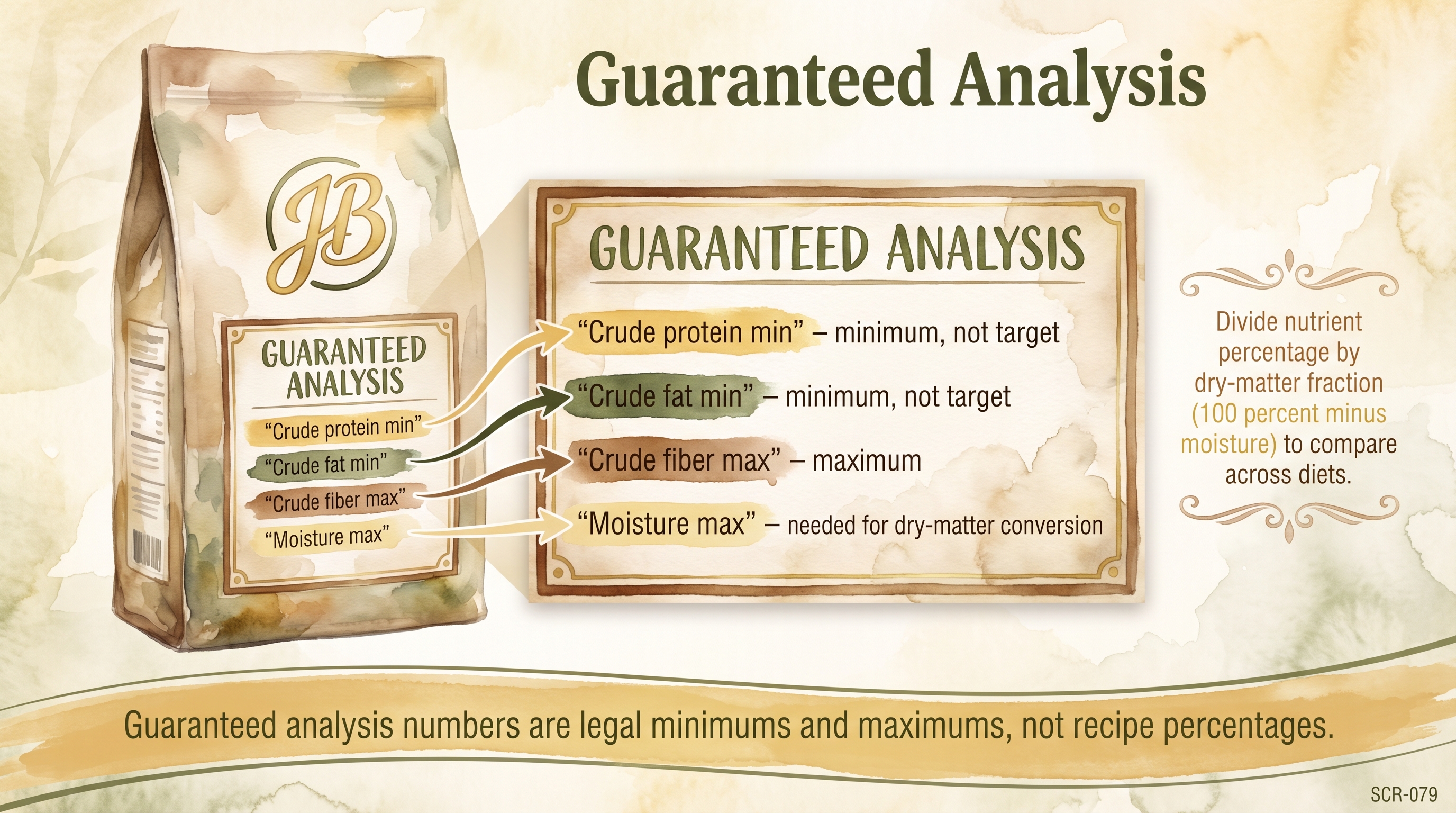
Guaranteed analysis numbers are legal minimums and maximums, not recipe percentages.
Key Takeaways
- The guaranteed analysis gives legal minimums and maximums, not precise nutrient totals for the exact bag in front of you.
- Crude nutrient terms are analytical labels, not full judgments of quality or digestibility.
- As-fed percentages can badly mislead when moisture differs greatly, which is why canned and dry foods should be compared on a dry-matter basis.
- The guaranteed analysis is useful, but only as one part of a larger label-reading and food-selection process.
The Evidence
This entry uses heuristic claim-level tags beyond the dedicated EvidenceBlocks below. These tags mark JB interpretive application rather than direct study findings.
The science and regulation around guaranteed analysis are quite stable. The legal structure of minimums and maximums is documented. The crude nutrient categories are documented. Dry-matter conversion is straightforward arithmetic, not a disputed theory. The confusion enters when families ask the guaranteed analysis to do jobs it was never designed to do, such as determining total food quality or predicting clinical response.
In that sense, the guaranteed analysis is best understood as necessary but incomplete. It is one piece of the label, not the whole interpretation. It helps most when combined with the adequacy statement, calorie content, ingredient-list literacy, and company-level evaluation.
That combination is what protects families from number-driven overconfidence. The guaranteed analysis is useful because it offers real, enforceable disclosure. It becomes risky only when it is mistaken for a complete answer. The healthiest reading is to value the numbers, understand their limits, and then move outward into the broader label and manufacturer picture.
- AAFCO labeling frameworkdog-food regulatory context
The guaranteed analysis provides legal minimums and maximums for specified nutrients, not exact measured values or a full nutrient audit. - Commercial regulation source synthesisdog-food consumer context
Crude nutrient figures describe analytical categories and must be interpreted carefully, especially across foods with different moisture levels. - Dry-matter comparison practicedogs
Fair comparison between canned and dry foods requires correcting for moisture rather than comparing as-fed percentages directly.
- Label-reading synthesisdog-food consumer context
Guaranteed-analysis values help with basic screening but do not by themselves reveal digestibility, bioavailability, or long-term food quality. - SCR-079 synthesisdog-food adequacy context
Minimum adequacy and regulatory disclosure are meaningful floors, but they are not total quality judgments.
No published study directly tests the practical implications of the guaranteed analysis: what those percentages actually mean for domestic dog raising programs. The application to household dog raising remains an interpretive synthesis rather than a directly tested intervention finding.
SCR References
Sources
- National Research Council. (2006). Nutrient Requirements of Dogs and Cats. Washington, DC: The National Academies Press.
- AAFCO. (2024). Official Publication. Association of American Feed Control Officials.
- U.S. Food and Drug Administration. (2014). Pet food labeling guide. FDA Center for Veterinary Medicine.
- FEDIAF. (2022). Nutritional Guidelines for Complete and Complementary Pet Food for Cats and Dogs. European Pet Food Industry Federation.
- WSAVA Global Nutrition Committee. (2011). WSAVA nutritional assessment guidelines. Journal of Small Animal Practice, 52(7), 385-396.