AAFCO Feeding Trials vs Formulation Substantiation
One of the most important lines on a dog-food label is also one of the easiest to miss: the part that tells you how the company substantiated the food's nutritional adequacy. This is where the label reveals whether the diet was formulated to meet an AAFCO nutrient profile or whether animal feeding tests were conducted according to AAFCO procedures. Families often hear these phrases and assume one is obviously rigorous while the other is worthless. The reality is more nuanced. Feeding trials are stronger evidence than profile-only formulation in some respects, but they are still minimum standards rather than lifelong health demonstrations. Documented
What It Means
AAFCO recognizes two main pathways by which a manufacturer can support a complete-and-balanced claim for a given life stage. Documented The first is formulation to the appropriate nutrient profile. The second is substantiation through animal feeding tests conducted according to AAFCO procedures.
The formulation pathway means the company has calculated or analyzed the food so that it meets the nutrient profile specified for the intended life stage. This is the more common route in the marketplace because it is faster, cheaper, and more scalable. It allows companies to formulate a recipe on paper and through nutrient analysis so that the finished food is expected to provide the minimum required nutrient levels, subject to the model profile and any relevant maximums.
The feeding-trial pathway adds an empirical layer. Instead of relying only on formulation math, the manufacturer feeds the food to live dogs according to an AAFCO protocol and monitors whether the food supports the required minimal outcomes over the test period. In adult maintenance, that typically means a minimum starting cohort of eight healthy adult dogs, a 26-week duration, weekly body-weight monitoring, and a limited set of blood parameters at the conclusion of the trial.
Those details are worth slowing down for because they show both why feeding trials matter and why they should not be mythologized. A live-dog feeding protocol is meaningfully stronger than a paper formulation alone. At the same time, a trial built around eight dogs over roughly six months is not the same thing as a lifelong, breed-diverse, disease-sensitive outcome study. Estimated Families who understand both sides of that point are much less likely to overread the label language.
What the Formulation Pathway Actually Tells You
The formulation pathway tells you that the food, as designed and measured, meets the AAFCO nutrient profile for the intended life stage. Documented That is not a meaningless result. It means the company has done the work to ensure the diet reaches a baseline adequacy floor. For many foods in the market, this pathway is entirely legitimate and is how a large proportion of commercially successful products are substantiated.
What formulation does not automatically tell you is how the food performs in living dogs over time. It does not by itself prove digestibility, palatability, long-term stability, or batch-to-batch execution under real feeding conditions. It also does not eliminate the possibility that processing will change the biological availability of a nutrient that looked adequate in laboratory calculation or assay. Documented
That limitation becomes clearer when families remember that nutrient adequacy on paper is not the same thing as nutrient delivery in the finished food matrix. Heat damage, ingredient variability, storage conditions, and manufacturing execution can all influence what the dog actually receives. None of this means profile-formulated foods are suspect by default. It means the pathway should be respected for what it is and not treated as though it had already answered every biologic question.
This is why families should think of formulation as a real floor rather than as a full seal of excellence. It matters, but it does not answer every question an owner may reasonably have.
What the Feeding-Trial Pathway Actually Tells You
Feeding trials are often described as the gold standard, and in one sense that phrase is fair. A food that has actually maintained a group of dogs under a defined protocol has passed a stronger test than a food validated only by formulation math. It has shown that living animals could eat the food as a sole nutritional source for the defined period without failing the limited trial criteria.
That said, the feeding trial is still a minimal screen rather than a sweeping verdict on lifelong optimality. The adult-maintenance protocol is relatively short at 26 weeks. The cohort is small. The measured endpoints are limited. The trial is not designed to detect rare adverse outcomes, subtle long-term physiologic costs, breed-specific vulnerabilities, or the kinds of slow-developing diseases that arise after years rather than months.
The trial design details help explain this clearly. Adult-maintenance testing centers on survival and basic stability, not on comprehensive wellness profiling. Dogs are weighed, examined, and evaluated with a narrow bloodwork panel rather than with broad long-term disease surveillance. There are also practical allowances in the protocol around removals and pass criteria that reinforce the point that this is a minimum adequacy screen, not a search for the single best food in the world.
This is the crucial discipline point. Feeding trials are better evidence than formulation alone when all else is equal. They are not proof that the food is perfect, universally optimal, or superior in every way to a profile-formulated diet from a strong manufacturer.
Why the Distinction Matters More in Some Contexts
The feeding-trial versus formulation distinction matters most when stakes are high. Growth and reproduction diets involve active developmental biology, which means mistakes can matter more quickly and more permanently. A company willing to support growth diets with stronger evidence may deserve special respect for that choice.
In adult healthy dogs, the distinction still matters, but not always enough to overturn every other variable. A thoughtfully formulated diet from a transparent company with strong quality control may still be a better practical choice than a trial-backed product from a company the family cannot sustain or trust for other reasons. The substantiation pathway is one important signal, not the only one.
Why Families Misread the Label Language
Many families misread "formulated to meet" as if it meant the diet had never touched a real dog. That is not the right inference. It means the adequacy claim rests on nutrient-profile compliance rather than the formal feeding-trial protocol. Likewise, many families misread a feeding-trial claim as if it proved the food had been validated over years of diverse breed use in thousands of dogs. That also is not correct.
This is why a calm explanation matters. The label language is technical, but the family-facing takeaway is manageable. Formulation means the food meets a defined nutrient floor. Feeding trials mean the food also passed a live-dog minimum screen. Both are legitimate. Feeding trials are stronger. Neither replaces the need for manufacturer quality, life-stage matching, and body-condition monitoring.
Why It Matters for Your Dog
This distinction matters because it changes how confidently a family should read a food's adequacy claim. A complete-and-balanced statement is important, but not all complete-and-balanced claims rest on identical evidence paths. Understanding the difference helps families ask better questions instead of treating the label as all-or-nothing.
For Golden Retriever families, this is especially relevant during puppyhood, when growth diets are doing real developmental work. A food selected for a growing large-breed dog should be evaluated with more care than a casual adult-maintenance choice for a healthy mature dog. The family's job is not to become a regulatory specialist. It is to notice when the evidence floor under the food is thinner or stronger.
Better evidence does not eliminate the need for observation, but it changes what the family is starting with. The more developmentally important the feeding decision, the more useful it is to know whether the food was only formulated on paper or also tested in live dogs under an adequacy protocol.
This page also matters because it protects families from false certainty in both directions. Some owners dismiss profile-formulated foods too aggressively, as though they are barely legitimate. Others inflate feeding trials into proof of comprehensive nutritional excellence. The truth sits in the middle. The trial is a stronger evidentiary step. It is still a modest step compared with the questions owners sometimes want it to answer.
For families, the cleanest practical conclusion is simple. If a food is feeding-trial substantiated, that is a real positive signal. If a food is only profile-formulated, that is still a legitimate starting floor, especially if the company is otherwise strong and transparent. The goal is not to sort every food into heroes and villains. The goal is to understand what level of evidence is actually sitting under the label.
Another reason this page matters is that it points families back toward company quality. A food can pass a feeding trial and still be vulnerable to later manufacturing problems if quality control is weak. Documented A profile-formulated food can perform beautifully if the company has strong formulation expertise, finished-product testing, and manufacturing oversight. The substantiation pathway matters, but it lives inside a larger system.
The pass criteria help explain why feeding trials should be respected but not romanticized. The protocol is built to detect obvious failure to maintain dogs through the trial window, not to survey the full horizon of canine health. Body weight and a narrow blood panel can catch some meaningful problems, but they are not designed to reveal every subtle nutrient issue, every breed-specific vulnerability, or every slow cumulative harm. This does not make the trial weak. It defines what kind of strength it actually has.
For families, the cleanest practical ranking is usually this: a strong company with feeding-trial-supported foods is offering a genuinely positive signal; a strong company using profile formulation transparently is still offering a legitimate adequacy floor; a weak or opaque company is not rescued simply because the food sounds premium. Once owners see the substantiation pathway as one important layer in a wider system, they usually make more balanced decisions than owners who treat the label language as either everything or nothing.
The distinction also matters because it shapes how owners hear the phrase complete and balanced. When that phrase sits on a feeding-trial-supported label, it rests on one kind of evidentiary floor. When it sits on a profile-formulated label, it rests on another. Both are real. They are simply not identical. Families who understand this are less likely to either idealize one route blindly or dismiss the other unfairly.
Another useful family-level point is that companies willing to discuss exactly how their foods are substantiated usually inspire more justified trust than companies that use adequacy language vaguely. Transparency about the pathway is itself a quality signal because it shows the manufacturer expects informed questions rather than only impulse buying.
This is why the feeding-trial phrase is best read as a meaningful plus sign rather than as an ending point. It tells the family that the company invested in a stronger adequacy pathway. It does not remove the need to ask whether the food is still right for this dog, whether the company manages manufacturing well, and whether the broader feeding plan is actually working in practice. Good label literacy keeps all of those layers visible at once.
That is enough to matter in a buying decision. It is simply not enough to end the conversation.
In practical family terms, this means the feeding-trial phrase should raise confidence without ending judgment. It is one of the best label signals available, especially when the dog is young or medically vulnerable, but it still belongs inside a larger conversation about manufacturer quality, product fit, and whether the dog is actually doing well on the food over time.
That clearer reading is usually enough to keep the label from being either overpraised or unfairly dismissed.
Once owners understand that scope correctly, the feeding-trial label becomes genuinely useful. It says more than a pure paper formulation, but much less than a lifetime guarantee. That middle reading is exactly the one that helps most in real food selection.
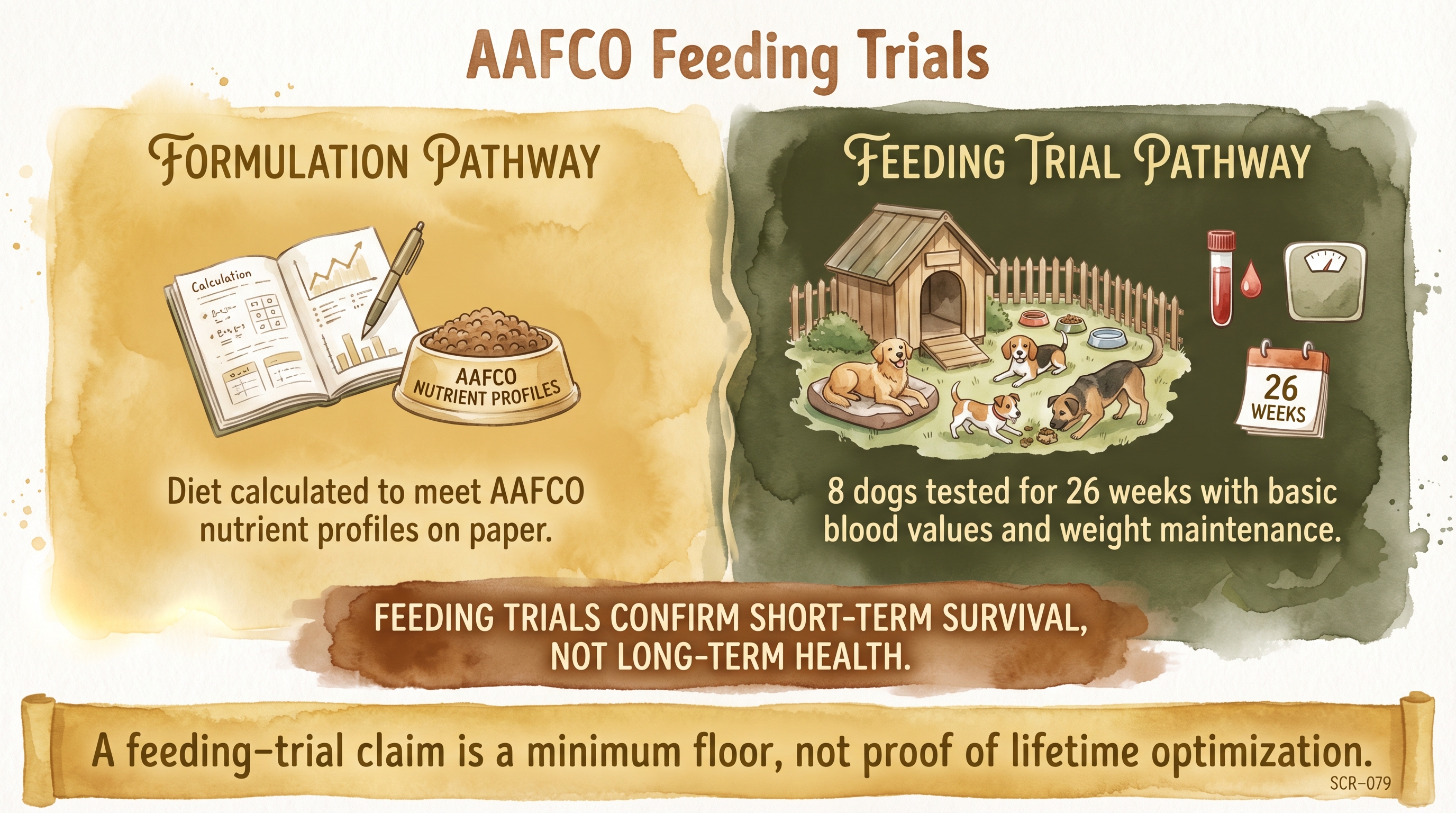
A feeding-trial claim is a minimum floor, not proof of lifetime optimization.
Key Takeaways
- AAFCO complete-and-balanced claims can be supported either by profile-based formulation or by animal feeding tests conducted according to AAFCO procedures.
- Feeding trials provide stronger evidence than formulation alone, but they are still short, small, and limited minimum standards rather than lifelong health studies.
- The distinction matters most in higher-stakes contexts such as growth and reproduction, where developmental outcomes carry more weight.
- Families should use the substantiation pathway as one important signal, not as the only signal, when evaluating a food.
The Evidence
This entry uses estimated claim-level tags beyond the dedicated EvidenceBlocks below. These tags mark approximate ranges or timing claims that should remain bounded by the cited sources.
The evidence here is largely regulatory and therefore relatively stable. It is documented that AAFCO recognizes both formulation and feeding-trial substantiation pathways. It is documented that adult-maintenance feeding trials are short, small, and limited in their measured outcomes. It is documented that these methods are designed as minimum standards, not comprehensive long-term health studies.
The strongest interpretive point flowing from that evidence is SCR-079's central idea: adequacy is a floor, not a proof of superiority. Feeding trials raise the floor more than formulation alone, but they still do not transform a commercial food into a lifelong optimality guarantee. That is the most important family-level takeaway from the entire discussion.
- AAFCO methods for substantiating nutritional adequacydog-food regulatory context
AAFCO recognizes profile-based formulation and animal feeding tests as the two main adequacy substantiation pathways. - Commercial regulation source synthesisdog-food regulatory context
Adult-maintenance feeding trials are limited by short duration, small cohort size, and narrow endpoints, making them stronger than formulation alone but still minimal. - SCR-079 synthesisdog-food adequacy context
Neither adequacy pathway proves long-term nutritional optimality or product superiority beyond the minimum claim being substantiated.
- Selection-framework synthesisdog-food consumer context
Feeding-trial support is a valuable positive signal, especially in higher-stakes life stages, but should be interpreted alongside manufacturer transparency and product fit. - Quality-control boundary synthesisdog-food manufacturing context
A stronger substantiation pathway does not replace the need for competent manufacturing and finished-product quality control.
No published study directly tests the practical implications of aafco feeding trials vs formulation substantiation for domestic dog raising programs. The application to household dog raising remains an interpretive synthesis rather than a directly tested intervention finding.
SCR References
Sources
- Association of American Feed Control Officials (AAFCO). (2024). Official Publication. Association of American Feed Control Officials.
- National Research Council. (2006). Nutrient Requirements of Dogs and Cats. Washington, DC: The National Academies Press.
- U.S. Food and Drug Administration. (2014). Pet food labeling guide. FDA Center for Veterinary Medicine.
- WSAVA Global Nutrition Committee. (2011). WSAVA nutritional assessment guidelines. Journal of Small Animal Practice, 52(7), 385-396.
- FEDIAF. (2022). Nutritional Guidelines for Complete and Complementary Pet Food for Cats and Dogs. European Pet Food Industry Federation.