Named vs Unnamed Meat Meals in Dog Food
Compound evidence detail1 SCR / 2 parts
- DocumentedAAFCO ingredient definitions, named versus unnamed rendered-meal categories, and the pre-cook label-weight mechanic that separates transparency from simple quality ranking
- Observed-JBindustry-practice evidence that species-named meals can improve traceability for consistency, allergy management, and supply-chain review without proving nutritional superiority
Few label words create more family confusion than meat meal. Some families read the word meal and assume it means low-quality filler. Others hear premium marketing attack unnamed meals and conclude every rendered ingredient is suspect. Both reactions miss the real question. The important distinction is not simply meal versus no meal. It is named versus unnamed, traceable versus vague, and transparent versus opaque. Documented
What It Means
Meat meal is a rendered ingredient. Rendering removes much of the water and fat from animal tissues, leaving a concentrated protein-and-mineral ingredient that can be used efficiently in dry-food manufacturing. Because moisture has already been removed, a meat meal often contributes substantial nutrient density compared with a fresh-meat ingredient that brings much more water into the formulation. Observed-JB
This alone should correct one major misunderstanding. A meat meal is not automatically a lower-value ingredient than fresh meat. In many kibble formulas, a named meat meal is nutritionally dense and functionally useful. The problem is not rendering itself. The problem is how clearly the source is defined.
A named meat meal identifies the species. Chicken meal, lamb meal, salmon meal, and turkey meal tell the buyer what animal the ingredient came from. That does not guarantee perfection, but it does create a clearer traceability story. The buyer knows what species the ingredient is supposed to represent.
An unnamed meat meal is more opaque. Terms such as meat meal, poultry meal, or animal by-product meal may involve broader source pools or less species-specific traceability. They can still be legally compliant ingredients. The issue is not that they are illegal. The issue is that the family has less information and less supply-chain clarity.
That loss of clarity matters most when the family actually needs specificity. A family managing a suspected food sensitivity, trialing a limited-ingredient approach, or simply trying to understand what the dog is repeatedly eating benefits from knowing the species involved. Documented Vague animal-source language may still be nutritionally workable, but it gives the family a weaker map of the ingredient stream.
Why Named Meals Usually Signal Better Transparency
Named meals are often preferred because they imply stronger ingredient specification and better source control. A company willing to name the species is usually telling you something about how the ingredient stream is organized. It may also be more relevant for dogs on elimination-style diets or for families trying to avoid poorly defined mixed-source ingredients. Heuristic
This preference for named meals is not merely cosmetic. Source clarity matters in nutrition. It matters for families managing suspected sensitivities. It matters for trust in the label. It matters for traceability if a problem arises. A named ingredient is simply easier to interrogate than a vague one.
It is also worth separating named meals from the broader fear of organ or by-product content. Dogs are not nutritionally best served by being fed only ingredients that flatter human culinary taste. Organ tissues can be highly nutritious. The more important question is whether the ingredient stream is well controlled and clearly identified, not whether it reads like a human dinner menu. Named meals help the family ask that better question.
That said, named does not automatically mean excellent. A named meal from a poorly managed supply chain can still be mediocre. An unnamed ingredient in a generally strong, transparent formulation may still be legally compliant and functionally useful. The named-versus-unnamed distinction is an important signal, not an all-purpose verdict.
Rendering and the By-Product Problem
Many families react strongly to the idea of rendering because it sounds industrial and because by-product language is often used in marketing as shorthand for waste. The reality is more complicated. Rendering is a legitimate industrial process used to stabilize animal materials, improve transport efficiency, and create concentrated ingredients for feed systems. It is not inherently a sign of poor nutrition.
The same applies to by-products. Organ tissues from the same species can be nutritionally valuable and in some cases richer in certain nutrients than skeletal muscle. The problem is not that an ingredient is not a boneless human-style chicken breast. The problem is that vague categories reduce the family's ability to know what the company is actually using and how consistently it is controlling that source.
This is why good label reading requires nuance. Families should not romanticize fresh meat and automatically demonize meal. They should ask whether the meal is named, traceable, and used by a company willing to answer sourcing questions clearly.
Why This Matters More in Dry Food
The meat-meal distinction is especially important in kibble because dry foods rely on relatively low-moisture ingredients to build stable formulas. A named meat meal can be a highly practical way to provide concentrated protein without the water burden of fresh meat. This means that dismissing all meal ingredients as inferior can actually make a family worse at reading dry-food labels.
At the same time, dry foods that rely heavily on vague unnamed animal ingredients do raise fair questions. If the company is unwilling or unable to be more specific on the label, families are justified in treating that as a transparency concern and asking harder questions about ingredient control and consistency.
Why It Matters for Your Dog
This page matters because the meat-meal conversation is one of the places where families are easiest to manipulate. Premium marketing loves to attack meal ingredients broadly because the word sounds industrial. Budget marketing may rely on family inattention to the difference between named and unnamed meals. A family that understands the real distinction is much harder to manipulate from either direction.
For Goldens and other family dogs, the practical question is not whether the food contains meal. It is whether the company is being clear about source identity and whether the overall formula still meets the dog's needs well. Families who reject a strong kibble solely because it uses chicken meal may be rejecting a perfectly good concentrated animal-protein ingredient. Families who ignore the difference between chicken meal and meat meal may be overlooking a useful traceability warning.
The label words worth respecting are the ones that increase clarity. Named meals usually increase clarity. Vague animal-source terms usually decrease it. That does not solve the whole quality question, but it improves the family's starting point.
This page also matters because it reorients the conversation away from emotional disgust reactions. Dogs do not need their food to read like a human restaurant menu. They need nutritionally appropriate ingredients from a trustworthy supply chain. The point of label reading is not to flatter a human aesthetic. It is to understand what the company is actually saying.
That shift in perspective can make families much more effective shoppers. Once the family stops reacting only to meal as a word, they can start distinguishing between concentrated animal protein from a named source and vague animal material from an unnamed one. Documented That is a much more useful distinction for real decision-making.
Another practical reason this page matters is that it helps families ask better follow-up questions. Once families understand that a named meal may be preferable to fresh meat plus vague plant theatrics, they become more sophisticated shoppers. They stop rewarding only the most human-friendly wording and start rewarding the clearest supply-chain language.
There is also a practical ranking lesson here for dry-food shopping. Many families instinctively prefer a bag led by fresh chicken to a bag led by chicken meal. But if the first formula leans heavily on split plant ingredients and the second uses a clearly named, concentrated animal meal from a transparent company, the second formula may actually be the clearer and more trustworthy choice. This does not make named meal automatically superior in every circumstance. It does show why the family's label logic has to mature beyond human-food intuition. Documented
The same clarity issue matters in the recall and sensitivity context. When an ingredient source is named, the company is easier to interrogate and the family's understanding of exposure is stronger. When the ingredient source is vague, everything from elimination-trial confidence to supply-chain trust becomes murkier. That is why named meals usually deserve respect not as prestige ingredients, but as clearer ingredients.
Rendering itself therefore deserves a calmer reading than it usually gets. In a practical sense, it is one of the ways animal tissues become shelf-stable, concentrated, and usable in dry foods. The real consumer issue is not that rendering exists. It is whether the rendered ingredient remains traceable, well defined, and competently sourced once it enters the formula. Named meals answer that question better than unnamed meals do.
This point matters even more when families are trying to identify what the dog is repeatedly exposed to over time. A species-specific ingredient history is simply easier to understand than a vague one. Whether the family is thinking about possible sensitivities, brand trust, or supply-chain confidence, specificity is usually an advantage.
A final practical rule helps here. Named animal ingredients in the early part of the list are usually a better sign than vague animal-source terms in the same position, especially in dry food where concentrated ingredients matter. That is not the only thing the family should care about, but it is a clean and useful label-reading preference.
Families who internalize this distinction usually become less reactive and more precise. They stop asking, “does this food have meal in it,” and start asking, “what kind of meal, from what source, and how clearly is the company willing to say so.” That is a much better question because it points toward traceability, not stigma.
The difference may sound small, but it changes shopping quality immediately. A named animal ingredient tells the family something definite. A vague animal-source term tells them something much less definite. In a label-reading environment already full of ambiguity, specificity is usually worth valuing whenever it appears.
In a label space full of noise, that level of clarity is often worth more than one more dramatic adjective.
This is also why the distinction matters more than many families first realize. Named meals give the family a cleaner record of repeated exposure, a better sense of what species the formula is actually relying on, and a more defensible starting point if questions arise later about sensitivity, recall, or sourcing. Vague meals do not automatically fail those tests, but they begin the conversation from a less informative place. In practical shopping, that is enough reason to prefer clearer language when it is available.
For most families, that extra clarity is already a meaningful improvement in how the label gets read.
That extra clarity is not everything, but in a crowded label environment it is usually worth taking seriously.
Once families start reading the label with that preference in mind, they usually become much less vulnerable to the simpler and much noisier “meal is bad” style of marketing. That alone makes the distinction worth learning.
Clarity is not the whole label, but it is one of the better things a label can offer.
That is why named meals usually deserve more confidence when everything else is roughly equal. They do not solve every question, but they give the family a firmer footing from which to ask the next ones.
In a label environment where so much is vague or stylized, that extra specificity is already doing real work for the family.
That is often reason enough to prefer the clearer label when the rest of the comparison is close.
That extra clarity often matters more in practice than families expect at first glance.
That practical advantage adds up over time.
Clarity compounds.
That matters.
Specificity helps.
It also gives the family a cleaner basis for comparing one bag to the next when marketing language is otherwise doing its best to blur the distinction.
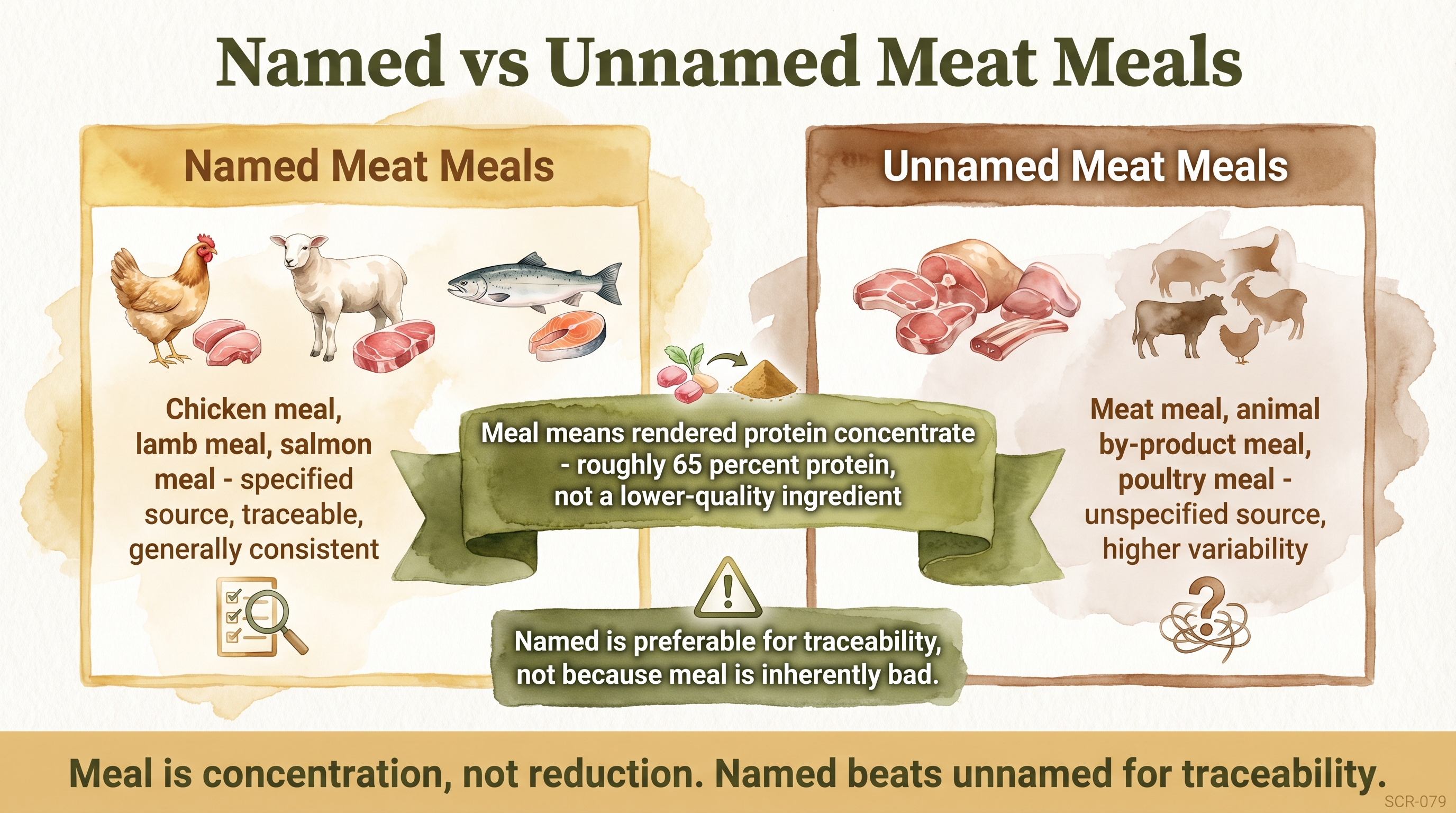
Meal is concentration, not reduction - named beats unnamed for traceability.
Key Takeaways
- Meat meal is a rendered, concentrated animal-protein ingredient and is not automatically a low-quality ingredient just because it is called meal.
- The most important distinction is named versus unnamed, because named meals provide clearer species identity and traceability.
- Unnamed animal meals are not automatically bad, but they do raise more questions about source control and transparency.
- Families should use the meal distinction as one signal within broader label and manufacturer evaluation, not as a stand-alone verdict.
The Evidence
This entry uses observed claim-level tags beyond the dedicated EvidenceBlocks below. These tags mark JB program observation or practice-derived claims that need dedicated EvidenceBlock coverage in a later content pass.
This entry uses heuristic claim-level tags beyond the dedicated EvidenceBlocks below. These tags mark JB interpretive application rather than direct study findings.
The evidence here is largely definitional and interpretive. It is documented that rendered meals are recognized ingredient categories and that labels can name species specifically or use broader animal-source terms. It is also documented in practical sourcing terms that named ingredients offer stronger traceability and specificity than unnamed ones.
That is enough evidence to support a simple family rule. Named meals usually deserve more trust than unnamed ones when all else is equal, not because rendering is bad, but because clarity is good. It is a small rule, but a useful one.
The family-facing interpretation should stay measured. Named meals are generally a good sign. Unnamed meals are a fair reason to ask harder questions. Neither rule is absolute. The best use of this distinction is as part of broader label and manufacturer evaluation.
- AAFCO ingredient definitions and commercial-regulation synthesisdog-food labeling context
Meat meals are rendered, concentrated animal-tissue ingredients that may be named by species or described in broader unnamed categories. - Supply-chain interpretation frameworkdog-food consumer context
Named meat meals generally provide clearer source identity and better traceability than unnamed animal meals.
- Label-reading synthesisdog-food consumer context
The main value of the named-versus-unnamed distinction is transparency and source clarity, not simplistic moral ranking of rendered ingredients. - Rendering-process interpretationdogs
Rendered ingredients are not inherently nutritionally inferior simply because they are rendered.
No published study directly tests the practical implications of named vs unnamed meat meals in dog food for domestic dog raising programs. The application to household dog raising remains an interpretive synthesis rather than a directly tested intervention finding.
SCR References
Sources
- National Research Council. (2006). Nutrient Requirements of Dogs and Cats. Washington, DC: The National Academies Press.
- AAFCO. (2024). Official Publication. Association of American Feed Control Officials.
- U.S. Food and Drug Administration. (2014). Pet food labeling guide. FDA Center for Veterinary Medicine.
- WSAVA Global Nutrition Committee. (2011). WSAVA nutritional assessment guidelines. Journal of Small Animal Practice, 52(7), 385-396.
- Algya, K. M., Cross, T. L., Leuck, K. N., Kastner, R. E., Baba, T., Lye, L., de Godoy, M. R., & Swanson, K. S. (2018). Apparent total-tract macronutrient digestibility, serum chemistry, urinalysis, and fecal characteristics, metabolites and microbiota of adult dogs fed extruded, mildly cooked, and raw diets. Journal of Animal Science, 96(9), 3670-3683.