Pancreatitis and Dietary Fat in Dogs
Compound evidence detail1 SCR / 3 parts
- Documentedthe diagnostic combination of clinical signs, Spec cPL or cPLI testing, and abdominal imaging - with serum amylase and lipase alone insufficient - alongside the supportive-care treatment standard of intravenous fluid therapy, analgesia, antiemetics, and early enteral nutrition
- Documentedthe role of obesity, dietary indiscretion, endocrinopathies, and breed factors as documented contributors to canine pancreatitis risk, with weight management and fat-restricted diets as recurrence-reduction levers in predisposed dogs
- Heuristicthe dietary fat percentage recommended after pancreatitis recovery - consensus-derived from clinical practice rather than established by outcome-validated trial data
Pancreatitis is one of the clearest examples of a nutrition problem becoming an emergency problem. Families often learn about it after a holiday, after table scraps, or after a dog that "always had a strong stomach" suddenly begins vomiting, refusing food, and hunching in abdominal pain. The category is bigger than one fatty meal, but the famous high-fat trigger story exists for a reason. Fat matters here. So do obesity, dietary indiscretion, and the practical reality that once a dog has inflamed its pancreas, casual feeding decisions stop being casual. Documented
What It Means
Pancreatitis is inflammation of the pancreas. In dogs, it can present as an acute event with severe vomiting, abdominal pain, and systemic illness, or as a more chronic, lower-grade, recurrent condition that waxes and wanes over time. Documented The acute form can be life-threatening. The chronic form is often under-recognized because the signs may be intermittent and families may interpret them as ordinary stomach upset.
The pancreas matters because it produces digestive enzymes and endocrine signals. When pancreatic inflammation develops, those digestive processes become disordered and the dog can become profoundly nauseated, painful, and systemically unwell. Severe cases can destabilize far beyond the GI tract, affecting hydration, perfusion, coagulation, and overall survival.
Where Dietary Fat Fits
Families often hear that fat causes pancreatitis. The more accurate statement is that high-fat meals and chronic high-fat feeding are documented risk factors in susceptible dogs, not that every fatty meal causes pancreatitis in every dog. This still leaves fat in an important clinical position. In real practice, fatty scraps, rich leftovers, access to trash, and abrupt indulgent meals are repeatedly implicated in dogs presenting for acute pancreatic inflammation.
This is the basis of the familiar "Thanksgiving pancreatitis" story. The seasonal example became famous not because it is folklore, but because it reflects a true risk pattern: a dog accustomed to a certain diet suddenly receives concentrated fatty food, often in larger quantity than the family realizes, and then presents with pancreatic distress.
Dietary fat is not the only factor. Obesity, hyperlipidemia, some endocrine disorders, certain medications, and breed predispositions all matter. Miniature Schnauzers are the classic breed overrepresented in the literature, but the broader lesson applies widely. A Golden Retriever may not carry the same textbook signal as a Schnauzer, but a Golden can absolutely develop pancreatitis and can absolutely be harmed by sloppy fat management.
Acute Versus Chronic Disease
The distinction between acute and chronic pancreatitis matters because it changes both urgency and long-term feeding expectations. Documented Acute pancreatitis can be sudden and dramatic. The dog vomits, will not eat, seems painful, may assume a prayer posture, and can deteriorate quickly. Chronic pancreatitis may look more like repeated "sensitive stomach" episodes, periodic appetite loss, or recurrent nausea that never quite becomes catastrophic until it suddenly does.
This is one reason families should resist the temptation to label repeated vomiting as simply dietary sensitivity. Some dogs with recurrent pancreatic inflammation get mislabeled until a more severe episode makes the pattern obvious. Documented
Diagnosis and Why Food History Matters
Pancreatitis is diagnosed through clinical context, examination, laboratory testing such as Spec cPL, and imaging support, especially ultrasound. No single test should be used without the clinical picture. Food history matters because it often clarifies the likelihood of dietary indiscretion, recent rich-food exposure, or chronic high-fat feeding that belongs in the interpretation.
This is also why families should not minimize table scraps when recounting history. A few slices of bacon, turkey skin, grease-rich drippings, or a large portion of leftovers can be medically relevant. Families often describe these as tiny treats because they were emotionally small decisions. Metabolically, they may not have been small at all.
Long-Term Nutritional Management
Once a dog has had pancreatitis, long-term nutritional discipline matters. Low-fat feeding becomes a core preventive strategy in recurrent or chronic cases and often after acute recovery as well. In practical terms, that usually means a prescription low-fat diet or another veterinarian-approved feeding plan that reliably keeps dry-matter fat well below ordinary maintenance foods. Many clinicians target under about 15 percent dry matter fat, and some dogs need lower.
The practical challenge is that families often understand the main diet change but forget that treats, chews, supplements, and "just this once" table food can undo the whole plan. Pancreatitis prevention is therefore rarely defeated by ignorance alone. It is often defeated by inconsistency.
Why It Matters for Your Dog
This page matters because pancreatitis is painful, expensive, and frightening, yet often partly preventable through food discipline once families understand the pattern. A dog with a pancreatitis history is not a dog who gets to share the household's intuitive food life anymore. That is not punishment. It is medical care.
For Goldens and other family dogs, this matters because large social breeds are often fed generously by multiple people. A dog that looks healthy and eager can accumulate exactly the kind of table-food exposure that families do not register as risk until the pancreas objects. The better the dog's appetite, the easier it is for the household to confuse enthusiasm with tolerance.
One of the cleanest preventive rules in pancreatitis-prone dogs is simple: the dog should not eat like a holiday guest. Rich human food may feel loving in the moment and biologically expensive by nightfall.
This page also matters because low-fat feeding after pancreatitis is not a trendy diet choice. It is a relapse-reduction strategy. Owners sometimes rebel against it because the dog "loves food" or because they interpret the restriction as emotionally harsh. The more honest view is that the dog's pancreas has already shown you its limit. Respecting that limit is part of the dog's safety.
There is also an obesity connection here. Lean body condition does not solve every pancreatitis case, but it belongs in the risk conversation. Overweight dogs often carry a broader metabolic burden and are less resilient when inflammatory disease strikes. Observed-JB That is why weight control and pancreatitis prevention belong in the same family conversation rather than in separate silos.
Another practical reason this page matters is that recovery diets and chronic low-fat diets are not interchangeable with every food marketed as "gentle" or "digestive support." The fat number matters. The ingredient list matters less than families often think. A beautifully marketed fresh food can still be wrong for a pancreatitis-prone dog if the fat burden is too high.
It also helps to picture the whole pancreatitis timeline rather than only the emergency-room moment. In the acute setting, veterinary management centers on pain relief, nausea control, hydration support, and stabilization. Food is not ignored, but the dog may need careful timing around when and how feeding resumes depending on severity, vomiting control, and overall status. Families sometimes leave the hospital believing pancreatitis was a one-night event that has now passed. In reality, the post-crisis diet plan is often where future risk is either reduced or recreated.
The treat issue deserves even stronger emphasis because it is where many relapses are born. The main bowl is low fat, but the dog still gets bacon, bully sticks, cheese, marrow bones, peanut-butter fillers, sausage as training rewards, or the end of a child's sandwich. Families do not experience these as medical decisions because each one is emotionally tiny. The pancreas does not experience them that way. A successful low-fat plan is a whole-intake plan or it is not really a low-fat plan.
Breed predisposition also needs a more careful reading. Miniature Schnauzers are the classic textbook breed, especially where hypertriglyceridemia is concerned, but that should not mislead Golden families into thinking the disease belongs to other dogs. Goldens are common family dogs living in treat-rich homes, and that social reality alone makes dietary indiscretion highly relevant. In other words, even when breed genetics are not the strongest risk factor, lifestyle can still be.
Another practical point is that families often confuse appetite with readiness. A dog recovering from pancreatitis may desperately want food, and that can tempt the household back toward ordinary feeding faster than is wise. Appetite is good news, but it is not independent evidence that the previous diet pattern was safe. Recovery should make the family more disciplined, not more relaxed.
Finally, the low-fat target should be understood as a working medical framework rather than a magic number. Many dogs do well on a prescription low-fat diet under about 15 percent dry matter fat, while others with repeated disease or specific metabolic issues need a tighter plan. Estimated This is why veterinary follow-up matters after the emergency. The family is not only trying to survive the episode. They are trying to prevent the next one.
Diagnostics deserve one more plain-language note because pancreatitis can look like many other abdominal problems. Spec cPL is helpful, but it belongs beside the physical exam, the history, and often imaging rather than above them. Ultrasound can support the diagnosis, though it is not perfect in every case. Families do not need to master the test characteristics. They do need to understand why veterinarians ask about exactly what the dog ate, when the vomiting started, and whether there has been prior history. Those questions are not small talk. They are central to interpretation.
Chronic pancreatitis also deserves more respect than it usually gets in family discussion. A dog who has several "mystery stomach" episodes each year may not simply be delicate. Recurrent mild flares can create the impression that the dog has an unpredictable stomach when the more useful interpretation is that the pancreas may be getting repeatedly irritated. When families finally understand this pattern, the low-fat plan often makes more emotional sense because it no longer feels like an overreaction to one isolated emergency.
This is another place where prevention looks less dramatic than people expect. It is not heroic medicine. It is declining the greasy treat, keeping trash inaccessible, choosing a truly appropriate low-fat food, and making sure every person in the house understands that "just once" is not a medically neutral phrase for this dog. That kind of ordinary discipline is what keeps many pancreatitis-prone dogs stable over time.
Families also benefit from making a literal list of safe foods and unsafe foods after diagnosis. That sounds almost too simple, but it removes ambiguity in the moments when people are most likely to make poor decisions. If everyone knows which treats are approved, which chews are banned, and which human foods are completely off limits, the dog is much less likely to get sick because someone guessed wrong in a generous moment.
For many households, that written list is what finally turns good intentions into actual pancreatic prevention.
It is often the difference between one recovered episode and a pattern of preventable relapse.
That is a very meaningful difference for both the dog and the family.
It is worth protecting on purpose.
That protection is usually very ordinary and very repetitive.
It still matters.
When to See a Veterinarian
Vomiting after a high-fat meal, repeated vomiting without a clear explanation, refusal to eat, marked lethargy, abdominal pain, or a prayer-posture appearance all warrant prompt veterinary evaluation. Pancreatitis is not a condition to monitor casually at home when the signs are active.
Urgent evaluation is especially important if the dog cannot keep water down, appears weak, is breathing rapidly, has severe pain, or seems to be worsening over hours rather than days. Acute pancreatitis can escalate quickly and can require hospitalization, pain control, anti-nausea therapy, fluid support, and close monitoring.
Families should also seek veterinary guidance after recovery if they are unsure what the dog can safely eat long term. Recurrent pancreatitis often reflects not bad luck but an incomplete feeding plan. If the dog has had more than one episode, the diet and treat strategy should be reviewed carefully rather than assumed.
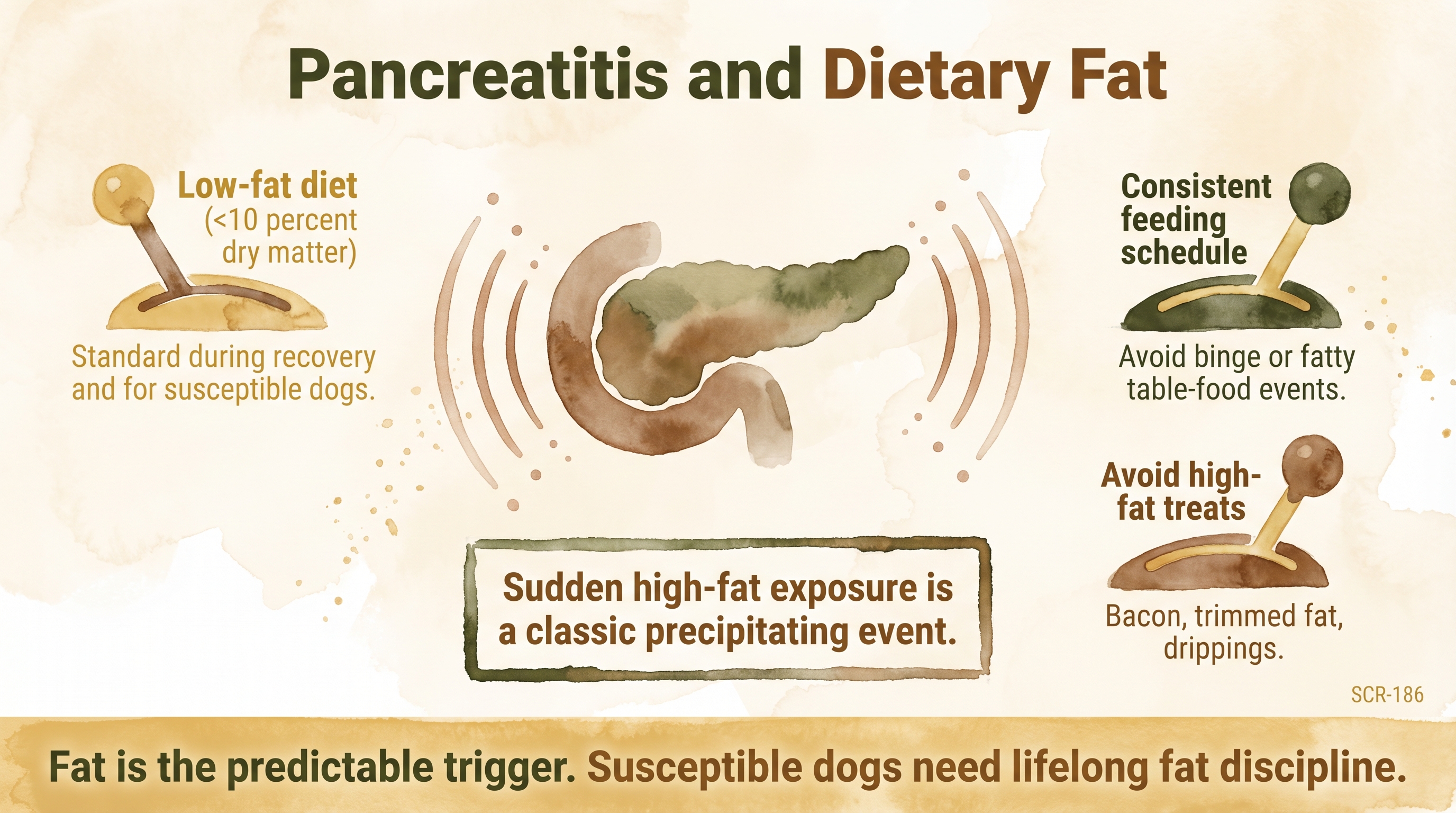
Fat is the predictable trigger - susceptible dogs need lifelong fat discipline.
Key Takeaways
- Pancreatitis ranges from chronic smoldering disease to acute life-threatening inflammation, so repeated vomiting and abdominal pain should never be shrugged off casually.
- Dietary fat matters most in susceptible dogs and in dogs with prior pancreatic disease, which is why table scraps and rich leftovers are such common failure points.
- Long-term low-fat feeding after pancreatitis is a relapse-reduction strategy, not a cosmetic or trendy preference.
- A pancreatitis-prone dog's safety depends on whole-household consistency because one generous feeding decision can undo weeks of discipline.
The Evidence
This entry uses observed claim-level tags beyond the dedicated EvidenceBlocks below. These tags mark JB program observation or practice-derived claims that need dedicated EvidenceBlock coverage in a later content pass.
This entry uses estimated claim-level tags beyond the dedicated EvidenceBlocks below. These tags mark approximate ranges or timing claims that should remain bounded by the cited sources.
The strongest evidence here supports pancreatitis as a real clinical disease category diagnosed through clinical context plus pancreatic testing, and supports dietary fat exposure, obesity, and dietary indiscretion as meaningful risk factors in susceptible dogs. SCR-186 anchors the diagnosis and treatment side. SCR-075 helps justify why lean body condition belongs in the prevention logic even though it is not the only variable.
Where the evidence should stay disciplined is in avoiding simplistic statements such as "fat causes pancreatitis in all dogs." The better clinical truth is that fat burden matters greatly in susceptible dogs and matters enormously after pancreatitis has already happened.
- SCR-186 supportdogs
Canine pancreatitis is diagnosed through clinical picture, Spec cPL, and imaging support, with supportive care and nutritional management central to treatment. - Pancreatitis risk-factor literaturedogs
Dietary indiscretion, high-fat meal exposure, obesity, and hyperlipidemia are established contributors to pancreatitis risk in susceptible dogs. - Low-fat management frameworkdogs with recurrent or chronic pancreatitis
Long-term low-fat feeding is a core management strategy after pancreatic inflammation because reducing dietary fat lowers one of the clearest modifiable triggers.
- SCR-075 supportdogs
Lean body condition remains one of the strongest modifiable health advantages in canine medicine and belongs in pancreatitis prevention as part of the broader metabolic context. - Clinical feeding-history synthesisdogs
Pancreatitis prevention often fails at the level of treats, leftovers, and household inconsistency rather than at the level of the main bowl alone.
No published study directly tests the practical implications of pancreatitis and dietary fat in dogs for domestic dog raising programs. The application to household dog raising remains an interpretive synthesis rather than a directly tested intervention finding.
SCR References
Sources
- National Research Council. (2006). Nutrient Requirements of Dogs and Cats. Washington, DC: The National Academies Press.
- AAFCO. (2024). Official Publication. Association of American Feed Control Officials.
- Newman, S. J., Steiner, J. M., Wooters, M. E., Leib, M. S., Williams, D. A., & Glantsching, P. B. (1996). Histologic examination of formalin-fixed, paraffin-embedded liver tissue specimens from dogs with suspect pancreatitis. Veterinary Pathology, 33(6), 655-659.
- Xenoulis, P. G., & Steiner, J. M. (2010). Lipid metabolism and hyperlipidemia in dogs. Veterinary Journal, 183(1), 12-21.
- Huth, S. P., Relford, R., Forsgren, K., & Summers, S. (2011). Mirtazapine as an appetite stimulant in cats with chronic kidney disease. Journal of the American Veterinary Medical Association, 239(11), 1441-1442.