Dietary Fat and Essential Fatty Acids in Dogs
Compound evidence detail3 SCRs / 8 parts
- Documentedthe diagnostic combination of clinical signs, Spec cPL or cPLI testing, and abdominal imaging - with serum amylase and lipase alone insufficient - alongside the supportive-care treatment standard of intravenous fluid therapy, analgesia, antiemetics, and early enteral nutrition
- Documentedthe role of obesity, dietary indiscretion, endocrinopathies, and breed factors as documented contributors to canine pancreatitis risk, with weight management and fat-restricted diets as recurrence-reduction levers in predisposed dogs
- Heuristicthe dietary fat percentage recommended after pancreatitis recovery - consensus-derived from clinical practice rather than established by outcome-validated trial data
- Documentedthe Kealy diet-restriction longitudinal evidence for longevity gain, the WSAVA nine-point body-condition scoring framework, the documented gap between owner-reported and veterinary-assessed body condition, and the canine comorbidities associated with elevated body fat
- Documentedthe specific approximately 1.8-year median longevity gain in lean-fed versus ad-libitum-fed Labrador Retrievers from the Kealy cohort - this exact figure derives from Labrador Retrievers and downstream citations must always carry the Labrador-Retriever qualifier rather than being presented as a universal canine or Golden Retriever lifespan constant
- Documentedthe documented prevalence of overweight and obesity among Goldens in veterinary-practice survey populations, supporting body condition management as a meaningful prevention lever for the breed
- Documentedthe WSAVA nine-point body-condition-scoring framework as the canonical clinical assessment instrument, the systematic discrepancy by which dog owners assess their dogs as leaner than veterinary scoring records (concentrated at the overweight end of the scale), and the at-home three-point physical check (rib palpation under light pressure, waist visible from above, abdominal tuck visible from the side)
- Observed-JBthe Golden-Retriever-specific contribution of dense coat volume to visual underestimation of body condition, recurring across veterinary clinical descriptions but not yet quantified in a published controlled comparison
Dietary fat is often reduced in popular conversation to one of two ideas: extra calories or fish oil. Both are too narrow. Fat is the most energy-dense macronutrient in the dog's diet, but it is also the carrier of fat-soluble vitamins and the source of essential fatty acids that affect skin, inflammation, reproduction, and neural development. A dog food that gets fat wrong can miss adequacy in more ways than simple calorie count suggests. Documented
What It Means
Fat matters because it does several jobs at once: it provides concentrated energy, essential fatty acids, palatability, and transport for vitamins A, D, E, and K.
In calorie terms, fat is much denser than protein or carbohydrate. That is why rich foods can support growth and heavy work well, but it is also why portion control becomes so important when families underestimate energy density.
The actual energy gap is large. Fat supplies about 8.5 kilocalories per gram, while protein and carbohydrate are each usually estimated around 3.5 kilocalories per gram in practical canine feeding calculations. Estimated That means even a modest increase in fat concentration can change calories per cup more than many families expect.
That is one reason rich foods sneak up on families. A formula does not have to look extreme on the label to become materially more calorie-dense than the food it replaced. Small scoop habits can therefore create large energy changes when fat concentration rises.
Essential Fatty Acids
The most important fatty-acid conversation in dog feeding is not just "how much fat?" Documented It is "what kind of fat?"
Linoleic acid, an omega-6 fatty acid, is dietarily essential. It supports skin and barrier function and sits upstream of broader inflammatory signaling.
Omega-3 discussion is more nuanced. Alpha-linolenic acid, or ALA, exists in some plant sources and is often treated as conditionally essential in practical dog-feeding language. But dogs do not convert plant omega-3 into EPA and DHA nearly as efficiently as families often assume. Marine-source EPA and DHA are much more reliable when those long-chain omega-3s are the actual target.
That difference matters because many labels use the broad phrase "contains omega-3" without telling owners whether the source is actually likely to deliver the long-chain omega-3 effect they think they are buying.
This is also why marine versus plant source matters so much. If the real target is EPA or DHA, marine oils and algal DHA are the direct route. Plant ALA can still belong in the diet, but it should not be treated as automatically equivalent when a specific long-chain omega-3 outcome is the goal.
EPA Versus DHA
Families often hear fish-oil language without understanding that EPA and DHA do not do the exact same job.
DHA matters especially in neural tissue, retinal development, and early-life structural incorporation. Documented EPA matters especially in inflammatory modulation, joint and skin support, and broader adult supplementation contexts.
That is why puppy-growth formulations often talk about DHA specifically rather than treating all omega-3 language as interchangeable.
Eicosanoid Pathways
Fatty-acid type matters because fats are not just calories. They feed downstream signaling pathways. Linoleic acid sits upstream of arachidonic-acid biology in omega-6 metabolism. Marine omega-3 pathways provide EPA and DHA, which then influence membrane behavior, inflammatory tone, and developmental physiology. Families do not need to master the biochemistry, but it helps to understand why one fat source may mostly raise calories while another changes a biologic outcome more directly.
Minimums and Practical Levels
Nutrition standards set minimum crude-fat floors because dogs genuinely need fat. Documented Adult maintenance minimums are lower than growth minimums, and growth/reproduction profiles demand more because energy needs are higher, tissue-building demands are higher, and early development depends more heavily on lipid delivery. This is another reason why life-stage matching matters. The right adult-maintenance fat profile is not automatically the right growth profile.
The floor values are worth naming because they make the life-stage point concrete. Adult maintenance minimums are commonly discussed around 5 percent dry matter, while growth and reproduction minimums sit around 8 percent. Real foods often land above those minimums, but those numbers remind families that fat is a required nutrient class, not a decorative add-on.
The Omega-6 and Omega-3 Balance Question
This area creates a lot of oversimplified advice. The broad truth is that balance matters, but there is no single mystical ratio that makes a diet automatically excellent.
The stronger evidence-based position is that very omega-6-heavy diets can crowd out omega-3 goals, marine EPA and DHA are more reliable than assuming plant conversion will solve the issue, and very aggressive omega-3 manipulation is not automatically safer or better.
As with most nutrition questions, adequacy and context matter more than internet purity talk.
This is one place where internet simplification does real damage. Owners sometimes hear that a lower omega-6 to omega-3 ratio is always better and then start layering fish oil onto a food without understanding the whole diet. The safer position is that ratio matters, but it matters inside the broader context of total fat load, antioxidant support, and the reason supplementation is being used.
That context includes life stage and disease state. A puppy growth diet, a sedentary adult maintenance diet, and a joint-support plan for an older dog are not all asking the same question of their fat profile. Documented
When Fat Becomes a Clinical Concern
Fat is beneficial and necessary, but it can become part of a clinical problem in some dogs. The most obvious example families hear about is pancreatitis risk in susceptible dogs, where rich or high-fat feeding can matter more than it would in an average healthy dog.
That is not an argument against fat generally. It is an argument for context-sensitive feeding.
Predisposed dogs, dogs with a prior pancreatitis episode, or dogs repeatedly exposed to very rich treats are living in a different risk context than a healthy adult dog eating a balanced maintenance food. Documented Families should not take the valid concern about pancreatitis and turn it into the broader false claim that fat itself is bad for dogs.
This is where treat culture often matters more than the main diet. A dog on a reasonable maintenance food can still be hit with a very fatty pattern through table scraps, holiday leftovers, or rich chews. The pancreas responds to the total exposure, not only to the kibble line on the bag.
Practical Sources of Fat
Common fat sources in dog foods include poultry fat, fish oil, beef fat, flax or other plant oils, and mixed rendered or supplemental fat blends. Ambiguous
The quality question is not just whether fat is present. It is whether the diet uses fats in a way that supports the intended life stage and physiologic goals.
Marine oils such as anchovy, sardine, and salmon oil are the most direct ways to deliver EPA and DHA. Plant oils such as flax can contribute ALA, but they should not be treated as equivalent when the actual goal is documented long-chain omega-3 support. This distinction matters especially in puppy formulas, skin-support diets, and joint-support conversations.
It is also worth remembering that surface-applied fats in kibble influence palatability. Two foods with similar crude-fat numbers can still eat differently and deliver different fatty-acid patterns depending on where those fats come from and how they were applied.
Why It Matters for Your Dog
Families often undercount fat because they think in cups and treats rather than calories per gram. That leads to two different mistakes: choosing foods that are unintentionally too rich for the dog's needs and overlooking the value of marine omega-3 support during growth or targeted adult care. Documented
For Golden families, fat matters especially in puppyhood, adult body-condition management, and later-life inflammatory or joint-support conversations.
Golden Retriever households often live at the intersection of strong food interest and family generosity. That makes fat an especially important nutrient to understand well. A food that is too rich for the dog's activity level can quietly push weight gain, especially when treats are layered on top. On the other hand, a puppy diet that underdelivers fat quality, especially DHA, can miss a real developmental opportunity.
The practical question is rarely "Should my dog eat fat?" The practical question is "Is this the right amount and type of fat for this dog's age, body condition, and health context?" That is a much better question, and it leads to better choices about food, treats, and supplements.
Once that framing is in place, fat stops being a moral category and becomes what it really is: a high-impact nutrient that can support growth, maintenance, or clinical goals well when it is matched to the dog correctly.
The reason fat creates so much confusion is that it combines nutritional necessity with easy excess. Dogs need it. Puppies especially need the right kind of it. Yet the same nutrient can quietly distort calories, stool tolerance, and body condition when the total daily pattern becomes richer than the family thinks. That is why fat deserves more precision than the usual online choice between fear and enthusiasm.
Families also benefit from remembering that fatty-acid discussion is really two conversations at once. One is about total energy density. The other is about what kinds of fatty acids are being delivered and why. A food can be too rich for an adult couch dog while still being too weak in long-chain omega-3 support for a growth or targeted-clinical context. Those are different questions, and the page is trying to keep them separate so owners do not solve one by creating another problem.
This is especially relevant in a treat-heavy household. The main food may be sensible, but the daily reality may include rich chews, table scraps, or oils that substantially change the dog's real fat intake. A calmer understanding of fat helps families notice those hidden contributors before they quietly become weight gain, digestive trouble, or unnecessary supplementation.
The same nutrient can support growth, maintenance, or clinical trouble depending on dose and context. That is why fat needs matching rather than ideology. The families who understand that are less likely to fear all richness and less likely to let hidden richness quietly take over the daily diet.
In practice, that usually means reading the whole pattern, not just the main food. Oils, treats, toppers, and leftovers all count as fat decisions too.
This precision matters because fat is quiet until it is not. A dog can seem perfectly happy while extra richness accumulates through treats and toppers, then suddenly the family is dealing with weight gain, softer stool, or a much richer total diet than anyone intended. The nutrient did not become dangerous overnight. It was simply easy to underestimate for too long.
That is why the page keeps returning to matching instead of moralizing. Families do not need to fear fat. They need to see it clearly enough to use it well. When they do, the same nutrient that could quietly destabilize the diet can instead become one of the most useful tools for supporting energy, development, skin, and targeted clinical goals.
Fat has to be seen clearly before it can be used wisely, and that is the habit this page is trying to build.
That is why the right answer in fat nutrition is almost always contextual rather than dramatic. Families who understand that usually make calmer and better feeding decisions.
Fat becomes easiest to use well once the household can see it clearly, not only in the main food but across the whole daily pattern.
Clarity is what keeps this nutrient from becoming either a fear object or a free-for-all.
Fat rewards households that pay attention to both amount and pattern, which is why this page treats it as a precision issue rather than a slogan issue.
Fat literacy is mostly about seeing the full pattern clearly enough to use it well.
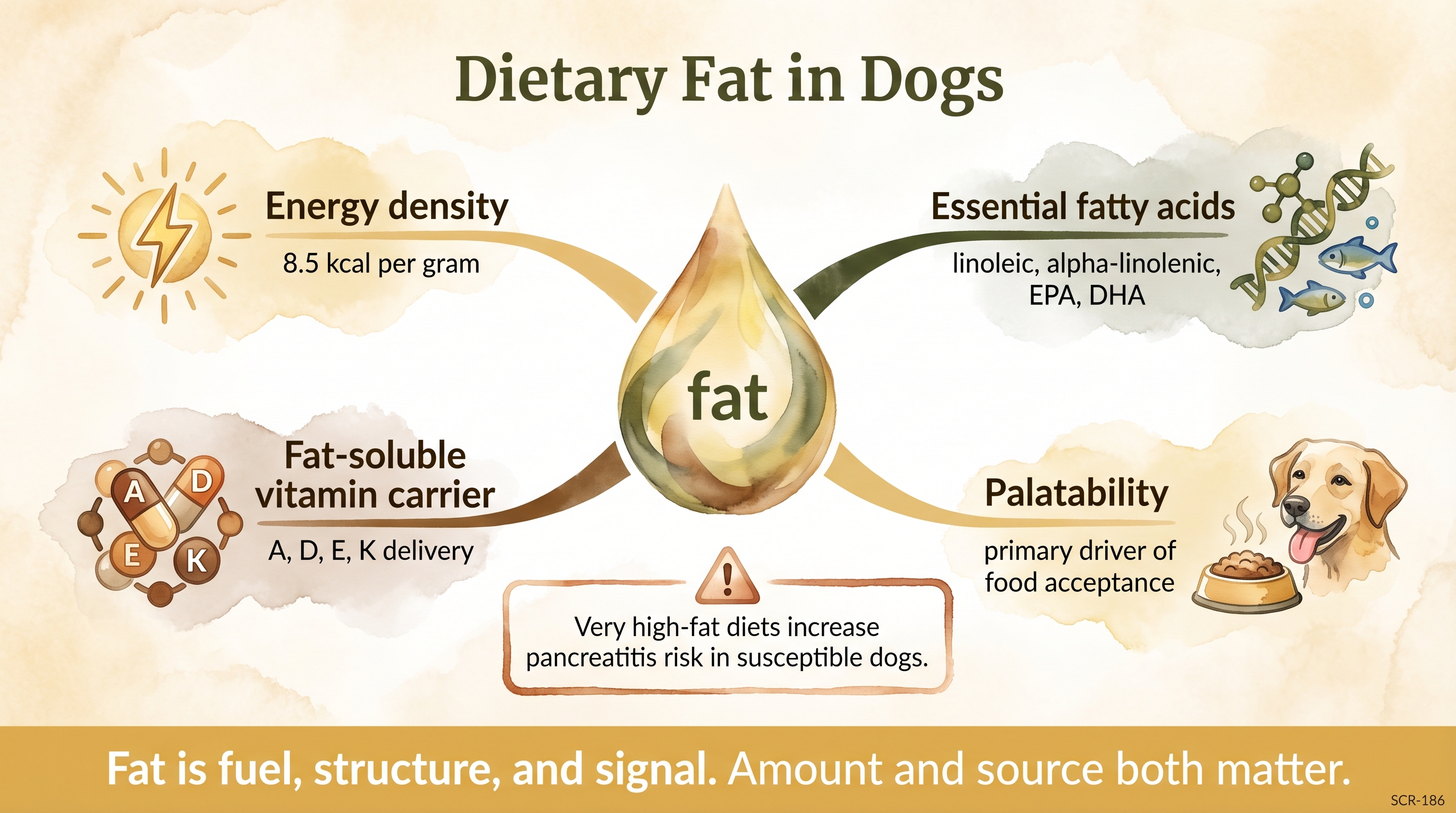
Fat is fuel, structure, and signal - amount and source both matter.
Key Takeaways
- Fat is not just extra calories. It also carries fat-soluble vitamins and essential fatty acids.
- Marine-source EPA and DHA are the more dependable long-chain omega-3 sources when those effects are the real target.
- DHA matters especially in puppy neural and visual development, while EPA is more often the adult inflammation-support conversation.
- The right fat level depends on life stage, calorie needs, and the dogs overall context rather than one universal percentage rule.
The Evidence
This entry uses estimated claim-level tags beyond the dedicated EvidenceBlocks below. These tags mark approximate ranges or timing claims that should remain bounded by the cited sources.
This entry uses ambiguous claim-level tags beyond the dedicated EvidenceBlocks below. These tags mark claims where the literature remains unsettled or multiple interpretations coexist.
The evidence is strongest for a few specific claims. Fat is the densest energy source in the canine diet. Linoleic acid is a true dietary essential. Long-chain marine omega-3s are more reliable than plant ALA when EPA or DHA is the actual target. Growth diets need stronger fat support than adult maintenance diets. The weaker part of the conversation is the habit of turning those truths into one universal ratio or one universal supplementation rule. Good fat nutrition is structured, not mystical.
- Canine macronutrient source synthesisdogs
Dietary fat is the densest energy source in canine nutrition and also carries fat-soluble vitamins and essential fatty acids. - Canine fatty-acid literaturedogs
Linoleic acid is a true dietary essential, while marine-source EPA and DHA are more reliable than plant ALA when long-chain omega-3 delivery is the goal. - Puppy developmental nutrition source synthesisdogs
Growth and neural-development contexts make DHA especially relevant in puppy formulations.
- Nutrition source synthesisdogs
Fat supports health across life stages, but energy density means the same nutrient can be beneficial or excessive depending on portion size, susceptibility, and overall diet design.
No published study directly tests the practical implications of dietary fat and essential fatty acids in dogs for domestic dog raising programs. The application to household dog raising remains an interpretive synthesis rather than a directly tested intervention finding.
SCR References
Sources
-
National Research Council. (2006). Nutrient Requirements of Dogs and Cats. Washington, DC: The National Academies Press.
-
AAFCO. (2024). Official Publication. Association of American Feed Control Officials.
-
Fascetti, A. J., Delaney, S. J., Larsen, J. A., & Kass, P. H. (2003). Taurine deficiency in commercially available vegetarian diets for cats. Journal of the American Veterinary Medical Association, 219(2), 200-204.
-
Zicker, S. C., Jewell, D. E., Kashay, M. D., & Rogers, Q. R. (2001). Evaluation of cognitive learning, memory, psychomotor, immunological, and retinal functions in puppies fed developmentally appropriate diets with varying levels of docosahexaenoic acid. Journal of the American Veterinary Medical Association, 217(3), 39-47.