NRC and AAFCO Nutrient Standards for Dogs
NRC and AAFCO sit underneath almost every serious dog-food conversation, but most families never hear what each one actually does. As a result, they often treat "meets AAFCO" as if it were either meaningless marketing or absolute proof of excellence. Neither is right. The more accurate frame is that NRC provides the main scientific nutrient-requirement backbone, while AAFCO provides the practical U.S. adequacy and labeling framework used in commercial feeding. Documented
What It Means
The easiest way to understand these standards is to separate science from regulation.
NRC
The National Research Council framework is the research-synthesis side. Documented It compiles nutrient-requirement logic using controlled feeding work, balance studies, requirement derivation, and safety-limit reasoning.
NRC is where many of the deeper nutrient reference ideas come from, including distinctions like minimum requirement, adequate intake, recommended allowance, and safe upper limit.
These are scientific tools, not bag-label phrases.
They also do different jobs. Minimum Requirement, or MR, is the lowest intake shown to meet the needs of animals under test conditions. Adequate Intake, or AI, is used when the evidence is thinner and a best-supported practical value is needed. Recommended Allowance, or RA, adds margin above the minimum to account for bioavailability and ordinary variation. Safe Upper Limit, or SUL, is the ceiling above which toxicity concern becomes more real. Families do not need to memorize the abbreviations, but it helps to know that NRC is not a single flat number system. It is a layered framework for thinking about adequacy, uncertainty, and safety.
The historical timeline matters too. NRC dog and cat nutrition guidance did not appear all at once in 2006. It evolved through earlier editions dating back to 1974, with later refinements responding to better science and better understanding of ingredient-based commercial feeding realities. The 2006 edition remains the major modern reference point because it consolidated a large amount of requirement logic into one widely cited framework.
AAFCO
AAFCO is the practical regulatory framework used in the United States. It translates nutrient-requirement logic into nutrient profiles, life-stage adequacy statements, feeding-trial standards, and label language.
This is why families encounter AAFCO directly while rarely reading NRC directly.
AAFCO also simplifies the life-stage question in a way families see on labels. The two main canine profile categories are adult maintenance and growth and reproduction. The second category is more demanding, which is why "all life stages" on a label usually means the food meets the growth-and-reproduction standard rather than a special third category.
The Relationship
The simplest accurate relationship is: NRC is the scientific reference layer, and AAFCO is the operational adequacy layer.
That means AAFCO does not replace science. It applies science in a commercial context.
That practical translation matters because commercial foods are not purified laboratory diets. They are mixed-ingredient, real-world products exposed to processing loss, storage stress, and variation in ingredient digestibility. AAFCO exists partly to create a workable adequacy floor in that commercial reality.
Formulated to Meet Profiles Versus Feeding Trial
This is one of the most important distinctions in the whole topic.
A food can be formulated to meet AAFCO nutrient profiles or substantiated by AAFCO feeding trial. Documented
Those are not the same evidentiary route.
Formulation means the nutrient targets are met on paper or through lab analysis. Feeding-trial substantiation means the food has actually been fed under standardized protocol to real dogs and passed the required benchmarks.
That does not mean every feeding-trial food is automatically superior in every way. It does mean the evidentiary path is different and, in some respects, stronger.
The practical label-reading implication is important. "Formulated to meet" tells the family the food cleared the nutrient-profile route. "Animal feeding tests using AAFCO procedures substantiate" tells the family the product has also been fed under the protocol. Both are legitimate. The feeding-trial route is generally the stronger evidentiary signal, but it is still a minimum system rather than a lifetime outcome guarantee.
That nuance protects against another common error. Some boutique marketing implies that feeding trials are irrelevant because the company trusts its ingredients. In reality, feeding real dogs under the substantiation protocol is still valuable because it adds performance evidence beyond spreadsheet adequacy.
What Complete and Balanced Really Means
This phrase carries too much emotional weight because it sounds like a final answer. The SCR already gives the correct ceiling: complete and balanced means minimum adequacy under the relevant standards. It is not proof of superiority, therapeutic value, or optimal lifelong outcomes.
That matters because families often confuse adequacy with excellence and with ideal fit for their dog. Those are different questions.
This is exactly why SCR-079 matters so much. Documented Families deserve to know that complete and balanced is the floor of adequacy, not the ceiling of excellence. That message protects against two equal and opposite errors: naive trust in the label and cynical dismissal of the label.
Why the Standards Still Matter
Even with those limitations, these standards are incredibly useful because they protect dogs from obvious inadequacy and create common reference points for manufacturers, regulators, and veterinarians.
Without them, the market would be even more driven by aesthetic ingredient storytelling than it already is.
That consumer-protection role is not glamorous, but it is essential. AAFCO and NRC do not answer every nutrition question. They do stop the conversation from collapsing into pure marketing.
They also give veterinarians and families a common baseline for discussion. Without that baseline, every company could invent its own definition of adequacy, and families would have even less protection against persuasive but nutritionally thin storytelling.
The Limits
NRC and AAFCO are strong tools, but neither one is a perfect map of lifelong thriving.
Important limits include many requirement values that are built on limited direct trials, bioavailability that varies across real-world foods, the distinction that long-term optimization is not the same as minimum adequacy, and feeding-trial windows that are shorter and narrower than a dog's lifespan.
This is why a food can be legally adequate and still not be the best fit for every dog or every household.
It is also why region-to-region comparison matters. Europe often uses FEDIAF guidance as the closest equivalent to the AAFCO nutrient-profile role. Observed-JB The numbers are not identical because safety margins and regulatory philosophy differ somewhat. That does not mean one region has truth and the other has error. It means adequacy frameworks are informed scientific constructions, not revealed law.
WSAVA and Broader Clinical Context
WSAVA adds another important layer by pushing the idea that nutrition should be treated as a clinical vital sign and that manufacturer quality, expertise, and research culture matter too. Documented
That complements NRC and AAFCO rather than replacing them.
WSAVA's contribution is especially useful because it asks better manufacturer questions. Does the company employ qualified nutrition professionals. Does it produce finished-product analysis. Does it run quality control systems that behave like a nutrition-and-safety organization rather than just a label-and-marketing organization. That is where families move from minimum compliance toward better stewardship.
This is part of why a serious nutrition conversation often sounds boring compared with marketing. It is asking about quality systems, substantiation pathways, and expertise rather than about ingredient romance. Boring is often safer.
Why It Matters for Your Dog
This page matters because families shop in a market full of certainty theater. AAFCO compliance is sometimes dismissed too casually by boutique marketing, while at other times it is treated as if it ends all further thought.
The steadier position is that adequacy standards matter, they are not the whole story, and label literacy should lead to better questions rather than false certainty.
For JB families, this is part of feeding with stewardship rather than with trend anxiety.
For Golden Retriever families, this matters because life-stage mistakes and label misunderstanding tend to happen at predictable moments. Puppy food shopping often gets reduced to ingredient emotion instead of growth-profile adequacy. Adult maintenance can become a vague trust exercise instead of a label-reading exercise. Senior or disease-management feeding can drift toward supplements and boutique claims when the stronger question should be whether the food is clinically and nutritionally substantiated.
Understanding NRC and AAFCO does not mean the family has to become a regulator. It means the family stops being easy to manipulate.
That is one of the quiet goals of this whole wiki category. Once families understand what these standards do and do not mean, they become much harder to scare with boutique rhetoric and much harder to over-reassure with one adequacy phrase.
That alone makes label literacy worth the effort. A family that understands the floor of adequacy, the difference between substantiation routes, and the role of manufacturer quality can shop much more calmly and much less reactively.
Standards knowledge is also valuable because it anchors disagreement. Without a shared adequacy framework, every company could tell its own story about what complete nutrition means, and families would have very little protection from whichever story sounded most persuasive. NRC and AAFCO do not eliminate judgment, but they keep judgment tied to a recognizable baseline instead of to brand mythology.
That baseline is especially important when families are choosing between foods that all sound scientific in different ways. One brand may emphasize ingredients. Another may emphasize testing. Another may emphasize heritage or naturalness. Knowing what the standards actually do lets the family sort out which claims are about minimum adequacy, which are about stronger substantiation, and which are simply marketing language wrapped in technical vocabulary.
The page therefore matters beyond regulation itself. It gives families a way to ask better questions. Does this food meet the right life-stage requirement. Was it substantiated through feeding trial or formulation. What do we know about the manufacturer behind it. Those questions shift the conversation away from certainty theater and toward a calmer, more evidence-led kind of shopping.
What standards do best is create a common reference point for what adequacy means. They do not decide every final nutrition judgment, but they stop the category from collapsing into pure persuasion. That is a bigger service than many families realize until they try to compare foods without any baseline at all.
Once families understand that, they can use the label more intelligently. The standards phrase becomes a starting question rather than a final answer, and that is exactly how it should function.
Once families understand what standards can prove, adequacy becomes less theatrical and more useful. A complete-and-balanced statement stops being either a magic shield or a meaningless slogan and starts becoming what it actually is: a floor that matters, but a floor that still leaves room for better or worse manufacturer practice, better or worse dog fit, and better or worse interpretation by the person shopping.
That is part of why this page belongs near the front of the nutrition category. It gives readers the tools to sort later claims more intelligently. A family that knows how to read standards language is less likely to be overawed by technical wording and less likely to be manipulated by anti-regulation storytelling.
Better label literacy is a form of protection, and that is the real daily value of these standards.
Clarity about the adequacy floor helps families ask better questions above it. That is the practical power of standards literacy.
Understanding the floor helps families think more clearly about everything that sits above it.
The baseline matters even when it is not the whole story, and that is exactly why standards literacy is so useful.
A family that understands the floor is much harder to mislead about the ceiling, and that is the quiet power of standards literacy.
That kind of clarity is quieter than marketing and much more durable.
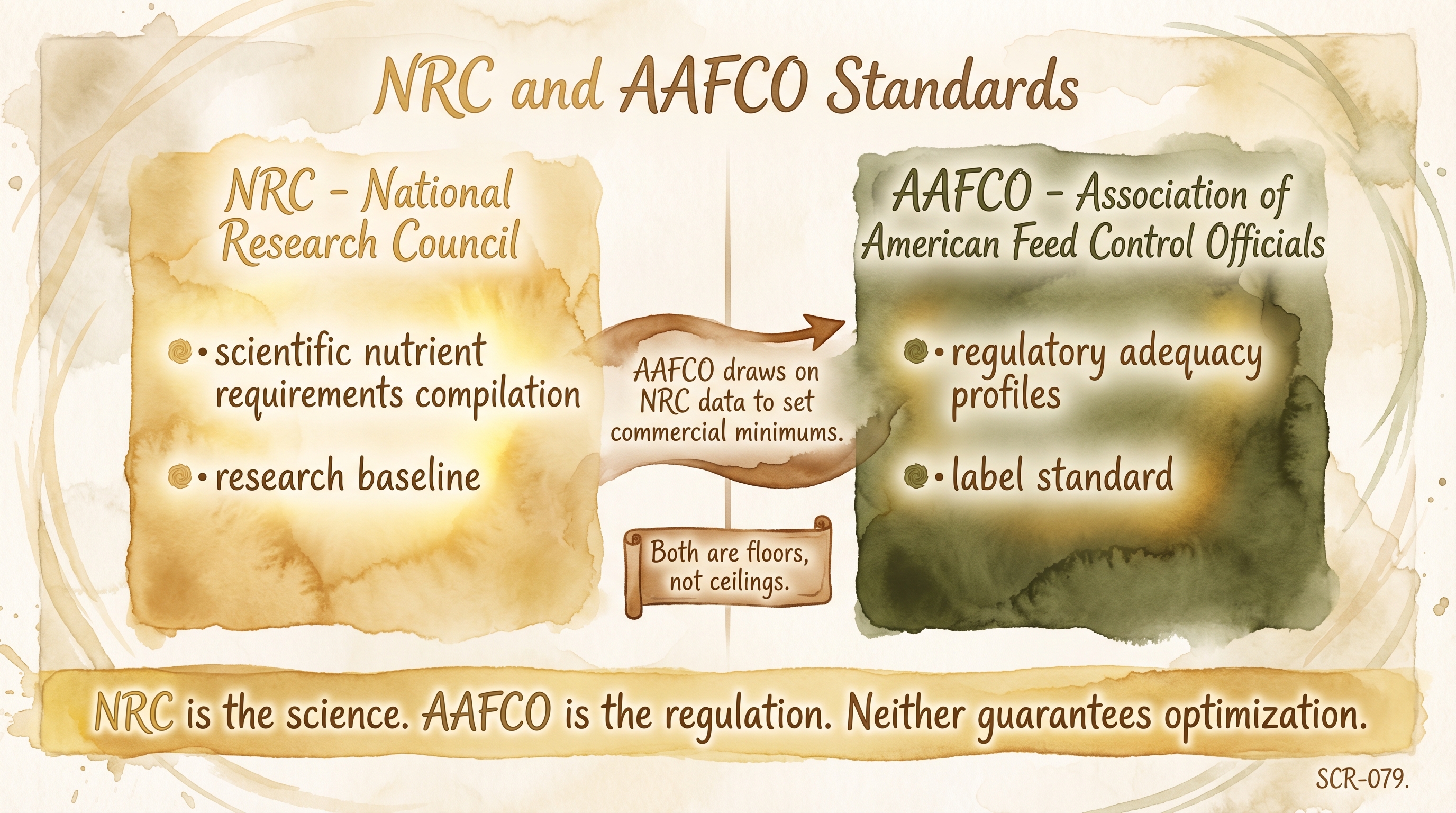
NRC is the science - AAFCO is the regulation - neither guarantees optimization.
Key Takeaways
- NRC is the main scientific requirement reference, while AAFCO is the practical adequacy and labeling framework most families encounter.
- Formulated-to-meet-profile and feeding-trial substantiation are different routes to complete-and-balanced status.
- Complete and balanced means minimum adequacy, not automatic superiority or ideal fit for every dog.
- Good label literacy should make families ask better questions rather than treating one standards phrase as the full answer.
The Evidence
This entry uses observed claim-level tags beyond the dedicated EvidenceBlocks below. These tags mark JB program observation or practice-derived claims that need dedicated EvidenceBlock coverage in a later content pass.
The strongest evidence here is not complicated. NRC is the science backbone. AAFCO is the practical U.S. adequacy framework. AAFCO uses two substantiation pathways, formulation and feeding trial. Complete and balanced means minimum adequacy, not superiority. FEDIAF plays a similar role in Europe. WSAVA adds manufacturer-quality and process-quality questions that help families move beyond the label floor. Once those five points are in place, a huge amount of pet-food confusion becomes easier to filter out.
That is why standards knowledge is so protective. It does not answer every feeding question, but it removes a tremendous amount of noise. Once the family knows what a label can and cannot prove, the rest of the nutrition conversation becomes much easier to handle honestly.
- Nutrition and regulation source synthesisdog-food regulatory context
NRC provides the scientific nutrient-reference backbone, while AAFCO provides the operational U.S. adequacy and labeling framework. - AAFCO frameworkdog-food regulatory context
Complete-and-balanced claims can be substantiated through nutrient-profile formulation or through standardized feeding trials, which are distinct evidence pathways. - SCR-079 supportdog-food regulatory context
AAFCO adequacy indicates a minimum nutritional floor rather than proof of superiority or long-term optimality.
- WSAVA clinical guidancedogs
Nutritional adequacy is necessary, but quality systems, manufacturer expertise, digestibility, and dog-level fit still matter beyond the adequacy statement alone.
No published study directly tests the practical implications of nrc and aafco nutrient standards for dogs for domestic dog raising programs. The application to household dog raising remains an interpretive synthesis rather than a directly tested intervention finding.
SCR References
Sources
- National Research Council. (2006). Nutrient Requirements of Dogs and Cats. Washington, DC: The National Academies Press.
- AAFCO. (2024). Official Publication. Association of American Feed Control Officials.
- FEDIAF. (2022). Nutritional Guidelines for Complete and Complementary Pet Food for Cats and Dogs. European Pet Food Industry Federation.
- WSAVA Global Nutrition Committee. (2011). WSAVA nutritional assessment guidelines. Journal of Small Animal Practice, 52(7), 385-396.
- U.S. Food and Drug Administration. (2014). Pet food labeling guide. FDA Center for Veterinary Medicine.