The Complete and Balanced Label
"Complete and balanced" is one of the most important phrases in dog nutrition and one of the most misunderstood. Families often hear it as a vague marketing reassurance, as though it simply means the food is decent. In fact, it is a specific adequacy claim with real practical consequences. Whether a food is complete and balanced determines whether it can reasonably serve as the dog's sole diet for the intended life stage or whether it is meant only as a topper, mixer, or occasional add-on. Documented
What It Means
At its core, a complete-and-balanced claim means the food is intended to provide all required nutrients in the right general profile for a stated life stage when fed as the sole source of nutrition. In other words, the diet is designed to stand on its own. It is not assuming that another food, a supplement, or a more complete base diet is going to fill in the missing pieces.
This is why the label matters so much. A product that is complete and balanced for adult maintenance is making a very different promise from one intended for intermittent or supplemental feeding only. The first is saying, within the limits of its substantiation pathway, that it can function as a full diet for adult dogs. The second is explicitly saying that it should not be used that way.
Many families miss this distinction because premium products often look nutritionally rich. A freeze-dried meat topper can look more impressive than a plain kibble. A bone broth can sound restorative. A stew-like canned food can sound like a meal. None of those impressions answers the adequacy question. A beautiful product can still be incomplete if the label says it is only for intermittent or supplemental feeding.
Sole Diet Versus Accessory Food
This is the clearest way to understand the phrase. Complete and balanced means the food is trying to be the whole nutritional package. Supplemental or intermittent feeding means the product is trying to do something narrower. It may add aroma, moisture, flavor, texture, or targeted support. It may be useful. It may even be excellent in its intended role. It is simply not claiming to carry the entire diet on its own.
This distinction protects dogs from a surprisingly common mistake. Families buy a premium-looking product, assume that anything sold in the dog-food aisle must be complete, and begin feeding it as the main or only food. Over time the dog may drift into nutrient imbalance because the product was never designed to be nutritionally complete in the first place.
This is one reason the phrase "intermittent or supplemental feeding only" should not be treated as fine print. It is the label openly telling the family that the product is incomplete for sole-diet use. That does not make the food useless. Some of these products are excellent in the role they were designed for. It simply means the family must not quietly promote them into the main caloric role without understanding the risk they are taking on.
The risk is particularly strong in categories full of visually attractive foods. Freeze-dried raw toppers, refrigerated broths, meal mixers, single-protein pates, and specialty "boosters" often live in the same shopping space as true complete diets. Observed-JB Without reading the adequacy statement carefully, families can confuse an accessory food with a foundation food.
Life Stage Matters
Even a complete-and-balanced food is only complete and balanced for the life stage stated on the label. Adult maintenance is not the same thing as growth. Growth is not the same thing as all life stages. Large-breed growth is a more specific practical concern within puppy feeding. This matters because adequacy is not just about having enough nutrients in the abstract. It is about having an appropriate nutrient profile for the physiological job being done.
For example, a food complete and balanced for adult maintenance may still be an inappropriate sole food for a growing Golden Retriever puppy. Documented That puppy is not simply a smaller adult. Growth carries different demands, and large-breed growth carries special developmental concerns. Owners who see the phrase complete and balanced and stop reading too early can make this mistake easily.
All life stages deserves particular mention because it is often misread as universally best. In practice, it usually means the food meets the higher bar required for growth and reproduction, allowing it to be fed more broadly. Observed-JB That can be convenient, but it does not mean the food is automatically perfect for every dog in every context. It means the adequacy claim clears the stricter relevant profile.
That convenience is why many families are drawn to all-life-stages foods. The label sounds like a simplification of life. Sometimes it truly is. But simplification should not replace thought. A large-breed puppy, an obese neutered adult, and a frail senior do not necessarily need the same practical feeding profile even if the same food is legally adequate for all of them. The adequacy statement clears one important hurdle. It does not erase the need for context.
Why the Phrase Is So Important
The complete-and-balanced statement matters because it is one of the few label phrases that speaks directly to the dog's long-term nutritional safety. Documented Ingredient glamour does not do that. "Holistic" does not do that. "Human grade" does not do that by itself. "Natural" does not do that. The adequacy statement does.
This is why families should not let the phrase disappear into the background. It is not a decorative legal sentence. It is one of the most important pieces of information on the entire package. If a food is being considered as the dog's primary daily diet, that statement should be read every time.
Why It Matters for Your Dog
This line matters because it protects families from unintentionally feeding an incomplete diet for months or years. Dogs often tolerate nutritional mismatch quietly at first. A product can seem rich, meaty, and high quality while still failing to provide all the nutrients needed for long-term daily feeding. That is exactly the kind of mistake the complete-and-balanced line is there to prevent.
For Golden Retriever families, this matters during every life stage. Puppy families need to be certain that the food is appropriate for growth, and large-breed families need to keep reading past vague growth language to make sure the food really fits the dog's developmental needs. Adult-dog families using toppers or fresh add-ons need to make sure the accessory food does not slowly replace the complete base diet. Senior-dog families may be especially vulnerable to this issue because soft, aromatic, supplemental products can become feeding crutches when appetite changes.
Many nutritional errors begin with a product being used for a job it was never designed to do. Reading the complete-and-balanced line is a preventive act because it matches the food's intended role to the way the family is actually using it.
This page also matters because it reduces the emotional power of premium packaging. Owners sometimes feel guilty when a plain-looking complete food sits next to a beautiful boutique product that appears more "real." The adequacy statement helps restore perspective. The useful question is not which food looks most nourishing to a human. It is which food is actually making the right nutritional promise for the dog's daily use.
Families are often surprised by how many seemingly meal-like products are actually not intended to stand alone. This is one of the quietest but most important label lessons in the whole category. The food's role is not determined by texture, aroma, or price. It is determined by what the label is willing to claim and support about adequacy.
The phrase also matters because it clarifies when mixed feeding is harmless and when it becomes risky. Ambiguous Adding a small amount of a supplemental product to a complete base diet may be perfectly reasonable. Letting the supplemental product gradually become most of the calories is not. The family has to know which category the product belongs to before they can judge whether their feeding pattern is still safe.
Examples help here. A freeze-dried topper may be a wonderful appetite aid and still be unsuitable as the dog's entire diet. A single-protein canned food may be useful during a narrow elimination phase and still not be intended for unrestricted lifelong feeding unless the adequacy statement says so. A bone broth may be a nice hydration add-on and still contribute almost nothing toward a full nutrient profile. Families often get into trouble not because they chose a bad product, but because they gave a good accessory product a job it was never built to do.
The complete-and-balanced line also changes how mixed feeding should be understood. If the main calories still come from a complete base diet and the topper remains a true topper, the plan may remain sound. If the accessory food becomes half or most of the calories, the family has effectively changed the dog's nutritional foundation whether they meant to or not. That is why role clarity matters so much. In feeding, small incremental shifts can quietly become full structural changes. The label is there to stop that drift before it becomes a deficiency story.
This is why families should be especially careful with products positioned as meal enhancers, freeze-dried mixers, bone broths, and richly marketed canned add-ons. These products often do exactly what they promise in their intended lane. The problem only begins when the owner quietly changes their lane. Once a supplemental product becomes the center of the bowl, the family is no longer enhancing a diet. They are replacing one.
The same logic applies to well-meaning homemade additions. If a complete food remains the clear nutritional foundation and the additions stay truly minor, the plan may remain stable. If the additions become a major share of the calories, the family has effectively built a new diet whether they intended to or not. The adequacy statement is there to keep that boundary visible.
This is why the complete-and-balanced line deserves to outrank many more glamorous claims during shopping. A product can be human grade, grain free, limited ingredient, freeze dried, or beautifully packaged and still be nutritionally incomplete for daily feeding if the adequacy statement does not support the role the family is giving it. The line may not be exciting, but it is one of the clearest safety signals on the package.
When owners keep that role boundary visible, the label starts doing exactly what it was meant to do: protecting the dog from slow accidental incompleteness.
It is also helpful to remember that the complete-and-balanced claim is not there to flatter the manufacturer. It is there to tell the owner whether the product can safely function as the nutritional foundation of the bowl. Once families start reading it that way, it becomes easier to resist front-panel glamour and much easier to spot when a beautiful product is still better kept in a supporting role.
When owners respect that role distinction, the rest of the feeding plan becomes much easier to keep nutritionally honest.
In that sense, complete and balanced is less a slogan than a permission line. It tells the family when a food may responsibly be allowed to carry the whole bowl and when it should remain in a supporting role.
The family does not need to remember every technical detail to use this line well. They only need to keep one practical question active: is this product being used as the complete nutritional foundation of the bowl, or is it being used as an accessory? Once that question is asked consistently, the adequacy statement becomes one of the clearest safeguards in the entire pet-food aisle.
That is exactly the kind of quiet clarity most families need.
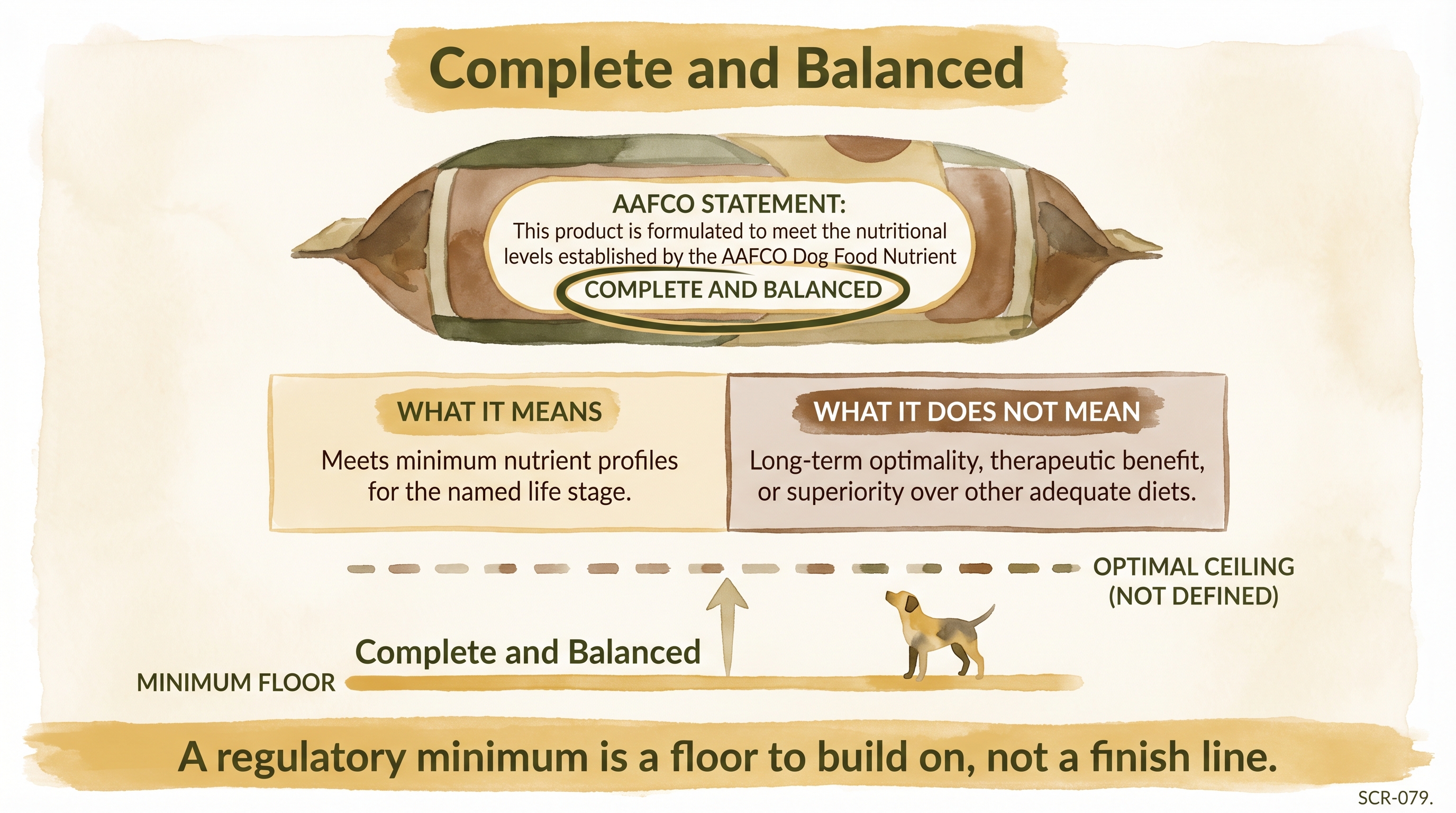
A regulatory minimum is a floor to build on, not a finish line.
Key Takeaways
- Complete and balanced means the food is intended to provide the dog's full nutrition for the stated life stage when fed as the sole diet.
- Intermittent or supplemental feeding means the product is not meant to carry the whole diet on its own, even if it looks rich or premium.
- Life stage still matters. Adult maintenance, growth, and all life stages are not interchangeable claims.
- This one line is often more important than the front-panel marketing because it tells you what job the food is actually designed to do.
The Evidence
This entry uses observed claim-level tags beyond the dedicated EvidenceBlocks below. These tags mark JB program observation or practice-derived claims that need dedicated EvidenceBlock coverage in a later content pass.
This entry uses ambiguous claim-level tags beyond the dedicated EvidenceBlocks below. These tags mark claims where the literature remains unsettled or multiple interpretations coexist.
The evidence here is strong because the core claim is regulatory and practical rather than speculative. A complete-and-balanced statement is a defined adequacy claim. A supplemental-feeding statement is a defined warning that the product is not meant to stand alone. The main family risk is not uncertainty about the rules. It is inattention to the line that contains them.
SCR-079 is especially important in this discussion because it sets the rhetorical ceiling clearly. Complete and balanced means minimum adequacy under a defined substantiation framework. It does not mean optimal for every dog. It does not mean superior to all alternatives. It does mean the product clears an important safety floor that supplemental products do not.
- AAFCO regulatory frameworkdog-food labeling context
The nutritional adequacy statement indicates whether a food is complete and balanced for a specific life stage or intended only for intermittent or supplemental feeding. - SCR-079 synthesisdog-food adequacy context
Complete and balanced is a meaningful floor for daily-feeding safety, even though it is not proof of superiority or lifelong optimality. - Commercial regulation source synthesisdog-food consumer context
Many premium accessory products are not intended to function as sole diets despite looking rich or meal-like to owners.
- Label-reading frameworkdog-food consumer context
The adequacy statement is one of the most consequential lines on the package because it defines the food's intended nutritional role. - Life-stage interpretation synthesisdogs
A complete-and-balanced claim must always be read together with the life stage named on the label.
No published study directly tests the practical implications of the complete and balanced label for domestic dog raising programs. The application to household dog raising remains an interpretive synthesis rather than a directly tested intervention finding.
SCR References
Sources
- National Research Council. (2006). Nutrient Requirements of Dogs and Cats. Washington, DC: The National Academies Press.
- Association of American Feed Control Officials (AAFCO). (2024). Official Publication. Association of American Feed Control Officials.
- U.S. Food and Drug Administration. (2014). Pet food labeling guide. FDA Center for Veterinary Medicine.
- American Association of Feed Control Officials. (2014). Model regulations on pet food. AAFCO Official Publication.