Canine Vitamin and Mineral Requirements
Compound evidence detail1 SCR / 2 parts
- Documentedcanine nutrient-profile and toxicity evidence showing defined vitamin and trace-mineral requirements, narrow safety margins for selected micronutrients, and clinically important deficiency-or-excess consequences
- Observed-JBthe recipe-survey pattern that unformulated home-prepared diets commonly miss mineral or vitamin targets and require veterinary-nutrition formulation review
Micronutrients are the reason a diet can look generous in calories and still be nutritionally poor. Vitamins and minerals are needed in much smaller amounts than protein, fat, and carbohydrate, but their biological importance is outsized. They support bone formation, oxygen handling, enzyme systems, antioxidant protection, nerve conduction, thyroid function, immune regulation, and more. In practice, this means a dog can be adequately fed in quantity and still be inadequately fed in composition if the micronutrient profile is wrong. Documented
What It Means
Micronutrients fall into two broad groups: vitamins and minerals.
The key nutrition lesson is not memorizing every number. It is understanding that balance, bioavailability, and life-stage fit matter as much as raw presence.
Fat-Soluble Vitamins
The fat-soluble vitamins are vitamin A, vitamin D, vitamin E, and vitamin K.
These matter because they are stored and because some can become toxic when overprovided.
Vitamin A matters for vision, epithelial health, and development, but excessive intake, especially in heavily liver-based homemade feeding, can be harmful. Documented
Vitamin D matters for calcium regulation and skeletal health, but dogs do not manage vitamin D excess casually.
Vitamin E functions as a key antioxidant partner, especially in higher-fat diets.
Vitamin K is associated with clotting function and broader biochemical roles.
Each one deserves a little more precision because this is where homemade diets go wrong so easily. Vitamin A supports vision, epithelial integrity, and growth, but toxicity is real, especially in liver-heavy homemade feeding where intake can quietly rise above a safe window. Vitamin D is essential because dogs rely on the diet for it much more than humans do, and it directly affects calcium and phosphorus handling. Vitamin E acts as a major antioxidant, especially when polyunsaturated fat intake rises. Vitamin K is best known for clotting, but it also participates in broader metabolic processes. Families do not need to memorize toxicity numbers, but they do need to know that fat-soluble vitamins are stored and can become dangerous when over-supplemented.
That storage point is one reason supplement stacking is risky. A family may start with a complete food, then add liver, then add a multivitamin, then add another targeted product without realizing that the same micronutrient is being delivered through several channels at once.
Water-Soluble Vitamins
The water-soluble group includes the B-complex vitamins and vitamin C.
The family-level practical point is that dogs can synthesize vitamin C, which is why it is not handled the same way as in humans. That does not make it irrelevant physiologically, but it does mean it is not a standard dietary essential in the canine profile.
The B vitamins remain important for energy metabolism, neurologic function, red blood cell support, and multiple enzyme systems.
This category includes thiamine, riboflavin, niacin, pyridoxine, folate, cobalamin, pantothenic acid, and biotin. Different deficiencies look different, but the general theme is the same: the body uses these vitamins for metabolism and cellular housekeeping at a scale too important to improvise. The practical family point is that dogs can synthesize vitamin C, which is why "add vitamin C to every diet" is not a basic adequacy requirement in the same way it is in some human nutrition conversations.
Major Minerals
The large-quantity minerals include calcium, phosphorus, magnesium, sodium, potassium, and chloride. Documented
These are not just bone minerals. They are also electrical, muscular, and fluid-balance minerals.
Calcium and phosphorus obviously matter for the skeleton, but magnesium, sodium, potassium, and chloride also keep the body electrically stable. Muscle contraction, nerve conduction, hydration status, acid-base balance, and cellular transport depend on these minerals working together. This is why a diet can be calorie-rich and still physiologically unsteady if the mineral pattern is off.
Calcium and phosphorus deserve special attention because their ratio matters, especially in growing large-breed dogs. That topic is so important it gets its own dedicated page later in this dispatch.
Trace Minerals
Trace minerals are needed in smaller quantities but are still essential. These include iron, copper, zinc, manganese, iodine, and selenium.
Trace does not mean optional. It means tiny amounts can still have large physiologic consequences.
Iron supports oxygen transport. Copper participates in connective tissue, iron metabolism, and pigmentation. Zinc matters for skin, immune function, and repair. Manganese supports enzyme systems and skeletal biology. Iodine is central to thyroid hormone production. Selenium is part of antioxidant systems and has a narrow safety margin. These are not glamorous nutrients, but they are exactly the nutrients a family notices only after something has gone wrong.
This is another reason homemade diets can look deceptively good. Meat and vegetables are visually convincing. Iodine, selenium, zinc, and vitamin D are not. The invisible part of nutrition is often the part that decides whether the diet is actually complete.
Balance Matters More Than Ingredient Mythology
This is one of the most important nutrition corrections families can learn. Nutrients do not work as isolated trophy items.
Problems arise from deficiency, excess, poor ratio, and low bioavailability.
That is why a homemade diet can look wholesome and still be dangerous if it is missing a premix or proper formulation. The most common homemade-diet problem is not that it contains bad ingredients. It is that it quietly omits micronutrient structure.
That omission pattern is also very predictable. The homemade diets most likely to fail are often meat-forward and emotionally appealing, but thin in calcium, iodine, zinc, vitamin D, and vitamin E. That means the food can look fresh, recognizable, and even luxurious while remaining nutritionally incomplete.
Toxicity Is Real Too
Families often think only in deficiency terms, but toxicity matters too.
Examples include excessive vitamin A from liver-heavy feeding, calcium excess in large-breed puppyhood, and some trace-mineral excesses when supplements stack on top of complete food. Documented
This is why "more" is not the same thing as "better."
Vitamin A toxicity is the classic example because it sounds counterintuitive to many families. Liver is nutrient-rich, but a diet anchored too heavily to liver can produce excessive vitamin A intake over time. The lesson is not that liver is bad. The lesson is that concentrated micronutrient sources require actual formulation discipline.
The same logic applies to trace-mineral blends and multivitamins. These products can be useful in a diet designed to need them. They can be unnecessary or destabilizing when layered on top of a complete food without a real plan.
Bioavailability Changes the Picture
Even when a mineral or vitamin is technically present, the dog's body may not absorb it equally well from every source.
Important differences can come from chelated versus inorganic mineral forms, phytate-rich ingredient interactions, processing effects, and the overall matrix of the diet.
This is why nutrient tables and real nutrient delivery are related but not identical.
Chelated minerals are part of this conversation because form affects absorption. In general, chelated or amino-acid-complexed minerals can behave differently from simple inorganic salts, especially in diets where plant compounds such as phytates interfere with absorption. That does not mean every chelated mineral is automatically superior, but it does mean source form can materially change real delivery.
Why Commercial Adequacy Is Usually Safer Than Improvised Adequacy
Well-formulated complete diets are not perfect, but they are much less likely than improvised homemade feeding to drift into major micronutrient imbalance.
The common high-risk homemade pattern is meat-heavy, calcium-poor, iodine-poor, vitamin D uncertain, and trace minerals are underbuilt. Ambiguous
That problem can be fixed, but only with proper formulation rather than intuition.
The more honest version of "whole foods are enough" is that whole foods are often not enough unless someone with nutrition expertise has already balanced the recipe. Dogs do not get partial credit for good intentions if the calcium is too low, the iodine is missing, or the selenium window is missed.
That is why this page is really about humility. Micronutrients are easy to overlook precisely because they are so small. Their small quantity does not make them optional. It makes them easy for intuition to miss.
That humility is especially useful in a supplement-heavy market. A family can feel more careful each time it adds another product, while the actual micronutrient picture becomes harder and harder to see clearly. Better stewardship often means fewer additions and more trust in a well-formulated base diet.
Why It Matters for Your Dog
Micronutrient literacy matters because it protects families from one of the most expensive nutrition mistakes: assuming that ingredient wholesomeness automatically creates nutritional completeness.
For Goldens, micronutrient balance matters across all life stages, but the stakes are especially high during puppy skeletal development, in homemade feeding protocols, when supplement stacking becomes a risk, and in older-dog disease management. It matters in the everyday household too. A family may start with a complete food, add fish oil, add a multivitamin, add toppers, add calcium because of a puppy-growth fear, and accidentally build an unnecessary excess. Another family may swing the opposite direction and replace part of a complete diet with a homemade meat-and-vegetable mix that quietly dilutes the micronutrient integrity of the food. Both mistakes come from not appreciating how much micronutrient balance depends on the full diet, not on one heroic ingredient.
For Golden Retriever families, this is especially relevant because Goldens spend meaningful time in two high-attention windows: puppy growth and later-life disease management. Documented In puppyhood, minerals and fat-soluble vitamins matter for structural safety. In older dogs, supplement culture expands quickly, which raises the risk of stacking products without clear need.
The invisible side of the diet is why micronutrients can be so counterintuitive for families. Protein, fat, and ingredient lists all feel tangible. Vitamins and minerals do not. Yet the dog's ability to regulate calcium, move oxygen, maintain skin integrity, support thyroid function, and run countless enzyme systems still depends on those invisible pieces being there in the right form and at the right level. That is why a diet can look abundant and still be biologically weak.
This also explains why nutrition mistakes at the micronutrient level often take longer to recognize. The dog may not collapse into one dramatic deficiency syndrome. Instead, the body may show a quieter pattern of instability, poorer tissue quality, weak growth, or inconsistent resilience over time. Families who understand that are less likely to trust appearance alone and more likely to respect formulation as the real safeguard.
For households feeding a complete commercial food, the safest practical lesson is often restraint. Before adding another powder, multivitamin, or liver-heavy topper, ask whether the existing diet is already designed to supply the nutrient architecture the dog needs. Many well-meaning mistakes begin when adults assume more support must be safer than leaving a complete diet alone.
Micronutrients are the quiet nutrient architecture of the diet. When that architecture is solid, the dog simply functions better. When it is weak, the problems may appear slowly and indirectly, which is why families need formulation discipline long before they see something dramatic.
That is also why improvised adequacy is so risky. It is easy to admire ingredients. It is much harder to build the invisible architecture they are supposed to support.
Small amounts do not mean small consequences. That may be the most important sentence in the whole page. Micronutrients are tiny by weight and massive by effect, which is exactly why intuition alone misses them so easily.
Formulation is what keeps the invisible side of the diet working. That is the real family takeaway. Micronutrients are easiest to miss exactly because they are not loud.
The quiet architecture is still architecture, and dogs depend on it every day whether families can see it or not.
Invisible does not mean optional. That may be the cleanest family lesson in the whole page, and it is exactly why micronutrient formulation deserves so much respect.
The hidden work is still work, and that is why micronutrient balance deserves so much respect in canine nutrition.
The small amount is not the same as a small role, and that is the key to understanding micronutrients.
Micronutrients are small by weight and large by consequence, which is why the page treats them as architecture rather than decoration.
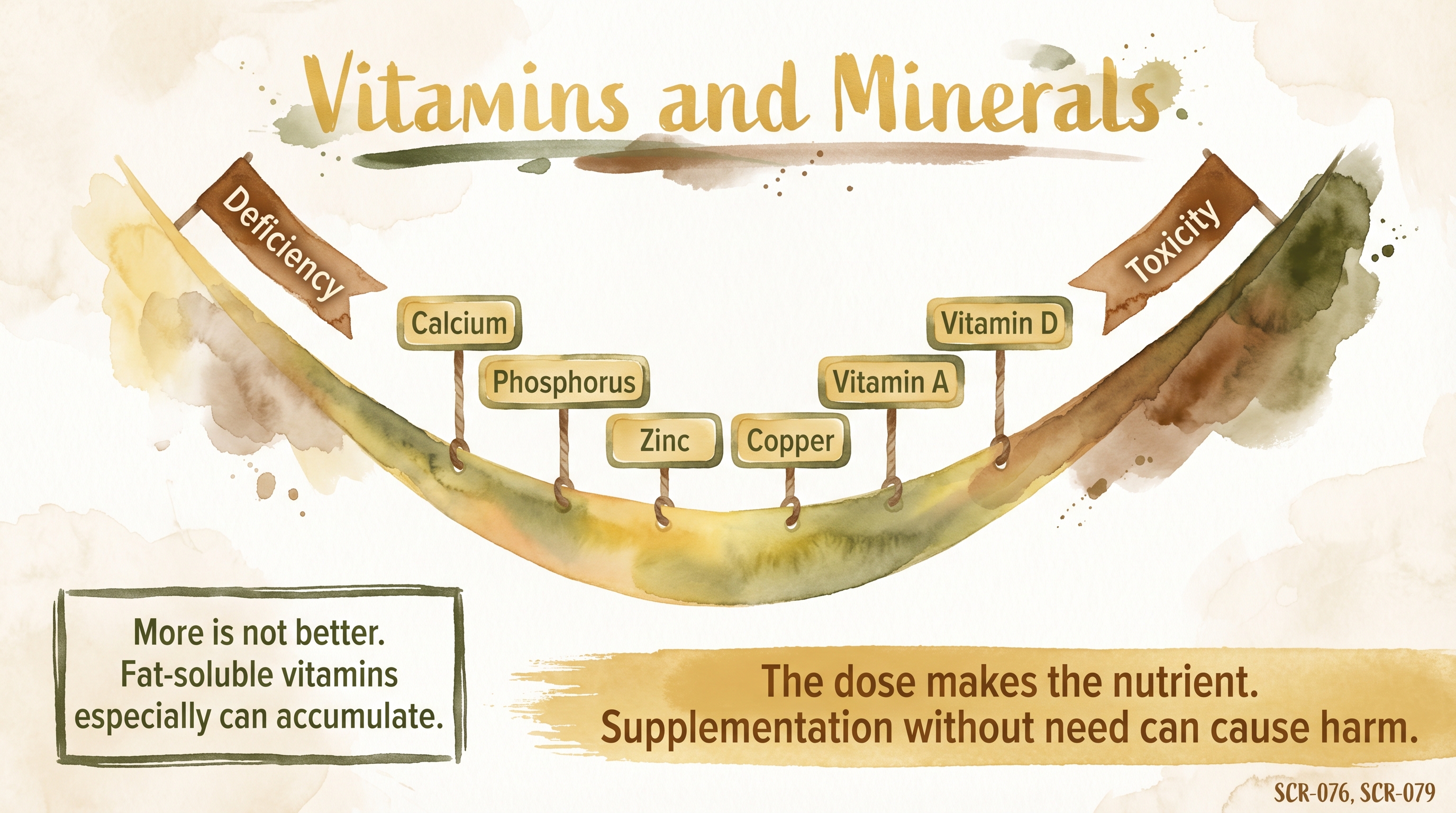
The dose makes the nutrient - supplementation without need can cause harm.
Key Takeaways
- Micronutrients are needed in small amounts, but deficiency, excess, and imbalance can all create serious health problems.
- Fat-soluble vitamins and major minerals deserve special respect because storage, ratio, and toxicity all matter.
- Calcium-phosphorus balance is one of the most important mineral issues in large-breed puppy nutrition.
- Homemade diets fail most often at the micronutrient level, not because food looks unhealthy but because formulation is incomplete.
The Evidence
This entry uses ambiguous claim-level tags beyond the dedicated EvidenceBlocks below. These tags mark claims where the literature remains unsettled or multiple interpretations coexist.
The strongest evidence here supports a simple but often neglected truth: micronutrients are architecture, not decoration. Dogs need fat-soluble vitamins, water-soluble vitamins, major minerals, and trace minerals in a balanced, bioavailable pattern. Homemade diets fail most often at this level because it is easy to supply meat and calories and much harder to build the invisible nutrient scaffolding correctly. That is why adequacy is a formulation issue, not an ingredient-aesthetics issue.
- Canine micronutrient source synthesisdogs
Canine nutrition depends on both vitamins and minerals in balanced, bioavailable forms, with life-stage demands affecting adequacy and risk. - NRC and AAFCO frameworkdog nutrition standards
Micronutrient guidance is built around minimums, safety logic, and practical profile translation rather than casual ingredient intuition. - Puppy developmental nutrition source synthesisdogs
Calcium and phosphorus balance is one of the most clinically important mineral issues in growing large-breed dogs.
- Nutrition source synthesisdogs
Improvised homemade diets most often fail not because the ingredients are obviously poor but because micronutrient balance and premix support are missing or incomplete.
No published study directly tests the practical implications of canine vitamin and mineral requirements for domestic dog raising programs. The application to household dog raising remains an interpretive synthesis rather than a directly tested intervention finding.
SCR References
Sources
- National Research Council. (2006). Nutrient Requirements of Dogs and Cats. Washington, DC: The National Academies Press.
- Association of American Feed Control Officials (AAFCO). (2024). Official Publication. Association of American Feed Control Officials.
- Kasper, K. C., Coates, J. R., & Argerich, S. (2019). Nutritional management of chronic kidney disease in dogs. Veterinary Clinics of North America: Small Animal Practice, 46(6), 1125-1138.
- Collins, M. C., & Shelton, G. D. (2019). Nutritional management of myopathies. Veterinary Clinics of North America: Small Animal Practice, 46(6), 1091-1105.