The Human Grade Pet Food Claim
Compound evidence detail1 SCR / 2 parts
- Documentedthe AAFCO human-grade framework requiring human-edible ingredients and human-food-facility handling across the full product manufacturing chain
- Heuristicthe boundary that human-grade status does not establish superior canine health outcomes because comparative long-term controlled diet data are absent
"Human grade" is one of the most powerful phrases in premium dog-food marketing because it seems to solve the quality question in two words. If the food is fit for humans, families naturally assume it must be cleaner, safer, and better for the dog. The claim is not meaningless, but it also does not mean what many families think it means. Human grade is first a handling and regulatory term, not a guarantee of nutritional superiority or better long-term health outcomes. Documented
What It Means
Under AAFCO-style guidance, a product can only be called human grade if every ingredient and the finished product have been stored, handled, processed, and transported in a way that would meet the standards applicable to human food. Documented-Cross-Species This is not supposed to be a loose adjective applied casually to whatever sounds cleaner than ordinary pet food. It is a defined claim with facility and handling implications.
That means the phrase does matter. A true human-grade claim signals something real about the chain of custody and the environment in which the food was produced. It suggests a higher bar for sourcing, storage, and handling than ordinary feed-grade pathways require. That is a legitimate consumer preference and, in some contexts, a meaningful quality signal.
The problem arises when families overread the claim. Human grade does not mean nutritionally complete by itself. Human grade does not mean the food passed stronger feeding trials. Human grade does not mean the formula is better matched to the dog's life stage. Human grade does not mean the dog will necessarily do better on it than on a well-made feed-grade food from a scientifically strong manufacturer. Documented
Why the Phrase Is So Attractive
The phrase works because it taps directly into human food intuition. Most families know very little about pet-food manufacturing. They know much more about their own comfort with kitchen standards and grocery language. "Human grade" therefore feels like a translation tool. It gives the family a familiar quality frame.
That familiarity is powerful enough that families sometimes begin treating the claim as a complete trust substitute. If the product is human grade, they feel less need to ask who formulated it, whether it is complete and balanced, how the adequacy claim was supported, or whether the company publishes meaningful research. Documented This is exactly where a useful claim can become a misleading shortcut. The phrase answers one important question about handling standards. It does not answer every other question that still determines whether the food is right for the dog.
That emotional pull is not silly. Families reasonably care about how ingredients were handled and where they were made. The trouble is that the claim can begin carrying far more symbolic weight than its actual evidentiary reach. Once that happens, owners may choose a food because the phrase feels morally clarifying rather than because the total nutrition case is stronger.
The Weaker Cousins of Human Grade
Part of the confusion comes from the softer phrases surrounding the claim. "Human-grade ingredients" is not the same thing as a fully human-grade pet food. Documented "Made in a human food facility" is also not the same claim. "Restaurant quality" is mostly marketing language with very little technical value. These phrases borrow the glow of the true claim without always carrying its full requirements.
Families need to read these distinctions carefully because the pet-food aisle often uses the emotional force of human-food language in diluted forms. A company may be telling the truth and still be using a much weaker statement than owners realize. That is why the exact wording matters.
The pricing pattern around the claim matters too. True human-grade products are often expensive because the manufacturing and handling pathway is more demanding. That makes it even more important that the family understand what they are paying for. If the food is being chosen mainly for the reassurance of the phrase rather than for a full evidence-based fit, the household may end up paying premium prices for a confidence feeling rather than for a clearly better nutrition plan.
Where Human Grade Shows Up Most Often
The claim is most common in fresh cooked food, refrigerated products, and some premium minimally processed categories. That makes intuitive sense because those products already lean on ingredient visibility and handling narratives. It is much less common in conventional kibble partly because the manufacturing chain and facility structure are different.
This pattern can create another interpretive mistake. Owners may start assuming that the absence of a human-grade claim is evidence of poor food. Documented-Cross-Species It is not. It may simply reflect a different category, a different facility model, or a company that is relying on other quality systems rather than this particular marketing and regulatory pathway.
What the Claim Does Not Solve
A human-grade claim does not resolve the basic questions that matter in dog feeding. Who formulated the food? Is the product complete and balanced for the intended life stage? Was the adequacy claim substantiated through formulation or feeding trial? Can the company provide transparent nutrient analysis and quality-control information? Does the dog actually do well on the food? These questions remain active whether the claim is present or not.
This is especially important because some owners begin treating human grade as a total quality shortcut. If the phrase is on the label, they stop asking harder questions. That is exactly the wrong move. A useful claim should narrow uncertainty, not end investigation.
Why It Matters for Your Dog
This page matters because many families are using human-grade language as a proxy for love, safety, or seriousness. They do not simply hear a technical handling claim. They hear a moral promise that the dog is being fed at a human standard. That is why the phrase has such power.
For some households that promise becomes a source of pressure. They begin to feel that not feeding a human-grade food means settling for something less caring, even when the alternative food is well made, appropriately substantiated, and much easier for the family to sustain. This page matters partly because it helps release that pressure. Good stewardship is not measured by one premium phrase. It is measured by the total fit between the food, the dog, and the household's ability to keep the plan going well.
For some households, that power can be helpful. A genuinely human-grade product from a transparent company may align well with the family's values and may improve trust in the feeding plan. That is not trivial. Confidence and consistency are both useful in daily care. The trouble begins when the phrase is allowed to outrank more important nutritional questions.
For Golden Retriever families, this matters because the breed often lives in emotionally invested homes where owners are trying very hard to "do the best." Human-grade language is tailor-made for that emotional effort. It sounds like proof that corners are not being cut. The healthiest response is not cynicism. It is proportional interpretation. The claim is meaningful, but it is one signal among several.
The safest use of a premium claim is to let it trigger more good questions, not fewer. A claim like human grade should lead the family to ask how the food is formulated, substantiated, and sustained in real life, not to stop the inquiry early.
This page also matters because it helps families avoid false hierarchy. A strong kibble from a transparent company may be a better nutritional fit for the dog than a human-grade fresh product the family cannot sustain or that does not match the dog's needs well. A therapeutic diet without a human-grade claim may be far more appropriate for a sick dog than a premium fresh formula with beautiful sourcing language. The right diet question is always bigger than one claim.
Another practical reason this page matters is that it helps owners spot diluted marketing language. Once the family understands the difference between human grade, human-grade ingredients, and made in a human food facility, they become far less vulnerable to being impressed by phrases that sound stronger than they are.
This is why the human-grade claim works best when it stays in proportion. It can reassure owners about sourcing and handling. It can align well with fresh-food formats that already depend on a stronger kitchen-style story. It can also become a distraction if it pulls attention away from adequacy, company transparency, and whether the dog is actually thriving on the food. A useful quality signal becomes misleading the moment it starts pretending to be the entire quality picture.
For families, the most protective attitude is simple. Treat human grade as one meaningful plus sign, not as a crown. If the rest of the food's evidence is strong and the household can sustain it, the claim may be a welcome additional reason to trust the plan. If the rest of the evidence is weak or the plan is impractical, the phrase should not be allowed to rescue the decision on its own.
The claim is also relatively rare for a reason. Meeting full human-grade standards across ingredients, finished product, handling, and facility requirements is demanding. That rarity can make the phrase feel even more prestigious, but prestige should not be confused with completeness of evaluation. A hard-to-make claim can still be only one part of a responsible buying decision.
Families who keep that proportion usually make better choices. They can appreciate the handling standard without turning it into a purity test. They can enjoy the reassurance when it fits the food and the household. They can also walk past the claim when another food, lacking that phrase, is still the better total answer for the dog.
The family-level lesson is that handling quality and nutrition quality overlap without being identical. A food can be handled beautifully and still be a poor fit for the dog's life stage or household reality. Another can lack the human-grade phrase and still be an excellent, evidence-aware choice. Keeping those categories separate is what allows the claim to stay useful instead of becoming exaggerated.
That is usually the healthiest long-term relationship to any premium claim: appreciation without surrender.
Owners often feel relieved once this distinction is clear, because it lets them keep the claim in perspective without dismissing it entirely. A human-grade label can still be a welcome sign of care in sourcing and handling. It just no longer has to carry the entire emotional burden of proving that the family is feeding at the highest possible level. Once that burden is lifted, the decision usually gets calmer and more accurate.
That proportional reading is what keeps a strong claim from turning into a distorted one.
That calmer reading protects both the dog and the family from giving a useful signal more power than it can honestly bear.
That distinction gives the claim its proper size. Important, useful, worth noting, but still only one part of a much larger feeding judgment.
Once owners see it that way, the phrase becomes a helpful detail instead of a total decision-making shortcut.
Seen this way, the claim still has value. It simply works best as supporting evidence rather than as the whole case. That is a more realistic and much more durable way to use it in actual food decisions.
That is usually the most mature way to read any premium claim. Let it inform the choice, but do not let it carry the whole weight of the choice by itself.
Keeping the claim in that supporting role is usually what lets it stay useful.
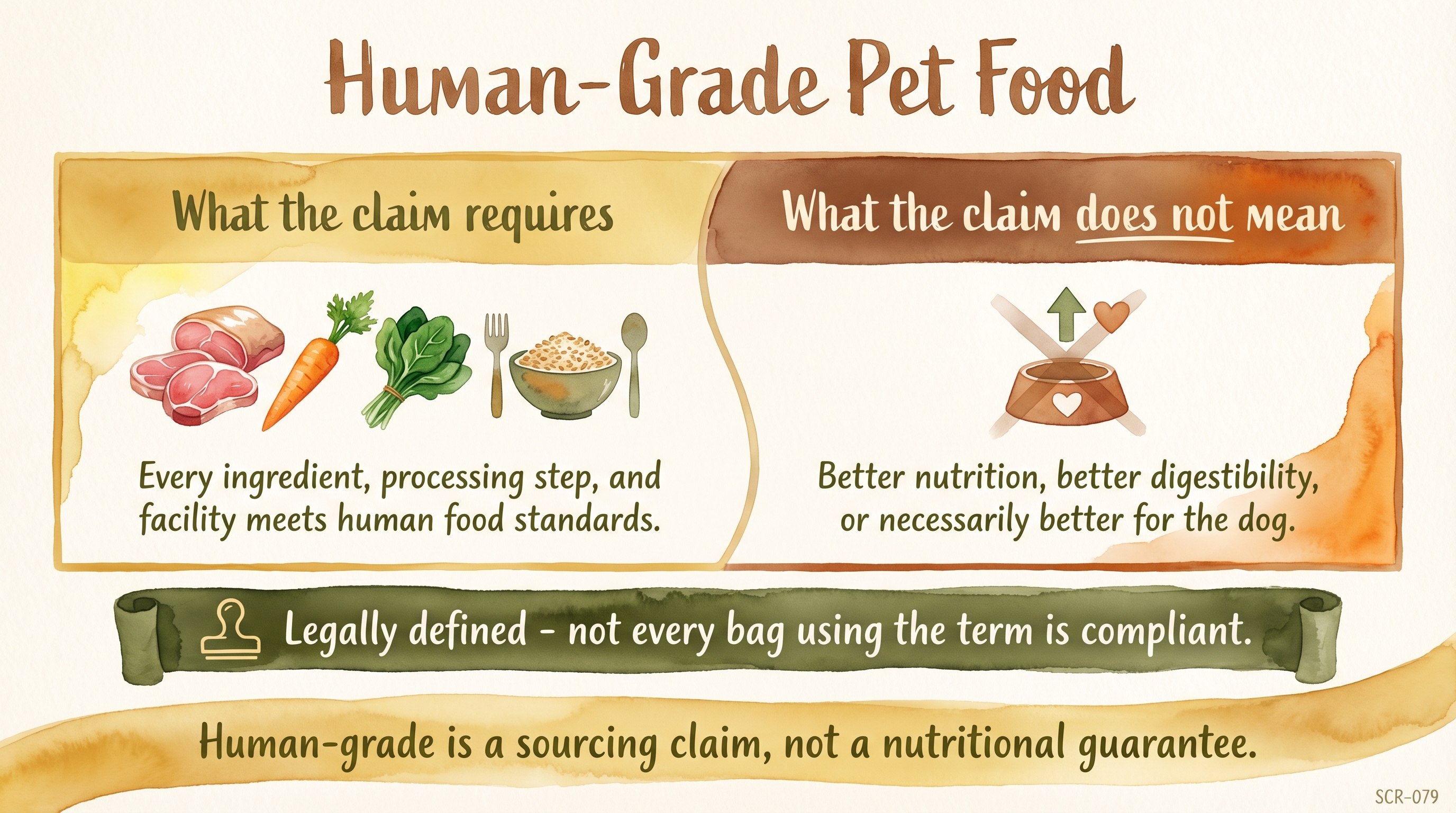
Human-grade is a sourcing claim, not a nutritional guarantee.
Key Takeaways
- Human grade is a real claim tied to handling and facility standards, not just a poetic marketing adjective.
- It does not by itself guarantee complete-and-balanced adequacy, stronger substantiation, or better long-term health outcomes.
- Weaker phrases such as human-grade ingredients or made in a human food facility should not be mistaken for the full claim.
- Human grade can be a useful quality signal, but it should never replace the more important questions about formulation, substantiation, and fit for the dog.
The Evidence
This entry uses documented cross-species claim-level tags beyond the dedicated EvidenceBlocks below. Species and application scope should be checked during the next evidence-chain authoring pass.
The evidence around human grade is mostly definitional and interpretive. The core claim is documented. There are real standards tied to the phrase. What is weaker is the leap from handling standard to canine health superiority. That is the point where the evidence thins out. Better sourcing and handling may be valuable. They do not by themselves prove better outcomes for the dog.
That evidence boundary is exactly why the claim should be respected without being inflated. Human grade can tell the family something useful about how the food moved through the system. It cannot, on its own, settle whether the dog would do better on that food than on a strong non-human-grade alternative. The wider nutrition picture still has to be built the usual way.
This is why the phrase should be treated as a legitimate but limited quality signal. It tells you something. It does not tell you everything. It should never replace adequacy, substantiation, company transparency, and the dog's real-world response as the main pillars of food selection.
- AAFCO human-grade guidancedog-food regulatory context
Human grade is a defined claim tied to ingredient and finished-product handling, storage, processing, and facility standards. - Commercial regulation source synthesisdog-food marketing context
Weaker phrases such as human-grade ingredients or made in a human food facility do not necessarily carry the full force of a true human-grade pet-food claim.
- Selection-framework synthesisdog-food consumer context
Human grade is a real quality signal about handling standards, but not a shortcut to proving better formulation, adequacy, or long-term health outcomes. - JB label-reading interpretationdog-food consumer context
The most responsible use of the claim is as one factor within a broader evidence-based evaluation, not as a final answer on food quality.
No published study directly tests the practical implications of the human grade pet food claim for domestic dog raising programs. The application to household dog raising remains an interpretive synthesis rather than a directly tested intervention finding.
SCR References
Sources
- National Research Council. (2006). Nutrient Requirements of Dogs and Cats. Washington, DC: The National Academies Press.
- AAFCO. (2024). Official Publication. Association of American Feed Control Officials.
- U.S. Food and Drug Administration. (2014). Pet food labeling guide. FDA Center for Veterinary Medicine.
- WSAVA Global Nutrition Committee. (2011). WSAVA nutritional assessment guidelines. Journal of Small Animal Practice, 52(7), 385-396.
- Do, S., Phalen, D. N., Marks, S. L., & Fascetti, A. J. (2021). Nutrient digestibility and fecal characteristics are altered in dogs fed a fresh, human-grade food compared with a conventional dry kibble and a fresh, raw food. Journal of the American Veterinary Medical Association, 259(1), 95-103.