Calcium and Phosphorus in Growing Dogs
Compound evidence detail2 SCRs / 4 parts
- Observed-JBthe clinical-management pattern in growing dogs with renal dysplasia, where growth requirements for minerals and protein conflict with phosphorus restriction for impaired kidneys
- Heuristicthe Golden-Retriever-specific maturity timing and practical diet-transition guidance that should remain veterinary-nutritionist-directed rather than treated as a standard formula
- Documentedcanine nutrient-profile and toxicity evidence showing defined vitamin and trace-mineral requirements, narrow safety margins for selected micronutrients, and clinically important deficiency-or-excess consequences
- Observed-JBthe recipe-survey pattern that unformulated home-prepared diets commonly miss mineral or vitamin targets and require veterinary-nutrition formulation review
Calcium and phosphorus are essential nutrients, but in a growing large-breed puppy they are not nutrients you want to improvise with. Their job is structural and biochemical, and the growth-phase safety margin is narrower than many families realize. For Golden Retriever puppies, calcium excess is one of the most important nutrition risks to understand clearly and early. Documented
What It Means
Calcium and phosphorus are both central to skeletal development, but they also do more than build bone.
Calcium supports bone and tooth mineralization, muscle contraction, nerve signaling, and blood clotting.
Phosphorus supports bone mineralization, cellular energy metabolism, membrane structure, and nucleic acid biology.
The issue in puppies is not just whether these minerals are present. It is whether they are present in the right absolute amount and in the right ratio.
That ratio is important enough to name directly. In practical AAFCO language, the calcium-to-phosphorus target generally lives around 1:1 to 1.8:1. Estimated That range exists because skeletal development is not simply about supplying mineral raw material. It is about supplying those minerals in a controlled relationship.
This is one reason families can get into trouble when they focus on one nutrient in isolation. A diet can advertise calcium and still be unhelpful if the ratio to phosphorus is poor, and it can have an acceptable ratio while still delivering too much absolute calcium for a large-breed puppy. Ratio and total load belong in the same conversation.
Ratio and Ceiling Both Matter
The calcium-to-phosphorus ratio matters because bone mineralization is a coordinated process. But the ratio is not the only issue. A diet can have a mathematically acceptable ratio and still deliver too much total calcium.
For large-breed growth, that second problem is critical. Modern large-breed standards cap calcium more tightly for exactly this reason.
The ceiling matters too. Large-breed growth guidance caps calcium around 1.8 percent dry matter, which is lower than the broader standard growth ceiling. Estimated Families sometimes hear "the ratio matters" and conclude that absolute amount is secondary. In large-breed puppyhood, both matter.
That 1.8 percent dry-matter ceiling is one of the most important numbers in the entire puppy-nutrition category because it reflects a direct lesson from the orthopedic literature. Large-breed puppies do not need more room for calcium improvisation. They need less.
Why Puppies Are Vulnerable
Adult dogs regulate calcium absorption better than puppies do. Young puppies, especially during the early large-breed growth window, cannot reliably downregulate absorption when dietary calcium is excessive. That means extra calcium does not simply get ignored. It can be absorbed and retained.
That difference from adults is the core physiologic danger. Adult dogs have stronger hormonal feedback for calcium handling. Growing puppies are much less able to protect themselves from excess dietary load. Passive absorption continues even when the diet is already too rich in calcium.
This is the physiological reason calcium supplementation is risky in an already complete puppy food.
It is also why adult-dog logic can mislead families. An adult dog with different endocrine control and a fully developed skeleton is not the same biological situation as a large-breed puppy in active growth. Documented Advice that sounds harmless for an adult can be genuinely unsafe for a puppy.
The Great Dane Evidence
The classic controlled Great Dane studies remain foundational because they directly tested calcium and phosphorus variation during growth. Documented The practical lesson from that literature is strikingly consistent: excess calcium disrupts skeletal development, mineral imbalance can produce retained cartilage abnormalities and other lesions, and correction later does not guarantee full reversal.
That last point matters most. A growth-phase mineral mistake can leave residue.
The specific lesion language matters because it makes the problem less abstract. Hazewinkel and related studies documented osteochondrosis, retained cartilage cores, and radius curvus-type deformity patterns in the setting of calcium excess and mineral imbalance. Documented This is not a vague "maybe the bones grow suboptimally" concern. It is a documented structural-development concern.
That is why this page sits so firmly inside the prevention framework. Once the lesion process has started, later diet correction does not guarantee that the developmental cost disappears. Avoiding the error is much cleaner than trying to undo it.
Goldens and Large-Breed Logic
Golden Retrievers were not the main experimental model in the classic Great Dane work, but the large-breed application is still the right one. Goldens are clearly large-breed puppies with the same need for controlled mineral delivery and moderated growth.
This is a direct, not ornamental, application of the evidence.
The fact that Goldens were not the classic experimental model does not weaken the practical conclusion. Golden Retrievers are large-breed puppies with the same growth-phase vulnerability to excess calcium and poor mineral design. Families should therefore treat the evidence as directly relevant to how they feed their own puppy.
The Two Most Common Family Errors
The two classic mistakes pull in opposite directions:
- adding calcium to a complete large-breed puppy diet
- feeding a homemade diet without a properly formulated vitamin-mineral premix
The first can push the puppy above the safe calcium ceiling. Documented The second can leave the puppy underprovided and at risk of nutritional secondary hyperparathyroidism and poor skeletal development.
That opposite error is worth slowing down for because families sometimes think only about excess. When calcium is underprovided, or when the calcium-phosphorus pattern is badly skewed in a homemade diet, the body may pull calcium from the skeleton to maintain serum balance. That is the path toward nutritional secondary hyperparathyroidism. So the lesson is not merely "avoid too much calcium." It is "get the whole mineral structure right."
This is one reason homemade puppy diets are so unforgiving. A family can accidentally create either side of the problem. Add calcium to a complete commercial food and total intake may become excessive. Skip a proper premix in a homemade diet and calcium may fall too low relative to phosphorus. Different mistakes, same skeleton paying the price.
What Families Should Actually Do
For most Golden families, the best rule is straightforward: feed a complete and balanced large-breed puppy food, confirm it meets large-breed growth standards, do not add calcium supplements, and do not add bone meal or dairy with the idea that more is better.
This is a place where simple discipline is much safer than homemade correction.
Families also need to know that dairy, bone meal, and casual calcium powders are not harmless add-ons to a complete diet. Even when the intention is protective, the effect can be the opposite. Large-breed puppy nutrition is one of the least forgiving places to improvise.
The safest practical mindset is therefore almost boring: choose a complete large-breed puppy food, verify it is built for growth, and resist the urge to engineer the minerals yourself. In this topic, boring is protective.
Why the Topic Feels Counterintuitive
Calcium is marketed to humans as obviously good for bones, so it feels intuitive to assume more calcium means stronger skeletons for puppies. But development is not a simple "more raw material equals better structure" system. Growth biology is about regulated construction, not piling more bricks onto a job site.
Why It Matters for Your Dog
This page matters because calcium overexposure is one of the most avoidable growth-phase injuries in large-breed puppy nutrition. Families can do many things imperfectly and still be okay. This is not one of the areas where casual supplementation is benign.
For a Golden Retriever family, this is one of the clearest examples of a good instinct producing a bad outcome if it is not evidence-guided. People hear "calcium builds bone" and want to help. But the safer help is not extra calcium. It is choosing a properly formulated large-breed growth food and then leaving the mineral engineering alone.
That is a freeing message for families because it reduces the pressure to micromanage. You do not need to become the puppy's mineral chemist. You need to avoid disrupting a formulation that has already been designed for a sensitive growth stage.
The Prevention Pillar fits calcium biology unusually well. A skeletal lesion initiated during growth is not the same as a behavior you can simply redirect later. The cleanest approach is not to start the injury process in the first place.
When to See a Veterinarian
Prompt veterinary review is appropriate if a growing puppy shows limb pain or persistent lameness, bowed limb appearance, reluctance to stand or walk normally, poor growth despite eating, or tremors and weakness on a homemade diet.
These signs can reflect more than one problem, but they are not appropriate to manage casually at home.
Veterinary review is also wise when a family has been feeding a homemade diet without professional formulation and later realizes the mineral pattern may have been incomplete or imbalanced. Even before obvious orthopedic signs appear, that history can justify earlier assessment.
A complete large-breed puppy food already represents a mineral-engineering decision. When families add dairy, bone meal, or calcium powder on top, they are not simply being generous. They are altering one of the most tightly consequential parts of the growth formula. That is why this page keeps pushing families away from improvisation. Calcium is not the place where affection should become experimentation.
The same caution matters in the other direction. A homemade diet can look rich in meat and still be quietly poor in balanced mineral support. Because the body protects serum calcium so tightly, skeletal compromise can begin well before the family understands that the recipe was incomplete. That is why homemade puppy feeding demands professional formulation rather than wholesome-looking ingredients and hope.
For Golden Retriever families, the reward for getting this right is not flashy. It is simply a safer developmental environment. The puppy grows on a diet that already contains the mineral logic it needs, and the adults resist the urge to interfere with that logic. In this topic, restraint is not passive. It is actively protective.
Families often need permission to believe that bone-friendly is not the same thing as more-calcium-heavy. In a large-breed puppy, better bone stewardship usually means leaving a correctly formulated diet alone. That can feel less active than supplementation, but it is the more biologically respectful choice because the puppy is already eating a food designed around a narrow developmental safety margin.
This also helps explain why the page keeps returning to confidence rather than fear. The family does not need to become expert mineral managers. The family needs to trust the large-breed formulation enough not to stack extras on top of it and not to improvise a homemade mineral pattern without professional guidance.
That is why the page keeps making restraint sound active rather than passive. In large-breed puppyhood, leaving a complete mineral design intact is part of the treatment plan before there is a problem.
The practical reason to care so much about this topic is that quiet mineral drift during growth can matter long before a family sees a dramatic orthopedic consequence. The safest approach is not more creativity. It is more trust in a correctly built large-breed formula and more patience with the idea that leaving the mineral design alone is often the most evidence-based thing a family can do.
Families are safest when they stop trying to out-engineer the formula and instead keep the puppy inside a mineral pattern already designed for large-breed growth.
Quiet overexposure is still overexposure, which is why mineral restraint matters so much in a growing large-breed puppy.
Good mineral stewardship often looks like disciplined non-interference, and that is exactly the kind of restraint this page is teaching.
Large-breed calcium safety is built more by restraint than by supplementation, and that is why this page sounds so insistently conservative.
That is the protective simplicity of the page.
It is safer because it is simpler.
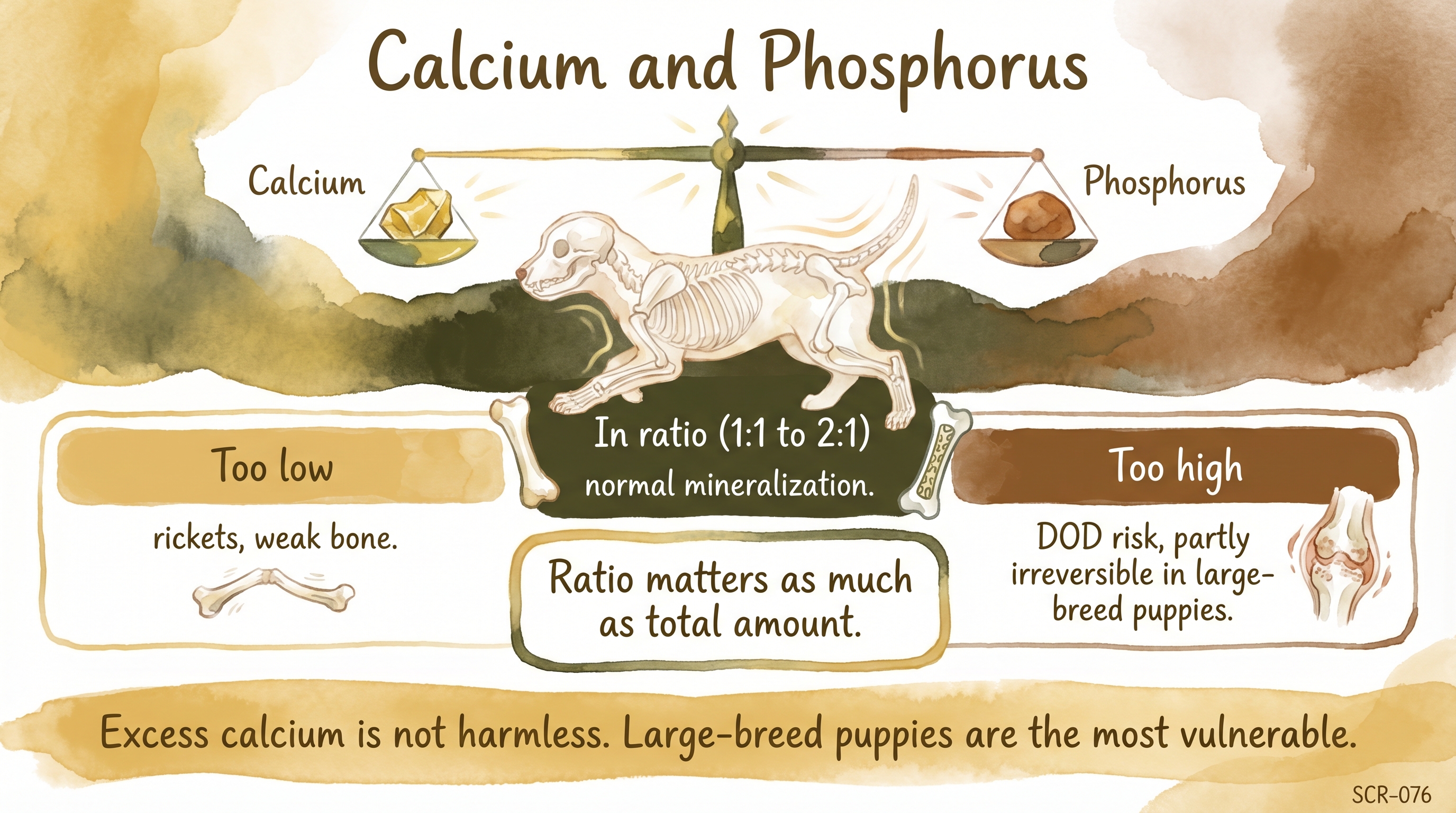
Excess calcium is not harmless - large-breed puppies are the most vulnerable.
Key Takeaways
- In growing large-breed puppies, calcium safety depends on both ratio and absolute intake, not ratio alone.
- Young puppies cannot reliably protect themselves from excess calcium the way adult dogs can.
- For a Golden puppy already eating a complete large-breed diet, extra calcium is more likely to create risk than benefit.
- The safest practical rule is to use a properly formulated growth diet and avoid calcium supplementation unless a veterinarian specifically directs otherwise.
The Evidence
This entry uses estimated claim-level tags beyond the dedicated EvidenceBlocks below. These tags mark approximate ranges or timing claims that should remain bounded by the cited sources.
The evidence in this area is unusually direct. Puppies regulate calcium less safely than adults. The calcium-to-phosphorus ratio matters. Absolute calcium load matters. Large-breed growth standards now reflect that reality with a lower ceiling. Hazewinkel and related work documented osteochondrosis, retained cartilage cores, and other structural consequences when the mineral pattern is wrong. That combination makes this one of the strongest prevention-style nutrition topics in the whole category.
It is also one of the rare nutrition topics where the practical takeaway is extremely simple because the evidence is so clear. Many pages in dog nutrition require nuance and tradeoff discussion. This page largely reduces to one protective rule: do not supplement calcium on top of a complete large-breed puppy diet, and do not improvise homemade mineral balance without professional formulation.
- Hazewinkel, Schoenmakers, Tryfonidou, and related studieslarge-breed puppies
Young large-breed puppies have limited protection against calcium excess, and excessive intake can produce significant skeletal developmental disturbance. - AAFCO large-breed growth frameworkdog-food regulatory context
Modern large-breed growth standards include a stricter calcium ceiling because absolute calcium load matters, not only the calcium-to-phosphorus ratio. - SCR-076 supportlarge-breed puppies
Excess calcium during growth can create injury that may not fully reverse later, making supplementation of complete diets unsafe.
- Large-breed to Golden Retriever inferencelarge-breed dogs to Golden Retrievers
Golden Retrievers should be treated as directly inside the large-breed calcium-control framework even though classic controlled trials often used Great Danes as the experimental model.
No published study directly tests the practical implications of calcium and phosphorus in growing dogs for domestic dog raising programs. The application to household dog raising remains an interpretive synthesis rather than a directly tested intervention finding.
SCR References
Sources
- National Research Council. (2006). Nutrient Requirements of Dogs and Cats. Washington, DC: The National Academies Press.
- Association of American Feed Control Officials (AAFCO). (2024). Official Publication. Association of American Feed Control Officials.
- Hazewinkel, H. A., van den Brom, W. E., Theyse, L. F., Karssenberg, D., Lloyd, M. H., Bennett, R. A., & Schoenmakers, I. (2000). Calcium metabolism in Great Dane dogs and the influence of vitamin D status. Journal of Small Animal Practice, 41(12), 571-577.
- Schoenmakers, I., Tryfonidou, M. A., van den Broek, J., & Hazewinkel, H. A. (2003). Nutritional factors in the development and prevention of orthopedic disease in growing dogs. The Veterinary Journal, 166(3), 221-232.
- Kalff, A., Tryfonidou, M. A., Hagen-Plantinga, E. A., & Hazewinkel, H. A. (2008). Nutritional strategies for the prevention and management of hip dysplasia in dogs. Journal of the American Veterinary Medical Association, 233(10), 1528-1535.