Puppy Nutrition: An Overview
Compound evidence detail1 SCR / 2 parts
- Documentedthe coordinated puppy-growth nutrition framework linking calorie density, nutrient adequacy margins, DHA, meal structure, and weaning pace as coupled developmental axes
- Heuristicthe practical target-setting layer for any single axis, which varies by puppy, breed, growth curve, and formulation rather than supplying universal numbers
Puppy nutrition is not just adult nutrition scaled down. Growth changes the whole feeding problem. Puppies need more energy per kilogram, more protein density, tighter mineral control, and a meal pattern that respects their developmental stage. For Golden Retriever families, that matters even more because Goldens are a large breed, and large-breed growth is one of the places where nutrition can genuinely change long-term orthopedic outcome. Documented
What It Means
The first year of life is a high-throughput developmental phase. Puppies are building bone, muscle, organs, nervous system tissue, and immune competence. That means nutrient density matters more than it does in adult maintenance. A food that is adequate for an adult dog may not be appropriate for a growing puppy.
Energy demand is a good example. In broad practical terms, a growing puppy can need roughly double the energy per kilogram of body weight compared with an adult dog in maintenance. That does not mean puppies should be fed carelessly. It means the growth phase is metabolically expensive, which is why underfeeding and overfeeding can both create problems.
Growth and Reproduction Is a Different Standard
One of the most important label distinctions families can learn is the difference between adult maintenance, growth and reproduction, and all life stages. In practice, "all life stages" foods must meet the more demanding growth-and-reproduction profile. Adult-maintenance foods do not have to do that. This is why a puppy should not simply be fed any adult food that looks high quality.
That label distinction is one of the easiest ways families accidentally make a mistake. "Adult maintenance" may sound like a mature, premium, perfectly responsible choice, but it is not automatically appropriate for a puppy. Growth and reproduction is the relevant regulatory standard because the puppy is building tissue, not merely maintaining it.
This is also why all-life-stages foods need to be read carefully rather than dismissed or romanticized. When they are legitimate, they are clearing the same more demanding growth-and-reproduction bar. The phrase sounds broad, but the standard underneath it is actually stricter than adult maintenance.
Energy Needs Are Higher
Growing puppies use more energy per kilogram than adults. They are building tissue while also supporting everyday movement, temperature regulation, immune development, and brain growth.
That does not mean the goal is maximal growth. For large-breed puppies, especially Goldens, the goal is controlled, lean growth. There is an important difference between adequately feeding growth and pushing growth. The second is where problems begin.
For Golden Retrievers, this timing matters because skeletal growth is still active through roughly 12 to 18 months, while soft-tissue and full maturational finishing can extend out toward 18 to 24 months. Estimated That means nutrition is not just a very early-puppy issue. It remains a developmental issue well beyond the first few months home.
This longer window helps families avoid a common mistake: treating the puppy-food decision as something that matters intensely for a few weeks and then becomes optional. For a Golden Retriever, growth nutrition remains relevant through much of the first year and into the broader maturation arc.
Protein Needs Are Higher Too
Puppies need more protein density than adult dogs because they are synthesizing tissue continuously. Documented The question is not whether puppies need protein. They do. The more useful question is whether the protein is adequate in amount, balanced in amino acids, and delivered in a digestible form. This is why growth-formula protein levels are properly higher than adult-maintenance levels.
A complete growth diet is therefore doing several jobs at once: providing enough energy for growth without pushing excess condition, delivering higher protein density, controlling calcium and phosphorus more tightly, and supporting neural development with appropriate fatty-acid profile. That full package is why "puppy food" is not just marketing when it is properly substantiated.
Calcium and Phosphorus Are the Biggest Safety Issue
For Goldens and other large-breed puppies, calcium and phosphorus are where nutrition stops being abstract and becomes structural biology.
Young puppies cannot regulate calcium absorption the way adults can. Documented Excess calcium intake, especially in large breeds, is strongly linked to skeletal developmental disturbance. That is why large-breed puppy formulas matter, and why casual calcium supplementation is one of the highest-risk feeding mistakes a well-meaning family can make.
DHA and Neural Development
Puppy food is also doing more than building bone and muscle. It is supporting the nervous system. DHA, the long-chain omega-3 fatty acid emphasized in growth formulas, matters because it is incorporated into neural and retinal tissue during a rapid developmental window. Documented
This is one reason puppy foods often feel more specifically engineered than adult formulas. They are.
The same logic explains why some family attempts at simplification go wrong. Feeding one adult food to the whole household can feel elegant and convenient, but convenience is not the same thing as developmental fit unless the food genuinely meets the growth profile.
Meal Structure Changes Through the First Year
Young puppies do best with smaller, more frequent meals because stomach capacity is limited, energy needs are high, and glycemic reserve is lower than in adults. As the puppy matures, meal frequency can gradually step down. This is a practical transition, not a moral one.
The practical feeding pattern matters enough to name clearly: about 4 meals per day before 12 weeks, about 3 meals per day from 12 weeks to 6 months, and about 2 meals per day after about 6 months. Estimated Those cutoffs are practical guideposts rather than magic thresholds, but they reflect real differences in gastric capacity, energy demand, and daily rhythm.
The Common Mistakes
The most common puppy-feeding errors are usually not malicious. They come from anxiety, mixed advice, or overcorrection. The major ones include feeding adult maintenance food too early, oversupplementing calcium, underfeeding because the family is afraid of joint disease, using body weight alone without watching body condition, and changing foods during the home transition too quickly. Another common mistake is assuming that "all life stages" means "generic." In regulatory terms, all life stages is actually a shortcut to the more demanding growth-and-reproduction profile. Used well, it can be a legitimate choice. Used casually, the label can confuse families who do not realize what standard it implies.
Families can also drift into over-management by changing foods too often. A puppy does not benefit from adults chasing every new recommendation, every boutique idea, or every small stool fluctuation with a brand-new formula. Growth nutrition works better when it is stable, measured, and evaluated against body condition and tolerance over time.
The Golden Retriever Context
Goldens are not the largest dogs in the classic giant-breed studies, but they are clearly within the large-breed orthopedic risk logic. Documented That means the large-breed puppy framework applies directly to them.
For a Golden puppy, the best nutritional posture is complete and balanced growth food, large-breed appropriate calcium control, lean body condition, measured portions, and slow, calm transitions. That posture is also philosophically consistent with JB's broader approach. The goal is not to maximize visible growth. The goal is to support orderly development. A puppy that is eating the right food, on the right schedule, with the right mineral control, and staying lean is on a much sounder path than a puppy whose diet is constantly being changed, supplemented, or emotionally overmanaged.
That is why this page functions as the gateway for the whole subcategory. Every later puppy-nutrition topic is a more detailed version of one of these core ideas: growth demands more than adult maintenance, large-breed mineral control matters, meal structure matters, and calm consistency usually outperforms nutritional improvisation.
That is also what makes overview discipline so useful. When the family has the main rules early, every later specialized page deepens the same framework instead of replacing it with new confusion.
Why It Matters for Your Dog
This page matters because it frames the whole first-year feeding problem correctly. The goal is not the fattest puppy, the biggest puppy, or the puppy eating the trendiest diet. The goal is a puppy that grows steadily, stays lean, and reaches maturity without avoidable nutritional stress.
That framing helps families avoid one of the most damaging emotional traps in puppy care: the belief that visible abundance must equal good stewardship. In large-breed puppies, abundance can become overload surprisingly fast. The more useful signs of good nutrition are steady growth, stable stool quality, good energy, lean body condition, and a food that genuinely matches the puppy's developmental stage.
It also helps families sort the difference between feeding generously and feeding well. Puppies absolutely need adequate calories and nutrient density. They do not need adults to prove love through constant extras, abrupt food upgrades, or a refusal to let the puppy ever look lean.
Puppy nutrition is one of the clearest examples of the Prevention Pillar in biology. A growth-phase mistake is not always something you clean up later. Some early nutritional errors, especially around calcium and excessive growth rate, leave structural residue.
Puppy nutrition becomes easier to manage once families understand that most of the confusing advice is fragmentary. One source talks about protein. Another warns about calcium. Another pushes DHA. Another obsesses over ingredients. The puppy, however, does not eat fragments. The puppy eats one complete diet living inside one developmental body. That is why the overview keeps pulling the conversation back toward whole-system feeding rather than one-nutrient panic.
That whole-system view is especially useful in the first months home, when families are often trying to do everything right all at once. A complete growth formula, a calm meal routine, controlled minerals, and lean condition will usually do more for long-term development than a constant cycle of upgrades, supplements, and anxious food switches. Observed-JB The harder part is not understanding that in theory. It is resisting the emotional urge to keep adding more variables.
For Golden Retriever families, that restraint is part of good raising rather than an absence of care. The puppy needs adequate fuel, developmental nutrients, and a food matched to large-breed growth. It does not need adults to keep reinventing the bowl in search of a perfect idea of optimization.
That is the advantage of seeing puppy feeding as one developmental feeding system. Protein, minerals, calories, meal structure, and transition stability all matter, but they matter as parts of one pattern instead of as isolated arguments. Once families see that pattern, later decisions become much less chaotic.
The overview is therefore not just introductory. It is organizational. It helps families decide which details deserve attention and which kinds of nutrition noise can be ignored.
A good overview reduces noise before it reduces mistakes. Once families see the feeding system clearly, they become much less vulnerable to panic, overcorrection, and fragmented advice.
The whole developmental pattern matters more than any one dramatic tweak, which is why calm consistency keeps winning in puppy feeding.
At the overview level, the message is simple: calm consistency beats frantic optimization far more often than puppy-food marketing suggests.
That is what lets the family stay focused on development instead of on constant reinvention.
System thinking is what makes the rest of the puppy pages usable. Without it, every later detail feels like a separate worry instead of part of one coherent developmental feeding plan.
The overview keeps the family oriented to the whole, which is often what prevents good intentions from turning into fragmented over-management.
Seeing the whole system is what keeps the details from becoming noise.
Good systems make later details easier to use, and that is exactly what this overview is for.
Clarity early usually means fewer avoidable mistakes later, which is why overview pages matter at all.
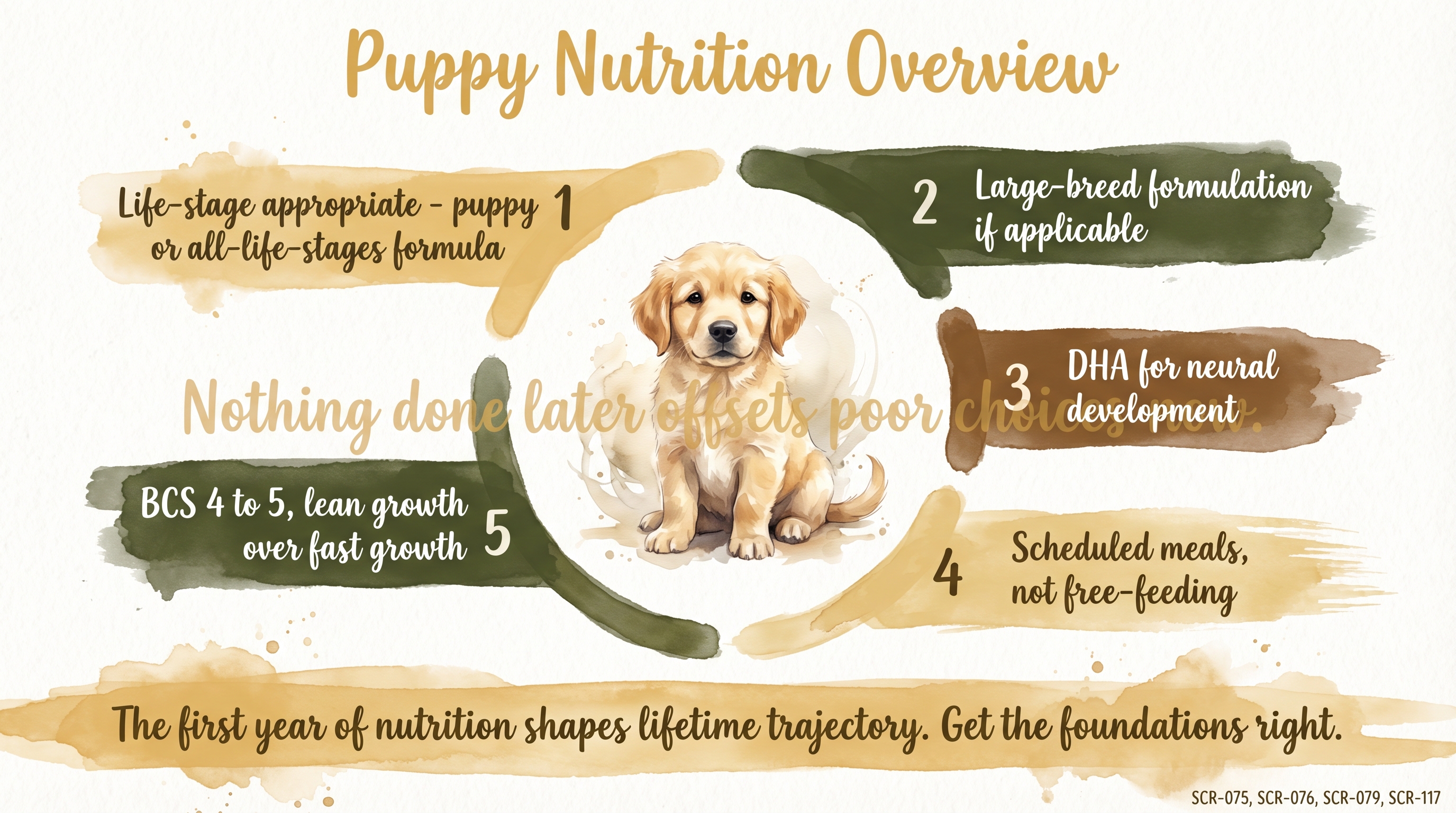
The first year of nutrition shapes lifetime trajectory - get the foundations right.
Key Takeaways
- Puppy nutrition is a developmental feeding problem, not just adult nutrition with smaller portions.
- Growth and reproduction standards matter because adult-maintenance foods may not deliver what a puppy needs.
- For Golden Retrievers, the most important nutritional priorities are lean growth, controlled calcium intake, and life-stage-appropriate food.
- The best puppy diet is the one that supports steady development without pushing growth faster than the body can safely handle.
The Evidence
This entry uses observed claim-level tags beyond the dedicated EvidenceBlocks below. These tags mark JB program observation or practice-derived claims that need dedicated EvidenceBlock coverage in a later content pass.
This entry uses estimated claim-level tags beyond the dedicated EvidenceBlocks below. These tags mark approximate ranges or timing claims that should remain bounded by the cited sources.
The evidence in puppy nutrition is strongest when it stays centered on development rather than ideology. Puppies need more energy per kilogram than adults. Growth and reproduction is the correct regulatory standard. All-life-stages foods clear that same higher bar. Meal frequency should be higher early and taper over time. Large-breed maturation stretches well beyond the first few months, which keeps nutrition relevant through much of the first year and beyond. Once those points are clear, the feeding job gets simpler and calmer.
That is why the page resists a more dramatic conclusion. The goal is not to turn puppy feeding into a constant optimization project. The goal is to get the developmental fundamentals right, preserve them consistently, and avoid the few mistakes that are especially consequential in large-breed growth.
When families understand that, the first year of feeding gets much less confusing. The job is not to chase every boutique idea. It is to match the food to growth, keep the puppy lean, protect mineral balance, and stay calm enough to let development proceed without unnecessary nutritional turbulence.
- Puppy nutrition source synthesisdogs
Growing puppies require greater nutrient density than adult dogs, including higher protein, controlled mineral delivery, and more energy per kilogram during active growth. - AAFCO growth-profile contextdog-food regulatory context
Growth and reproduction standards are more demanding than adult maintenance standards, which is why adult-maintenance foods are not the default choice for puppies. - SCR-076 supportlarge-breed puppies
Excess calcium during growth can cause skeletal injury, making mineral control a central rather than peripheral issue in large-breed puppy feeding.
- Golden Retriever applicationlarge-breed dogs to Golden Retrievers
Goldens are best treated as directly relevant to the large-breed growth framework even when the classic experimental models were Great Danes or Labradors rather than Goldens themselves.
No published study directly tests the practical implications of puppy nutrition: an overview for domestic dog raising programs. The application to household dog raising remains an interpretive synthesis rather than a directly tested intervention finding.
SCR References
Sources
- National Research Council. (2006). Nutrient Requirements of Dogs and Cats. Washington, DC: The National Academies Press.
- AAFCO. (2024). Official Publication. Association of American Feed Control Officials.
- Nap, R. C., & Hazewinkel, H. A. W. (1994). Growth and skeletal development in the dog in relation to nutrition; a review. Veterinary Quarterly, 16(1), 50-59.
- Schoenmakers, I., Hazewinkel, H. A. W., Voorhout, G., Carlson, C. S., & Richardson, D. (2000). Effect of diets with different calcium and phosphorus contents on the skeletal development and blood chemistry of growing Great Danes. Veterinary Record, 147(23), 652-660.
- Kealy, R. D., Lawler, D. F., Ballam, J. M., Mantz, S. L., Biery, D. N., Greeley, E. H., Lust, G., Segre, M., Smith, G. K., & Stowe, H. D. (2002). Effects of diet restriction on life span and age-related changes in dogs. Journal of the American Veterinary Medical Association, 220(9), 1315-1320.