Canned and Wet Dog Food
Canned food is often treated as either a luxury upgrade or a messy indulgence, but that framing misses what wet food actually is. Canned and pouch-based diets are simply another way of delivering complete and balanced nutrition. Their defining feature is moisture, not nutritional unseriousness. When made well, wet food can be an excellent daily diet, a useful mixed-feeding tool, or an especially helpful option for dogs whose appetite, hydration, or medical needs make dry food less practical. Documented
What It Means
Wet dog food is usually manufactured through a retort process. Ingredients are mixed into a slurry, loaf, stew, pate, or chunks-in-gravy formula, portioned into cans or pouches, sealed, and then heated under pressure to commercial sterility. The retort phase commonly reaches about 121 degrees Celsius, which is high enough to destroy pathogenic microorganisms and make the product shelf stable until opened.
The most obvious nutritional difference between canned food and kibble is water content. Most canned foods sit around 70 to 80 percent moisture, while most kibble sits near 8 to 10 percent. That single difference changes almost every family experience of the food. Wet food is bulkier per calorie, more aromatic, usually softer, and often more appealing to picky or nauseated dogs. It also means the as-fed percentages on the label can look deceptively low for protein and fat if the owner forgets to compare on a dry-matter basis.
That dry-matter issue is one of the biggest reasons families misunderstand canned food. A wet diet listing 8 percent protein on the label can sound nutritionally weak compared with a kibble listing 26 percent protein. But because the canned food carries so much more water, the dry-matter protein may be entirely respectable once moisture is mathematically removed. Documented This is why label reading and moisture correction matter so much in the wet-food category. Without that step, families end up comparing water to nutrients instead of nutrients to nutrients.
Why Wet Food Exists
Wet food persists not because it is trendy but because it solves real feeding problems. Its aroma and texture can help dogs with low appetite, recent illness, medication-related food aversion, or recovery from surgery. The higher water content can support overall moisture intake, which may be useful in dogs that drink poorly or in situations where families want more water moving through the urinary tract. The softer texture can be easier for dogs with dental pain, oral masses, jaw injury, or reduced chewing ability.
Wet food also changes satiety dynamics. Because it contains more water and less calorie density by volume, some dogs feel more satisfied on a larger-looking meal even when calorie intake is controlled. Documented That does not make canned food a magic weight-loss tool, but it is one reason wet diets or mixed feeding can help some households manage portion psychology more successfully.
Processing and Nutrient Integrity
Like every food category, canned diets carry processing tradeoffs. Retort sterilization uses substantial heat, and that can affect some vitamins and texture-sensitive nutrients. But canned food is not processed in the same way as extrusion. The high-moisture format and sealed-container cooking create a different nutrient and texture profile. The end result is usually a food with higher palatability and moisture, but shorter usable life after opening and much greater shipping weight because families are paying to move water.
The bigger family point is that canned food is not automatically nutritionally richer or poorer than kibble. It is simply a different delivery system. A poor canned food can be poor. A strong canned food can be excellent. The same adequacy questions still apply: is it complete and balanced, appropriate for the dog's life stage, and made by a company with credible nutritional and manufacturing oversight?
Cost, Storage, and Convenience
The practical drawbacks of canned food are real and deserve clear treatment. Per calorie, wet food is usually substantially more expensive than kibble, often in the range of two to three times the cost or more depending on brand and formula. Observed-JB It also takes up more pantry or storage space for the calories delivered. After opening, it has to be refrigerated and used quickly, usually within a couple of days. That is a manageable burden for some families and an annoyance for others.
Pouches reduce some of the storage and disposal issues but do not eliminate the basic reality that wet food is heavier, bulkier, and less convenient to store than dry food. For large dogs like adult Goldens, those differences are especially noticeable because a full canned-only feeding plan can require a lot of physical product each week.
That does not make canned food a poor choice. It means it should be chosen with eyes open. Families who adore the idea of wet feeding but are already stretched on budget and refrigerator space may be happier using wet food strategically rather than exclusively.
Mixed Feeding
One of the most practical uses of canned food is mixed feeding. Many households feed a measured dry-food base with a smaller amount of canned food added for aroma, texture, or palatability. This can make meals more attractive without fully converting the household to a canned-only system. Mixed feeding also allows families to increase moisture and variety while controlling cost. Ambiguous
The main caution is arithmetic. Adding canned food without adjusting total calories is one of the easiest ways to create slow overfeeding. A "little topper" can be nutritionally harmless and emotionally satisfying, but it is not calorie-free. If mixed feeding is going to be part of the routine, families should think in total daily calories rather than in emotional categories like meal and bonus. Ambiguous
BPA and Packaging Questions
Packaging concerns sometimes come up in wet-food discussions, especially around older worries about bisphenol A in can linings. Many major manufacturers have shifted toward BPA-free liners, but packaging chemistry remains a reasonable question for consumers to ask brands about directly. It is worth keeping perspective here. The core evidence-supported issues in canned feeding are still adequacy, calorie management, manufacturer transparency, and storage hygiene. Packaging questions matter, but they should not distract from the larger nutrition questions.
Another practical point families often miss is just how different canned food feels to the dog compared with dry food. The smell is stronger, the texture is softer, and the meal often seems larger because so much of the volume is water. These differences can matter enormously in households with senior dogs, dogs with poor dentition, dogs recovering from illness, or dogs that have begun to treat dry food as background rather than as an inviting meal. In these situations, canned food is not indulgence. It is sometimes the format that restores steady intake.
Wet food is also worth discussing in the context of hydration and urinary management with appropriate caution. A moisture-rich diet does not replace medical management, and it does not solve every urinary or renal issue automatically. What it can do is increase total water entering the dog's system through the meal itself, which may be useful in some practical feeding plans. That is one reason therapeutic diets are often available in wet form as well as dry. The format can help compliance and hydration at the same time.
Why It Matters for Your Dog
Wet food matters because dogs do not eat in a laboratory. They eat in homes with individual appetites, individual preferences, and individual medical quirks. A category that increases aroma, moisture intake, and ease of eating can be extremely helpful even if it is not the cheapest or simplest option.
For some families, wet food is the difference between a dog eating confidently and a dog picking at meals. This matters with senior dogs, dogs recovering from illness, dogs on medications that suppress appetite, and dogs whose mouths hurt. Wet food can also be a relief for families who feel stuck between "my dog needs to eat" and "my dog is rejecting the dry food I know is technically fine." A carefully chosen canned option can restore stability without turning the feeding plan into a daily negotiation.
Golden Retriever families often meet wet food at three common points. The first is during puppyhood, when families use small amounts of canned food to support transitions or medication hiding. The second is during adulthood, where mixed feeding can improve meal acceptance without fully abandoning a dry-food base. The third is later life, where appetite drift, dental wear, or other health issues make softer and more aromatic food more attractive.
Wet food works best when it supports a calm routine rather than becoming a bargaining chip. The family sets the feeding plan, portions it clearly, and uses wet food intentionally instead of letting appetite theater push the bowl around from day to day.
Wet food also matters because it helps families understand that convenience and biology are always being traded off in some way. Kibble wins on storage, portability, and cost. Wet food often wins on aroma, softness, and water content. The right answer depends on the dog and the household. Some families need permission to keep feeding kibble. Others need permission to use canned food without feeling as though they are being nutritionally unserious. This page should support both kinds of families.
Another quiet benefit of canned food is that it can make therapeutic feeding easier when a dog is unwell. Many prescription diets are available in both dry and wet forms because the wet version can improve adherence. A theoretically perfect diet is not useful if the dog refuses it. Wet formulations can therefore improve real-world success in ways that are easy to overlook when families only compare nutrient tables.
The main caution is over-romanticizing the category. Wet food is not automatically better because it looks closer to human food. It is not automatically worse because it is canned. It is a tool. Used well, it can be an excellent one.
One final practical point is that canned food often works best when the family uses it intentionally instead of sentimentally. If it is part of mixed feeding, the calories should still be measured. If it is supporting a senior dog, the household should still reassess whether the formula remains complete and appropriate. If it is being used because the dog is medically fragile or appetite-challenged, the family should be alert to the possibility that changing the food format may solve one problem while revealing another, such as hidden calorie density or incomplete adequacy in a product that was never meant to be fed alone. Wet food can be deeply useful. It works best when the owner respects it as nutrition rather than as comfort imagery.
Because canned food is so often associated with comfort feeding, it also deserves a body-condition reminder. Dogs rarely gain weight because wet food is inherently bad. They gain weight because the same sensory richness that makes wet food useful can also make owners more generous with portions. A family that weighs or measures wet-food calories and still uses the dog's body condition as the main feedback loop can enjoy the format's advantages without drifting into the slow overfeeding that gives the category an undeserved reputation for being too rich.
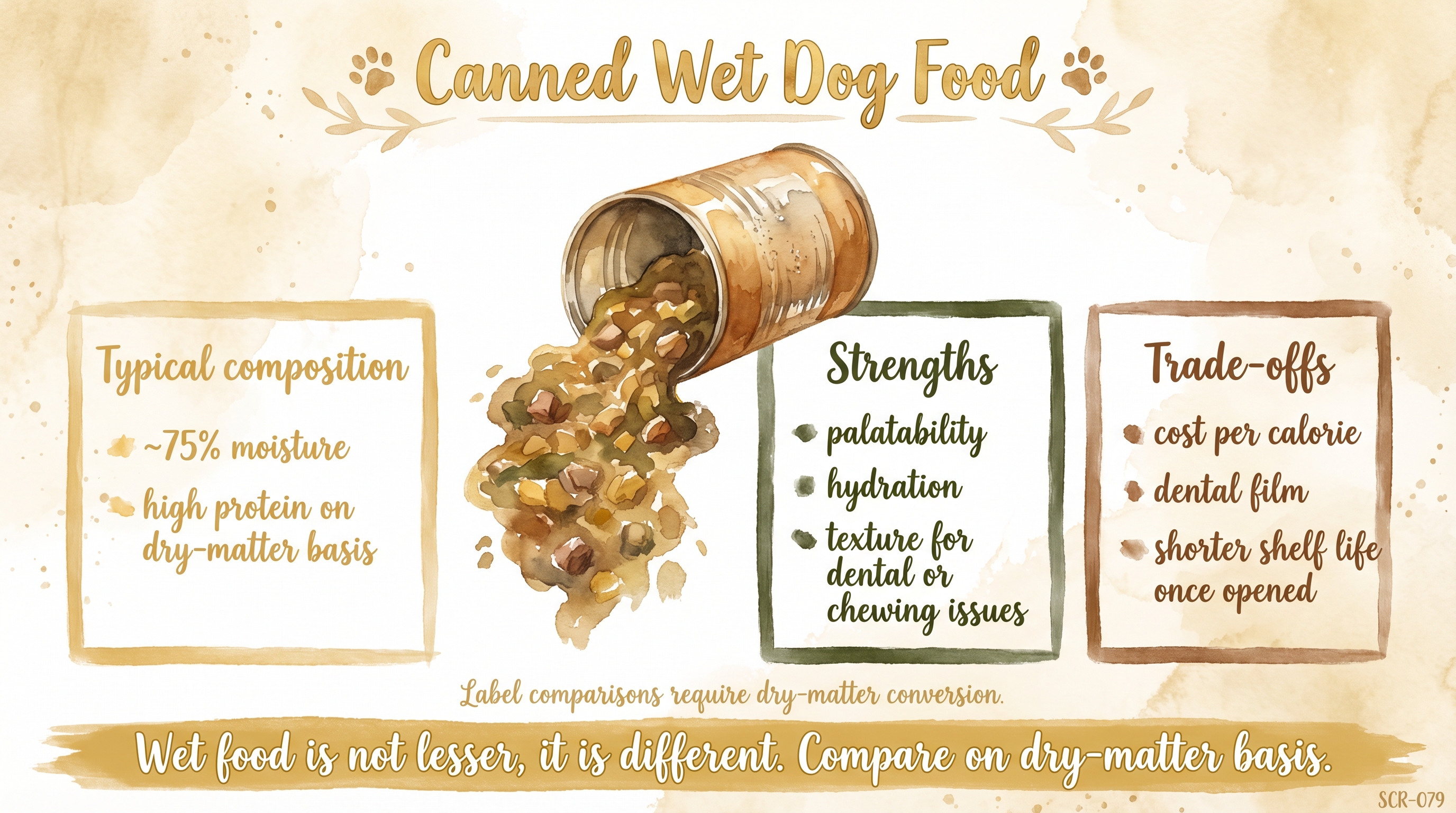
Wet food is not lesser, it is different - compare on dry-matter basis.
Key Takeaways
- Canned food is a legitimate complete-diet category, not merely a topper or luxury product.
- Its biggest distinction from kibble is moisture, which changes calorie density, aroma, texture, and practical use cases.
- Wet food can be especially helpful for dogs with low appetite, dental discomfort, or households that benefit from mixed feeding.
- The main tradeoffs are cost per calorie, storage burden, and the need to refrigerate and use the food promptly after opening.
The Evidence
This entry uses observed claim-level tags beyond the dedicated EvidenceBlocks below. These tags mark JB program observation or practice-derived claims that need dedicated EvidenceBlock coverage in a later content pass.
This entry uses ambiguous claim-level tags beyond the dedicated EvidenceBlocks below. These tags mark claims where the literature remains unsettled or multiple interpretations coexist.
The evidence on wet food is steadier and less ideological than the evidence on raw or ultra-processed debates. It is documented that canned diets can provide complete and balanced nutrition when properly formulated. It is documented that their moisture content is much higher than kibble, which changes calorie density and can influence hydration and satiety. It is documented that wet food is often more expensive per calorie and less convenient after opening. These are straightforward category facts, not contested claims.
The evidence becomes less definitive when people ask whether canned food is broadly healthier than kibble. That question is too large for the current literature to answer cleanly. Both formats can work well when nutritionally adequate and appropriately used. The strongest practical conclusion is not that one format always wins. It is that wet food offers distinct functional advantages, especially around aroma, texture, and water content, while imposing distinct cost and storage burdens.
Mixed feeding also sits in a practical rather than ideological zone. There is no strong dog-specific evidence that combining kibble and canned food is inherently problematic if calories are controlled and both products are appropriate for the dog's life stage. In fact, mixed feeding is often a realistic family solution precisely because it allows moisture and palatability gains without requiring a full conversion.
The family-level conclusion is therefore steady rather than dramatic. Wet food is not a miracle and not a mistake. It is a useful nutrition format with clear strengths in aroma, moisture, and texture, and equally clear tradeoffs in storage, cost, and convenience. Families who understand those tradeoffs usually make much calmer feeding decisions than families who treat wet food as either obviously superior or merely fancy packaging.
- Comparative format source synthesisdogs
Canned food typically provides much higher moisture content than kibble, lower calorie density per volume, and strong palatability advantages for many dogs. - SCR-079 synthesisdog-food regulatory context
Complete-and-balanced canned diets can legitimately serve as a sole diet when substantiated for the relevant life stage. - Commercial processing frameworkpet-food manufacturing context
Retort processing creates shelf-stable wet foods through sealed-container sterilization rather than extrusion.
- Clinical feeding practice synthesisdogs
Wet food is especially useful in dogs with reduced appetite, oral discomfort, or a need for more aromatic feeding, even though those advantages are not a blanket proof of superiority. - Mixed-feeding stewardshipdogs
Combining kibble and canned food can be a practical compromise when total calorie intake is still managed deliberately.
No published study directly tests the practical implications of canned and wet dog food for domestic dog raising programs. The application to household dog raising remains an interpretive synthesis rather than a directly tested intervention finding.
SCR References
Sources
- National Research Council. (2006). Nutrient Requirements of Dogs and Cats. Washington, DC: The National Academies Press.
- Association of American Feed Control Officials (AAFCO). (2024). Official Publication. Association of American Feed Control Officials.
- U.S. Food and Drug Administration. (2014). Pet food labeling guide. FDA Center for Veterinary Medicine.
- Hill, R. C. (1998). Digestibility and metabolizable energy of commercial diets for dogs and cats. Journal of the American Veterinary Medical Association, 212(5), 658-666.