Fresh Cooked Dog Food: Commercial and Home-Prepared
Fresh cooked dog food is the category many families imagine when they say they want to feed "real food." It usually looks more recognizable than kibble, feels less risky than raw, and carries a story about gentle processing, better ingredients, and fewer industrial compromises. Some of those claims have real support. Some are still more aspirational than proven. The useful question is not whether fresh food sounds appealing. It is what the category actually offers, what it costs, and how much of its premium story is already documented in dogs rather than assumed from common sense. Mixed Evidence
What It Means
Fresh cooked food is a broad category that includes commercially prepared gently cooked diets and carefully designed home-cooked plans. In both cases, the food is cooked rather than served raw, but the cooking methods are usually milder than the extrusion used for kibble. Observed-JB Ingredients may be simmered, steamed, lightly baked, kettle-cooked, or cooked sous vide before refrigeration or freezing.
The best-known commercial segment is the subscription fresh-food market, including brands such as The Farmer's Dog, Ollie, Nom Nom, and Just Food For Dogs. These products are usually shipped frozen or refrigerated in portioned packs. Families often like them because the ingredient panels look familiar and the meal appearance resembles human food more than dry pellets do. That visual familiarity is part of the category's power. It reassures families that they are feeding recognizable components rather than an opaque industrial blend.
Home-prepared fresh cooked food belongs in the same broad category when it is intentionally formulated and cooked. A family may work with a board-certified veterinary nutritionist, use a service such as BalanceIT or PetDiets, receive a recipe tailored to the dog's needs, and then prepare the meals at home. Mixed Evidence The home-prepared version shares the category's lower-heat and higher-moisture profile, but it also introduces a major extra variable: family execution. A strong home recipe still fails if the family improvises, swaps ingredients casually, or stops using the premix that makes the diet complete.
What the Category Is Actually Promising
Fresh food makes three main promises, whether stated openly or implied in marketing. The first is lower processing burden. The second is better ingredient visibility and palatability. The third is the possibility that less heat damage and more intact ingredients may translate into better health. The first two are easier to defend than the third.
Lower processing burden is a real manufacturing distinction. Gentler cooking usually means less exposure to the intense heat and shear of extrusion, which can reduce Maillard reaction intensity and preserve some heat-sensitive nutrients more effectively. Better ingredient visibility is also real. A family can often recognize pieces of meat, vegetables, or starches in a fresh product in a way that is impossible with kibble. Palatability advantages are real too. Many dogs find fresh cooked food highly appealing, and that can improve adherence in dogs that are selective eaters.
The harder claim is the outcome claim: that these manufacturing and ingredient differences translate into superior long-term health. That remains a much thinner evidence space than marketing language suggests. Documented There are digestibility data, metabolomic differences, and some promising short-term outcomes. There are not yet large, independent, long-horizon canine trials proving that a healthy dog fed a good fresh cooked diet will reliably experience better lifelong outcomes than a similar dog on a good kibble.
Cooking Method and Nutrient Retention
The strongest scientific case for fresh cooked food is process-level rather than destiny-level. Cooking at lower temperatures generally preserves more reactive amino acids and some vitamins than the high-heat extrusion used for dry food. It can also reduce formation of some advanced glycation end products. That matters because it shows the category is not merely aesthetic. There are meaningful biochemical differences.
At the same time, fresh food is still processed food. Cooking changes nutrients. Storage changes nutrients. Freezing and thawing change texture and can affect handling quality. The category should not be romanticized into "raw biology plus safety." It is its own format with its own compromises.
Commercial fresh diets are also not all created equal. Some are fully formulated to AAFCO profiles or supported through feeding-trial-style work. Others are boutique products leaning heavily on marketing language while offering thinner substantiation. The family still has to ask the same questions they would ask of any diet: who formulates it, what quality control exists, where is it made, and can the company support its adequacy claims with more than style?
This is one of the most important corrections in the fresh-food conversation. Owners sometimes assume that a visible ingredient list makes quality-control questions less important. In reality, freshness and adequacy are different categories of concern. A diet can use excellent ingredients, be cooked gently, and still be incomplete if the formula was not built carefully. It can also be complete and well-designed but still be a poor fit for the household if freezer space, shipping reliability, and budget all work against long-term consistency.
The Algya and Related Comparative Studies
Fresh-food advocates often cite studies showing better digestibility or better metabolic biomarkers in dogs fed mildly cooked diets versus extruded kibble. Observed-JB That literature is real, and it matters. In comparative work such as Algya et al., dogs fed mildly cooked diets can show improved apparent digestibility and different fecal or metabolite patterns relative to extruded comparators. Those results support the claim that processing method and total formula can change how the dog's body handles the food.
The main discipline point is that many of these studies are short, involve limited sample sizes, and often come from or are funded by companies with direct commercial stakes in the fresh-food category. Observed-JB That does not automatically invalidate the findings. It does mean they should be read as promising category data rather than definitive proof that premium fresh food justifies every premium claim made around it.
Cost and Practical Burden
Fresh food's biggest weakness is not usually adequacy when formulated well. It is cost and logistics. For many households, a commercial fresh diet costs three to five times as much as kibble for similar calories, sometimes more. It usually requires freezer or refrigerator space, more delivery coordination, and more planning during travel, boarding, or power outages.
Those are not trivial inconveniences. They shape real compliance. A family may begin with great enthusiasm and then discover that portion packs are cluttering the freezer, travel is harder, and the monthly cost is not sustainable. In those households, a strong dry or canned option may actually be the more protective long-term plan because the family can execute it consistently.
This is one reason JB emphasizes sustainability instead of prestige. A diet cannot be a long-term health advantage if the household cannot keep doing it calmly and reliably.
Fresh-food plans also create a hidden transition question. Many families start using fresh food at the exact same time they are also changing routines, treats, supplements, and feeding amounts. When the dog's stool or appetite changes, the family can no longer tell which variable mattered. A calmer approach is to treat fresh food as one change at a time, transition deliberately, and evaluate the dog's response before layering on additional feeding experiments. That kind of restraint does not make the diet less modern. It makes the result easier to trust.
Why It Matters for Your Dog
Fresh cooked food matters because it sits in the sweet spot many families are looking for. It feels safer than raw because the food is cooked. It feels more biologically respectful than kibble because the processing is gentler and the ingredients are more recognizable. For families who can manage the cost and logistics, that combination can be genuinely attractive.
There are dogs for whom this category is especially appealing. Highly selective eaters may accept fresh food more readily. Dogs recovering from illness may do better with warmer, more aromatic meals. Families working through ingredient-control concerns sometimes find the category psychologically easier to trust because the ingredient list feels less abstract. Those are not fake advantages. They are real quality-of-life factors.
For Golden Retriever households, the main question is whether fresh food fits the family's full system. Goldens are large enough that calorie cost matters. They are active enough that consistent portions matter. Many families board, travel, or leave puppies with sitters, which can make frozen or refrigerated feeding less simple than it first appears. A plan that works beautifully for a single urban dog with stable routines may be much harder for a multi-person family with frequent schedule changes.
Fresh food is most protective when it is chosen for clear reasons and sustained calmly. Repeatedly upgrading, downgrading, pausing, and improvising around a premium food can create more instability than a less glamorous plan the family can execute cleanly every day.
Fresh food also matters because it forces an important adult conversation about evidence tiers. Families often want permission to believe that less processing must equal better health. That intuition is understandable, and some process data point in that direction. But good stewardship means holding the distinction between plausible and proven. Fresh food can be a legitimate choice without being sold as a solved health miracle.
Another reason this page matters is that it helps separate commercial fresh from careless home cooking. Owners sometimes assume they are very similar because both involve real-looking food. They are not similar unless the home-cooked diet is deliberately formulated. A commercial fresh diet may be expensive, but a poorly balanced home-cooked imitation can be expensive and nutritionally unsafe. This category overview protects against that false equivalence.
The warmest and most honest summary is that fresh food is a real category with meaningful advantages and meaningful costs. Its best arguments are about digestibility, palatability, ingredient visibility, and reduced processing burden. Its weakest arguments are sweeping claims of universal superiority. Families deserve to know both.
That balanced summary is especially important because fresh food often becomes the category onto which families project their hope that there must be a simple way out of pet-food ambiguity. Sometimes the answer really is that a well-made fresh diet suits the dog beautifully and fits the family. Sometimes the better answer is a more ordinary food that clears the evidence bar and survives daily life more easily. Fresh food earns its place as a serious option when it is evaluated that soberly. It does not need to be crowned the universal winner to be a legitimate and often very appealing feeding method.
Fresh food also sits in a complicated middle ground between aspiration and evidence. That makes honesty especially important. Families should feel free to value freshness, visible ingredients, and lower processing if those things matter to them. They simply should not be pressured into pretending the science is already broader than it is. The most responsible fresh-food decision is one that is enthusiastic but still proportionate.
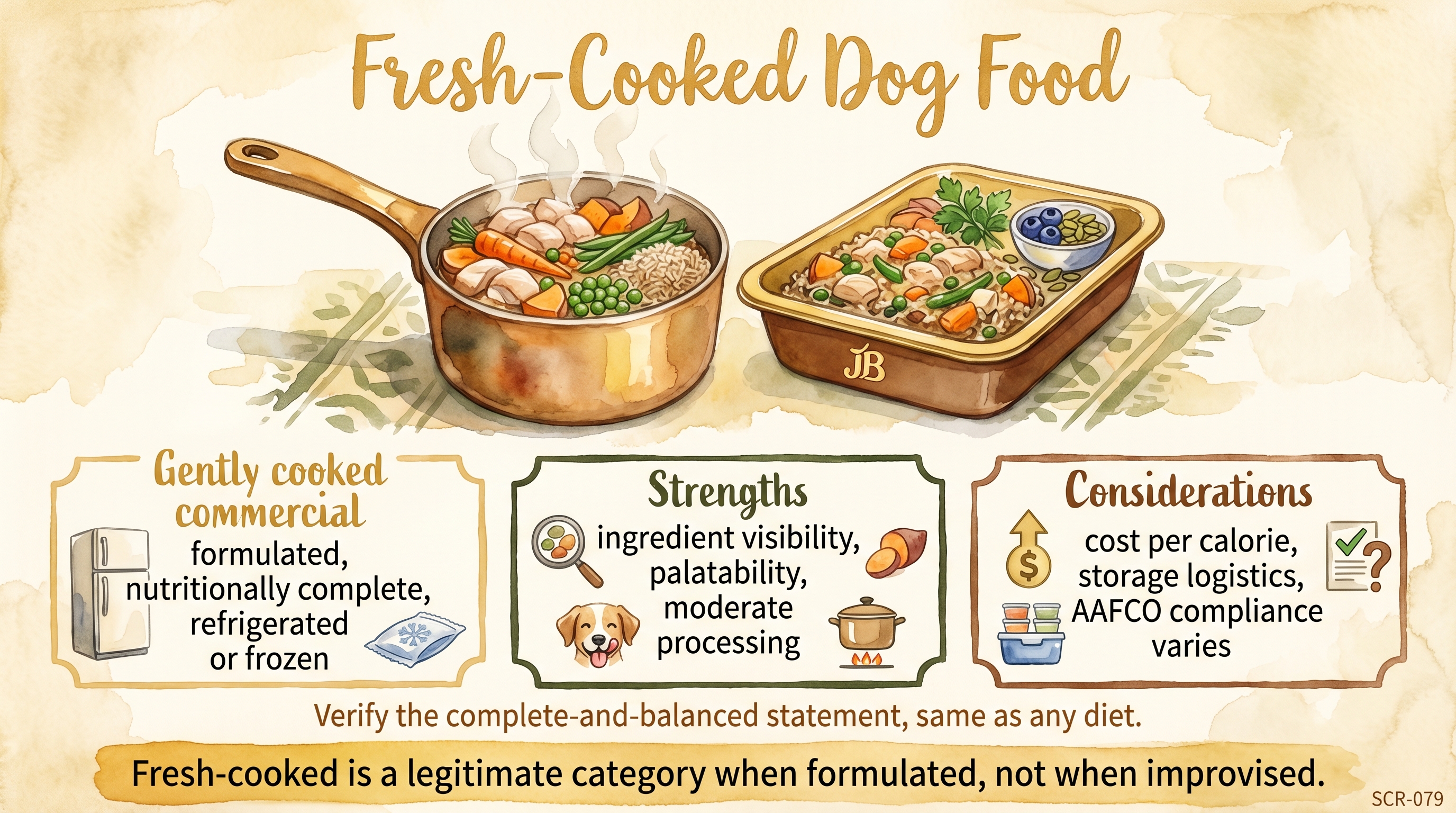
Fresh-cooked is a legitimate category when formulated, not when improvised.
Key Takeaways
- Fresh cooked food is a legitimate category with meaningful advantages in palatability, ingredient visibility, and lower processing burden relative to kibble.
- The best-supported fresh-food claims are about digestibility and process differences, not guaranteed lifelong health superiority.
- Commercial fresh diets and properly formulated home-cooked diets can both work well, but improvising a fresh-looking homemade plan is a common route to deficiency.
- Fresh food is often most limited not by biology but by cost, freezer space, travel complexity, and whether the family can sustain the plan long term.
The Evidence
This entry uses observed claim-level tags beyond the dedicated EvidenceBlocks below. These tags mark JB program observation or practice-derived claims that need dedicated EvidenceBlock coverage in a later content pass.
The evidence for fresh cooked food is mixed not because the category is fake, but because its strongest claims and its biggest marketing claims are not identical. It is documented that gently cooked diets can differ from extruded diets in digestibility, metabolomic profile, fecal characteristics, and some biomarkers. It is documented that lower thermal load can preserve more of some nutrients and reduce some processing byproducts relative to extrusion. Those are real process-level findings.
What remains less certain is the long-term clinical significance of those differences. A dog may digest a fresh diet more completely or show a different serum metabolite pattern without that automatically proving fewer chronic diseases, longer lifespan, or better whole-life outcomes. Current trials are not yet broad or long enough to carry that full interpretive burden. This is especially true when the studies come from manufacturers in the category.
The safety picture is also mixed in a productive way. Cooked fresh food avoids the pathogen burden of raw feeding, which is a substantial advantage. But home-prepared cooked food without proper formulation has well-documented deficiency risk, which means "fresh" by itself is not a nutritional guarantee. Fresh cooked food is safest as a category when it is either commercially well-formulated or professionally formulated for home execution.
The clearest family-level summary is that fresh cooked food has earned a place in the legitimate-option category, not the miracle category. It is real nutrition, not hype. It is also a space where premium pricing, conflict-sensitive studies, and family emotion can magnify weak evidence into strong claims. Families are best served when they enjoy the category for the advantages it actually offers and resist the urge to demand from it more certainty than the science can currently provide.
- Algya et al. (2018)dogs
Mildly cooked diets differed from extruded diets in apparent digestibility and fecal or metabolic outcomes, supporting real category-level physiological differences. - Raw and fresh comparative source synthesisdogs
Lower-heat cooking generally preserves more heat-sensitive nutrients and reduces some processing burden compared with extrusion. - SCR-079 synthesisdog-food regulatory context
Fresh diets still require the same adequacy discipline as any other complete food and cannot rely on ingredient appearance alone.
- Fresh-food comparative literaturedogs
Short-term digestibility and biomarker improvements do not yet establish broad long-term superiority in healthy household dogs. - Stockman et al. (2013)dogs
Home-prepared diets may look fresh and wholesome while still being nutritionally incomplete if they are not professionally formulated and supplemented.
No published study directly tests the practical implications of fresh cooked dog food: commercial and home-prepared for domestic dog raising programs. The application to household dog raising remains an interpretive synthesis rather than a directly tested intervention finding.
SCR References
Sources
-
National Research Council. (2006). Nutrient Requirements of Dogs and Cats. Washington, DC: The National Academies Press.
-
AAFCO. (2024). Official Publication. Association of American Feed Control Officials.
-
Algya, K. M., Zicker, S. C., Burgess, J. R., Cave, N. J., & Wolko, D. A. (2018). Apparent total-tract digestibility, serum chemistry, and fecal outcomes in dogs fed extruded, mildly cooked, and raw diets. Veterinary Medicine and Science, 4(3), 180-187.
-
Do, S., Phalen, D. N., Marks, S. L., & Fascetti, A. J. (2021). Nutrient digestibility and fecal characteristics are altered in dogs fed a fresh, human-grade food compared with a conventional dry kibble and a fresh, raw food. Journal of the American Veterinary Medical Association, 259(1), 95-103.
-
Stockman, J., Fascetti, A. J., Kass, P. H., & Larsen, J. A. (2013). Evaluation of recipes of home-prepared maintenance diets for dogs. Journal of the American Veterinary Medical Association, 242(11), 1500-1505.
-
Yamka, R. M., Kitchell, B. E., Harmon, D. L., & Jewell, D. E. (2007). In vitro fermentation of cellulose, pectin, and fructooligosaccharide by dog fecal microbiota. Nutrition Research, 27(3), 160-166.