Carbohydrates in Canine Diets
Compound evidence detail1 SCR / 2 parts
- Documentedcanine digestive anatomy and physiology evidence covering GI organs, AMY2B-linked starch adaptation, gastric acidity, transit-range variability, and microbiome fermentation
- Documentedthe bounded comparison to humans and wolves, where canine pH, transit, and starch-digestion findings support difference-from-wolf framing without diet absolutism
Carbohydrates are the most argued-over nutrient in modern dog feeding and one of the least discussed in a biologically precise way. Families are often told that dogs do not need carbohydrates, which is technically true in one narrow metabolic sense, and then pushed toward the much bigger claim that carbohydrates are therefore inappropriate or harmful for dogs. That second claim does not follow cleanly from the first. Documented
What It Means
Dogs have no absolute dietary carbohydrate requirement because they can generate glucose through gluconeogenesis from amino acids and glycerol. That is the starting biochemical fact.
But carbohydrate nutrition is still relevant because carbohydrates can provide efficient energy, starch substrate for commercial foods, fermentable fractions that influence gut ecology, and insoluble fractions that affect stool quality and transit.
This is why "non-essential" does not mean "irrelevant."
Gluconeogenesis is the reason dogs can live without carbohydrate in the strict biochemical sense. The liver can make glucose from amino acids and glycerol when dietary carbohydrate is absent. But that flexibility does not prove carbohydrate is harmful, useless, or incompatible with canine biology. It simply means carbohydrate is optional in a way that protein and essential fatty acids are not.
Dogs Are Not Cats
One reason carbohydrate discussion goes sideways is that people borrow cat nutrition language and apply it directly to dogs.
Cats are obligate carnivores with much stricter prey-adapted nutrition. Dogs are different. They retain carnivore ancestry, but domestication changed their starch-handling biology meaningfully enough that moderate dietary carbohydrate is not biologically foreign to the species. Documented
This is one reason the term facultative carnivore is useful. Dogs are still carnivore-shaped animals, but they have more metabolic flexibility than cats do. Families who collapse dogs into cat nutrition often end up making dog-feeding rules that sound ancestral but are not actually species-accurate.
The Domestication Point
The strongest shorthand for this issue comes from domestication genomics. Dogs show adaptation in starch-processing pathways compared with wolves, including amylase-related shifts associated with living alongside human food systems. Documented
This does not mean dogs became herbivores. It means the blanket "feed them like wolves" story ignores an important part of actual dog evolution.
Axelsson et al. 2013 is the key paper here. One of its most cited findings was expanded AMY2B copy number in domestic dogs relative to wolves, alongside other changes supporting enhanced starch digestion and glucose uptake. In plain language, domestic dogs inherited more starch-handling machinery as part of domestication. That finding does not prove every high-starch food is therefore excellent, but it very clearly undercuts the claim that modern dogs are nutritionally identical to wolves.
Starch, Sugars, and Fiber Are Not the Same Thing
Carbohydrates are often spoken about as if they were one ingredient. They are not.
A practical distinction helps: simple sugars are rapid small carbohydrate molecules, starches are longer-chain digestible carbohydrate sources, and fibers are carbohydrate fractions that are partly or largely resistant to small-intestinal digestion.
In dog foods, most carbohydrate discussion is really about starch and fiber rather than about sugar in the human junk-food sense.
That distinction matters because carbohydrate sources in dog food are not all equivalent either. Rice, corn, oats, barley, sweet potato, peas, and lentils all contribute different starch structures, fiber loads, protein interactions, and manufacturing behavior. Two foods can both contain carbohydrate and still behave very differently in the bowl and in the gut.
This is one reason ingredient fear is usually less helpful than formulation literacy. A bowl containing rice is not automatically worse than a bowl containing lentils, and a food with oats is not automatically better than one with corn. Digestibility, processing, fiber profile, and the complete nutrient design still decide how the dog experiences the food. Documented
Why Commercial Foods Use Carbohydrates
Carbohydrates in kibble are not only there as cheap filler. They also contribute to extrusion structure, calorie delivery, manufacturing stability, and satiety pattern.
That does not mean every carbohydrate-heavy formula is ideal. It means carbohydrate inclusion has practical functions beyond cost.
Kibble in particular depends on starch for structure. During extrusion, starch gelatinization helps create the finished shape and texture. That means asking whether a kibble "should contain carbohydrate at all" is often the wrong question. The better question is what type, how much, and how it interacts with the rest of the formulation.
Moderate Carbohydrate Intake Is Usually Well Tolerated
Healthy dogs generally tolerate moderate dietary carbohydrate well. The stronger questions are about source, processing, overall diet design, and how the carbohydrate choice interacts with protein, fat, fiber, and micronutrient adequacy.
This is a better question set than "Are carbs bad?"
In healthy dogs, moderate carbohydrate inclusion around 30 to 50 percent dry matter is generally well tolerated when the food is otherwise well formulated. Estimated That is not a sacred number, but it is a useful corrective to the idea that ordinary starch-containing foods are metabolically bizarre for dogs.
Some of the same caution applies to glycemic language. Glycemic index is a real concept, but it is often imported from human diet culture with too much certainty. In dogs, carbohydrate source, processing, fiber content, and whole-meal context all shape the physiologic response. A lower-glycemic starch may be useful in some settings, but no single glycemic label tells the whole nutritional story.
Grain-Free and the DCM Shadow
Carbohydrate talk became even more emotionally loaded during the grain-free diet-associated DCM debate. Ambiguous The evidence ceiling here matters.
The current SCR supports a careful claim: saying grain-free diets cause DCM is too strong. The better supported position is that diet-associated DCM concerns remain multifactorial and unresolved, often involving pulse-heavy formulations rather than a simple grain-absence mechanism.
That means grain-free should not be treated as automatically dangerous or automatically superior. It deserves a calmer and more specific conversation than marketing language usually allows.
This is also where ingredient source matters more than slogan. Pulse-heavy formulas using peas and lentils high in the ingredient list raised much of the concern in the diet-associated DCM conversation. The full analysis belongs in the later dispatch, but families should understand the preview now: "grain-free" is not the mechanistic answer by itself, and "grains are bad for dogs" is not a sound summary of the evidence.
Glycemic Ideas Need Proportion
Some families worry about glycemic index as if dog feeding should map directly onto human blood-sugar culture. There is real physiology here, but the canine GI methodology is not as settled or as clinically dominant as popular nutrition language suggests.
The better practical takeaway is that carbohydrate source matters, processing matters, and whole-diet context matters more than one trendy glycemic number.
That same principle protects families from over-reading low-glycemic style marketing. A useful carbohydrate discussion still has to ask what the whole meal is doing, not just how one ingredient sounds in isolation.
Fiber Changes the Carbohydrate Story
As soon as fiber enters the picture, carbohydrate stops being only an energy discussion and becomes a gut-health discussion too. Some fibers ferment into short-chain fatty acids that support colonic function. Others mainly provide bulk and stool-shaping effects.
This is one reason a dog food cannot be evaluated well by total carbohydrate fear alone. The carbohydrate fraction can be doing very different things depending on what it contains.
Fermentable fiber fractions can feed colonic microbes and change short-chain-fatty-acid production. Documented Insoluble fractions can change fecal bulk and transit. Starch source can change digestibility and stool response. In other words, carbohydrate is partly an energy conversation and partly a gastrointestinal ecology conversation.
Why It Matters for Your Dog
Families often make poorer feeding choices when they let carbohydrate talk turn ideological. That can lead to dismissing good diets for the wrong reason, overvaluing exotic formulas, misreading grain-free marketing, and ignoring digestibility and life-stage fit.
For JB families, the better question is whether the diet is well formulated, digestible, and supportive of lean condition and stable stool quality. That is much more useful than asking whether the bag has a morally acceptable amount of starch.
For Golden Retriever families, carbohydrate fear often shows up in specific ways: dismissing a good large-breed puppy food because it contains rice or oats, overvaluing grain-free marketing without understanding the pulse issue, assuming visible whole-food carbohydrate ingredients are automatically worse than more abstract ones, and forgetting that calories, digestibility, and body condition matter more than carb rhetoric.
The steadier approach is to look at the whole diet. A dog maintaining lean condition, tolerating the food well, and eating a properly substantiated formula is not nutritionally endangered simply because carbohydrate is part of the bowl.
That is an especially important correction in a market where carbohydrate fear is often used to sell expensive foods with very little additional proof of benefit. The dog is nourished by the whole formulation, not by the absence of a villainized word.
Carbohydrate discussion is also easier when families stop treating every starch source as if it belongs to the same nutritional story. A complete food using rice or oats in a digestible, well-formulated way is asking a different question than a boutique formula leaning heavily on pulses for both starch and protein structure. Source still matters, but it matters inside formulation, not as a purity contest.
This is why carbohydrate literacy pairs so naturally with the rest of the nutrition category. Once families understand digestibility, manufacturing role, fiber, and the grain-free DCM boundary, they no longer have to choose between fear and denial. They can evaluate carbohydrate as one real, evidence-bound part of a whole food.
Another reason the page resists slogans is that carbohydrate questions often stand in for broader trust questions about kibble, processing, and modern feeding. The science does not force families into a simple moral answer. It asks them to evaluate source, digestibility, formulation, tolerance, and the evidence for the whole diet.
That is why a careful middle position is so valuable. It gives families a way to reject both carbohydrate panic and carbohydrate indifference. The goal is not to excuse every starch-heavy food. The goal is to assess carbohydrate honestly as one real, evidence-bound part of a larger nutritional design.
The page is therefore arguing for a different style of reading than most carbohydrate debates encourage. Instead of asking whether the bowl contains a morally acceptable amount of starch, ask what kind of carbohydrate is present, how digestible the whole food is, how the dog tolerates it, and whether the formulation has been substantiated responsibly. In other words, the question is formulation before it is ideology.
That style of reading protects families from both overreaction and complacency. It keeps them from dismissing a good food because it contains rice, and it also keeps them from assuming every grain-free or low-carb narrative is automatically superior. The goal is not to defend all carbohydrate equally. The goal is to evaluate carbohydrate with the same evidence discipline expected of every other nutrient class.
The careful middle position is a strength here, not a compromise. It lets owners stay evidence-led in a topic that marketing keeps trying to polarize.
That is also why the page refuses to let one ingredient story stand in for the whole diet. The food still has to be judged as a whole formulation.
Better carbohydrate decisions usually come from better formulation thinking, not from louder rhetoric about starch alone. Once families understand that, the whole category becomes much easier to navigate.
The middle position is where the evidence is strongest, which is why the page keeps bringing families back to formulation, tolerance, and context.
Evidence beats rhetoric in this nutrient class too, which is why the page keeps choosing nuance over slogans. Documented
The right question is still what the whole food is doing in the dog, not how loudly one nutrient class is being marketed.
Good carbohydrate judgment is still whole-diet judgment, which is why the page keeps refusing simple camps.
That is the value of keeping the question whole.
That is the calmer standard.
And it keeps families much less vulnerable to binary thinking about canine feeding.
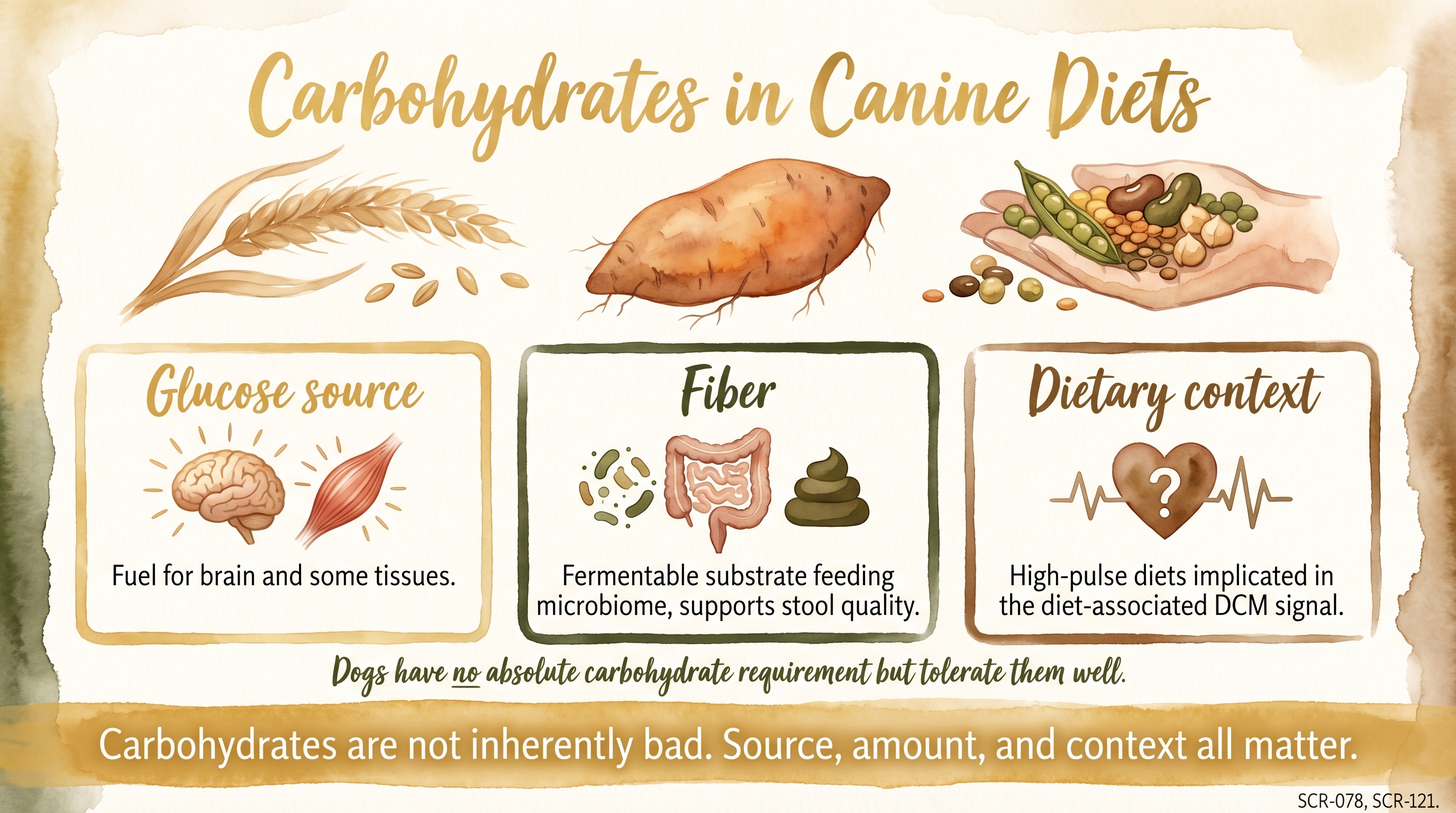
Carbohydrates are not inherently bad - source, amount, and context all matter.
Key Takeaways
- Dogs have no absolute carbohydrate requirement, but that does not make carbohydrates biologically inappropriate.
- Domestication changed canine starch-handling biology enough that the wolf comparison is not a complete feeding model.
- Carbohydrates include starch and fiber fractions that can support energy delivery, stool quality, and food structure in different ways.
- Grain-free and carbohydrate debates should be handled with much more evidence discipline than marketing language usually provides.
The Evidence
This entry uses estimated claim-level tags beyond the dedicated EvidenceBlocks below. These tags mark approximate ranges or timing claims that should remain bounded by the cited sources.
The evidence supports a calmer middle position than most online debates allow. Dogs do not have an absolute dietary carbohydrate requirement because gluconeogenesis exists. Dogs do have domestication-linked starch adaptation, including expanded AMY2B copy number relative to wolves. Healthy dogs generally tolerate moderate dietary carbohydrate well. Grain-free diet-associated DCM concern is real enough to warrant care, but the blanket causal slogan exceeds the evidence. Once those pieces are held together, the conversation becomes much more honest.
- Canine macronutrient source synthesisdogs
Dogs have no absolute dietary carbohydrate requirement, but carbohydrates remain a practical energy and fiber-bearing component of many well-formulated diets. - Axelsson et al. (2013)domestic dogs
Domestication-related starch-processing adaptation supports the conclusion that modern dogs are not nutritionally identical to wolves on this question. - Canine digestibility literaturedogs
Healthy dogs generally tolerate moderate dietary starch well, with source and processing influencing the physiologic response.
- SCR-078 supportdogs
The blanket claim that grain-free diets cause dilated cardiomyopathy overstates the current evidence, which is better described as a multifactorial, unresolved diet-associated concern.
No direct canine research located for this specific topic. Current understanding relies on related research, clinical observation, and cross-species inference.
SCR References
Sources
- National Research Council. (2006). Nutrient Requirements of Dogs and Cats. Washington, DC: The National Academies Press.
- Association of American Feed Control Officials (AAFCO). (2024). Official Publication. Association of American Feed Control Officials.
- Axelsson, E., Ratnakumar, A., Arendt, M. L., et al. (2013). The genomic signature of dog domestication reveals adaptation to starch-rich diet. Nature, 495(7441), 360-364.
- Baucells, M. D., & Isidro, E. (1997). Development and validation of in vitro methods for predicting apparent amino acid availability in pet food. Journal of Animal Science, 75(Supplement 1), 35.
- Monzón, G. A., & Sartirana, M. L. (2008). Grain-free and feline grain-free diets: An update on digestibility, nutritional profile, and their effect on long-term health. Small Animal Practice, 39, 542-549.