Food Allergy and Intolerance in Dogs
Compound evidence detail1 SCR / 2 parts
- Documentedthe ICADA parasite-then-food-then-atopy diagnostic hierarchy with elimination diet trial as the standard for diagnosing cutaneous adverse food reaction; the long-term multi-pillar therapeutic approach combining allergen avoidance, antipruritic agents, topical care, and infection control; and the documented Golden Retriever predisposition to canine atopic dermatitis
- Ambiguousthe precise role early-life microbial exposures play in canine atopic dermatitis pathogenesis - mechanistically active research rather than settled science
Food allergy is one of the places where family intuition and veterinary reality often separate almost completely. Families commonly blame grains, look for one suspicious ingredient on a label, or buy an over-the-counter "hypoallergenic" food and assume they have solved the problem. Clinical food reaction workups are much less casual than that. True food allergy in dogs exists, but it is not the same thing as every itchy dog, every soft stool, or every internet claim about inflammation. The only useful path through this topic is one that separates immune-mediated disease from non-immune intolerance and then stays disciplined about diagnosis. Documented
What It Means
In canine medicine, the term most often used for true food allergy is cutaneous adverse food reaction, often abbreviated CAFR. This refers to an immune-mediated reaction to one or more food components, usually proteins, that leads to skin disease and sometimes gastrointestinal signs. Food intolerance is different. Intolerance refers to adverse reactions to food that are not primarily driven by an allergic immune mechanism. A dog may react badly to a food because of digestibility issues, fat load, additive sensitivity, osmotic effects, or another non-immune mechanism. Documented
That distinction matters because families use the word allergy for almost everything. A dog gets diarrhea after a rich treat, so the family says allergy. A dog scratches in spring, so the family suspects chicken allergy. A dog fails three boutique diets and the family concludes grains are the root problem. In reality, the differential list is wider. Environmental atopy is more common than food allergy. Flea allergy still matters. Secondary yeast and bacterial skin disease can drive intense itch. Chronic GI disease can mimic food-related problems without being a classic allergy.
What Food Allergy Usually Looks Like
The most common presentation of food allergy in dogs is non-seasonal itching. Observed-JB The dog may scratch year-round rather than only during a pollen season. The itch often involves the face, ears, paws, axillae, groin, and ventral abdomen. Some dogs develop recurrent ear infections. Some develop recurrent superficial skin infections because the skin barrier stays inflamed and traumatized. A subset also has gastrointestinal signs such as chronic soft stool, intermittent vomiting, or increased stool frequency.
The most important pattern word there is non-seasonal. A dog whose signs reliably flare with seasonal pollen peaks is more likely dealing primarily with environmental atopy than pure food allergy. Documented That does not mean food can never be a contributor. It does mean food allergy is often overdiagnosed in the family's imagination and underdiagnosed correctly in the clinic because people start swapping retail foods before anyone does a proper trial.
Which Ingredients Are Actually Implicated
The classic family narrative is that grains are the big culprit. The clinical literature does not support that emphasis. Reviews of canine food-allergy cases consistently place proteins such as beef, chicken, dairy, wheat, egg, lamb, and soy among the most frequently implicated ingredients. Wheat appears in the literature, which is part of why grain talk persists, but the broader point is that true food reactions are usually about exposure history and immune recognition, not about grains as a mystical inflammatory class.
This is a useful corrective because it exposes a common marketing distortion. Grain-free products became emotionally attractive partly because they appeared to solve a problem families had already been taught to fear. In many real canine allergy cases, the more likely issue is repeated exposure to common animal proteins, not grain presence itself.
Why Testing So Often Fails Families
One of the most frustrating parts of this topic is that many commercially offered blood, serum, saliva, or hair tests sound definitive while performing poorly for actual diagnosis of canine food allergy. Sensitivity and specificity are not strong enough for these tests to replace elimination trials, and false reassurance or false alarm is common. Families often spend money on a panel, get a colorful list of alleged triggers, and then build an entire diet plan around a test that veterinary dermatology does not treat as the diagnostic gold standard. Observed-JB
The gold standard remains the elimination diet trial followed by structured rechallenge. That sentence alone would save many families months of confusion if they heard it early enough.
What a Real Elimination Trial Requires
A proper elimination trial means feeding a diet built from either a truly novel protein and carbohydrate source or a hydrolyzed veterinary diet in which the protein has been broken down enough to reduce immune recognition. The trial must be strict. No flavored medications unless cleared. No table scraps. No random training treats. No chews that contain hidden proteins. No switching brands halfway through because the dog seems a little better but not perfect.
The typical trial length is about eight weeks, though some dogs need longer to show the full skin response. The reason strictness matters is that partial compliance makes the result uninterpretable. A dog can improve enough to confuse everyone while still receiving enough trigger exposure to prevent a clear answer. Families then conclude the diet failed when what really failed was trial discipline.
The rechallenge phase matters just as much. If the dog improves on the elimination diet and then reliably worsens again when the original food or suspect ingredient is reintroduced, the diagnosis becomes much stronger. Without that step, the family may not know whether improvement came from the removal of a real trigger, spontaneous fluctuation in atopy, control of secondary infection, or the simple fact that the replacement diet was more digestible.
Why Over-the-Counter "Hypoallergenic" Foods Disappoint
Retail limited-ingredient or hypoallergenic foods sound attractive because they are easy to buy and marketed directly to itchy-dog families. The problem is that they are often not suitable for a true diagnostic trial. Cross-contamination, undeclared traces, recipe shifts, or simple mismatch between the advertised and actual useful novelty can all make them poor tools for serious diagnosis.
That does not mean every over-the-counter sensitive-skin food is useless. It does mean that when the goal is to answer the question "does this dog have food allergy," veterinary-grade trial discipline is much more reliable than retail label optimism.
Why It Matters for Your Dog
This page matters because food allergy is one of the easiest problems for families to chase in circles. The dog is itchy. The family changes foods three times. Someone online says it is chicken. Someone else says it is grains. Another person recommends raw. Six months later the dog still has inflamed ears, still licks its paws, and now the family thinks the dog is allergic to everything.
What usually happened in that story is not that the dog is impossibly complicated. It is that the family never got a clean diagnostic process. The most useful intervention is often not a more exotic bag of food. It is a stricter and better supervised trial.
For Goldens and other family dogs, this matters because chronic itch erodes quality of life quickly. Dogs cannot explain that they feel raw, inflamed, or miserable. They scratch, lick, chew, shake, rub, and become restless. Families may then read the dog's distress as behavioral instead of medical. That is why a disciplined nutrition workup helps the dog far beyond the food bowl itself.
The preventive move in food-reaction cases is not endless self-experimentation. It is reaching a clean diagnosis before weeks or months of dietary chaos make the picture harder to interpret.
This page also matters because it protects families from grain mythology. Grain allergy can occur, but grain blame is dramatically overrepresented in family conversation compared with confirmed clinical diagnoses. Families who fixate on grain often miss the much more common reality that environmental allergy, recurrent infection, or repeated exposure to a common protein is the real issue.
The distinction between allergy and intolerance matters in practical life too. A dog with food intolerance may need a digestibility solution, a fat-management solution, or a simplified diet, not necessarily a lifelong immunologic trigger-avoidance plan. Documented A dog with true CAFR, by contrast, usually does need long-term avoidance of identified triggers once they are known. Without diagnosis, those two dogs can look similar to a family while needing very different management.
There is also a trust issue here. A family that goes through a well-run elimination trial usually comes out calmer, because the plan replaces vague suspicion with a structured answer. Even if the answer is "this does not appear to be food allergy," that is still valuable. It frees the dog to be worked up appropriately for environmental atopy, chronic otitis drivers, or GI disease instead of remaining trapped in label roulette.
It also helps to picture what a real trial looks like day to day. The chosen diet becomes the dog's only caloric exposure for the trial window. Treats, chew sticks, dental chews, flavored supplements, flavored preventives, and table foods all have to be evaluated through the same lens: if it contains protein that is not part of the trial, it can break the trial. This is where many families accidentally sabotage the process while feeling fully compliant. They keep the main bowl clean but continue giving a flavored chew every night or a few bites of chicken after medication. The dog then remains exposed and the result never becomes clear.
The ear-infection piece deserves special attention too. Recurrent otitis is one of the presentations that should make food allergy stay on the list. Many families focus only on visible scratching, but some food-reactive dogs are first experienced as "the dog with chronic ears." When that pattern coexists with paw licking, face rubbing, or non-seasonal itch, veterinary guidance becomes especially important because ear disease alone can make the whole household feel as though nothing ever fully clears.
Rechallenge deserves more respect than it usually receives because it converts suspicion into actual diagnostic confidence. If a dog improves on a strict elimination diet and then flares when the old food or a suspect ingredient is reintroduced, that sequence is extremely informative. Without rechallenge, families sometimes spend years avoiding ingredients they were never sure were truly culpable. Rechallenge is not cruelty. It is part of getting a real answer when the dog is stable enough to do it safely.
Another practical benefit of doing the process properly is that it protects families from false multi-allergen stories. Dogs are often labeled allergic to six or eight ingredients after informal food switching and unreliable testing. Once a clean elimination and challenge sequence is performed, the trigger set is often smaller and more manageable than the family feared. That matters for long-term quality of life because sustainable feeding is much easier when the diagnosis is precise instead of theatrical.
When to See a Veterinarian
Veterinary evaluation is appropriate whenever a dog has recurrent itching, recurrent ear infections, chronic paw licking, chronic face rubbing, or repeated GI upset that does not resolve with simple and sensible care. The visit becomes especially important when signs are non-seasonal, when the dog has secondary skin infection, when multiple over-the-counter diet changes have already failed, or when weight loss, vomiting, or blood in stool is also present.
Families should seek veterinary guidance before starting a formal elimination trial if they want the result to mean something. The veterinarian can help choose a hydrolyzed or truly novel diet, identify hidden exposures, treat secondary skin or ear infection that would otherwise cloud the outcome, and set a real trial window. That is dramatically more useful than guessing from a store aisle.
Urgent evaluation is warranted if the dog is extremely uncomfortable, has open skin lesions, has severe vomiting or diarrhea, loses weight, or seems lethargic or painful. Severe itch can become a welfare emergency even when the cause is not life-threatening. Chronic untreated ear disease can also become much harder and more expensive to control if families delay because they are still trying internet food swaps.
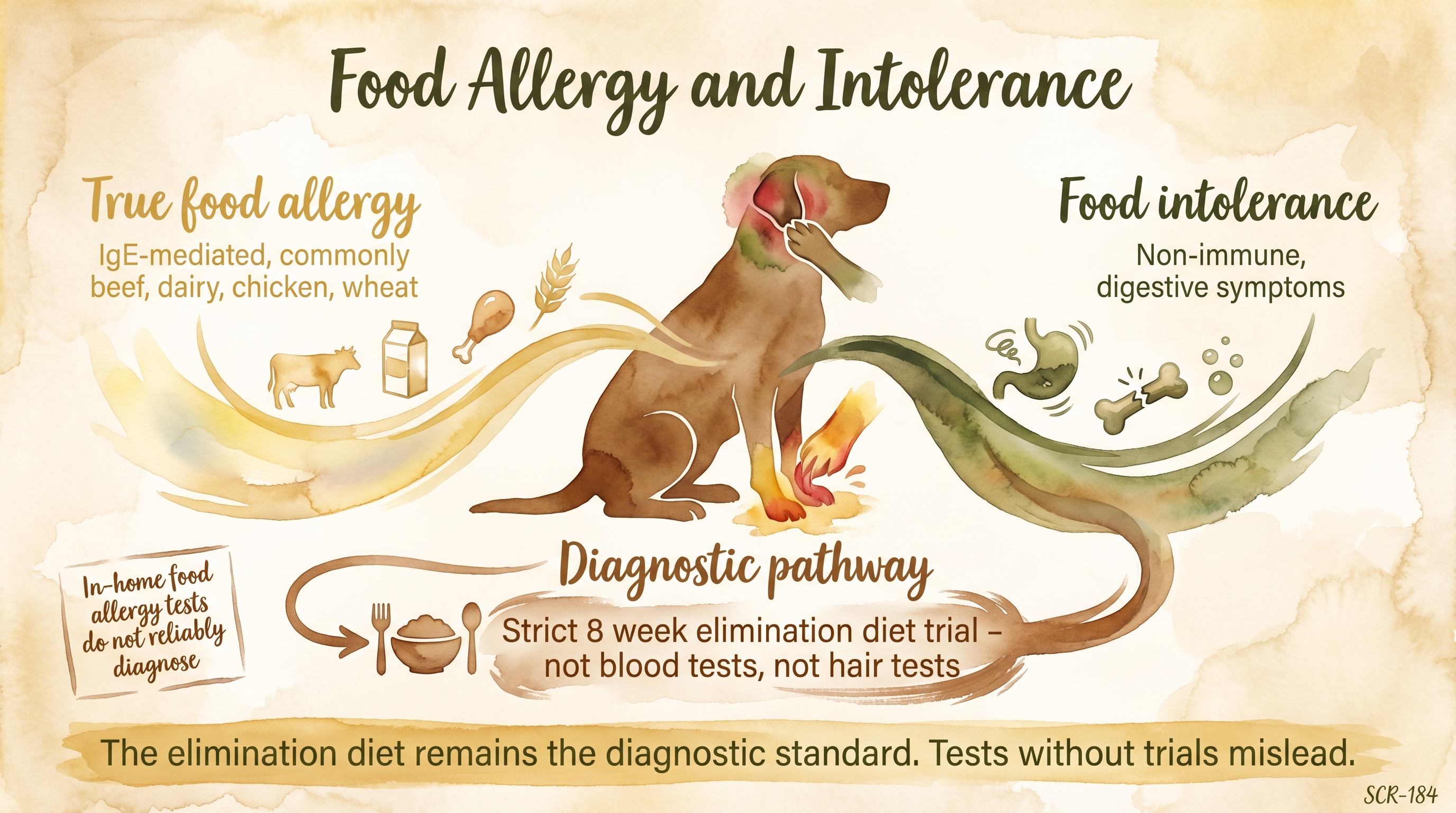
The elimination diet remains the diagnostic standard - tests without trials mislead.
Key Takeaways
- True food allergy in dogs is usually an immune-mediated cutaneous adverse food reaction, while food intolerance is a different and non-immune category.
- Environmental atopy is more common than food allergy, and grain blame is much louder in owner culture than in confirmed clinical diagnosis.
- The only reliable diagnostic standard is a strict elimination diet trial followed by structured rechallenge, not a retail label or mail-order test panel.
- Families usually get the clearest answer fastest when they involve a veterinarian early instead of rotating through multiple self-chosen foods.
The Evidence
This entry uses observed claim-level tags beyond the dedicated EvidenceBlocks below. These tags mark JB program observation or practice-derived claims that need dedicated EvidenceBlock coverage in a later content pass.
The evidence base strongly supports the distinction between true food allergy and food intolerance, the relative overrepresentation of environmental allergy compared with CAFR, and the diagnostic primacy of the elimination diet trial. It also supports the claim that common proteins such as beef, chicken, dairy, egg, soy, and wheat appear more often in confirmed canine food-reaction cases than the family conversation around grain-free marketing would suggest.
Where the evidence remains thinner is not on the existence of food allergy, but on the reliability of consumer shortcuts. Retail hypoallergenic labels, blood tests, and self-diagnosis all promise precision they often cannot deliver. That is why this page stays clinically firm. The diagnostic process matters more than the marketing vocabulary.
- Mueller et al. review and related veterinary dermatology literaturedogs
Cutaneous adverse food reaction is a real but minority component of allergic skin disease, with environmental atopy usually more common. - Canine food-allergy trigger reviewsdogs
Commonly implicated ingredients include beef, chicken, dairy, wheat, egg, lamb, and soy, while owner concern about grain allergy is disproportionate to confirmed diagnoses. - Veterinary dermatology diagnostic consensusdogs
The gold standard for diagnosing canine food allergy remains a strict elimination diet trial followed by structured rechallenge.
- Canine allergy-testing evaluationsdogs
Blood, saliva, and similar commercial tests have poor enough diagnostic performance that they do not replace elimination trials for food allergy diagnosis. - Clinical trial-discipline frameworkdogs
Over-the-counter limited-ingredient or hypoallergenic foods are often poor diagnostic tools because cross-contamination, hidden exposures, and partial compliance make results difficult to interpret.
No published study directly tests the practical implications of food allergy and intolerance in dogs for domestic dog raising programs. The application to household dog raising remains an interpretive synthesis rather than a directly tested intervention finding.
SCR References
Sources
-
National Research Council. (2006). Nutrient Requirements of Dogs and Cats. Washington, DC: The National Academies Press.
-
AAFCO. (2024). Official Publication. Association of American Feed Control Officials.
-
Mueller, R. S., Olivry, T., & Prélaud, P. (2016). Critically appraised topic on adverse food reactions of companion animals (2): common food allergens. BMC Veterinary Research, 12(1), 9.
-
Verlinden, A., Hesta, M., Millet, S., & Janssens, G. P. (2006). Food allergy in dogs and cats: a review. Critical Reviews in Food Science and Nutrition, 46(3), 259-273.
-
Ishida, R., Masuda, K., Kurata, K., Ohno, K., & Tsujimoto, H. (2004). Lymphocyte subpopulations in canine atopic dermatitis. Veterinary Dermatology, 15(4), 269-276.