Ear Infections in Dogs
Ear infections are one of the most common everyday veterinary problems in Golden Retrievers. They are not usually life-threatening, but they are miserable, recurrent, and often badly understood. Families tend to think of them as isolated ear problems. In reality, chronic otitis externa is very often the ear expression of a larger skin-and-allergy story. If that underlying pattern is missed, the dog gets temporary relief and then lands right back in the same cycle a few weeks later. Documented
What It Means
What an Ear Infection Usually Means
Most family conversations about "ear infections" are really about otitis externa, inflammation and infection of the external ear canal. The usual microbial players are Malassezia yeast; Staphylococcus species; and in more chronic or complicated cases, organisms such as Pseudomonas.
These organisms often overgrow after the ear environment has already become inflamed and abnormal. Observed-JB That is why the important question is not only "what is growing in the ear?" but also "why does this ear keep becoming a place where overgrowth happens?"
Why Goldens Get So Many
Goldens have several real-world disadvantages pendulous ears that reduce ventilation; frequent swimming and wet-ear cycles; hair and wax that can trap moisture; and strong representation in the atopic-dog population. Documented
None of those factors alone guarantees infection. Together, they create a very familiar pattern: warm, moist, poorly ventilated ears in a dog already prone to allergic inflammation. Documented
The Allergy Connection
This is the key concept for families to understand.
Many recurrent ear infections are not primarily "ear diseases." They are allergy diseases showing up in the ears. If the dog also licks feet, itches the face, rubs the body, or has seasonal skin flares, the ear disease is often part of the same allergic architecture. Observed-JB
Treating the ear infection without addressing the allergy can absolutely provide short-term relief. It just does not usually end the recurrence cycle.
What Families Notice
Typical signs include head shaking, scratching at the ears, odor, redness, visible brown, yellow, or dark discharge, pain when the ear is touched, and reluctance to have the head handled.
In more serious cases, dogs may cry out, keep the head tilted, or become unusually irritable because the ears hurt.
Why It Matters for Your Dog
Why Cytology Matters
Good ear medicine depends on looking at ear debris under the microscope. Cytology tells the veterinarian whether yeast, cocci, rods, inflammatory cells, or a mixed population is present. That matters because treatment selection should match what is actually there.
Culture also has a place, especially in chronic, refractory, or rod-heavy cases, but it is not the first tool for every straightforward ear flare.
The important family lesson is that visual inspection alone does not tell the whole story. Two red ears may need different treatments.
The Chronic-Ear Problem
Repeated untreated or poorly controlled otitis can change the ear canal itself. Documented The canal becomes more thickened, scarred, narrowed, and difficult to medicate. What began as a common surface problem can gradually turn into a more entrenched chronic disease state.
That is another reason the "it always comes back, so maybe this is just normal for my dog" mindset is not a good endpoint.
What Families Can Do at Home
Home care can help, but it works best as maintenance inside a veterinary plan rather than as guesswork during pain.
Helpful habits may include drying the ears after swimming, using a veterinarian-approved cleaner when advised, watching for the early smell or redness that often precedes a full flare, and noticing whether ear flares track with seasonal itch or food changes.
What families should avoid is improvising with harsh cleaners, repeated over-the-counter products, or leftover medication from an old infection when they do not know what organism is active this time.
Why This Page Matters for Goldens
This is one of the highest-volume quality-of-life issues in the breed. Families may never face hemangiosarcoma. Many will face otitis.
That reality matters because breed health is not only about catastrophic mortality. It is also about the common, chronic problems that shape daily comfort, veterinary cost, and household stress. Ear disease belongs in that category.
When to See a Veterinarian
Veterinary evaluation is warranted for head shaking, strong ear odor, visible discharge, redness inside the ear, pain when touching the ear, recurrent ear flares, and head tilt or balance change.
Prompt same-day evaluation is appropriate if the dog is very painful, seems neurologic, or cannot tolerate the ear being approached at all.
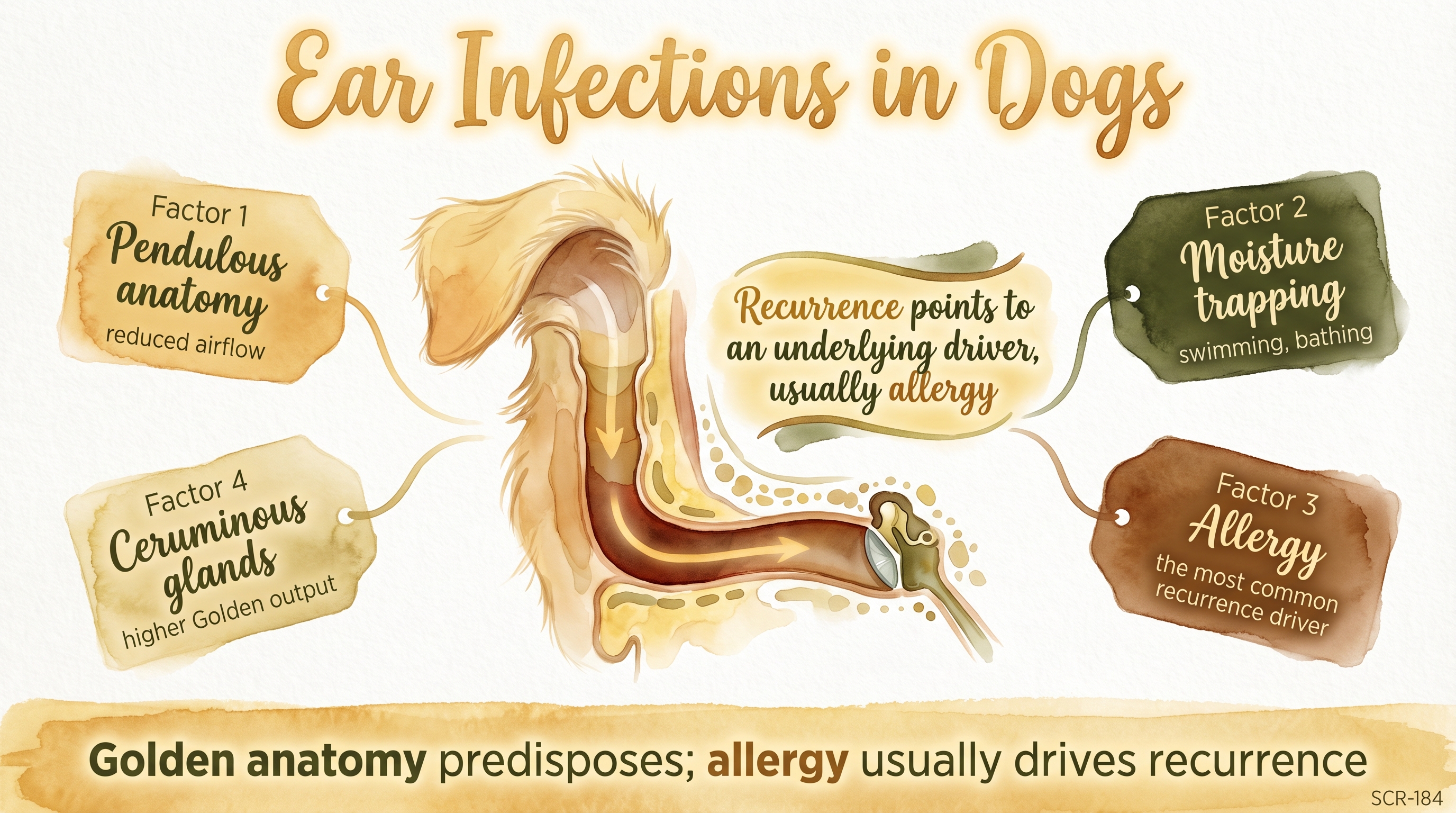
Golden anatomy predisposes; allergy usually drives recurrence.
Key Takeaways
- Ear infections are one of the most common quality-of-life problems in Goldens and often recur because the underlying allergy pattern is missed.
- Cytology matters because two red ears can reflect different organisms and need different treatment choices.
- Repeated untreated or poorly controlled otitis can permanently change the ear canal and make future disease harder to manage.
- Head shaking, odor, discharge, pain, or recurrence are the practical signs families should take seriously and bring to the vet.
The Evidence
This entry uses documented claim-level tags beyond the dedicated EvidenceBlocks below. These claims should remain tied to the entry Sources and SCR references during the next evidence-chain authoring pass.
This entry uses observed claim-level tags beyond the dedicated EvidenceBlocks below. These tags mark JB program observation or practice-derived claims that need dedicated EvidenceBlock coverage in a later content pass.
- Veterinary dermatology and otology literaturedogs
Otitis externa is one of the most common canine problems in primary practice, especially in floppy-eared and allergy-prone dogs. - Canine otitis guidelinesdogs
Cytology is central to diagnosis because the microbial and inflammatory picture guides appropriate therapy. - Chronic-otitis literaturedogs
Repeated inflammation can remodel the ear canal and make later disease harder to control.
- Breed-pattern clinical literatureGolden Retrievers
Goldens are a common chronic otitis breed because conformation, moisture retention, and allergic burden often overlap. - Skin-ear overlap principledogs
Many recurrent ear infections are secondary to a broader atopic-dermatitis pattern rather than isolated ear-only disease.
- domestic dogs
No published study directly compares the most effective long-term management paths for ear infections in dogs in dogs across breeds and ordinary home settings.
SCR References
Sources
- Hensel, P., Santoro, D., Favrot, C., Hill, P., & Griffin, C. (2015). Canine atopic dermatitis: Detailed guidelines for diagnosis and allergen identification. BMC Veterinary Research, 11, 196. https://doi.org/10.1186/s12917-015-0515-5
- Secker, B., Shaw, S., & Atterbury, R. J. (2023). Pseudomonas spp. in canine otitis externa. Microorganisms, 11(11), 2650. https://doi.org/10.3390/microorganisms11112650
- Nuttall, T., & Cole, L. K. (2007). Evidence-based veterinary dermatology: A systematic review of interventions for treatment of Pseudomonas otitis in dogs. Veterinary Dermatology, 18(2), 69-77. https://doi.org/10.1111/j.1365-3164.2007.00575.x
- O'Neill, D. G., Volk, A. V., Soares, T., Church, D. B., & Brodbelt, D. C. (2021). Frequency and predisposing factors for canine otitis externa in the UK: A primary veterinary care epidemiological view. Canine Medicine and Genetics, 8, 7. https://doi.org/10.1186/s40575-021-00106-1
- Saridomichelakis, M. N., Farmaki, R., Leontides, L. S., & Koutinas, A. F. (2007). Aetiology of canine otitis externa: A retrospective study of 100 cases. Veterinary Dermatology, 18(5), 341-347. https://doi.org/10.1111/j.1365-3164.2007.00619.x