Developmental Orthopedic Disease and Puppy Nutrition
Developmental orthopedic disease, often shortened to DOD, is the clearest place where puppy nutrition proves that "more" can be biologically worse. Families often picture nutrition mistakes as deficiency, but in large-breed puppies the classic injury pattern is often excess: too much calcium, too much energy, too rapid a growth curve, and too little respect for what an immature skeleton can actually regulate. Golden Retrievers sit squarely inside that conversation. They are large-breed puppies for nutritional purposes, and the evidence-supported way to feed them is not to push them toward maximum size as quickly as possible. Documented
What It Means
Developmental orthopedic disease is not one single diagnosis. It is a cluster of growth-phase skeletal disorders that include hip dysplasia, elbow dysplasia, osteochondrosis or osteochondritis dissecans, hypertrophic osteodystrophy, panosteitis, retained cartilage cores, and related developmental joint or bone problems. Genetics matter greatly in many of these disorders, but nutrition still matters because the growing skeleton is not an abstract genetic script. It is a living system built under mechanical load, endocrine signaling, and mineral handling constraints.
This is the key framing families need: nutrition does not usually erase genetic predisposition, but it can influence whether borderline vulnerability gets expressed more severely or less severely. That is why the best language is gene-environment interaction, not a fight between genetics and feeding.
The Three Main Nutritional Risks
The strongest nutritional risk factors are calcium excess, overfeeding with rapid growth, and excessive dietary energy density. These are related but not identical problems. A puppy can be fed too much total food, too much calcium, or a food whose energy density makes overconsumption easy even when the family thinks portions are moderate. Documented In the real world, these often travel together.
Calcium excess deserves special respect because growing puppies are not miniature adults in mineral regulation. Classic Hazewinkel and Schoenmakers work in Great Dane puppies demonstrated that young large-breed dogs cannot protect themselves adequately against chronic high calcium intake. The skeleton can be pushed into abnormal development, and some damage patterns do not fully reverse even after the diet is corrected later. That is exactly the kind of finding JB's prevention language is built around: the error is easier to avoid than to undo.
The calcium story is important because families are often tempted to supplement what already should be complete. They add cottage cheese, bone meal, calcium products, or home tweaks because the puppy is growing and they assume extra building material must help. In large-breed puppies, that instinct can be actively dangerous.
Why Growth Rate Matters
The second major risk is overfeeding. The classic Kealy Labrador work showed that restricted feeding reduced hip dysplasia expression and later osteoarthritis burden compared with more generous intake. The broader Purina life-span findings also reinforced the long-term value of maintaining lean body condition. During growth, this does not mean undernourishing the puppy. It means refusing the widespread idea that bigger faster equals healthier.
Rapid growth places more mechanical and developmental burden on immature joints. The puppy may still look glorious to an admiring family, but the skeleton is paying the price. This is one of the most important mindset corrections in large-breed raising. A smooth, lean growth curve is safer than an accelerated one.
Why Energy Density Matters
Energy density matters because a food can make overfeeding easier even when the family is not trying to overfeed. Large-breed puppy formulas exist partly for this reason. They often moderate calorie density and control calcium more carefully than generic growth foods. Observed-JB The point is not that every ordinary puppy food is automatically harmful. The point is that large-breed growth nutrition should be engineered for controlled development rather than maximal size.
This is also where all-life-stages foods can become tricky. Some all-life-stages foods are perfectly reasonable. Others meet broad growth profiles without being especially well tuned to large-breed calcium ceilings. The AAFCO large-breed growth profile matters because it places a tighter upper ceiling on calcium than the broader standard growth profile. Since 2016, that large-breed growth ceiling has been a central regulatory protection for puppies expected to exceed about 70 pounds as adults.
The Calcium Ceiling Families Need to Know
For practical family use, the most important number is the large-breed growth calcium maximum of 1.8 percent dry matter. Documented That ceiling exists because the old idea that puppies could self-regulate calcium adequately turned out to be too optimistic. Large-breed puppies absorb calcium too passively during early growth for families to play loosely with supplementation or with foods not designed for their developmental category.
That is why Golden Retrievers belong in large-breed puppy logic. Not every individual Golden will exceed 70 pounds, especially females, but the breed unquestionably lives inside the range where cautious large-breed growth feeding is the safest default. The cost of feeding conservatively is low. The cost of overconfidence can be permanent.
DOD Is Not Only About Calcium
It is still important not to overcollapse the whole field into calcium alone. Hip dysplasia has heritability estimates often cited in the rough range of 0.2 to 0.5 depending on population and method. Estimated Elbow disease has its own genetic architecture. OCD and other disorders are not explained by one nutrient in isolation. This is why good breeding, screening, lean growth, controlled exercise, and sound nutrition all belong in the same conversation.
The best family-level sentence is simple: nutrition cannot guarantee orthopedic safety, but bad nutrition can absolutely worsen orthopedic risk.
Why It Matters for Your Dog
This page matters because developmental orthopedic disease often begins invisibly. The puppy is cute, growing fast, eating enthusiastically, and receiving praise for how substantial it looks. Nothing about that picture naturally tells the family that the growth rate may be too fast or the mineral burden too high. That is why nutritional discipline has to come from the adults, not from the puppy's enthusiasm or the family's pride.
For Golden Retriever families, this matters doubly. Goldens are beloved partly because they are substantial, athletic, family-centered dogs. Those same qualities make it emotionally easy to romanticize fast growth and heavy-boned puppyhood. The evidence says the safer goal is not a giant puppy. It is a lean, steadily developing puppy whose skeleton is not being overloaded.
You do not wait until the adult dog is limping to decide whether growth mattered. The orthopedic future is being shaped during puppyhood, which is why food choice, portions, and calcium discipline belong in the prevention conversation from the first day home.
This page also matters because it protects families from supplement mythology. Many well-intentioned families still believe that extra calcium, raw meaty bones, or "strong bone" add-ons must help a growing dog. For a Golden on a complete large-breed growth diet, those extras are far more likely to destabilize the plan than improve it.
Another practical reason this matters is that DOD does not announce itself with one single disease. A puppy may show intermittent lameness, reluctance to exercise, stiffness after rest, awkward gait, or swollen joints. Some of these diseases self-limit more than others. Some are primarily developmental and later degenerative. The common thread is that growth stewardship matters before those signs become obvious.
There is also a real emotional benefit to understanding the evidence correctly. Families often feel guilty when an orthopedic problem emerges, or they feel falsely omnipotent and assume every disease proves they fed incorrectly. The truth is calmer than either emotion. Genetics matter. Breeding decisions matter. Activity management matters. But feeding still belongs in the controllable category, and that means it deserves careful execution.
It also helps families to understand the disease list itself a little better. Hip dysplasia and elbow dysplasia are the best-known names because they remain part of the dog's orthopedic story for life. Osteochondrosis and OCD reflect disordered cartilage development, often at joint surfaces under high stress. Hypertrophic osteodystrophy and panosteitis can look different clinically, but both remind families that growing bone is a dynamic tissue system, not just a structure getting bigger. The practical point is not that nutrition causes every disorder equally. It is that growth-phase biology is vulnerable enough that poor feeding choices become genuine co-factors.
The 2016 adoption of the AAFCO large-breed growth profile matters for exactly this reason. Documented Before that ceiling logic was clearer in regulation, families could choose broad growth foods or all-life-stages foods without always realizing that a large-breed puppy needed tighter calcium control than a smaller dog. The newer framework did not create the risk. It acknowledged it more honestly. This is why the label statement now deserves such close attention in Golden puppies. "Growth" alone is not always specific enough. Large-breed growth support is the safer reading.
All-life-stages feeding deserves especially careful handling. Some all-life-stages foods are well engineered and explicitly suitable for growth including large-breed puppies. Others meet broad adequacy floors without being ideal for a Golden's developmental orthopedic risk profile. Families should therefore avoid assuming that every all-life-stages label is automatically a large-breed puppy food just because it sounds comprehensive. The calcium number, the large-breed suitability statement, and the manufacturer's formulation seriousness all matter.
Growth monitoring is part of this discussion too. A Golden puppy should not be fed by appearance alone, and certainly not by the family's pride at how substantial the puppy looks. Regular weight checks, body condition scoring, and a willingness to trim portions before the puppy looks obviously heavy are what protect the skeleton. By the time the dog looks dramatically overweight, the growth plan has already been too loose for too long.
This is where the large-breed literature and JB philosophy line up cleanly. Prevention is not theoretical here. A skeletal error made during active growth can leave a residue that later surgery, pain control, or exercise modification only partly manages. When the science says the puppy cannot protect itself fully from calcium excess or from chronic overfeeding, the human obligation becomes very concrete.
That obligation shows up in ordinary feeding choices more than in dramatic ones. The family that measures meals, watches body condition, avoids high-calorie extras, and resists the urge to "beef the puppy up" is doing genuine orthopedic prevention. The family that keeps adding calories because the puppy looks hungry or because a fast-growing large-breed puppy seems impressive is often making a musculoskeletal decision without realizing it.
It is worth saying plainly that slower, leaner growth is not lesser growth. It is safer growth. A Golden puppy does not need to look oversized at sixteen or twenty weeks to be thriving. In fact, the puppy who looks a little more moderate while staying energetic, proportionate, and lean is often the puppy being fed with better orthopedic judgment.
That is a harder message emotionally, but it is the message the large-breed evidence keeps rewarding.
The puppy does not need to win a growth race in order to become a strong adult dog.
It only needs a body that was allowed to mature without unnecessary nutritional pressure.
That is the safer kind of success.
It is also the more durable kind.
Long term.
When to See a Veterinarian
Veterinary evaluation is appropriate whenever a growing puppy develops lameness, stiffness after rest, reluctance to run or jump, joint swelling, pain on limb handling, or an abnormal gait. Puppies are not supposed to be written off as "growing weird" for weeks when real orthopedic discomfort is present.
Prompt evaluation matters even more in a rapidly growing large-breed puppy, because some developmental conditions benefit from earlier recognition, exercise adjustment, imaging, and diet review. If the puppy is on a non-large-breed growth food, an all-life-stages food of uncertain calcium level, or is receiving supplements or home additions, that information should be part of the visit.
Families should also ask for veterinary guidance if the puppy is becoming visibly heavy or if growth seems excessively fast. The best time to correct a growth trajectory is before orthopedic strain becomes visible, not after.
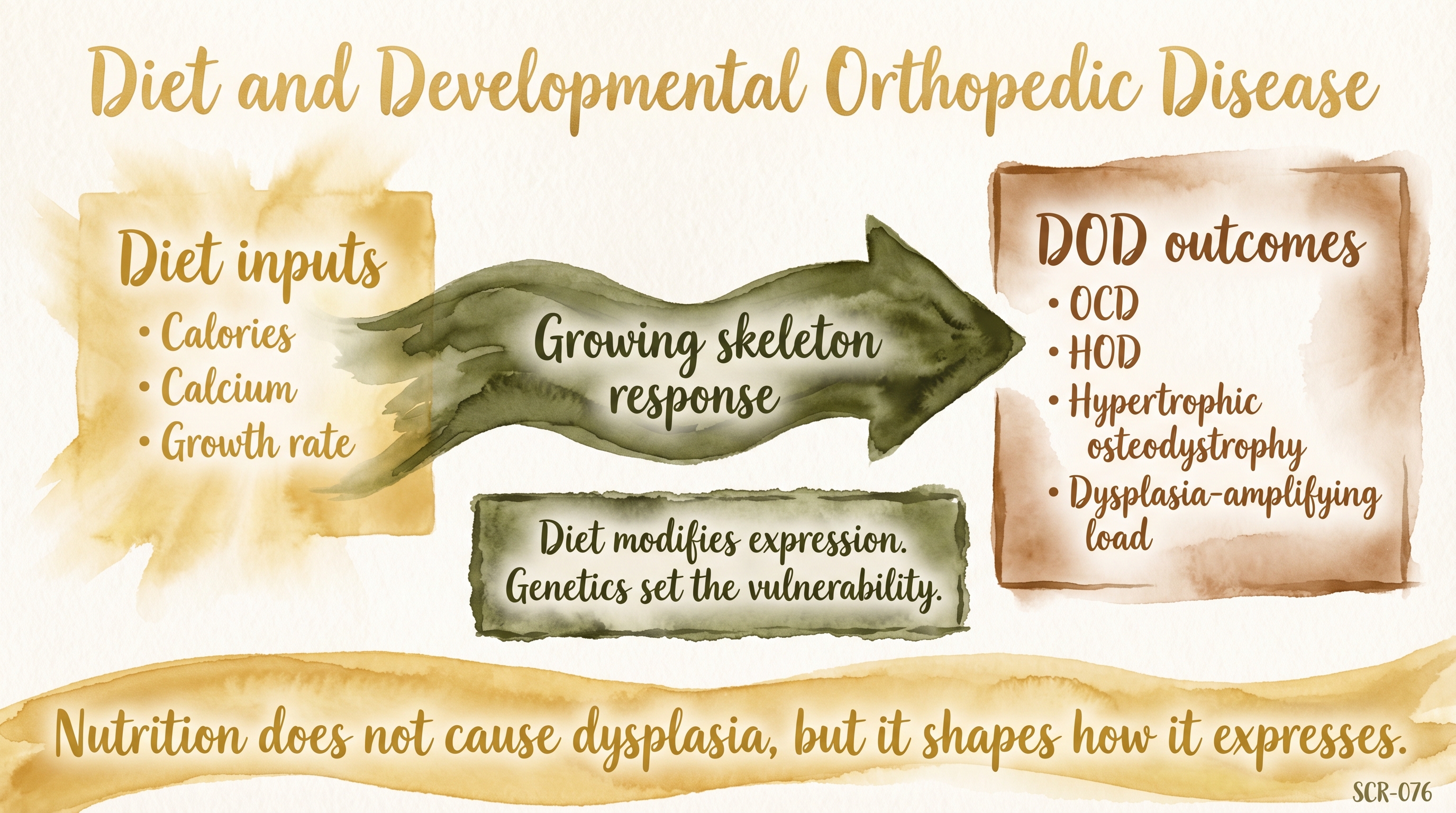
Nutrition does not cause dysplasia, but it shapes how it expresses.
Key Takeaways
- Developmental orthopedic disease is a disease cluster, but the strongest nutritional risks are calcium excess, overfeeding, and excessive energy density during growth.
- Golden Retrievers should be treated as large-breed puppies nutritionally, which makes large-breed growth diets and lean growth targets the safest default.
- The large-breed growth calcium ceiling of 1.8 percent dry matter matters because puppies cannot protect themselves well from chronic calcium excess.
- Nutrition does not erase genetics, but poor nutrition can absolutely worsen the expression of orthopedic vulnerability during puppyhood.
The Evidence
This entry uses observed claim-level tags beyond the dedicated EvidenceBlocks below. These tags mark JB program observation or practice-derived claims that need dedicated EvidenceBlock coverage in a later content pass.
This entry uses estimated claim-level tags beyond the dedicated EvidenceBlocks below. These tags mark approximate ranges or timing claims that should remain bounded by the cited sources.
The evidence is strong on the core points. SCR-076 captures excess calcium during large-breed puppyhood as a real skeletal injury mechanism with partly irreversible consequences. SCR-075 supports lean body condition as a long-term health advantage. SCR-096 supports the broader developmental timing vulnerability of large-breed skeletons. Together they support a very firm practical recommendation: feed Goldens as large-breed puppies, keep them lean, and do not improvise with calcium.
What should remain modest is the claim that nutrition alone determines orthopedic destiny. It does not. The cleaner and more accurate statement is that poor nutritional management can materially worsen the expression of orthopedic vulnerability during growth.
- SCR-076 supportlarge-breed puppies
Excess calcium during growth disrupts skeletal regulation and can produce developmental injury that may not fully reverse later. - Hazewinkel, Schoenmakers, and related large-breed studieslarge-breed puppies
Growing puppies have limited ability to protect themselves from chronic calcium excess, which is why calcium supplementation of complete diets is unsafe. - Kealy and related feeding studieslarge-breed dogs
Restrained growth and lean body condition reduce orthopedic burden and improve long-term outcomes compared with more generous feeding.
- SCR-096 supportlarge-breed dogs
Growth timing keeps the immature skeleton vulnerable for much of puppyhood and adolescence, so feeding strategy and developmental protection belong together. - AAFCO large-breed growth frameworklarge-breed puppies
The 1.8 percent dry matter calcium maximum exists because large-breed growth requires tighter mineral control than broad generic growth feeding.
No published study directly tests the practical implications of developmental orthopedic disease and puppy nutrition for domestic dog raising programs. The application to household dog raising remains an interpretive synthesis rather than a directly tested intervention finding.
SCR References
Sources
-
National Research Council. (2006). Nutrient Requirements of Dogs and Cats. Washington, DC: The National Academies Press.
-
AAFCO. (2024). Official Publication. Association of American Feed Control Officials.
-
Hazewinkel, H. A., Goedegebuure, S. A., Poulos, P. W., & Beynen, A. C. (1985). Influences of chronic calcium excess on the skeletal development of growing Great Danes. Journal of the American Animal Hospital Association, 21(3), 377-391.
-
Kealy, R. D., Olsson, S. E., Monti, K. L., et al. (1992). Effects of limited food consumption on the incidence of hip dysplasia in growing dogs. Journal of the American Veterinary Medical Association, 201(6), 857-863.