DHA and Neural Development in Puppies
DHA is one of the few nutrients that families hear about in puppy food marketing that is actually worth understanding. It is not a magic intelligence ingredient, but it is a real developmental nutrient with documented relevance to neural and visual development. In other words, this is one of the places where the marketing story grew around a genuine scientific core. Documented
What It Means
DHA, or docosahexaenoic acid, is a long-chain omega-3 fatty acid. In puppyhood it matters because it is incorporated into neuronal membranes, retinal tissue, and developing brain structures.
During rapid development, the body is not simply using DHA as fuel. It is using it as structural material.
That is the key point families usually miss. DHA is not in the bag because "omega-3 is trendy." It is there because developing nervous tissue actually incorporates it into the membranes being built during early growth.
That structural role is why DHA belongs in a different conversation from generic fat calories. Fat can be burned for energy. DHA is also being woven into high-value tissue, especially in the retina and central nervous system. When a puppy is in a phase of fast brain growth, membrane formation, synapse stabilization, and sensory development, a structural fatty acid carries more significance than it would in a mature adult whose basic neural architecture is already laid down.
This is also why the page cannot be reduced to "omega-3 is healthy." The specific identity of the fatty acid matters. A puppy does not benefit equally from every fat source or every omega-3 precursor. DHA is being highlighted because it is the long-chain omega-3 with the strongest structural-development case in the early-life canine literature. Documented
DHA Versus EPA
Families often hear omega-3 discussed as if all omega-3s do the same job. They do not.
In simple terms, DHA is the structurally emphasized omega-3 in brain and retinal development, while EPA is more often discussed for inflammatory modulation. Observed-JB
Both can matter, but puppy formulas emphasize DHA for a reason.
That difference is worth naming clearly. DHA is the structurally emphasized omega-3. EPA is more often discussed for anti-inflammatory support in older dogs or targeted clinical supplementation. When a puppy formula talks about DHA specifically, it is naming the fatty acid most relevant to the developing brain and retina rather than just waving at fish-oil marketing.
ALA, the plant-derived omega-3 precursor found in ingredients such as flax, belongs in the same comparison. ALA is not useless, but it is not the same as delivering ready-made DHA. Conversion from precursor forms to DHA is limited and not something families should rely on when the goal is dependable developmental support. That is why marine oils and algal DHA are more meaningful sources for this page than broad claims about "contains omega-3."
Why Puppyhood Is the Important Window
The first weeks and months of life involve intense neural growth and organization. A nutrient that contributes to membrane architecture matters more during a period when that architecture is being built rapidly.
That is the developmental logic behind DHA inclusion in growth diets.
The timing window matters too. The first 12 to 16 weeks are the period most often emphasized for preferential neural incorporation. Estimated That does not mean DHA stops mattering on week 17, but it does mean the earliest months are where the structural-development argument is strongest.
That early window overlaps with several of the most intense developmental demands in a puppy's life. Visual processing is maturing. Sleep-dependent brain organization is active. Social learning is accelerating. The puppy is also entering a period where attention, novelty processing, and behavioral flexibility are becoming more visible to human caregivers. DHA does not create all of that development, but it belongs to the nutritional support package that makes healthy development more likely to proceed well.
It is also one reason breeder nutrition and early-home nutrition belong in the same conversation. A puppy does not begin development when it reaches the family. By the time a Golden Retriever puppy goes home, much of the preferential DHA incorporation window has already been underway. Families are therefore building on a nutritional story that started before pickup day.
What the Puppy Studies Found
The best-known canine developmental DHA work showed that puppies fed DHA-enriched diets performed better on some trainability, visual, and cognitive tasks than comparison groups. Those results should be stated carefully. They do not mean DHA turns puppies into prodigies. They do mean developmental outcomes can be measurably influenced by a nutrient that has a biologically plausible structural role.
The Zicker series is the name families are most likely to see in this conversation. Those studies reported measurable advantages in trainability, visual acuity, and task performance in puppies fed DHA-enriched diets compared with controls. Documented That is more specific and more useful than vague marketing language because it ties DHA to concrete developmental endpoints rather than to generic promises about intelligence.
That concrete outcome language matters. "Trainability" in these studies does not mean DHA made the puppies morally better or magically obedient. Documented It means measurable performance differences showed up in tasks that reflect developmental processing. "Visual acuity" does not mean sharper eyesight in a cartoon sense. It means functionally better performance on tests designed to detect visual maturation. Those distinctions keep the science useful and stop it from turning into pet-food mythology.
The Zicker work is also helpful because it anchors the conversation to outcomes families actually care about. Neural tissue composition can sound remote. Task performance and visual function are easier to picture. The studies therefore bridge mechanism and lived relevance better than many nutrition papers do. Heuristic
There is also a restraint lesson here. The studies support including DHA in an appropriate growth diet. Documented They do not justify saying DHA guarantees superior intelligence, a calmer temperament, or easier handling in every puppy. The outcome is real. The exaggeration is optional.
Where DHA Comes From
The main practical sources in commercial puppy foods are marine oils such as anchovy, sardine, and salmon.
Algal DHA products also exist and can provide the same key fatty acid without marine sourcing.
For families reading labels, marine source matters because it is usually the more direct route to actual DHA delivery. This is one reason plant-based omega-3 claims do not always answer the same question. A food can contain omega-3 precursors without delivering much ready-to-use DHA.
That source distinction becomes especially relevant when marketing language is vague. "Rich in omega oils" is not the same as "contains marine-source DHA." A family reading labels should look for evidence that the formulation contains a genuine DHA source rather than assuming every oil claim means the same thing. Anchovy, sardine, salmon, and algal DHA are all more informative than a generic front-of-bag promise.
Source also interacts with stability and formulation quality. Long-chain polyunsaturated fats are not infinitely stable. Proper processing, antioxidant protection, and manufacturing care matter if the goal is to deliver usable DHA rather than just listing it on an ingredient panel. That is another reason the finished diet matters more than the ingredient story alone.
The Label Question
The useful family question is not "Does this bag say omega-3?" The useful question is whether the food specifically includes DHA or marine-source omega-3 support at a meaningful growth-life-stage level.
This is another place where the finished formulation matters more than the ingredient-story vibe.
The practical benchmark often cited in this discussion is around 0.05 percent dry matter DHA from a marine source. That is not a magic number, but it is a useful evidence-based recommendation level rather than vague marketing language.
This is also where the AAFCO growth-and-reproduction conversation becomes useful. Modern growth guidance acknowledges DHA as a relevant nutrient in developmental formulas. That does not mean every puppy food uses the same amount or the same source, but it does mean the regulatory conversation has moved beyond treating DHA as a decorative add-on.
For families, the label-reading sequence can be straightforward: confirm the food is appropriate for growth or all life stages with large-breed suitability if relevant, look for explicit DHA or marine-source omega-3 inclusion, prefer a credible manufacturer over relying on one flashy nutrient claim, and avoid turning one number into the whole-food evaluation. Heuristic
That last point matters because a food can include DHA and still be a poor overall choice if the rest of the growth formula is badly designed.
Why This Fits the Larger Development Picture
DHA does not act alone. It sits inside a larger growth system that includes adequate protein, controlled energy, mineral balance, normal sleep, and low unnecessary stress load. Documented
That larger context matters because nutrients do not replace development. They support it.
This is part of what keeps the rhetoric honest. DHA matters. It does not single-handedly produce a calm, brilliant, perfectly trainable puppy. It supports the development of a nervous system that still depends on sleep, low unnecessary stress, appropriate social experience, and the rest of the growth diet to develop well.
The myelination connection belongs here too. Early neural development is not only about cell membranes. It is also about how neural networks become insulated, organized, and functionally efficient over time. DHA is not the whole myelination story, but it belongs inside the larger developmental environment that supports brain maturation. That is why it pairs naturally with the broader developmental and neuroscience entries elsewhere in the wiki.
This broader-development lens also protects against supplement tunnel vision. A puppy eating a poor-quality diet with erratic sleep, constant stress load, and unstable routines is not rescued by one capsule of fish oil. A puppy on a well-formulated growth diet, with sane developmental management, gets much more meaningful value from DHA because it is part of a coherent developmental system rather than a lonely add-on.
Why It Matters for Your Dog
For Golden Retriever families, DHA is a worthwhile part of a good puppy formula because it supports a real developmental process during a time when the nervous system is building quickly.
That does not mean families need to obsess over one nutrient or start stacking supplements. It means that, among the many flashy front-of-bag claims in pet food, DHA is one of the more evidence-grounded ones when used in a properly formulated puppy diet.
For families trying to decide what matters most on a puppy-food label, DHA is therefore in a different category than many decorative claims. It is still not the whole food. But it is one of the clearer examples of a nutrient that really does match a real developmental job.
This is especially helpful for Golden Retriever families because Goldens are often marketed to with an avalanche of premium-food claims. It can be hard to tell what is cosmetic and what is substantive. DHA is one of the easier signals to take seriously, provided it is read in context and not used as a substitute for evaluating the entire food.
It also gives families a calmer decision rule. They do not need to chase the highest possible fish-oil promise or pile on separate supplements automatically. They need a complete puppy food that already delivers developmentally relevant DHA in a life-stage-appropriate formulation. That is a much simpler and usually safer standard.
Supplementation deserves its own caution. Extra DHA is not automatically better, especially if it begins to distort total caloric intake or fat balance. For most families, the cleanest approach is to choose a well-formulated puppy food that already includes meaningful DHA rather than trying to custom-build the fatty-acid profile at home.
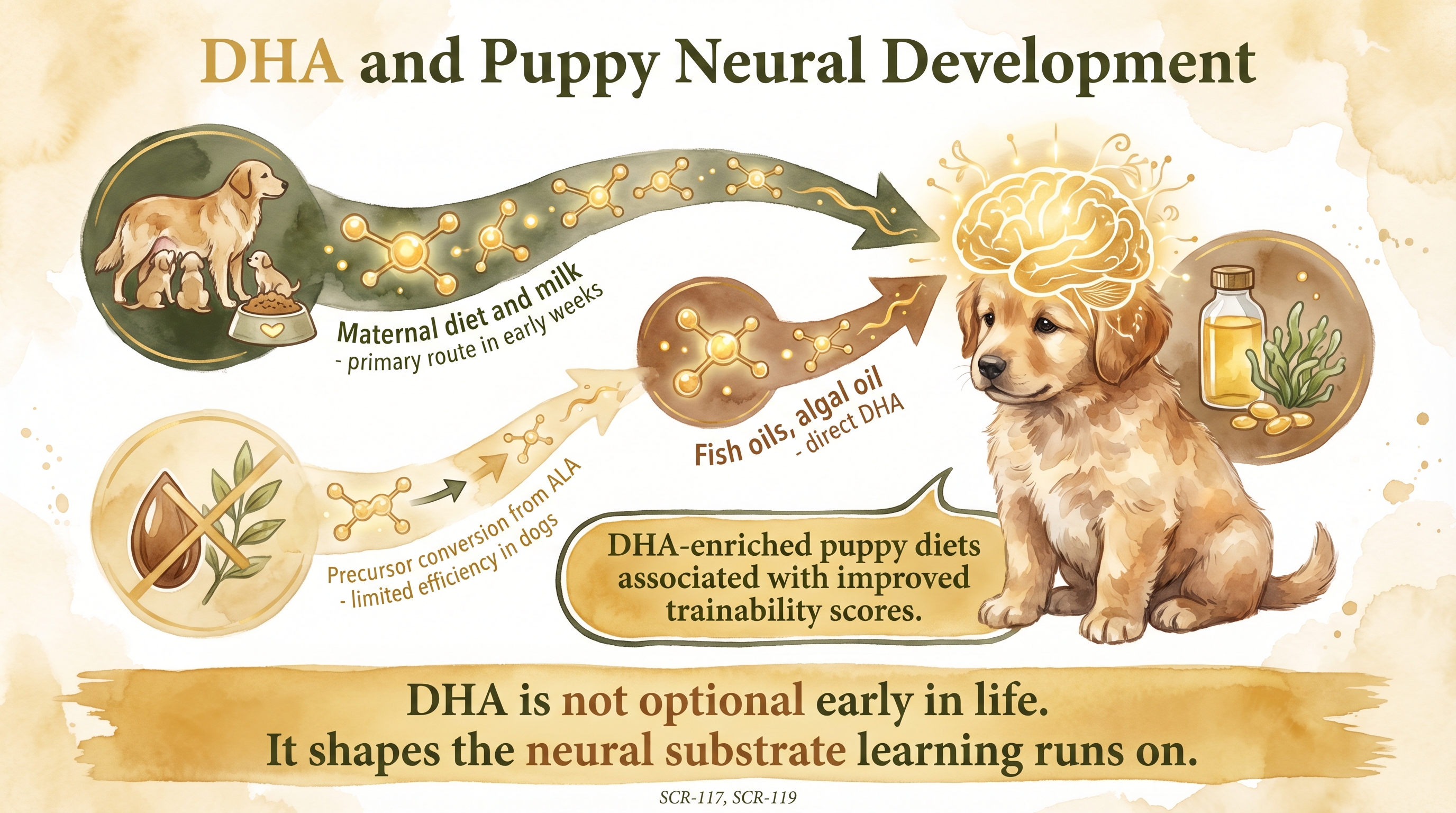
DHA is not optional early in life - it shapes the neural substrate learning runs on.
Key Takeaways
- DHA is a structurally important omega-3 fatty acid for brain and retinal development during puppyhood.
- Puppy DHA evidence is stronger than many front-of-bag nutrition claims, but it still should be framed with proportion.
- DHA is not the same as EPA, and growth formulas emphasize DHA because of its developmental role.
- The practical goal is a complete puppy diet that includes meaningful DHA support, not a one-nutrient obsession.
The Evidence
This entry uses observed claim-level tags beyond the dedicated EvidenceBlocks below. These tags mark JB program observation or practice-derived claims that need dedicated EvidenceBlock coverage in a later content pass.
This entry uses estimated claim-level tags beyond the dedicated EvidenceBlocks below. These tags mark approximate ranges or timing claims that should remain bounded by the cited sources.
The evidence here is attractive because it is more concrete than many pet-food claims. DHA has a biologically plausible structural role. Puppy studies, especially the Zicker work, reported measurable differences in visual and trainability-related outcomes. The strongest recommendation is for meaningful DHA delivery from marine sources during the earliest development window. The weak version of the claim is the marketing exaggeration that DHA alone makes a better puppy. The strong version is simply that it is a real developmental nutrient worth having in a properly formulated growth diet.
What makes this page unusually satisfying is that the mechanism and the outcomes line up reasonably well. DHA is not being praised on the basis of a very distant theory. It is a structural neural lipid with puppy studies showing relevant developmental endpoints. That does not happen for every trendy nutrition topic.
The evidence is still bounded in the right way. The studies support inclusion and support the developmental relevance of the nutrient. They do not prove that every difference in temperament or trainability between puppies is nutritionally caused. They also do not justify turning DHA into a stand-alone intervention detached from total diet quality. The correct family message is therefore strong but proportionate: DHA is real, useful, and worth looking for in a growth formula, but it still belongs inside the broader architecture of good puppy raising.
- Puppy developmental nutrition synthesisdogs
DHA is incorporated into developing neural and retinal tissues during puppyhood and is treated as a meaningful growth-phase nutrient in modern formulation standards. - Zicker and related puppy DHA studiespuppies
DHA-supplemented puppy diets have shown measurable advantages in visual and trainability-related developmental outcomes compared with control formulations. - Growth-profile contextdog-food regulatory context
Modern growth-formula guidance recognizes DHA as a relevant nutrient for growth and reproduction.
- Clinical stewardship interpretationpuppies
DHA belongs in a well-designed growth diet, but it should not be framed as a standalone substitute for overall developmental stewardship.
No published study directly tests the practical implications of dha and neural development in puppies for domestic dog raising programs. The application to household dog raising remains an interpretive synthesis rather than a directly tested intervention finding.
SCR References
Sources
-
National Research Council. (2006). Nutrient Requirements of Dogs and Cats. Washington, DC: The National Academies Press.
-
AAFCO. (2024). Official Publication. Association of American Feed Control Officials.
-
Zicker, S. C., Jewell, D. E., Kashay, M. D., & Rogers, Q. R. (2001). Evaluation of cognitive learning, memory, psychomotor, immunological, and retinal functions in puppies fed developmentally appropriate diets with varying levels of docosahexaenoic acid. Journal of the American Veterinary Medical Association, 217(3), 39-47.
-
Zicker, S. C., Jewell, D. E., Rogers, Q. R. & Lepine, A. J. (2002). Supplemental vitamin A and the development of retinal function in puppies. Journal of Nutrition, 132(12 Suppl), 1697S-1702S.