Myelination in Dogs
Myelination is the process by which oligodendrocytes wrap axons in a fatty insulating sheath called myelin. That sheath increases conduction speed, improves long-range communication efficiency, and helps distributed brain systems work together more smoothly. In dogs, the timing is region-specific and continues well beyond the earliest puppy stage. Documented
What It Means
Myelin matters because brains are not just collections of regions. They are communication systems. When myelination increases, signals travel faster and more efficiently. That changes how well distant regions can coordinate perception, movement, attention, and inhibition. In practical terms, better white-matter insulation helps turn scattered processing into integrated processing. This is one reason immature behavior can coexist with obvious physical capability. A dog may already be mobile, social, and highly responsive while still lacking the fully mature connectivity profile that supports adult-like regulation. Documented
The Canine Sequence
The strongest direct dog evidence comes from MRI, histology correlation, diffusion imaging, and proteomics. Gross and colleagues found that canine maturation proceeds in a staged pattern, with brainstem and cerebellar structures maturing earlier than much of the cerebrum. Early myelination signatures appear first in brainstem auditory pathway regions, while broader cerebral white matter takes longer to reach adult-like appearance. Documented SCR-040 captures the practical summary: early postnatal maturation is rapid, by about 16 weeks the brain looks mostly adult-like on MRI, and maturation continues beyond that point, especially in white matter. That last point matters the most. A structurally more mature scan does not mean all major long-range pathways are finished developing.
Dogs Are Not Tiny Humans
Cross-species comparison is helpful here, but only if it is done carefully. Humans are often described as showing a broadly caudal-to-rostral developmental pattern, with later frontal maturation. Dogs share the broad mammalian principle that white matter matures over time and that association systems lag earlier sensory-motor infrastructure. But the canine spatial pattern is not a simple human copy. The source layer notes that rostral cerebral regions can myelinate earlier than would be expected from the usual human shorthand, and the canine corpus callosum develops with its own sequence. Documented-Cross-Species So the safe conclusion is not "dogs myelinate exactly like humans, only faster." It is that both species show staged white-matter maturation, while the canine regional pattern has its own architecture.
White Matter and Later Control
The importance of myelination becomes even clearer when paired with prefrontal and executive-function pages. Inhibitory control depends on more than one region firing. It depends on communication among frontal, striatal, sensory, and limbic systems. Myelination is part of what makes that coordination reliable. Rodent skill-learning work also supports a broader principle that experience and myelination interact. The exact causal chain has not been mapped cleanly in pet dogs, but the mammalian evidence supports a reasonable inference: repeated experience is being laid down in a brain whose communication infrastructure is still maturing. Documented-Cross-Species
Why It Matters for Your Dog
Myelination helps explain why juvenile behavior can feel inconsistent. Documented When white-matter systems are still maturing, integration across regions is less efficient, response timing is less stable, distraction is easier, and sustained inhibitory control is harder. This is not the only reason puppies behave like puppies, but it is part of the biological substrate. The dog is not only learning rules. The nervous system itself is becoming faster and more coordinated over time. The direct dog evidence supports a real developmental timeline. It does not justify assigning a precise percent of completion to every age, claiming adult-level frontal integration at 8 or 12 weeks, or treating visible physical maturity as proof of neural maturity. The most accurate summary is simpler than that. White matter in dogs develops in a staged way, early systems mature first, and later control-relevant systems continue maturing after the obvious puppy period.
The calmness layer often treats "puppy brain" as a real developmental limitation rather than a moral flaw. Myelination is one of the clearest biological reasons that framing is justified.
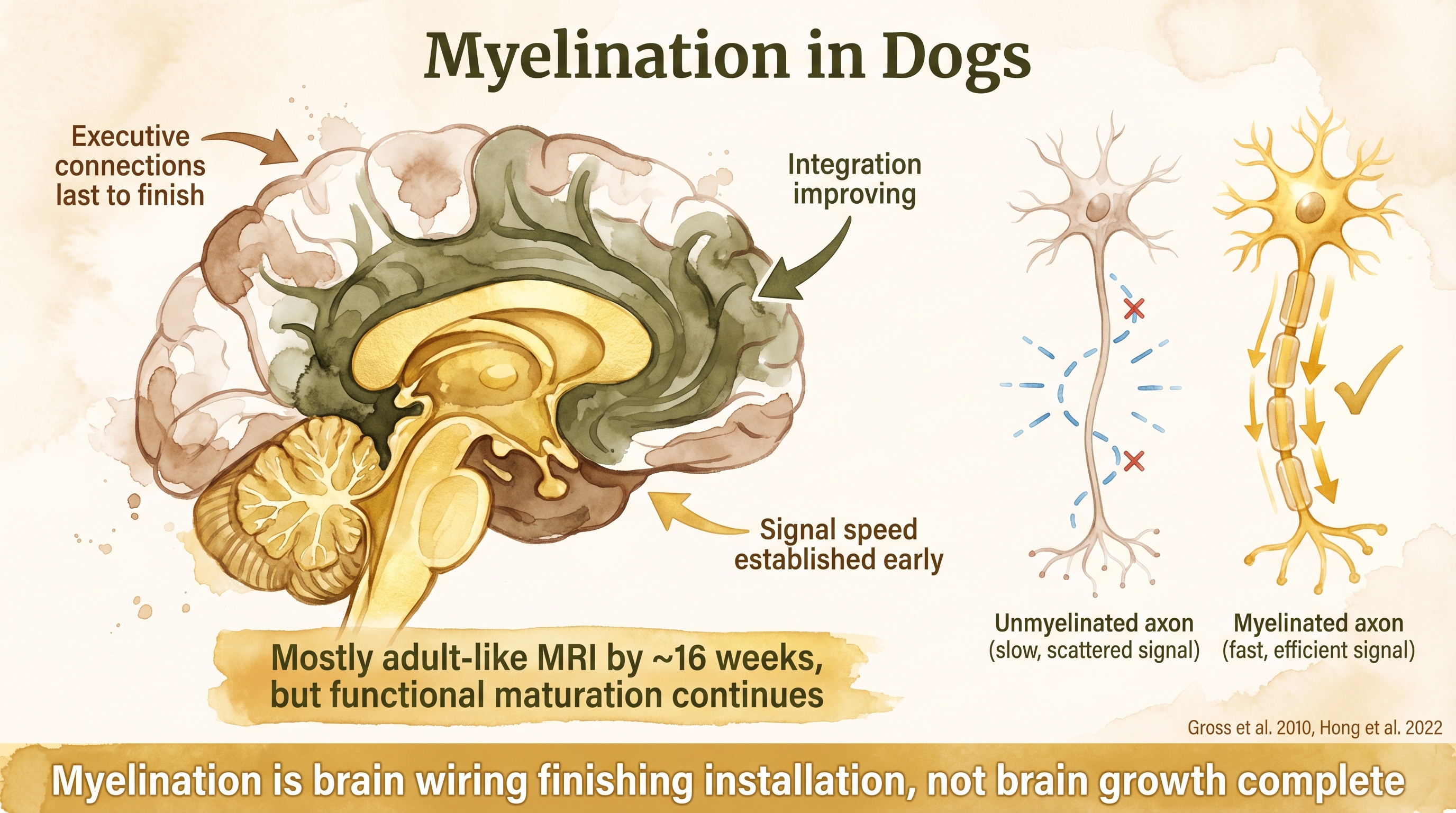
Myelination proceeds from sensory to executive regions - impulse control circuits are literally the last to come online.
Key Takeaways
- Myelin improves speed and efficiency of communication across the brain.
- In dogs, myelination follows a staged developmental sequence rather than appearing all at once.
- A mostly adult-like MRI appearance by about 16 weeks does not mean white-matter maturation is finished.
- Developing white matter is one reason juvenile dogs often lack adult-level integration and inhibitory stability.
The Evidence
- Gross, B. et al. (2010)domestic dogs
MRI and histology correlation showed a staged pattern in which brainstem and cerebellar structures matured before much of the cerebrum. - Wu, Y. C. et al. (2011)domestic dogs
Diffusion imaging supported ongoing white-matter maturation through the later juvenile period. - Hong, H. et al. (2022)domestic dogs
Proteomic work showed strong developmental regulation of myelin-related pathways across newborn, juvenile, and adult brains.
- Paus, T. (2001)humans
Reviewed white-matter maturation as a core part of developmental brain integration. - Mount, C. W., & Monje, M. (2017)rodents and multiple mammals
Summarized experience-dependent myelination as a biologically important part of circuit refinement.
No longitudinal study has tracked the same dogs' white-matter maturation using the same MRI protocol from newborn age through adulthood, making it impossible to define a precise normal developmental sequence for canine myelination.
No study has measured whether early environmental enrichment, experience variation, or learning demands correlate with the pace or degree of white-matter maturation in dogs.
SCR References
Sources
- Gross, B., Garcia-Tapia, D., Riedesel, E., Ellinwood, N. M., & Jens, J. K. (2010). Normal canine brain maturation at magnetic resonance imaging. Veterinary Radiology & Ultrasound, 51(4), 361-373.
- Hong, H., et al. (2022). Comparative proteome and cis-regulatory element analysis reveals specific molecular pathways conserved in dog and human brains.
- Mount, C. W., & Monje, M. (2017). Wrapped to adapt: Experience-dependent myelination. Neuron, 95(4), 743-756.
- Paus, T. (2001). Maturation of white matter in the human brain: A review of magnetic resonance studies. Neuroscience & Biobehavioral Reviews, 25(6), 511-519.
- Wu, Y.-C., Field, A. S., Duncan, I. D., & Samsonov, A. A. (2011). High b-value and diffusion tensor imaging in a canine model of dysmyelination and brain maturation. NeuroImage, 58(3), 829-837. DOI: 10.1016/j.neuroimage.2011.06.067.