Canine Brain Development Timeline
Compound evidence detail1 SCR / 2 parts
- Documentedthe synaptic pruning mechanism documented in cross-mammal developmental neuroscience and confirmed functionally necessary in dogs by canine LGI2 evidence (Seppala 2011)
- Heuristicthe JB-specific application asserting that prevention of behaviors during development translates into pruning of the corresponding neural circuits
The canine brain develops fast, but not all at once. The strongest direct dog evidence shows rapid early postnatal tissue change, staged myelination, and continued maturation well beyond the first weeks of life. What the literature does not support is the idea that puppy brain development is basically finished by six or eight weeks. The structure is changing, the connectivity is changing, and the systems that support adult-like inhibition are still maturing long after puppies leave the litter. Documented
What It Means
Developmental timing changes what a behavior means. A young dog who cannot disengage from a salient distraction is not necessarily showing a stable character trait or a training deficit. In many cases, the brain systems that support rapid long-range integration, behavioral inhibition, and flexible regulation are still under construction. That is why neuroscience pages like this matter. They do not replace behavior. They explain why behavior looks the way it does at different ages.
The Earliest Postnatal Period
In the first weeks after birth, the canine brain is changing rapidly in basic tissue properties. Longitudinal MRI work from Gross and colleagues tracked normal dogs from 1 to 36 weeks and found a staged transition in gray and white matter appearance tied to decreasing water content and progressive myelination. Early visible maturation begins in the brainstem and cerebellum, not in the full association cortex. Documented That pattern is important because it means the earliest-maturing systems are not the ones most associated with later executive control. Basic sensory and motor support comes online early. More distributed control and integration come later.
Fox's classic developmental work also supports rapid early maturation in sensory and sensorimotor systems, including adult-like features in some evoked-potential measures by around five to six weeks. But that finding should not be inflated into a claim that the whole brain is already mostly adult in every meaningful sense.
Weeks 3 to 8: A Window of Fast Change
The 3 to 8 week period is one of the densest phases of visible developmental transition. MRI-visible gray-white contrast changes accelerate, the corpus callosum becomes easier to identify, and the brain moves from a very immature imaging pattern toward a more organized one. This is also the life stage that overlaps with the best-established behavioral socialization window in dogs. The important point is correlation, not over-precision. We know behaviorally that social experience matters strongly in this period. We also know neurologically that the brain is in a high-change state. What we do not yet have is a dog-specific pruning calendar that lets us map one behavioral milestone to one exact synaptic event.
Weeks 8 to 16: More Adult-Like, Not Finished
One of the most important SCR boundaries in this whole topic is SCR-040. It supports the statement that the dog brain approaches a mostly adult-like MRI appearance by about 16 weeks, while maturation continues beyond that point. Estimated That wording matters. "Mostly adult-like" does not mean fully myelinated, fully integrated, behaviorally adult, or neurologically done. It means that on structural imaging, major tissue contrasts have moved substantially toward adult appearance. The same literature still shows ongoing subcortical white matter arborization and continued maturation through at least 36 weeks, with good reason to think important development continues beyond that interval.
Myelination Continues After the Obvious Puppy Stage
Myelination is one of the main reasons the early timeline can feel misleading. The puppy may already look coordinated, social, and physically capable while the longer-range communication infrastructure is still being refined. Dog MRI, diffusion work, and proteomics all support continued white-matter maturation after the earliest visible transitions. Wu and colleagues showed age-related diffusion changes across roughly 3 to 16 months consistent with ongoing maturation. Hong and colleagues found strong developmental regulation of myelin-related pathways and region-enriched synapse-associated systems across newborn, juvenile, and adult stages. Documented This is one reason "puppy brain" is not just a metaphor. Signal transmission speed, integration efficiency, and large-scale coordination are developing processes.
Pruning: Real Mechanism, Incomplete Canine Calendar
Pruning is where the evidence needs the most discipline. Across mammals, early development involves more synaptic possibilities than the mature brain ultimately keeps. Experience biases which circuits are stabilized and which are eliminated. That principle is strongly established in human, primate, rodent, and broader mammalian neuroscience. In dogs, two things are true at once: the pruning machinery is confirmed and the normal developmental timeline is not fully mapped. SCR-043 gives the direct canine anchor. The LGI2 gene is involved in synaptic pruning and cellular adhesion in the developing dog brain, and loss-of-function mutation causes aberrant connectivity with juvenile epilepsy. That confirms the mechanism is real and biologically necessary in dogs. What it does not give us is a week-by-week pruning calendar for normal puppy development. That is the boundary SCR-024 and SCR-043 are protecting.
The Unverified "70% by 6 Weeks" Claim
SCR-041 exists because one developmental number is unusually easy to repeat and unusually hard to defend cleanly. The commonly cited claim that a dog's brain reaches roughly 70% of adult size or mass by 6 weeks has not been verified against a primary canine growth series with explicit numerical confirmation. Fox's work supports rapid early brain growth and substantial development by that age, but the specific percentage is not locked down in the current evidence base. Ambiguous The safer phrasing is: brain growth is rapid early, substantial development is present by six weeks, and the exact percentage claim remains unverified. That is still a strong developmental statement. It just avoids false precision.
Later Juvenile Development and Functional Maturity
The structural dog literature is denser for early postnatal change than for late-adolescent cortical timing. Even so, the broader picture is clear enough to matter: development does not stop when the puppy comes home, does not stop at 16 weeks, and does not stop when the dog looks physically large. Sleep EEG development, executive-function measures, inhibitory-control tasks, and ongoing white-matter findings all point in the same direction. Adult-like regulation is assembled over time. The exact upper endpoint is less sharply mapped in dogs than in humans, but the practical scientific takeaway is still solid: a juvenile dog is neurologically less finished than its body often suggests.
Why It Matters for Your Dog
A developmental timeline does not excuse every behavior. It calibrates expectations. When the people caring for a young dog ask for sustained impulse control, flexible recovery from arousal, resistance to distraction, and stable generalization across contexts, they are asking for capacities that depend on systems still maturing through the first year and functionally beyond. Documented That does not mean nothing can be taught early. Early experience matters enormously. It means the target should be scaffolded, not misread as if the dog already has adult hardware.
The prevention layer often emphasizes that what is rehearsed early can become structurally easier later. This page supports the narrower biological claim: the puppy brain is highly plastic, rapidly changing, and still assembling the infrastructure for adult regulation well after the earliest socialization period.
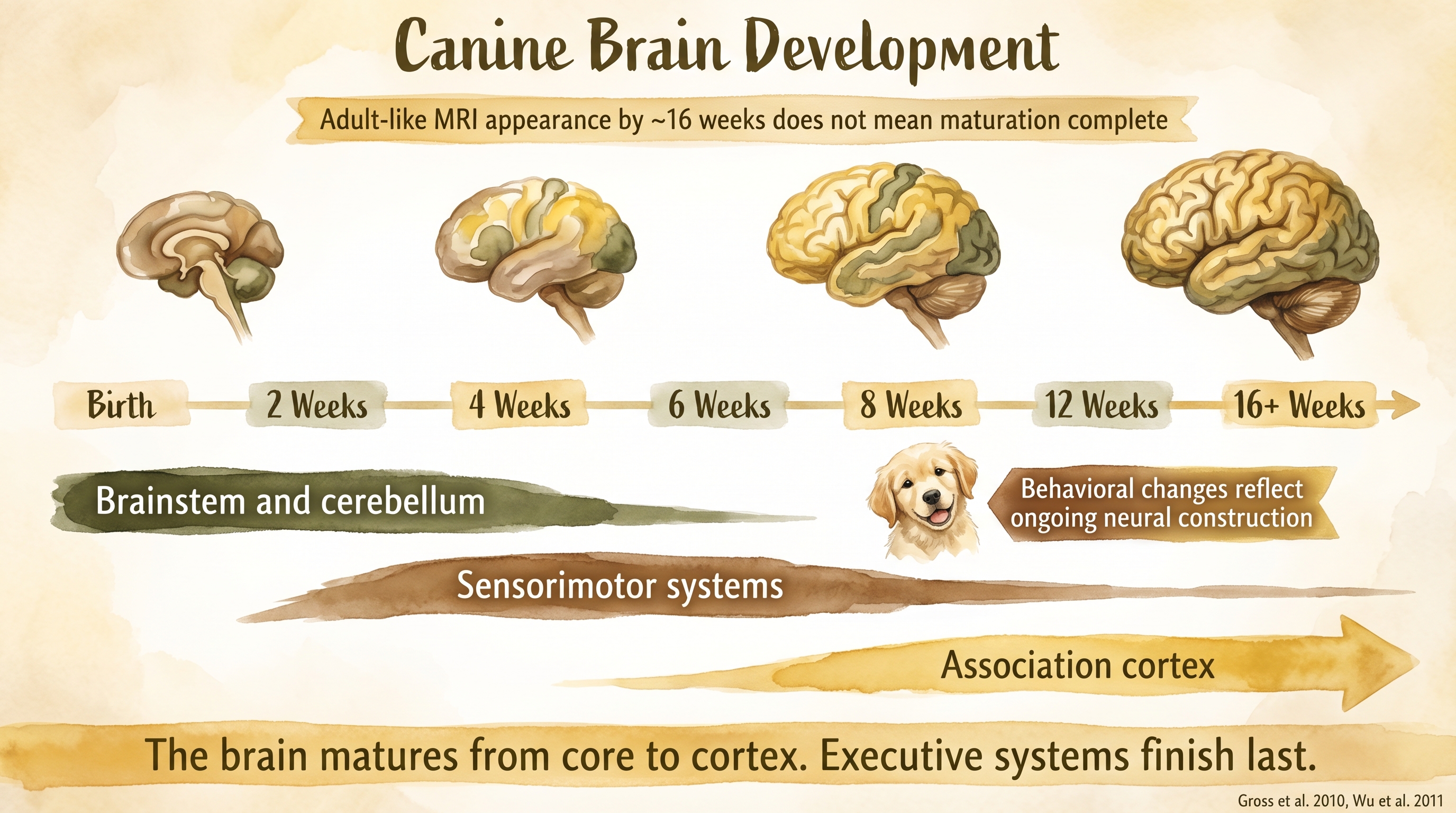
Brain development follows a predictable timeline with critical windows for sensory, social, and executive function maturation.
Key Takeaways
- The dog brain develops rapidly after birth, but not all systems mature at the same rate.
- A mostly adult-like MRI appearance by about 16 weeks does not mean the brain is finished.
- Myelination and other maturation processes continue well beyond the earliest puppy stage.
- Pruning machinery is confirmed in dogs, but a detailed normal pruning calendar has not yet been mapped.
The Evidence
This entry uses estimated claim-level tags beyond the dedicated EvidenceBlocks below. These tags mark approximate ranges or timing claims that should remain bounded by the cited sources.
- Gross, B. et al. (2010)domestic dogs
Longitudinal MRI and histology correlation showed staged postnatal maturation with early brainstem and cerebellar change followed by broader cerebral maturation. - Wu, Y. C. et al. (2011)domestic dogs
Diffusion imaging across approximately 3 to 16 months supported ongoing white-matter maturation beyond the earliest puppy period. - Hong, H. et al. (2022)domestic dogs
Dog brain proteomics showed strong developmental regulation of myelination-related and synapse-associated pathways across newborn, juvenile, and adult stages. - Fox, M. W. (1964, 1971)domestic dogs
Classic canine developmental work documented rapid early brain growth and early maturation in some sensory and cortical measures.
- Huttenlocher, P. R. (1979)humans
Established postnatal synaptic overproduction and later reduction in cortex. - Faust, T. et al. (2021)multiple mammals
Reviewed activity-dependent pruning mechanisms including complement signaling and microglial engulfment. - Freedman, D. G. et al. (1961) and Scott, J. P. & Fuller, J. L. (1965)domestic dogs
Established the behavioral socialization window in dogs, which overlaps developmentally with the high-plasticity early postnatal period.
- SCR-041 boundarydomestic dogs
Rapid early brain growth is documented, but the widely repeated claim that the brain is about 70 percent of adult size by six weeks remains unverified.
No direct canine research located for this specific topic. Current understanding relies on related research, clinical observation, and cross-species inference.
SCR References
Sources
- Faust, T., Gunner, G., & Schafer, D. P. (2021). Mechanisms governing activity-dependent synaptic pruning in the developing mammalian CNS. Nature Reviews Neuroscience, 22, 657-673.
- Fox, M. W. (1964). The postnatal growth of the canine brain and correlated anatomical and behavioral changes during neuro-ontogenesis. Growth, 28, 135-141.
- Fox, M. W. (1971). Integrative development of brain and behavior in the dog. University of Chicago Press.
- Freedman, D. G., King, J. A., & Elliot, O. (1961). Critical period in the social development of dogs. Science, 133(3457), 1016-1017.
- Gross, B., Garcia-Tapia, D., Riedesel, E., Ellinwood, N. M., & Jens, J. K. (2010). Normal canine brain maturation at magnetic resonance imaging. Veterinary Radiology & Ultrasound, 51(4), 361-373.
- Hong, H., et al. (2022). Comparative proteome and cis-regulatory element analysis reveals specific molecular pathways conserved in dog and human brains.
- Scott, J. P., & Fuller, J. L. (1965). Genetics and the social behavior of the dog. University of Chicago Press.