SDMA (Symmetric Dimethylarginine)
SDMA became important in canine kidney screening because it improved the field's ability to notice renal trouble earlier than creatinine alone. That is its real value. Not that it magically diagnoses every kidney disease from one number, and not that it replaces urine, imaging, or trend data, but that it gives veterinarians a better early warning signal than older chemistry panels could provide on their own. Documented
What It Means
What SDMA Is
Symmetric dimethylarginine is a methylated amino-acid byproduct released during normal protein turnover and cleared largely by the kidneys. Because it tracks glomerular filtration rate more directly than creatinine in some contexts, it tends to rise earlier as renal function declines. Documented
That is the central clinical reason it matters.
Why It Improved Kidney Screening
Creatinine has two major limitations it rises relatively late in kidney decline; and it is influenced by lean muscle mass.
The SCR now supports that SDMA can rise when kidney function has declined by roughly 20 to 40 percent, whereas creatinine often does not become clearly abnormal until much more functional loss has occurred. Estimated It is also less distorted by how muscular or thin the dog is.
This makes SDMA especially useful in early CKD detection; senior wellness screening; dogs with lower muscle mass; and trend-based monitoring over time. Documented
What It Does Not Do
The value of SDMA is easy to oversell, which is why the specificity caveat matters.
An elevated SDMA does not automatically mean confirmed chronic kidney disease; irreversible renal failure; and one fixed prognosis.
The SCR explicitly carries the warning that SDMA is not perfectly specific. It must travel with context. That usually means pairing it with creatinine; urinalysis; urine specific gravity; blood pressure; imaging when warranted; and repeat testing and trend interpretation.
Where It Fits in IRIS Staging
SDMA is now built into the IRIS approach to renal staging. That does not mean SDMA replaced creatinine. It means renal medicine now recognizes that multiple markers together tell the story better than one marker alone.
This is one of the biggest reasons the biomarker matters. It is not a niche lab curiosity anymore. It is part of the modern framework by which kidney disease gets noticed and staged.
Why It Matters for Your Dog
Why Families Should Care
Families do not need to memorize reference intervals. They do benefit from knowing two things a mildly elevated SDMA is a reason for workup, not instant doom; and a normal creatinine does not always mean the kidneys are completely fine.
That second point is especially important in older dogs and in dogs with subtle early renal decline.
How Veterinarians Use It Well
The best use of SDMA is usually longitudinal. A single value may help raise suspicion, but trends often say more than isolated snapshots.
For example, a veterinarian may think more seriously about kidneys when SDMA is persistently elevated; the value is rising over time; urine concentration is falling; and the dog is drinking and urinating more. Documented
This is exactly what good screening is supposed to do. It moves the question forward before the patient is in obvious late-stage failure.
The JRD and Young-Dog Boundary
Because this wiki now includes juvenile renal dysplasia, it is worth saying clearly that SDMA is not only a senior-dog marker. Documented It can contribute to the workup of abnormal kidney function in younger dogs too.
What changes is the interpretation. In a young dog, the clinician has to ask developmental and congenital questions, not only the usual age-related CKD questions.
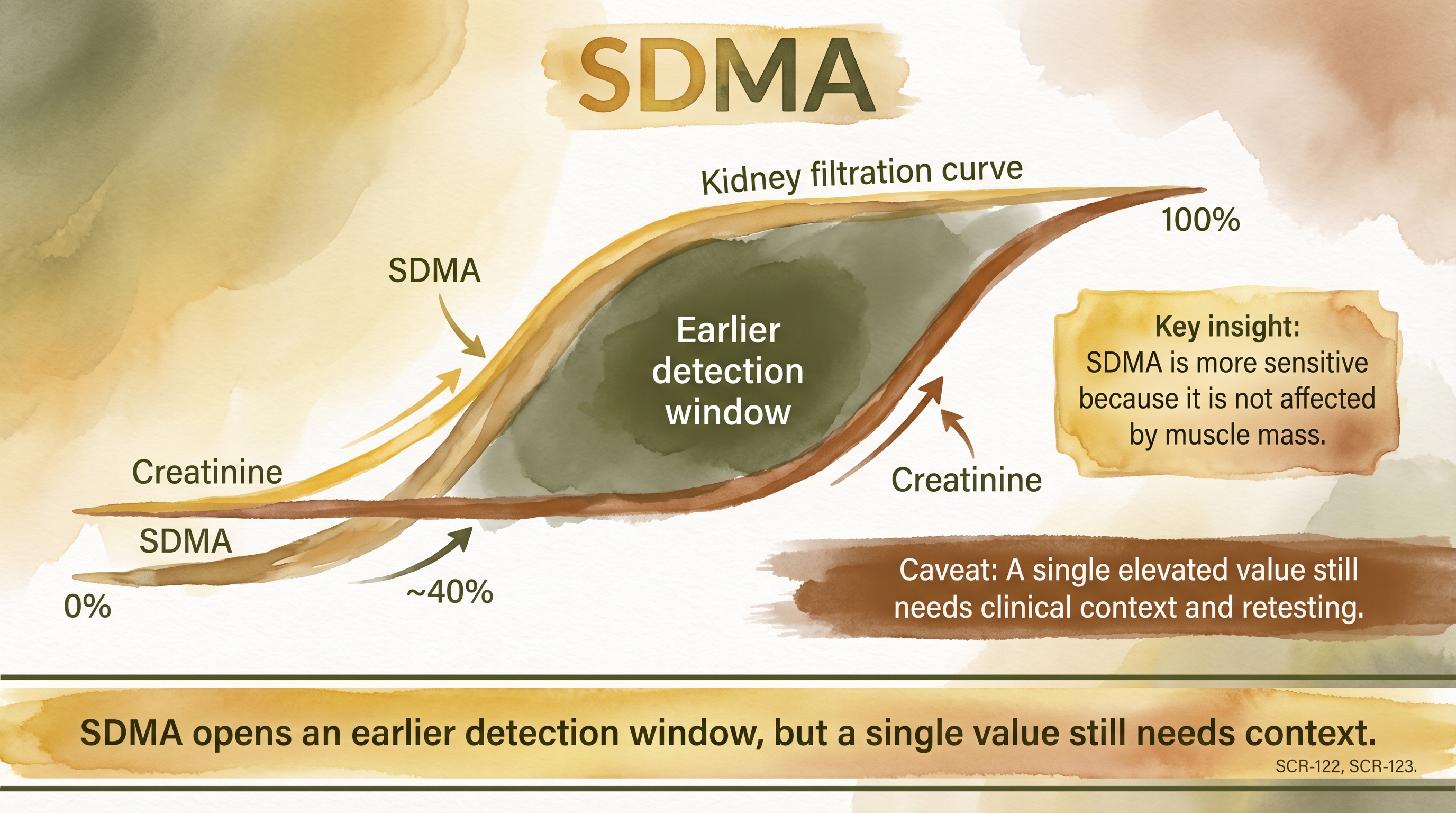
SDMA opens an earlier detection window, but a single value still needs context.
Key Takeaways
- SDMA improved canine kidney screening because it tends to rise earlier than creatinine as filtration declines.
- It is especially helpful in early renal detection and in dogs whose muscle mass makes creatinine harder to interpret cleanly.
- An abnormal SDMA value is not a stand-alone diagnosis and still needs urine, trend, and clinical context.
- Its importance is now cemented by integration into the IRIS renal-staging framework.
The Evidence
This entry uses estimated claim-level tags beyond the dedicated EvidenceBlocks below. These tags mark approximate ranges or timing claims that should remain bounded by the cited sources.
- SCR-122 supportdogs
SDMA rises earlier than creatinine as GFR declines and is less confounded by lean muscle mass. - SCR-123 supportdogs
Modern IRIS staging incorporates SDMA into the broader canine CKD framework rather than treating creatinine as the only meaningful renal marker. - Renal screening literaturedogs
The strongest clinical use of SDMA is early warning within a trend-based renal workup, not as a stand-alone diagnosis.
- IRIS interpretation caveatdogs
SDMA is useful but not perfectly specific, so abnormal values require context, repeat assessment, and complementary testing. - Clinical-pathology frameworkdogs
A mildly abnormal biomarker should trigger workup and interpretation rather than automatic labeling of CKD from one value alone.
- domestic dogs
No published study directly defines the single best testing interval, threshold, or decision rule for sdma (symmetric dimethylarginine) across all Golden Retriever households and breeding programs.
SCR References
Sources
- Nabity, M. B., Lees, G. E., Boggess, M. M., Yerramilli, M., Obare, E., Yerramilli, M., Rakitin, A., Aguiar, J., & Relford, R. (2015). Symmetric dimethylarginine assay validation, stability, and evaluation as a marker for the early detection of chronic kidney disease in dogs. Journal of Veterinary Internal Medicine, 29(4), 1036-1044. https://doi.org/10.1111/jvim.12835
- International Renal Interest Society. (2023). IRIS staging of CKD. https://www.iris-kidney.com/iris-staging-system
- International Renal Interest Society. (2024). IRIS best practice consensus guidelines for the diagnosis and management of acute kidney injury in dogs and cats. https://www.iris-kidney.com/iris-guidelines-1
- Boundary approved by Queue1-DecisionTree: the existing Nabity et al. (2015) SDMA validation paper plus current IRIS staging guidance are the support boundary for this entry. No separate primary-source citation beyond this SDMA / IRIS boundary was located or required after SCR-122 and SCR-123 were upgraded to Verified.