IRIS CKD Staging
IRIS CKD staging is the language modern veterinary medicine uses to describe chronic kidney disease with enough structure that different clinicians can talk about the same patient coherently. That is its real contribution. It does not magically reveal the cause of kidney injury, and it does not turn a continuum disease into four perfectly clean boxes. What it does do is give the profession a shared framework for severity, treatment planning, and longitudinal tracking. Documented
What It Means
What IRIS Is
IRIS stands for the International Renal Interest Society, a veterinary consortium that publishes widely used guidance for canine and feline kidney disease. In practice, when a veterinarian says a dog is "IRIS Stage 2" or "IRIS Stage 3," they are using a global consensus framework rather than inventing a local shorthand. Observed-JB
That matters for families because kidney disease is one of the conditions where vague language can create a lot of confusion. "The kidneys are a little off" does not tell you much. A defined stage does.
The Four Main Stages
IRIS classifies chronic kidney disease into four stages using serum creatinine as the central anchor, with SDMA and other evidence refining interpretation.
The current canine framework is Stage 1 means creatinine under 1.4 mg/dL, with some other evidence of renal injury; Stage 2 means creatinine 1.4 to 2.8 mg/dL; Stage 3 means creatinine 2.9 to 5.0 mg/dL; and Stage 4 means creatinine over 5.0 mg/dL.
That 2.9 threshold matters because the SCR now reflects the more recent upward revision of the Stage 2 to Stage 3 boundary. Documented Anyone still quoting the older 2.1 to 5.0 Stage 3 window is working from outdated staging.
Why Stage 1 Is Different
Stage 1 often surprises families because the creatinine can still be in or near the laboratory reference interval. This is why Stage 1 does not mean "no disease." It means the kidneys show evidence of injury or impaired reserve before the more obvious azotemic stages appear.
That evidence might include persistently increased SDMA, inappropriate urine dilution, imaging changes, persistent renal proteinuria, and biopsy or pathology evidence.
This is also why SDMA matters so much. It helps make Stage 1 visible earlier than older chemistry panels could on their own.
Why Creatinine Is Still Used
Families sometimes hear that SDMA is newer and assume creatinine is now obsolete. It is not.
Creatinine is still clinically useful because it is familiar across decades of renal medicine; easy to trend; built into the staging framework; and still meaningful when interpreted alongside body condition and hydration.
Its main problem is not that it is bad. Its problem is that it rises relatively late and is influenced by muscle mass. A very lean dog and a heavily muscled dog can carry the same creatinine in different physiologic contexts. That is exactly why SDMA was added rather than why creatinine was discarded.
Substaging: Proteinuria and Blood Pressure
IRIS is not only a creatinine table. Once the dog is staged, the disease is also substageable by proteinuria, usually using the urine protein:creatinine ratio; and systemic blood pressure.
This is clinically important because two dogs with the same creatinine can still face different risks and need different management if one is proteinuric or persistently hypertensive and the other is not.
Proteinuria matters because it can both reflect and worsen glomerular injury. Documented Blood pressure matters because hypertension can damage kidneys further while also threatening the eyes, brain, and cardiovascular system.
Why It Matters for Your Dog
What the Stages Usually Mean in Practice
The stages are not prognosis in a bottle, but they do change the treatment conversation.
Stage 1 often centers on identifying underlying cause when possible; confirming the problem with repeat testing; monitoring trends; and protecting renal function early.
Stage 2 often introduces a more explicit chronic-disease management plan renal diet discussion; blood pressure monitoring; urine protein assessment; and serial chemistry and urinalysis. Observed-JB
Stage 3 generally reflects more obvious loss of renal reserve and often requires a more intensive management structure tighter dietary management; greater attention to phosphorus and hydration; more frequent lab monitoring; and more active symptom control. Observed-JB
Stage 4 is the severe end of the disease where quality of life, supportive intensity, and prognosis conversations become much more central.
The point is not that every stage has one mandatory protocol. The point is that staging organizes the decision tree.
Why the Framework Is Useful
IRIS staging does three important jobs well.
First, it standardizes communication. A referral clinician, primary-care veterinarian, and family can talk about the same disease state with less ambiguity.
Second, it improves trend interpretation. Kidney disease is a disease of movement over time. Staging helps make that trajectory legible.
Third, it supports evidence-based treatment decisions. Most renal recommendations in the literature are not written for an abstract dog with "kidney issues." They are tied to severity, proteinuria status, blood pressure, and trend.
The Limits of the System
The IRIS framework is valuable, but it is still a framework rather than a mechanistic theory of kidney disease.
Important limits include stage boundaries are pragmatic cut points, not sharp biologic walls, dehydration and acute events can distort interpretation, dogs within the same stage may differ enormously in cause and prognosis, and creatinine and SDMA say something about function, not the entire etiology.
That means staging answers "how severe does this look right now?" more directly than it answers "why did this happen?" or "what will happen next?"
The Chronic Versus Acute Boundary
IRIS CKD staging is for chronic kidney disease, not every abnormal renal lab value. A dog with acute kidney injury can have a severe creatinine elevation without fitting neatly into the chronic staging conversation until the clinician knows whether the problem is acute, chronic, or acute on chronic.
This matters because families can easily hear "Stage 3 numbers" and assume the same prognosis in every circumstance. Documented The context still matters.
Why This Page Matters for Goldens
Golden Retrievers face the same senior-kidney issues many large breeds do, but this wiki also carries a juvenile renal dysplasia page. That makes the IRIS page especially useful because it gives families a shared staging language while still preserving the difference between developmental renal disease in the young dog; progressive chronic kidney disease in the older dog; and acute kidney injury that does not belong in the same bucket. Documented
The framework helps. It does not erase those distinctions.
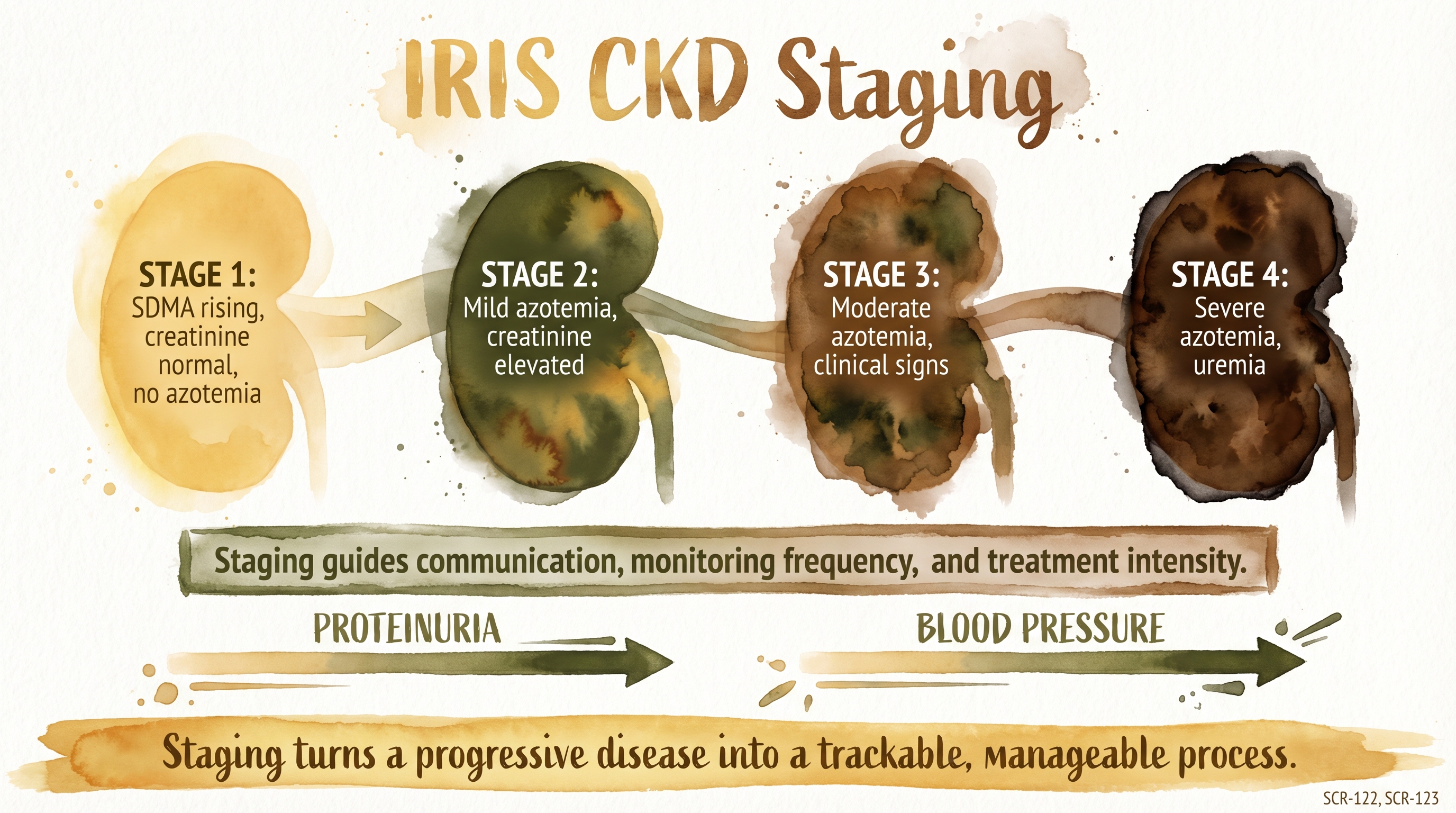
Staging turns a progressive disease into a trackable, manageable process.
Key Takeaways
- IRIS CKD staging gives veterinary medicine a common language for describing chronic kidney disease severity and tracking it over time.
- The current canine stage boundaries are Stage 1 under 1.4 with other renal evidence, Stage 2 at 1.4 to 2.8, Stage 3 at 2.9 to 5.0, and Stage 4 above 5.0.
- SDMA did not replace creatinine. It improved the framework by making earlier and cleaner interpretation possible in more dogs.
- Proteinuria, blood pressure, trend, and cause still matter because no staging system can tell the whole renal story by chemistry alone.
The Evidence
This entry uses observed claim-level tags beyond the dedicated EvidenceBlocks below. These tags mark JB program observation or practice-derived claims that need dedicated EvidenceBlock coverage in a later content pass.
- SCR-123 supportdogs
The current IRIS canine CKD framework uses the revised Stage 2 to Stage 3 boundary, with Stage 3 beginning at creatinine 2.9 mg-dL rather than the older lower threshold. - SCR-122 supportdogs
SDMA contributes earlier functional warning than creatinine alone and is now integrated into modern renal staging and interpretation. - IRIS guidancedogs
Proteinuria and systemic blood pressure are core substaging variables because renal disease severity is not captured by creatinine alone.
- Veterinary nephrology consensusdogs
IRIS stages are practical communication categories rather than pure mechanistic disease classes, so individual prognosis still depends on cause, trend, and response to management. - Clinical-pathology logicdogs
Abnormal renal biomarkers must still be interpreted against hydration status and the acute-versus-chronic question rather than being read in isolation.
- domestic dogs
No published study directly compares the most effective long-term management paths for iris ckd staging in dogs across breeds and ordinary home settings.
SCR References
Sources
- Nabity, M. B., Lees, G. E., Boggess, M. M., Yerramilli, M., Obare, E., Yerramilli, M., Rakitin, A., Aguiar, J., & Relford, R. (2015). Symmetric dimethylarginine assay validation, stability, and evaluation as a marker for the early detection of chronic kidney disease in dogs. Journal of Veterinary Internal Medicine, 29(4), 1036-1044. https://doi.org/10.1111/jvim.12835
- International Renal Interest Society. (2023). IRIS staging of CKD. https://www.iris-kidney.com/iris-staging-system
- International Renal Interest Society. (2024). IRIS best practice consensus guidelines for the diagnosis and management of acute kidney injury in dogs and cats. https://www.iris-kidney.com/iris-guidelines-1
- Boundary approved by Queue1-DecisionTree: the existing Nabity et al. (2015) SDMA validation paper plus current IRIS staging guidance are the support boundary for this entry. No separate primary-source citation beyond this SDMA / IRIS boundary was located or required after SCR-122 and SCR-123 were upgraded to Verified.