The Canine Digestive System
Compound evidence detail2 SCRs / 4 parts
- Documentedcanine digestive anatomy and physiology evidence covering GI organs, AMY2B-linked starch adaptation, gastric acidity, transit-range variability, and microbiome fermentation
- Documentedthe bounded comparison to humans and wolves, where canine pH, transit, and starch-digestion findings support difference-from-wolf framing without diet absolutism
- Documentedthe canonical canine emergency red flags - unproductive retching with abdominal distention (possible GDV), collapse or pale gums (possible internal hemorrhage, hypovolemia, or cardiac disease), repeated vomiting with inability to retain water, suspected toxin ingestion, difficulty breathing or cyanosis, prolonged or cluster seizures, severe trauma, acute limb-use loss, inability to urinate, and heatstroke - each linked in canine emergency-medicine reference texts to a critical underlying problem warranting prompt veterinary evaluation rather than watchful waiting
- Observed-JBthe documented reduction in time-to-care that comes from family preparation in advance - knowing the nearest emergency hospital, a backup hospital, and a poison control number - recognized across emergency-medicine practice but not quantified in a published controlled outcome trial
The canine digestive system is the hardware underneath every feeding decision. If you want to understand why one food works, why sudden changes trigger diarrhea, or why dogs and humans respond differently to the same meal, you start with anatomy and physiology. Dogs are not wolves, but they also are not furry little humans with human digestion. Their gastrointestinal system has its own logic, and good nutrition advice has to respect it. Documented
What It Means
Digestion is the coordinated process of breaking food into absorbable components, moving it through specialized compartments, absorbing nutrients across the small intestine, and handing the leftover material to the colon and microbiome.
The canine digestive tract is optimized for a mixed carnivore-style pattern: relatively short compared with herbivores, strongly acidic in the stomach, enzyme driven in the small intestine, and less fermentation dependent than a human or true hindgut fermenter. Ambiguous
Mouth and Esophagus
Digestion technically begins before the food reaches the stomach. Smell, anticipation, and chewing trigger the cephalic phase, priming acid and enzyme secretion downstream.
Dogs do chew, but not the way humans do. They are built more for tearing and swallowing than for prolonged mechanical grinding. Saliva mainly lubricates the bolus rather than performing major starch digestion. That is one important difference from people.
The absence of meaningful salivary amylase is one of the cleanest dog-human differences families can understand. Humans begin significant starch digestion in the mouth. Dogs do not rely on that same early step. They can digest starch well when the diet is properly processed, but the work happens farther down the tract.
The esophagus is also worth mentioning because transit from mouth to stomach is usually quick and efficient. That speed works well for an animal built to consume meals relatively rapidly. It also helps explain why swallowing behaviors, meal pacing, and bowl design can matter clinically in some dogs even before the food reaches the stomach.
The Stomach
The canine stomach is a high-acid holding and processing chamber. In fasting states, gastric pH can be very low, often cited around the 1 to 2 range. Estimated That acidity helps denature proteins, activate pepsin, suppress some ingested microbes, and prepare food for controlled emptying into the small intestine.
This is part of why dogs can sometimes tolerate microbial exposures that would upset humans more readily. But it should not be exaggerated into a myth that dogs are immune to foodborne risk. Strong stomach acid lowers risk. It does not erase it.
That distinction matters in raw-feeding arguments. A fasting gastric pH around 1 to 2 is genuinely impressive and absolutely part of the dog's biologic resilience. But resilient is not the same as invulnerable. Pathogen dose, immune status, meal composition, and the specific organism all still matter.
The stomach is also where one of the major digestion phases becomes visible to families: gastric digestion is not just storage. It is active chemical and mechanical processing. Protein denaturation, pepsin activation, mixing, and controlled emptying all start here. If gastric emptying is too fast, too slow, or challenged by an unusually fatty meal, downstream tolerance changes.
The Small Intestine
Most nutrient absorption happens in the small intestine. This is where pancreatic enzymes, bile acids, and brush-border transport systems do the heavy lifting.
Key contributors include amylase for starch digestion, lipase for fat digestion, proteases for protein digestion, and bile acids for fat emulsification and absorption. Documented
The intestinal villi and microvilli massively increase absorptive surface area. This is where amino acids, fatty acids, glucose, minerals, and many vitamins actually cross into the body.
This is also where the brush-border enzymes and transporters matter. The microvillar border is not just passive surface area. It is metabolically active tissue that finishes digestion and coordinates absorption. When families hear that a puppy needs time to "adjust" to a new diet, much of that adjustment is happening here, where the intestine is handling a changed pattern of starch, fat, protein, and fiber.
The small intestine is the main arena for usable nutrition. A food can look perfect on the label, but if pancreatic output, bile delivery, mucosal health, or brush-border function are compromised, the dog's body may not capture what the formulation promised.
The Pancreas and Liver
The pancreas is central to digestion because it delivers the enzyme package that turns intact food into absorbable pieces. The liver and gallbladder contribute bile acids, which are crucial for handling dietary fat and the fat-soluble vitamins that travel with it. Documented
If these organs are not functioning well, digestion fails even if the diet looks perfect on paper.
The enzyme pattern is especially important in practical feeding. Pancreatic amylase handles starch, lipase handles fat, and proteases break down protein. That means abrupt changes in macronutrient distribution, especially a sudden jump in dietary fat, can change how hard the upper gastrointestinal system has to work.
This is one reason low-fat diets are often prescribed for pancreatitis management. The point is not that fat is bad in all dogs. The point is that pancreatic stimulation and fat handling can become clinically important in dogs whose digestive system is inflamed or vulnerable.
Bile acids are the other half of that story. Without adequate emulsification, dietary fat and fat-soluble vitamin absorption become inefficient. Families often think about digestion in terms of "what goes into the mouth," but the hidden chemistry of bile flow and enzyme release is what turns food into nutrition.
The Colon
The colon is where water recovery, stool formation, and microbial fermentation take center stage. Dogs do have colonic fermentation, but it is much less dominant than in herbivores and still somewhat less extensive than in humans.
That matters because fibers and resistant fractions are not useless leftovers. Some are fermented into short-chain fatty acids that help support colon health and barrier function.
This colon-level fermentation is one reason fiber type can change stool character so quickly. A diet with more fermentable substrate can alter gas production, stool bulk, stool water, and microbial metabolites. A diet with less fermentable substrate may reduce some of those effects while changing others. The colon is therefore not merely a waste chute. It is a meaningful metabolic site, just not the primary one for energy capture in the way it would be for a true hindgut fermenter.
This is also why dogs and humans often react differently to the same fiber-heavy food. Human nutrition conversations frequently center colon fermentation more heavily because the human colon contributes differently to dietary handling than the canine colon does. Dog nutrition still cares about fiber, but within a system that is overall shorter and more upper-intestine focused.
Transit Time and the Change Problem
Dogs often move food through the system faster than people expect. Most meals move through on a scale of hours rather than days. That faster transit pattern helps explain why sudden diet changes can create fast, obvious stool effects.
Common references place total transit for many meals in the broad range of roughly 4 to 10 hours, though actual time varies with meal size, moisture, fat content, fiber pattern, individual dog factors, and what exactly is being measured. Estimated The takeaway is not the exact number. The takeaway is that canine digestion moves quickly enough that changes in food quality or tolerance often show up in the next several stools rather than weeks later.
A new diet changes substrate profile, osmotic load, fat content, fiber type, and microbiome fermentation pattern.
When families change all of that abruptly, diarrhea is not a mystery. It is the gut reacting to a different input pattern before the microbial and enzymatic system has time to adapt.
That same logic also explains why clinically sensitive dogs are often transitioned very conservatively. The shorter transit and lower fermentation buffer mean dogs can show digestive displeasure promptly when the substrate pattern changes. Sometimes the answer is the new food itself. Sometimes the answer is simply that the pace of change was faster than the gastrointestinal system tolerated gracefully.
Hormonal Control
Digestion is not just plumbing. It is also hormone regulated. Gastrin, secretin, and cholecystokinin help coordinate acid secretion, pancreatic release, gallbladder activity, and gastric emptying.
This matters because feeding pattern, meal size, and fat load all influence the pace and comfort of digestion.
The three classic digestion phases are a helpful way to organize that story. The cephalic phase starts with anticipation, smell, and early oral activity. The gastric phase intensifies once food reaches the stomach and stimulates acid and mechanical processing. The intestinal phase takes over as chyme enters the small intestine and hormonal signaling coordinates pancreatic enzymes, bile flow, and ongoing gastric emptying.
Gastrin is heavily involved in stimulating gastric secretion. Secretin responds to acidic chyme entering the small intestine and helps coordinate bicarbonate-rich pancreatic secretions. Cholecystokinin responds strongly to fat and protein in the intestinal lumen and promotes pancreatic enzyme release and gallbladder contraction. These are not details for textbook trivia only. They explain why meal composition changes how the dog feels after eating.
Why Dogs and Humans Feel Different After the Same Meal
One of the most useful outcomes of understanding canine digestion is that it stops families from assuming human nutrition rules map cleanly onto dogs.
Dogs differ in several important ways: much less salivary starch digestion, stronger gastric acidity, shorter gastrointestinal transit, and less colon-based fermentation reliance.
That does not mean they can eat recklessly. It means their digestive physiology is built differently, and good feeding decisions should be dog-specific.
It also explains why families get confused when they borrow advice from their own diet culture. A human conversation about high-fiber satiety, raw salad intake, or extremely low-carbohydrate eating does not map cleanly onto canine physiology. Dogs can digest cooked starches very effectively, but they do it with a different digestive architecture. They can handle meat-rich diets, but they still require complete formulation and pathogen realism. They can ferment fiber, but not as the central engine of caloric capture.
Once families understand those differences, many everyday recommendations become more intuitive. Measured transitions make sense. Low-fat therapeutic diets make sense in pancreatitis-prone dogs. Documented Stool quality becomes a useful readout of digestive tolerance rather than a mysterious event.
Raw Tolerance Without Raw Romanticism
The stomach-acid point is often used in raw-feeding arguments, and it deserves proportion. Dogs do have biologic features that make them more tolerant of certain exposures than humans. But the documented pathogen-risk conversation remains real. Documented A digestive system can be resilient and still not be invulnerable.
That is the balanced position this page is trying to preserve. Overstating canine digestive resilience turns into careless feeding. Understating it turns into anthropomorphism. The dog's digestive system is both specialized and bounded. Respecting both truths leads to better decisions than using either extreme as ideology.
The Bridge to the Microbiome
The digestive system and the microbiome are not separate stories. Digestion determines what substrate reaches the colon, and the microbiome determines what happens to a meaningful fraction of what remains. That is why stool quality, fermentable fiber, antibiotics, and diet transitions can have outsized downstream effects.
Put differently, the digestive tract is the upstream machinery and the microbiome is part of the downstream ecosystem. Change the machinery's input, and the ecosystem changes. Documented Change the ecosystem, and stool quality, barrier function, and metabolite production can change too. That bridge matters because many practical feeding questions live right at that junction.
Why It Matters for Your Dog
This page matters because digestive physiology explains everyday realities families deal with, including why abrupt food changes trigger diarrhea, why fat-heavy diets can be harder on some dogs, why stool quality reflects more than one variable, and why the same ingredient can behave differently in a different food matrix. It also protects families from two common errors. The first is assuming that if dogs descended from carnivorous ancestors, every modern nutrition question has a simple ancestral answer. The second is assuming dogs are close enough to humans that human digestive logic can simply be imported. Neither view pays attention to the actual canine system in front of us.
For Golden Retriever families especially, this foundation helps with routine life. Puppies change foods, chew strange things, eat meals quickly, and sometimes show digestive sensitivity during stressful transitions. Documented Understanding the system underneath those events makes feeding calmer and more precise.
One of the clearest preventive habits in nutrition is to stop treating the gut like a machine that should tolerate constant abrupt change. Stable food, measured transitions, and attention to stool quality respect the actual biology of the canine digestive system.
That preventive stance is simple but powerful. A large share of home digestive trouble comes not from exotic disease, but from adults asking the gastrointestinal system to absorb unnecessary variability. Calmer feeding reduces biologic noise and makes true problems easier to detect when they really do arise.
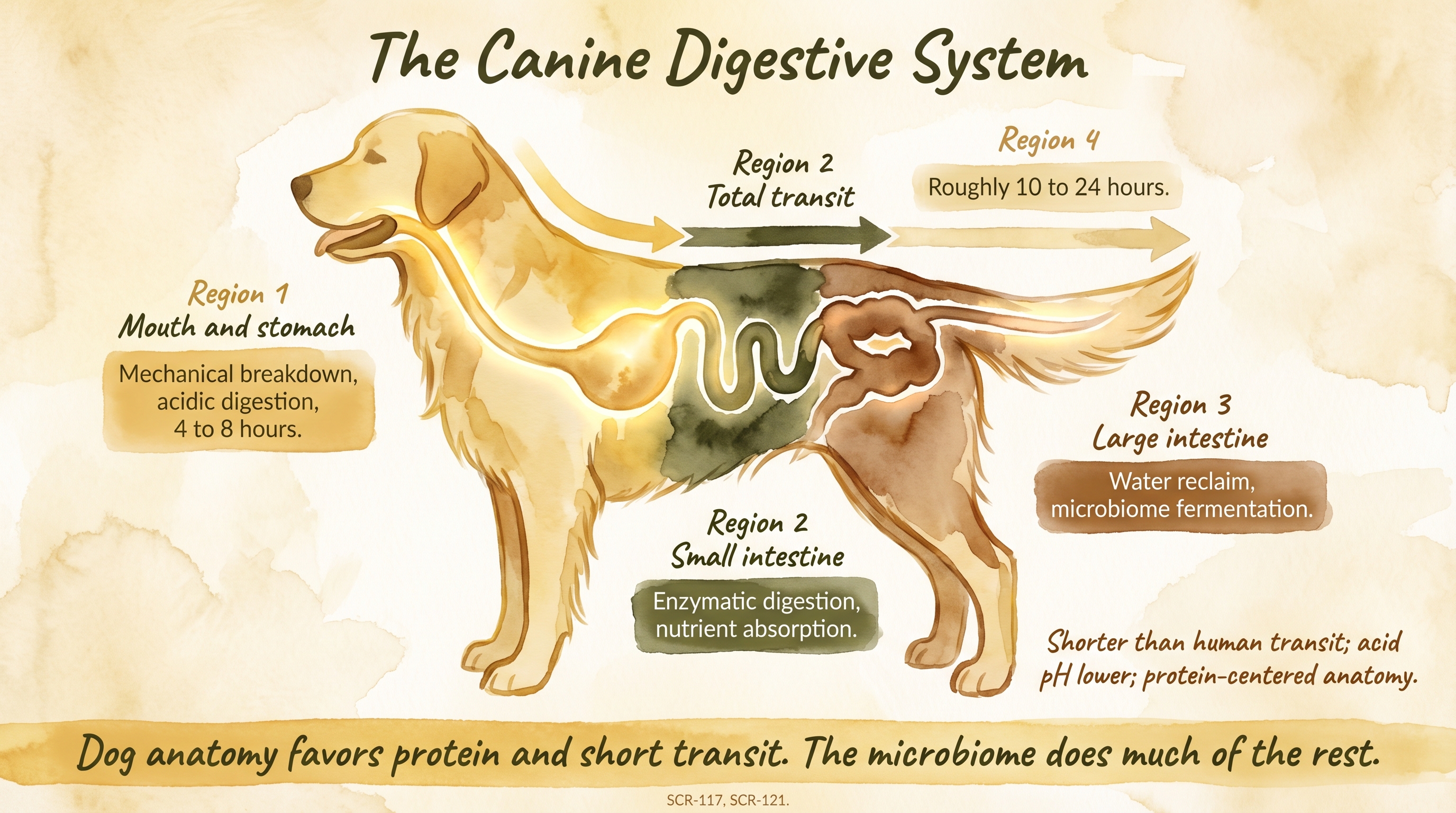
Dog anatomy favors protein and short transit - the microbiome does much of the rest.
Key Takeaways
- Dogs digest food through a short, acid-strong, enzyme-driven gastrointestinal system that differs meaningfully from human digestion.
- Most absorption happens in the small intestine, while the colon handles water recovery, stool formation, and a smaller but important amount of fermentation.
- Sudden diet changes commonly cause diarrhea because the digestive and microbial system needs time to adapt to the new substrate pattern.
- Understanding canine digestion helps families make calmer, more realistic feeding decisions instead of borrowing human diet logic for dogs.
The Evidence
This entry uses estimated claim-level tags beyond the dedicated EvidenceBlocks below. These tags mark approximate ranges or timing claims that should remain bounded by the cited sources.
This entry uses ambiguous claim-level tags beyond the dedicated EvidenceBlocks below. These tags mark claims where the literature remains unsettled or multiple interpretations coexist.
- Canine macronutrient source synthesisdogs
The canine digestive tract is relatively short, strongly acid in the stomach, enzyme driven in the small intestine, and less fermentation dependent than herbivore systems. - GI source synthesisdogs
Diet transitions can alter stool quality because digestive and microbial systems require time to adapt to a changed nutrient and fiber pattern. - Canine gastrointestinal physiology literaturedogs
Pancreatic enzymes, bile acids, villous absorption, and colonic fermentation together explain most everyday digestive outcomes families observe at home.
- Stewardship interpretationdogs
Strong gastric acidity helps dogs tolerate some exposures better than humans, but it should not be translated into a claim that foodborne risk is irrelevant in dogs.
The evidence is strongest for the core anatomy and physiology: strong fasting gastric acidity, enzyme-driven small-intestinal digestion, meaningful but secondary colonic fermentation, and the practical fact that diet changes can alter stool quality quickly. The more interpretive claims are the household applications. For example, the exact degree to which dogs can safely tolerate a raw exposure better than humans depends on many variables. The page therefore keeps that point as biologic context rather than turning it into a sweeping safety claim.
This is another place where translation discipline matters. We can confidently describe the canine digestive system as shorter, more acidic, and less salivary-amylase dependent than the human system. We should be more careful when using those facts to imply that any specific feeding style is automatically safe or optimal.
No published study directly tests the practical implications of the canine digestive system for domestic dog raising programs. The application to household dog raising remains an interpretive synthesis rather than a directly tested intervention finding.
SCR References
Sources
- National Research Council. (2006). Nutrient Requirements of Dogs and Cats. Washington, DC: The National Academies Press.
- AAFCO. (2024). Official Publication. Association of American Feed Control Officials.
- Smeets-Peeters, M., Watson, T., Minekus, M., & Havenaar, R. (1998). A review of the physiology of the canine digestive tract related to the development of in vitro systems. Nutrition Research Reviews, 11(1), 45-69.
- Hernot, D. C., Biourge, V. C., Martin, L. J., Dumon, H. J., & Nguyen, P. G. (2005). Relationship between total transit time and faecal quality in adult dogs differing in body size. Journal of Animal Physiology and Animal Nutrition, 89(3-6), 189-193.
- Martinez, M. N., & Papich, M. G. (2009). Factors influencing the gastric residence of dosage forms in dogs. Journal of Pharmaceutical Sciences, 98(3), 844-860.