When to Call the Breeder
Calling the breeder should not feel like escalating a problem or admitting failure. In JB, it is the relationship working the way it is supposed to work. The breeder is not only the person who sold the puppy. The breeder is the person who knows the litter, the parents, the early environment, and the language the puppy came from. That makes breeder contact especially valuable in the first month, when families are trying to interpret behavior, separate normal adjustment from true concern, and hold the soft landing under real-life pressure. Observed-JB
What It Means
Many families hesitate to call because they assume one of two things: this is probably too small to bother them with and this is probably too embarrassing to admit. Observed-JB
Both assumptions are unhelpful.
The breeder is often the best first interpreter of: what is normal for this litter, what is ordinary transition noise, and what sounds outside the expected range.
That does not replace the veterinarian.
It complements the veterinarian.
When a Call Is Especially Worth Making
The first month gives families a fairly clear list of good reasons to reach out: persistent stomach upset, sleep that stays unusually poor, a resident dog problem that is not settling, a behavior pattern the family does not know how to read, a household disruption that changed the whole routine, and simple doubt that keeps getting louder. Observed-JB
The last one matters more than people think.
Families do not need to wait until something becomes dramatic to ask for help.
What the Breeder Can Do
A good breeder can help in ways that are genuinely specific: compare this puppy to its litter pattern, talk about what the parents were like, suggest a reset inside the actual JB vocabulary, and tell the family when veterinary follow-up is the better next step.
Those are not small contributions.
They can save families from losing days to worry or from taking advice from people who do not know the dog at all.
What the Breeder Cannot Do
This page is warmer and more useful when it is clear about limits too.
The breeder cannot: replace veterinary diagnosis, run the household from a distance, and override what the family actually sees in the home.
Support is real.
So are the boundaries of support.
Why It Matters for Your Dog
This page matters because families who isolate themselves often drift further before they ask for help. By the time they call, they are tired, ashamed, or already reacting too strongly. Earlier contact protects the puppy from that buildup.
It also matters because the breeder relationship itself is part of JB's philosophy. Observed-JB The handoff is not supposed to be transactional. It is supposed to be relational and durable.
When the family calls, several good things happen at once: uncertainty narrows, the adults get steadier, and the puppy benefits from that steadiness. Observed-JB
That is not a side service.
It is part of the model.
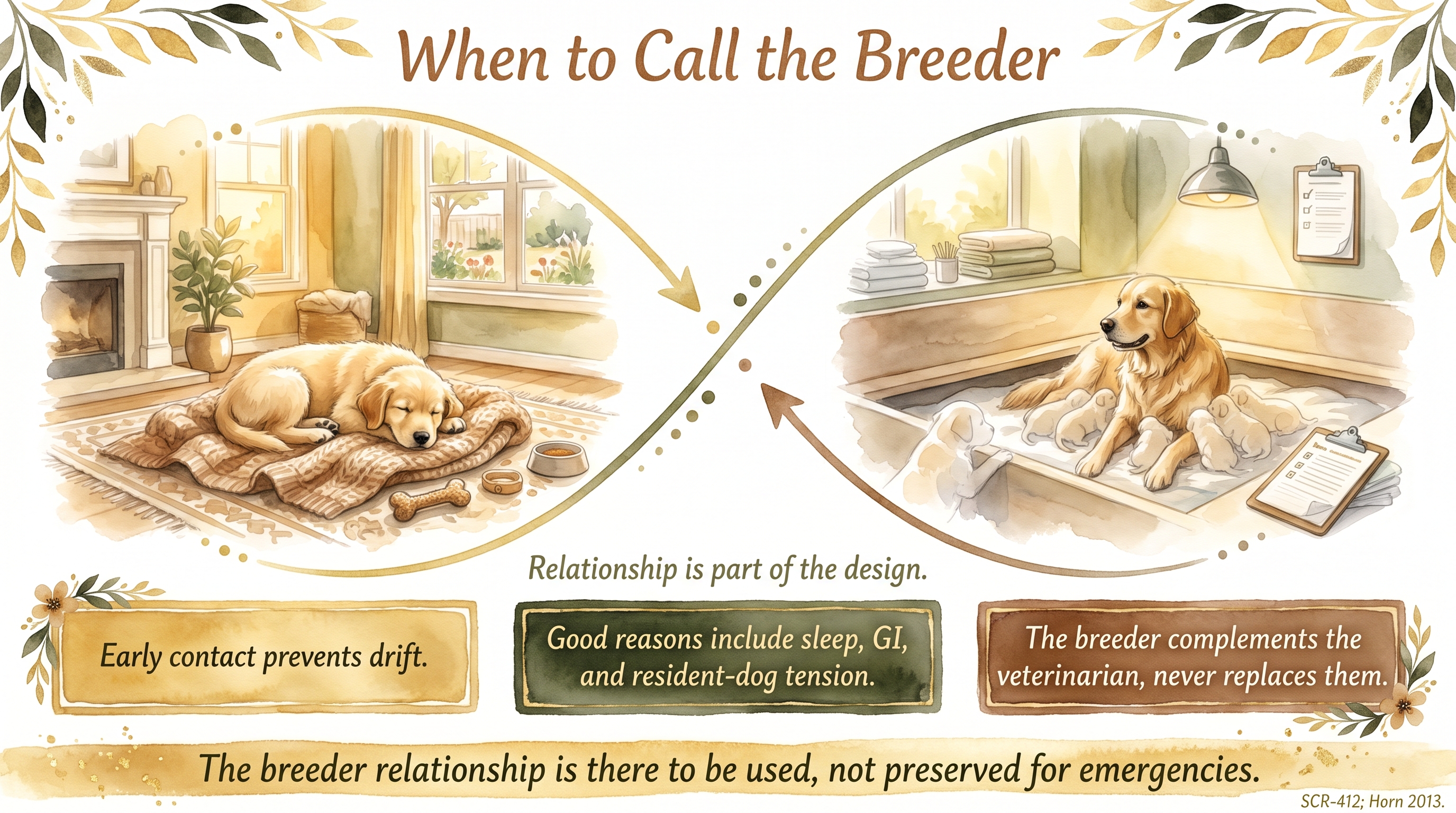
The breeder relationship is there to be used, not preserved for emergencies.
Key Takeaways
- Calling the breeder in the first month is normal and useful, not an admission that the family is failing.
- The breeder can often help interpret what is ordinary transition noise, what reflects the litter pattern, and what needs other professional follow-up.
- Early contact is especially worthwhile for GI issues, sleep problems, resident-dog conflict, household disruption, or persistent uncertainty.
- The breeder relationship is part of the JB model, not an after-sales courtesy added on top of it.
The Evidence
- Horn et al. (2013); Brubaker & Udell (2023); van Herwijnen et al. (2018); Dale et al. (2024)domestic dogs
Better adjustment tends to follow more responsive and informed caregiving, which supports the practical value of early guidance when families are unsure what they are seeing.
- JB breeder-network practicefamily-raised puppies
Families who call earlier when they are confused, concerned, or simply uncertain often stabilize the transition more quickly than families who wait until the household is already discouraged.
No published study directly tests the specific Just Behaving guidance on when to call the breeder. This entry relies on broader canine evidence, breeder observation, and practical synthesis.
SCR References
Sources
- Horn, L., Huber, L., and Range, F. (2013). The importance of the secure base effect for domestic dogs. PLoS ONE, 8(1), e65296. https://doi.org/10.1371/journal.pone.0065296
- Brubaker, L., & Udell, M. A. R. (2023). Does pet parenting style predict the social and problem-solving behavior of pet dogs (Canis lupus familiaris)? Animal Cognition, 26(1), 345-356. https://doi.org/10.1007/s10071-022-01694-6
- van Herwijnen, I. R., van der Borg, J. A. M., Naguib, M., & Beerda, B. (2018). The existence of parenting styles in the owner-dog relationship. PLOS ONE, 13(2), e0193471. https://doi.org/10.1371/journal.pone.0193471
- Dale, F. C., Burn, C. C., Murray, J., & Casey, R. (2024). Canine separation-related behaviour at six months of age: Dog, owner and early-life risk factors identified using the 'Generation Pup' longitudinal study. Animal Welfare, 33, e60, 1-16. https://doi.org/10.1017/awf.2024.56