The Two-Year Review: What the Adult Looks Like
Around two years of age, many Golden Retrievers begin to look recognizably landed. Not every dog on the same birthday. Not in exactly the same way. Not with identical speed. But for many families, somewhere around this point the dog starts to feel less like a project under pressure and more like the companion they were being promised all along. Observed-JB
That change is the reason the adolescence category exists. The hard months need a destination. This page names it.
What It Means
What the Landed Adult Often Looks Like
The most satisfying adult markers are not flashy. The dog settles more easily, the daily rhythm runs with less supervision, recall is more dependable in ordinary contexts, guests create less charge, other dogs and strangers matter less, and the house feels quieter because the dog is quieter inside it.
This is often the first time families fully understand what JB meant by raising rather than training. The adult does not merely perform more cues. The adult inhabits ordinary life more easily.
What Has Usually Changed
Several things often come together by this stage. The dogs baseline arousal is easier to read, the body is more finished, the household rhythm has become fully normal to the dog, the relationship has moved past the simple puppy bond and through the strain of adolescence into something steadier, and the dog is no longer needing the same amount of moment-to-moment external scaffolding, not because structure stopped mattering, but because so much of that structure has now been absorbed.
What Still Varies
Two years is a useful checkpoint, not a magical deadline. Some dogs land earlier. Some carry adolescent signatures into the third year. Some males stay socially louder longer. Some females settle earlier in certain domains and later in others.
Temperament matters. environment matters. genetics matter. history matters.
The right use of this page is encouragement, not rigid comparison.
What JB Thinks Families Built
If the dog feels settled at this stage, JB sees that as the long arc of the five pillars made visible. Observed-JB Calmness built the floor, mentorship gave the dog something adult to organize around, structured leadership kept the households boundaries readable, prevention stopped countless bad rehearsals before they became habits, and indirect correction preserved communication without making the relationship adversarial.
The adult dog is not the reward for surviving adolescence by accident. It is the result of years spent pulling the young dog upward, one ordinary day at a time.
Why This Review Matters
Families often spend so much energy getting through adolescence that they forget to look at what emerged. This review matters because naming the adult form helps the whole developmental arc make sense. Documented The first week was calibration, the first month was integration, the first year built the base, adolescence consolidated the dog under pressure, and adulthood reveals what held.
That perspective changes how people remember the difficult stretches. They stop seeing them as pointless turbulence and start seeing them as the bridge to a dog whose companionship is quieter, deeper, and more durable than puppy charm could ever be. Heuristic
The Hand-Off Beyond This Dispatch
Life does not stop at two years. The adult dog still needs thoughtful living. The next stage of the category moves into that broader adult arc: lifestyle decisions, travel, changes in family structure, multi-dog life, and eventually the senior years.
What changes there is not the philosophy. It is the context. The same vocabulary carries forward.
Why It Matters for Your Dog
The two-year review matters because it gives families permission to believe that the hard work was building toward something real. The settled adult is usually not louder than the puppy - it is quieter. Not more entertaining, but more companionable. Not more managed, but more integrated.
That is the adult JB is trying to raise.
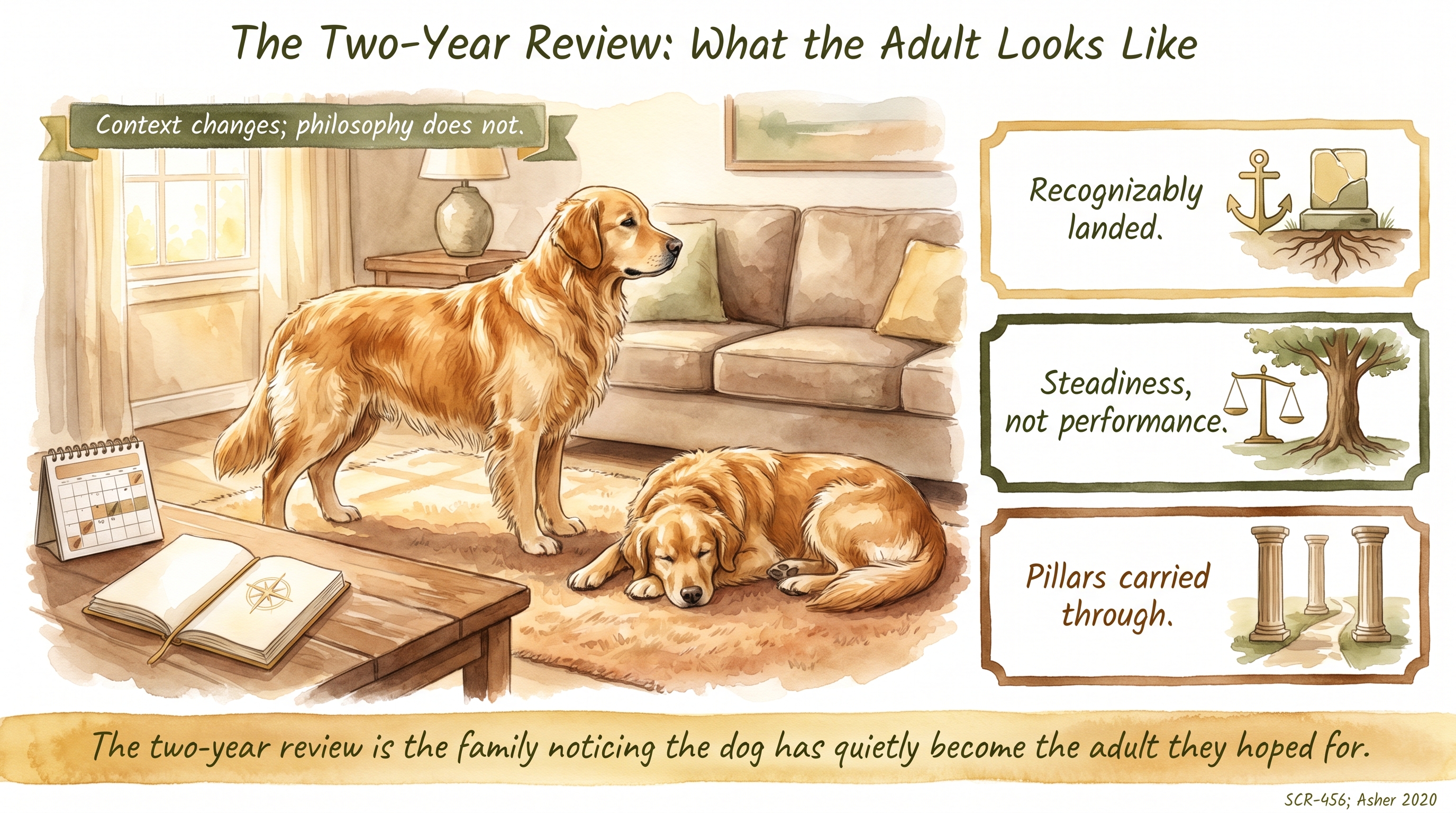
The two-year review is the family noticing the dog has quietly become the adult they hoped for.
Key Takeaways
- Around two years many Golden Retrievers begin to feel recognizably landed, though timing still varies by individual.
- The adult marker is usually less about performance and more about steadiness, readability, and easy companionship.
- JB sees the adult as the cumulative result of the five pillars carried through puppyhood and adolescence.
- The next life stage changes the context, not the philosophy.
The Evidence
- JB breeder observationGolden Retrievers
Many Goldens show a marked increase in steadiness and household readability by roughly two years of age, though individual timing varies. - JB family practicefamily-raised Goldens
The adult that emerges from a calm structured adolescence is usually less effortful and more companionable than the same dog looked mid-phase.
- developmental literaturedomestic dogs
Canine maturity unfolds across an extended timeline, and physical adulthood does not mean every behavioral domain is finished at the same moment.
- JB synthesisfamily dogs
The settled adult dog reflects not one technique but the cumulative effect of calmness, mentorship, structure, prevention, and indirect correction lived consistently across development.
No published study directly tests the practical implications of the two-year review: what the adult looks like for domestic dog raising programs. The application to household dog raising remains an interpretive synthesis rather than a directly tested intervention finding.
SCR References
Sources
- Creevy, K. E., Grady, J., Little, S. E., Moore, G. E., Strickler, B. G., Thompson, S., & Webb, J. A. (2019). 2019 AAHA canine life stage guidelines. Journal of the American Animal Hospital Association, 55(6), 267-290. https://doi.org/10.5326/JAAHA-MS-6999
- Asher, L., England, G. C. W., Sommerville, R., & Harvey, N. D. (2020). Teenage dogs? Evidence for adolescent-phase conflict behaviour and an association between attachment to humans and pubertal timing in the domestic dog. Biology Letters, 16(5), 20200097. https://doi.org/10.1098/rsbl.2020.0097
- Just Behaving program observation disclosure. (2026). Boundary: this internal observation is limited to JB-raised Golden Retrievers whose families continued the JB framework after placement; cohort size, time window, and counting rule are deferred in this revision. Treat as program observation supporting the roughly two-year adult-outcome pattern in Golden Retrievers, not as published external evidence.