The Adolescent Baseline Shift
Families often do not first notice adolescence as a philosophical issue. They notice it as a household feeling.
The dog that had begun to feel easy now feels slightly louder.
The settle that used to arrive on its own takes longer.
The walk that felt companionable turns more outward.
The recall that seemed natural becomes negotiable.
The young dog is not suddenly wild, but the internal weather has changed.
JB calls this the adolescent baseline shift.
That phrase matters because it moves the conversation away from regression. Observed-JB The dog has not slid backward into puppyhood. It has shifted into a new developmental state, and the old daily rhythm no longer fits as cleanly as it did a month earlier.
What It Means
What Families Usually See
The baseline shift often begins subtly. A Golden Retriever around six to nine months may get up from rest more often to monitor the room, scan more intensely on walks, show more restlessness in the evening, notice sounds, movement, guests, and doors more quickly, interrupt its own calm behavior to go look at something, and feel less impressed by familiar household expectations. Observed-JB
None of those behaviors automatically means the dog is becoming a problem. They mean the dogs internal system is allocating attention differently. The environment has become more compelling, and self-regulation has become less automatic. The family feels that change as increased friction in ordinary life.
This is why adolescence is so often misnamed. It does not always look dramatic enough to be called a crisis, yet it feels too persistent to be dismissed as a bad day. The dog simply seems harder to keep on the same channel.
Shift, Not Regression
The word regression implies the dog lost something it had already fully built. That is not usually the cleanest explanation.
In many adolescents, the earlier puppy rhythm worked because the nervous system was simpler. The world was smaller. The dog tired differently, slept differently, oriented more closely to the family, and needed less active management around stimulation. When adolescence arrives, the dog does not become worse so much as more complicated. The nervous system has more drive, more environmental pull, more hormonal influence, and more developmental work still in progress.
That is why the same family can honestly say two things at once: the dog learned the household well and the dog now feels less steady inside it.
Both can be true. The foundation is still there. The system sitting on top of that foundation has changed.
Where the Shift Shows Up Most
The first place many people see it is settling.
The late puppy could often lie down near the family and stay there through long stretches of ordinary life. The adolescent can still do that, but often with more interruptions. It hears more, checks more, and rises more. The house has not changed. The dogs threshold for orienting to the house has.
The second place is outdoor attention. A young dog who used to move with the family may now move through the environment with more personal agenda. Smells matter more. Distance matters more. Other dogs matter more. Moving things matter more. This is not rebellion. It is the environment becoming developmentally more rewarding.
The third place is responsiveness to ordinary routine. The dog may still know the household pattern, but it inhabits it with less automatic ease. That is the moment when families often begin to feel they need to do more to get the dog back.
JB recommends something more restrained: re-audit the rhythm.
Re-Auditing the Rhythm
A puppy rhythm does not automatically remain the right rhythm for an adolescent. Rest windows may need to be fewer but longer. Walks may need to lengthen in duration while remaining calm in tone. Environmental access may need to tighten briefly if the dog is self-selecting poor decisions. Thresholds may need more deliberate body-language enforcement because the dog is testing them more actively. The family may need to reduce exciting social exposures for a few weeks and rebuild calm participation first.
In other words, the right response to the baseline shift is not theatrical discipline. It is adjustment.
When the baseline shifts, Calmness becomes more active. The family is no longer just enjoying a settled dog. It is deliberately protecting the conditions that let the dog settle again inside a more demanding developmental phase.
The Most Common Mistake
The biggest error is escalation. Families feel the dog becoming harder to live with, interpret that as loss of discipline, and answer with more intensity. Walks get faster, corrections get sharper, recall becomes emotionally loaded, the house becomes more verbally busy, and the dog is put into more stimulating activities because it has so much energy now.
All of those responses can make the baseline worse.
An adolescent whose internal regulation is already under pressure does not benefit from a family that raises the overall charge of the environment. The dog may comply in moments and still become less settled overall.
The second error is sentimental looseness. Some families respond to adolescence by giving up the structure they maintained during puppyhood. The dog is older now, so the gates come down, rest becomes optional, greetings become bigger, and household expectations soften. That often feels kind in the moment and expensive later. The dog is older, but it is not finished.
The Soft Landing Still Applies
One of the reassuring truths of adolescence is that the same social vocabulary still works. The dog still reads body blocking, quiet disengagement, and calm threshold control. Observed-JB The dog still benefits from an orderly morning, predictable mealtimes, and a legible evening wind-down.
The transition language did not stop working just because the dog got bigger. The family simply has to use it a little more intentionally.
That is why JB sees adolescence less as a rupture and more as a continuation under heavier load. The same principles that made the first month readable are the principles that make the eighth month survivable.
Why It Matters for Your Dog
How a family interprets the baseline shift affects almost everything that follows.
If they read it as disobedience, they are more likely to personalize the phase and escalate emotionally.
If they read it as regression, they are more likely to panic and start over with the dog as though the relationship disappeared.
If they read it as developmental baseline change, they are more likely to tighten management, adjust rhythm, protect rest, and wait for the system to mature. Observed-JB
That third response usually produces the adult dog people hoped they were raising in the first place.
The adolescent baseline shift is not the proof that the dog is slipping away. It is usually the proof that the dogs internal world is changing faster than the family has adjusted yet. Once the family catches up, the dog often becomes readable again.
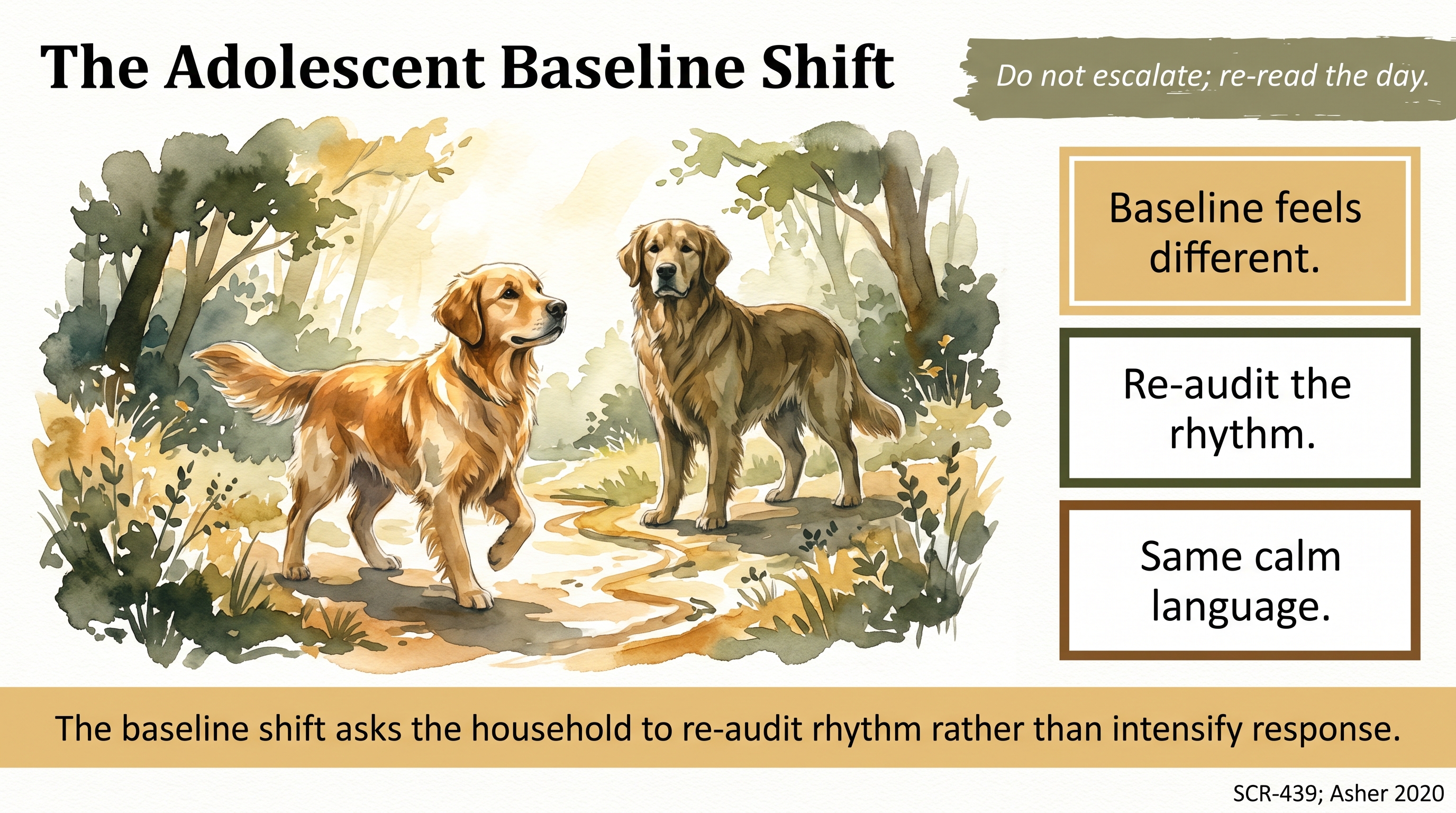
The baseline shift asks the household to re-audit rhythm rather than intensify response.
Key Takeaways
- The adolescent baseline shift is the household feeling that the dog is running a new nervous system, not proof that learning disappeared.
- Settling, walking, recall, and thresholds often feel different during this period because the environment has become more rewarding and regulation less automatic.
- JB responds by re-auditing the daily rhythm, not by escalating intensity.
- The same calm social vocabulary that worked in the transition still works in adolescence when it is used deliberately.
The Evidence
- Asher et al. (2020)domestic dogs
Adolescent dogs show a temporary carer-specific dip in responsiveness and trainability, supporting the idea that normal household behavior can feel different during this phase. - development and adolescence reviews summarized in the source documentsdomestic dogs
Ongoing developmental change in adolescence affects regulation and social behavior beyond the early puppy months.
- JB breeder observationGolden Retrievers
Families reliably report a household-level change in settling, responsiveness, and environmental pull between roughly six and nine months. - JB household practicefamily-raised dogs
Re-auditing rest, walks, thresholds, and stimulation usually helps the adolescent dog more than escalating exercise or correction.
- JB synthesisfamily-dog households
The best practical reading of adolescent friction is that the dogs baseline has changed and the household rhythm now needs recalibration rather than a punitive reset.
No published study directly tests the practical implications of the adolescent baseline shift for domestic dog raising programs. The application to household dog raising remains an interpretive synthesis rather than a directly tested intervention finding.
SCR References
Sources
- Asher, L., England, G. C. W., Sommerville, R., & Harvey, N. D. (2020). Teenage dogs? Evidence for adolescent-phase conflict behaviour and an association between attachment to humans and pubertal timing in the domestic dog. Biology Letters, 16(5), 20200097. https://doi.org/10.1098/rsbl.2020.0097
- Bray, E. E., Gruen, M. E., Gnanadesikan, G. E., Horschler, D. J., Levy, K. M., Kennedy, B. S., Hare, B. A., & MacLean, E. L. (2021). Dog cognitive development: A longitudinal study across the first 2 years of life. Animal Cognition, 24, 311-328. https://doi.org/10.1007/s10071-020-01443-7
- Reicher, V., Kis, A., Simor, P., Bodizs, R., Gacsi, M., & Topal, J. (2021). Developmental features of sleep electrophysiology in family dogs. Scientific Reports, 11, 22760. https://doi.org/10.1038/s41598-021-02117-1
- Just Behaving program observation disclosure. (2026). Boundary: this internal observation is limited to JB-raised Golden Retrievers whose families continued the JB framework after placement; cohort size, time window, and counting rule are deferred in this revision. Treat as program observation supporting the adolescent baseline-shift pattern, not as published external evidence.