Social Maturity (18 to 36 Months)
Social maturity is the stage when the dog's adult social style becomes more stable than provisional. The body usually looks adult earlier than this. The social and regulatory picture often does not. That gap is why a one-year-old dog can look grown while still behaving in recognizably adolescent ways. Mixed Evidence
What It Means
Physical maturity and social maturity are not the same event.
That distinction matters because many families treat size, strength, or sexual maturity as proof that development is basically complete. In many dogs, especially larger breeds, that is too early.
Historical framing
The literature on dog social maturity is thinner than the literature on early socialization or adolescence. That means this page needs a more cautious evidence floor. The broad developmental story is clear: adolescence gives way gradually to a more stable adult pattern. The exact universal timetable is not.
So the goal of this page is not to pretend we have one perfect scientific clock. It is to explain what the phase means, what parts are well supported, and where breeder and family experience still outrun the formal literature.
What tends to settle during social maturity
By social maturity, several things often become more stable how the dog handles frustration; how quickly the dog recovers from arousal; how the dog greets, disengages, and self-settles; how the dog manages social tension with other dogs; and how much adult guidance is still needed for ordinary regulation.
This does not mean every adult dog becomes easy or calm. It means the dog's style stops changing as rapidly and starts expressing itself with more consistency.
Why the phase can reveal new problems
One reason social maturity matters is that some patterns do not fully express until this stage.
That can include more stable adult confidence, more reliable self-management, and or, in some dogs, the clearer emergence of adult conflict patterns that were not obvious earlier. Mixed Evidence
This is why people sometimes feel surprised by the adult dog they have "suddenly" discovered at two years old. The dog may not have changed overnight. The dog may simply have finished revealing the adult version of tendencies that were still moving around during adolescence.
Adult social style is more than obedience
Another reason social maturity deserves its own page is that adult style is not reducible to how many cues the dog knows.
A socially mature dog is often easier to recognize by pattern than by training list how the dog enters and exits arousal; how quickly the dog recovers after frustration; how the dog carries itself around other dogs; whether the dog escalates or diffuses tension; and whether guidance is absorbed as background or treated as conflict.
This is why some issues become more visible at maturity even when the dog has been living in the same home all along. Adult social style is about threshold, recovery, and relational pattern as much as about specific obedience skills.
The neuroscience boundary
The strongest dog-direct evidence that matters here is indirect but useful. Dogs show frontal-cortical involvement in inhibitory control, and later juvenile development continues beyond the earliest puppy stage. Adolescence itself is documented as a distinct phase. What the literature does not yet give us is one precise dog-wide marker declaring social maturity complete at exactly one age.
So the defensible conclusion is not "every dog matures socially at twenty-four months." The defensible conclusion is that social maturity usually trails behind visible physical maturity; that adulthood emerges gradually out of adolescence rather than replacing it in one step; and that later control and social stability are developmental achievements, not automatic features of adult body size.
Larger breeds and longer arcs
In practice, social maturity often feels later in larger breeds, including Golden Retrievers, than in many smaller dogs. That observation is widespread and developmentally plausible. The direct formal literature for one exact Golden-specific maturity age is still sparse, which is why this page is marked mixed rather than fully documented.
The safest phrasing is that many larger dogs continue settling socially well into the second year and, in some cases, beyond. That is strong enough to calibrate expectations without pretending a breed-specific stopwatch has already been scientifically settled.
Why It Matters for Your Dog
Understanding social maturity changes expectations at exactly the point where many people stop thinking developmentally.
A family with a fifteen-month-old or eighteen-month-old dog often feels that the grace period is over. Sometimes that is useful. Adults should not be treated as eternal babies. But there is a difference between expecting more and assuming the developmental story is done.
The adult dog is often built in public
Social maturity is where earlier patterns become harder to dismiss as temporary.
If adolescence was noisy, social maturity is clearer.
If the dog has learned to settle, disengage, recover, and take guidance, those patterns often feel more solid now.
If the dog has rehearsed impulsive behavior, conflict, or chronic overarousal, those patterns can also feel more durable now. Documented
This is why the phase matters so much to adult ownership. It is the point where the dog begins living less like a rapidly changing youngster and more like the adult social animal the family will actually have.
Why structure still matters here
One mistake is to relax all scaffolding because the dog is technically an adult. Another is to panic because a fully settled adult does not appear on the first birthday.
Both miss the gradual nature of the phase.
Social maturity does not eliminate the value of structure. It clarifies what the structure built. By this stage, the dog is more likely to express the adult consequences of earlier guidance or earlier inconsistency.
That does not mean adults should behave as if all plasticity is gone. Mature dogs can still improve. Environment still matters. Relationships still matter. What changes is that the adult picture is usually clearer now, so the work becomes less about waiting for developmental settling and more about responding to the dog that is increasingly showing its stable social form.
The JB-specific caution
JB often uses practical language like "who the dog is becoming shows up around twenty-four to thirty months." That can be a useful breeder and family heuristic, especially in Golden Retriever lines. It should still be presented as a program-informed developmental expectation rather than a universally verified canine law.
That distinction matters because it keeps this page inside the evidence ceiling. The general pattern is solid. The exact breed-line timetable is less formally settled.
Limits and open questions
This is one of the more under-researched developmental transitions in dogs. We still need better work on explicit markers of social maturity across breeds; how sex, body size, and line affect timing; the relation between adult temperament expression and late developmental change; and how often apparent adult behavior is still partly reversible with environmental change. Observed-JB
How this connects to the rest of the wiki
This page closes the first developmental sequence opened by neonatal-period.
It follows adolescence, where instability and caregiver conflict are strongest. Documented
It also points back to prefrontal-cortex-and-inhibitory-control, because adult self-management is one of the clearest traits that feels different once social maturity has largely arrived. Documented
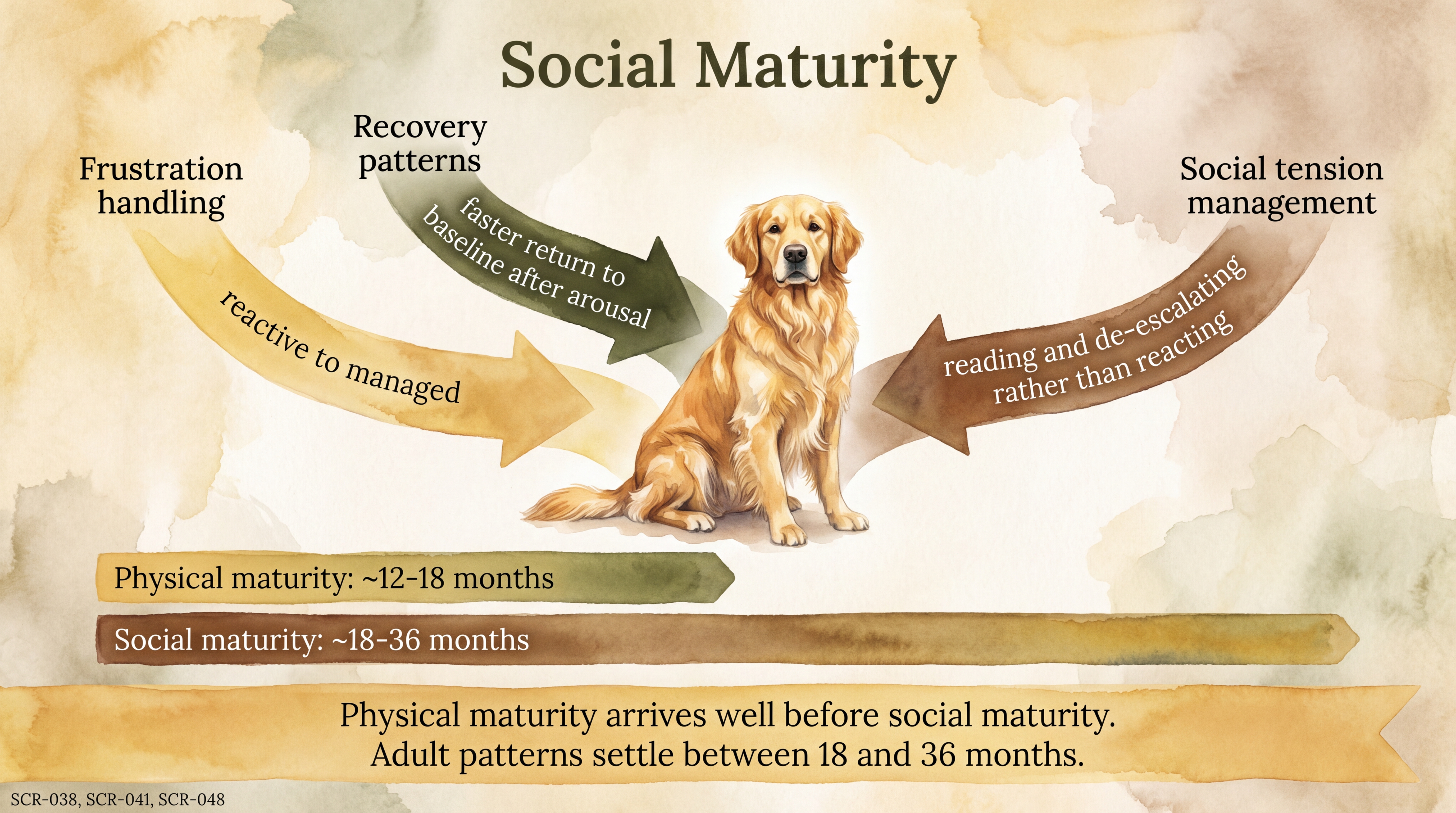
Physical maturity arrives well before social maturity - adult patterns settle between 18 and 36 months.
Key Takeaways
- Social maturity usually arrives later than physical maturity.
- Adult social style becomes clearer after adolescence because behavior is changing less rapidly and expressing itself more consistently.
- This phase can reveal both the strengths and the weaknesses of earlier developmental foundation.
- The broad pattern is real, but exact age markers for social maturity remain less tightly mapped than earlier puppy phases.
The Evidence
This entry uses observed claim-level tags beyond the dedicated EvidenceBlocks below. These tags mark JB program observation or practice-derived claims that need dedicated EvidenceBlock coverage in a later content pass.
This entry uses mixed-evidence claim-level tags beyond the dedicated EvidenceBlocks below. These tags mark claims that combine documented findings with observed practice, heuristic application, or unresolved gaps.
- Asher, L. et al. (2020)domestic dogs
Documented adolescence as a distinct caregiver-conflict phase, which implies that later adult stabilization emerges out of a real developmental transition rather than appearing all at once. - Cook, P. F. et al. (2016)domestic dogs
Direct canine frontal-control evidence supports the idea that adult-like restraint depends on systems that must develop, not just on body size or obedience history. - Gross, B. et al. (2010) and Wu, Y. C. et al. (2011)domestic dogs
Canine neural maturation continues beyond the earliest puppy stage, supporting a gradual development model rather than immediate adult completion.
- Canine developmental synthesisdomestic dogs
The broad pattern that social maturity often follows adolescence by many months is well supported conceptually, but exact universal age markers remain weakly standardized in the literature. - Golden Retriever applicationGolden Retrievers
The common breeder view that many Goldens settle more fully around the second year is plausible and useful, but not yet pinned to one breed-specific experimental timetable.
- Current literature gapdomestic dogs
There is no single validated canine-wide marker that defines the exact endpoint of social maturity across breeds, sexes, and environments.
SCR References
Sources
- Asher, L., England, G. C. W., & Sommerville, R. (2020). Teenage dogs? Evidence for adolescent-phase conflict behavior and attachment in domestic dogs. Biology Letters, 16(7).
- Cook, P. F., Spivak, M., & Berns, G. S. (2016). Neurobehavioral evidence for individual differences in canine cognitive control: An awake fMRI study. Animal Cognition, 19(5), 867-878.
- Gross, B., Garcia-Tapia, D., Riedesel, E., Ellinwood, N. M., & Jens, J. K. (2010). Normal canine brain maturation at magnetic resonance imaging. Veterinary Radiology & Ultrasound, 51(4), 361-373.
- Wu, Y. C.