The Daily Rhythm of the Calm Household
The first question many families ask once the transition settles is wonderfully ordinary: what does this actually look like on a normal Tuesday? In JB, the answer is not a stack of exercises. It is a rhythm. The dog rises with the household, goes outside, eats in a predictable place, walks at a calm pace, rests for long stretches while life unfolds around it, and joins the family without needing to be entertained every hour. That exact day-plan has not been tested as a single formal intervention, which is why the full JB household-rhythm claim remains grounded mainly in breeder observation and long-form family practice. But the supporting floor is serious. Human and animal synchrony research shows that shared daily state, predictable caregiving, and calm co-presence alter physiology rather than merely aesthetics. Observed-JB
What It Means
The calm household is easiest to understand from the dog's point of view.
The dog does not experience the home as a series of human intentions. It experiences the home as a repeating pattern: when bodies rise, when doors open, where food appears, how quickly people move, whether greetings explode, and whether stillness is normal.
That pattern becomes the dog's lived understanding of family life.
In a JB household, the day is organized around rest punctuated by activity. That order matters. Many modern homes run the reverse pattern. The dog is expected to be available for action all day, then is handed a bed, a crate, or a chew when the humans finally need a break. JB reverses that. Calm is the floor. Activity is real and enjoyable, but it emerges out of regulation and returns to regulation.
Morning
Morning does not begin as a pep rally. The household wakes, the dog goes outside, there is a straightforward bathroom opportunity, and breakfast happens in a predictable location. Observed-JB The family is not trying to produce excitement as proof of love. It is giving the dog the same gift it gives children and adults alike: a day that starts legibly. That often means no dramatic good-morning greeting ritual, no immediate rough play in the kitchen, no running commentary over every movement, and no breakfast turned into a performance.
After the practical needs are handled, the dog settles near the family's ordinary activity. Coffee is made. Children get ready for school. The workday begins. The dog learns that participation in the family does not require being the center of the room.
Mid-Morning Activity
For many households, the first meaningful activity window of the day is a walk. In JB, that walk is not treated as an energy-dump mission or a step-count obligation. It is relational time. The pace is human, the leash stays loose as often as possible, sniffing is allowed, and the dog's nervous system is not deliberately ratcheted upward.
After that activity window, the home becomes quiet again.
This is one of the hardest parts for modern families to trust. They worry that a resting dog is a bored dog. In reality, a well-regulated dog often spends a very large portion of the day asleep, drowsing, or simply observing in calm proximity. Observed-JB That is not deprivation. It is normal mammalian energy economy inside a safe home.
Midday and Afternoon
The middle of the day is usually simple: a bathroom break, a brief outside period, perhaps a small interaction window, and then more rest.
In a calm household, the dog does not need a new project every time it wakes up. Observed-JB It learns the family's cadence and joins it. If the adults are working, the dog rests nearby. If the home is briefly empty, the dog handles ordinary separation as part of life. If children return from school, the family still protects the floor of the house from tipping into chaos.
This is where rhythm becomes culture. Anyone can manage a quiet morning. The stronger test is whether the household still behaves like itself when the day gets busy.
Evening
Evening usually includes another walk, some outside time, or a brief natural retrieve session in the yard. Then the house downshifts again. Dinner is made. The family sits. The dog lies nearby. There may be a brushing session, quiet petting, or calm co-presence on the floor by the sofa.
What matters is not that evenings are empty. It is that they are readable.
The dog should not have to guess whether each doorway, visitor, television moment, or returning family member means the entire emotional temperature of the home will jump twenty degrees.
Bedtime
By bedtime, the JB day has a clear closing shape. The dog has moved through activity, meals, outside opportunities, and rest in a sequence that makes sense. That sequence is one reason the home feels secure. Predictability is not only convenient. It is regulatory.
What This Is Not
The calm household is often misheard as a low-joy household. It is not a house where the dog never plays, affection is rationed, the humans are cold, silent, or emotionally absent, or a minimalist performance in which every object of delight has been removed for the sake of discipline.
The real contrast is elsewhere. JB is replacing the household model in which the dog is managed through entertainment, product-based stimulation, and repeated mini-lessons scattered throughout the day. In that model, the dog is often expected to be mentally occupied whenever awake. If it is not, the humans worry that they are failing it.
That is the industry default this page pushes against.
The dog does not need life to feel like a schedule of attractions.
The dog needs life to feel coherent.
A coherent day still contains joy. It simply places that joy inside relationship instead of inside constant stimulation.
Why It Matters for Your Dog
Dogs are exquisitely sensitive to household pattern. They notice tempo, emotional consistency, departure-and-return rhythm, touch style, and the difference between ordinary movement and escalated movement. The synchrony literature matters here because it supports the narrower but powerful claim that humans and dogs do not merely share space. They co-modulate. Cortisol findings, autonomic findings, and cross-species caregiver synchrony work all point in the same practical direction: your state and your rhythm are part of the dog's environment.
That does not mean every family must run the same clock.
It means every family should run a clock the dog can read.
The calm household is where the pillar stops being philosophy and becomes architecture. The dog learns that rest is normal, connection is nearby, and excitement is occasional rather than constant.
When the home has a readable rhythm, several downstream things usually become easier: the dog settles faster after activity, greetings carry less charge, leash walking improves because the dog starts from a lower baseline, mealtimes become straightforward, and alone moments feel less dramatic.
Just as important, the family begins to enjoy the dog differently. Many people think the deepest bond comes from doing more and more with the dog at higher and higher intensity. JB offers a quieter claim. Calm proximity is often the true currency of the bond. The dog lying at your feet while you work, the dog moving from room to room without fanfare, the dog resting while dinner is cooked, the dog watching the family and feeling no need to control it. This is not empty time. It is the shape of companionship.
That is why a calm household is not a boring household.
It is a household where the dog has finally stopped auditioning for relevance because belonging has become ordinary.
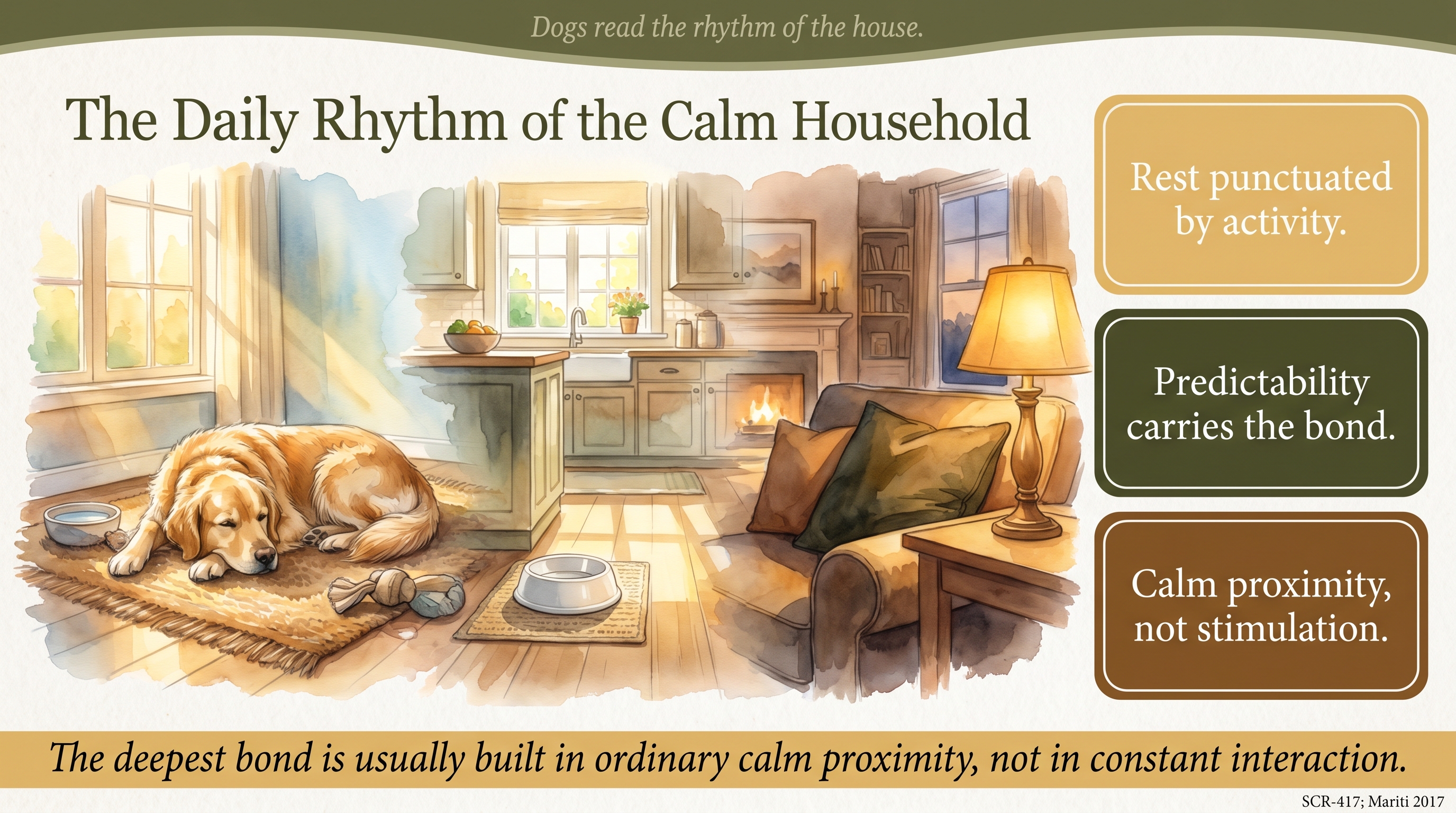
The deepest bond is usually built in ordinary calm proximity, not in constant interaction.
Key Takeaways
- A calm household is organized around rest punctuated by activity, not around constant stimulation with brief forced downtime.
- Dogs read the emotional and temporal rhythm of the house, so predictability and calm co-presence become part of regulation itself.
- The deepest bond in daily life is often built through ordinary calm proximity rather than through nonstop entertainment and instruction.
- The full JB daily-rhythm model is grounded in observation and synthesis, while its physiological floor is supported by synchrony research.
The Evidence
- Feldman traditionhumans and social mammals
Caregiver-infant and close social dyads show physiological synchrony, with predictable shared rhythm and calm co-presence functioning as regulatory variables rather than as background scenery. - Sundman et al. (2019)domestic dogs and humans
Long-term cortisol levels in some dog-owner dyads are significantly synchronized, supporting the claim that shared household state can be biologically coupled. - Koskela and related HRV workdomestic dogs and humans
Dog and owner autonomic measures can co-modulate during interaction in ways that exceed simple shared movement explanations.
- JB breeder and family observationGolden Retriever puppies and adult family dogs
Dogs raised in homes where rest is the baseline and activity is punctuated tend to maintain easier settling, calmer greetings, and more durable household manners across time. - JB household observationfamily-raised dogs
Families who stop trying to occupy every waking minute of the dog often discover that calm proximity becomes the dog's preferred daily mode.
- JB synthesisfamily-dog daily life
The claim that a calm Tuesday rhythm should be organized around rest punctuated by activity rather than activity punctuated by rest is an applied framework built from synchrony, attachment, and breeder practice rather than a single direct canine trial.
No published study directly tests the practical implications of the daily rhythm of the calm household for domestic dog raising programs. The application to household dog raising remains an interpretive synthesis rather than a directly tested intervention finding.
SCR References
Sources
- Feldman, R. (2012). Parent-infant synchrony: A biobehavioral model of mutual influences in the formation of affiliative bonds. Monographs of the Society for Research in Child Development, 77(2), 42-51. https://doi.org/10.1111/j.1540-5834.2011.00660.x
- Koskela, A., Tornqvist, H., Somppi, S., Tiira, K., Kykyri, V.-L., Hanninen, L., Kujala, J., Nagasawa, M., Kikusui, T., & Kujala, M. V. (2024). Behavioral and emotional co-modulation during dog-owner interaction measured by heart rate variability and activity. Scientific Reports, 14, 25201. https://doi.org/10.1038/s41598-024-76831-x
- Sundman, A.-S., Van Poucke, E., Svensson Holm, A.-C., Faresjo, A., Theodorsson, E., Jensen, P., & Roth, L. S. V. (2019). Long-term stress levels are synchronized in dogs and their owners. Scientific Reports, 9, 7391. https://doi.org/10.1038/s41598-019-43851-x
- Schork, I. G., Manzo, I. A., De Oliveira, M. R. B., da Costa, F. V., Palme, R., Young, R. J., & de Azevedo, C. S. (2022). How environmental conditions affect sleep? An investigation in domestic dogs (Canis lupus familiaris). Behavioural Processes, 199, Article 104662. https://doi.org/10.1016/j.beproc.2022.104662
- Just Behaving program observation disclosure. (2026). Boundary: this internal observation is limited to JB-raised Golden Retrievers whose families continued the JB framework after placement; cohort size, time window, and counting rule are deferred in this revision. Treat as program observation supporting daily calm-household rhythm outcomes, not as published external evidence.