Adolescent Bonding: The Relationship Deepens, It Does Not Break
One of the most painful things families say during adolescence is, I think my dog does not love me the way he used to. Heuristic
The dog is more distracted.
The dog is less instantly available.
The dog seems to care more about the environment.
The dog is harder to call off something exciting.
All of that can feel like emotional distance. JB asks families to read it more carefully. Heuristic The bond is usually not breaking. The bond is being tested inside a new developmental state.
What It Means
What Attachment Research Helps With
The canine attachment literature gives JB an important floor. Documented Dogs form attachment relationships with humans. Secure-base behavior and stress-buffering effects are documented enough that the bond should be treated as real, not sentimental projection.
That documented floor matters because it gives families something sturdier than mood to stand on. Documented The adolescent dog may act differently. That does not mean the attachment disappeared every time the behavior changed.
The JB Interpretation
JB makes a further move, and this is where the page remains [Heuristic]. JB argues that the secure relationship often becomes more visible through adolescence precisely because adolescence pressures it.
In other words, the adolescent pushes against the edge of the bond because the bond is there to push against.
That claim is interpretive. It is not a direct canine experimental finding. But it is a coherent reading of what many families live through. The dog becomes harder, less simple, less immediately available, and still orients back to the same household, the same people, the same shared rhythm. The relationship on the far side often feels deeper than the puppy bond, not because the puppy bond was fake, but because the family and dog have passed through more together.
The bond does not deepen because adolescence is easy. It deepens because the family keeps acting like a secure base while the dog is harder to be around.
Why Adolescence Can Feel Like Distance
Puppies are often highly available because their world is small. They want closeness, guidance, and contact in a very direct way. Adolescents are more outward-looking. They have more internal agenda. The same dog that once followed every human movement may now spend longer scanning the world and making independent choices.
That change can be misread as emotional withdrawal. Often it is developmental broadening.
The dog is still inside the relationship. It is simply no longer expressing the relationship in the very puppy-like way the family grew used to.
Secure Base Does Not Mean Constant Compliance
This is another place where the attachment frame helps. A secure attachment is not the same thing as uninterrupted obedience. Human children with secure relationships test, separate, return, hesitate, and challenge while still remaining securely attached. Dogs are not children, and JB should not over-identify the models. But the general principle is useful: strain in behavior is not automatically rupture in bond.
That distinction matters during adolescence because families can start relating to the dog as though a series of difficult weeks means the whole relationship changed. Often the better conclusion is smaller and kinder. The dog is harder right now and still bonded.
The Practical Implication
If the family believes the bond is breaking, it often responds anxiously. It talks more, performs more, pleads more, tests the dog more, and tries to re-secure closeness through intensity. None of that usually helps.
If the family believes the relationship is still there, it is more likely to keep the rhythm steady, manage without resentment, protect rest, keep affection quiet and available, and hold the same boundaries without panic.
That creates the conditions under which the dog can come through the phase and reappear as a more mature companion rather than as a source of emotional confusion.
Why It Matters for Your Dog
The adult bond is not supposed to look exactly like the puppy bond. It is supposed to become steadier, quieter, and less frantic. Adolescence is often the bridge between those two forms.
JB wants families to understand that the bridge can feel strange without being broken.
That is the reassurance this page exists to give: your dog can be harder, more distant-feeling, more distracted, and still deeply attached to you. In many homes the relationship that emerges on the other side is not weaker. It is less needy and more settled, which is not a loss but a maturation.
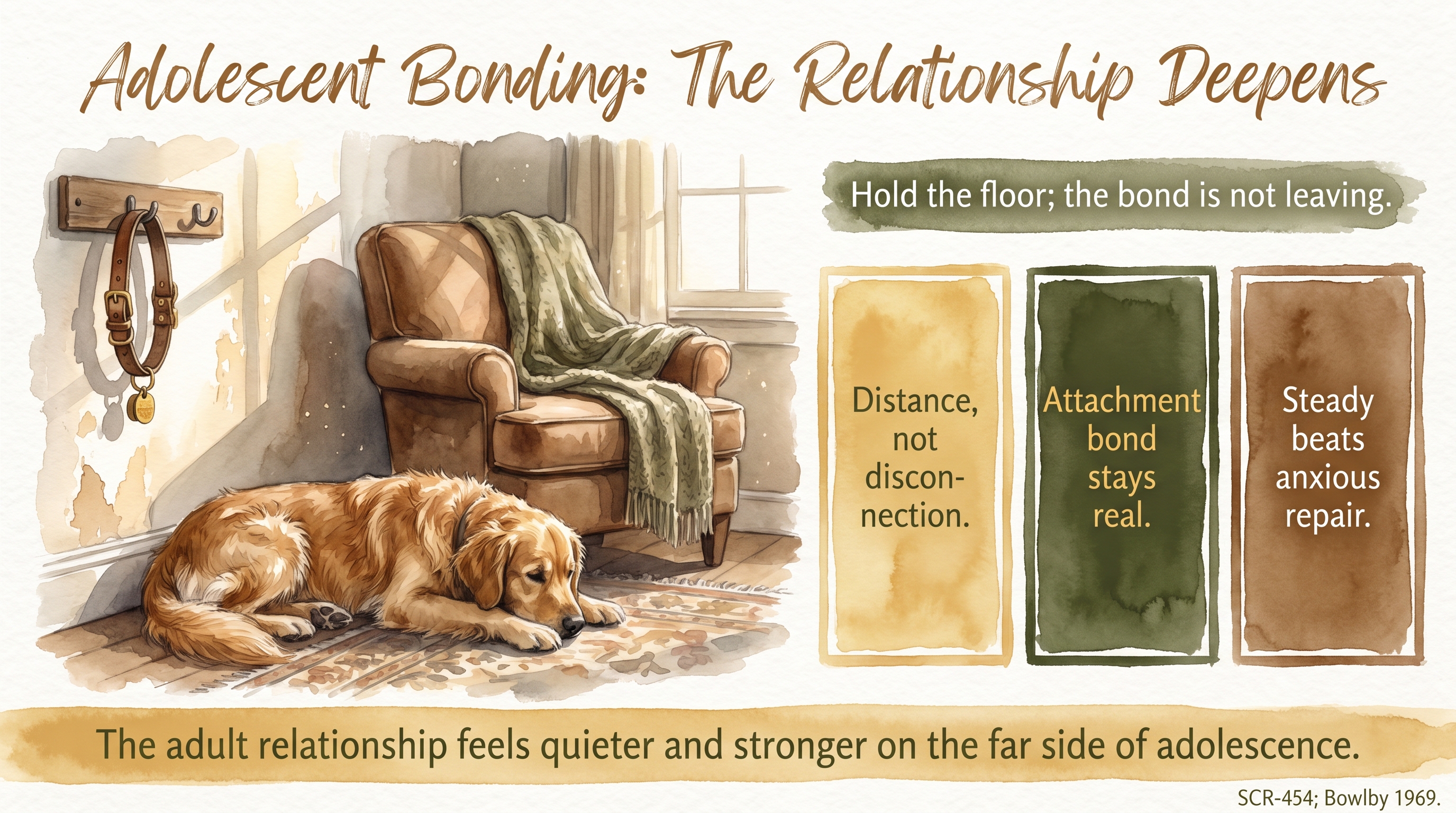
The adult relationship feels quieter and stronger on the far side of adolescence.
Key Takeaways
- Adolescent behavior can feel more distant without meaning the attachment bond has broken.
- Canine attachment research supports treating the bond as real, even though JB's claim that it deepens through adolescence remains interpretive.
- Families usually help the bond most by staying steady rather than by anxiously trying to prove closeness.
- The adult relationship often feels quieter and stronger on the far side of adolescence, not weaker.
The Evidence
- Topal and related canine attachment literaturedomestic dogs
Dogs show secure-base and attachment-related behavior toward human caregivers, and caregiver presence can influence stress regulation. - attachment and cortisol buffering researchdomestic dogs
The dog-human relationship has measurable physiological relevance rather than being only sentimental description.
- JB breeder observationGolden Retrievers
Families often report that the adolescent feels more distant or different while the underlying bond remains intact and becomes clearer again after the phase settles.
- JB synthesisfamily-raised dogs
The relationship often deepens across adolescence because the family remains a secure, regulating base during the most demanding developmental stretch.
No published study directly tests the practical implications of adolescent bonding: the relationship deepens, it does not break for domestic dog raising programs. The application to household dog raising remains an interpretive synthesis rather than a directly tested intervention finding.
SCR References
Sources
- Topal, J., Miklosi, A., Csanyi, V., & Doka, A. (1998). Attachment behavior in dogs (Canis familiaris): A new application of Ainsworth's Strange Situation Test. Journal of Comparative Psychology, 112(3), 219-229. https://doi.org/10.1037/0735-7036.112.3.219
- Payne, E., Bennett, P. C., & McGreevy, P. D. (2015). Current perspectives on attachment and bonding in the dog-human dyad. Psychology Research and Behavior Management, 8, 71-79. https://doi.org/10.2147/PRBM.S74972
- Nagasawa, M., Mitsui, S., En, S., Ohtani, N., Ohta, M., Sakuma, Y., Onaka, T., Mogi, K., & Kikusui, T. (2015). Oxytocin-gaze positive loop and the coevolution of human-dog bonds. Science, 348(6232), 333-336. https://doi.org/10.1126/science.1261022
- Asher, L., England, G. C. W., Sommerville, R., & Harvey, N. D. (2020). Teenage dogs? Evidence for adolescent-phase conflict behaviour and an association between attachment to humans and pubertal timing in the domestic dog. Biology Letters, 16(5), 20200097. https://doi.org/10.1098/rsbl.2020.0097
- Just Behaving program observation disclosure. (2026). Boundary: this internal observation is limited to JB-raised Golden Retrievers whose families continued the JB framework after placement; cohort size, time window, and counting rule are deferred in this revision. Treat as program observation supporting the adolescent-bonding-deepens pattern, not as published external evidence.