The Senior Transition
There is usually a stretch in a Golden Retrievers life when the family realizes adulthood is no longer the right map. The dog is not suddenly old in a theatrical way. The dog is simply asking for more accommodation than the family has been needing to provide. JB names that period the senior transition because naming it helps families respond earlier and more gently. Observed-JB
The transition often appears somewhere between eight and ten years in Goldens, though individual variance is wide. What matters is not the birthday. What matters is the cluster of changes that tells the family the dog now needs a slightly different version of ordinary life.
What It Means
What Families Usually Notice First
The early senior transition often announces itself through small practical moments: the jump onto the couch is less automatic, stairs are taken more carefully, the morning body is slower to loosen, one long walk now needs more recovery, evening fatigue arrives earlier, and the dog opts out sooner when the house is noisy. Observed-JB
None of these changes means the dog has exited family life. They mean the old settings may no longer be the right settings.
Why This Period Deserves Its Own Name
Families often resist the senior transition because naming it feels like admitting mortality. So they wait to add traction, wait to change bedding, wait to shorten outings, wait to discuss more frequent veterinary care, and wait until the change is undeniable. Observed-JB
JB thinks that waiting costs dogs comfort. Observed-JB The senior transition is easier when the family meets it as a developmental stage rather than as a personal insult from time.
Practical Changes That Usually Help
The changes are often simple: better supportive bedding, non-slip rugs in key movement areas, ramps where repeated jumping has become less wise, slower stairs, smaller but still meaningful activity windows, more deliberate rest protection, and feeding adjusted to current metabolism rather than old appetite.
These supports do not make the dog old. They make the dog's current life easier to live.
The Relational Adjustment Matters Too
The senior transition is not only about hardware. It also changes how the household reads the dog.
The older dog may want more quiet contact, less crowding, more predictable evenings, gentler handling when tired, and fewer socially dense experiences.
Families sometimes misread these changes as sadness or withdrawal when they are simply a request for a more age-fitting pace. The dog is often still deeply social. It is just less willing to spend margin carelessly.
Why Structured Leadership Still Matters
Some people hear "senior dog" and assume structure should disappear in favor of pure indulgence. JB does not agree. The older dog still benefits from a legible household, a protected rhythm, and adults who make thoughtful choices on its behalf.
The senior dog should not have to negotiate all of its new limits alone. Good leadership in this phase means making the practical changes early enough that the dog can stay comfortable without fighting the house to get there.
This is not rigid control. It is parental care carried into old age.
What This Is Not
The senior transition is not proof that the dog is declining catastrophically, a reason to stop including the dog in ordinary life, a signal to push harder to keep the dog "young," or a purely medical event detached from daily rhythm.
It is a stage where the family begins adapting the house and schedule to a dog whose needs have shifted in ways that are usually manageable if noticed soon enough.
Why It Matters for Your Dog
The senior transition matters because it is where comfort is either protected early or surrendered gradually. Families who accept the stage usually discover that the dog becomes easier, not harder, once the accommodations match the body.
The walk becomes more pleasant again.
The evenings become easier again.
The dog rests more deeply.
The household stops arguing with reality.
That is the gift of naming the transition. It lets everyone soften into the truth early enough for the truth to still be gentle.
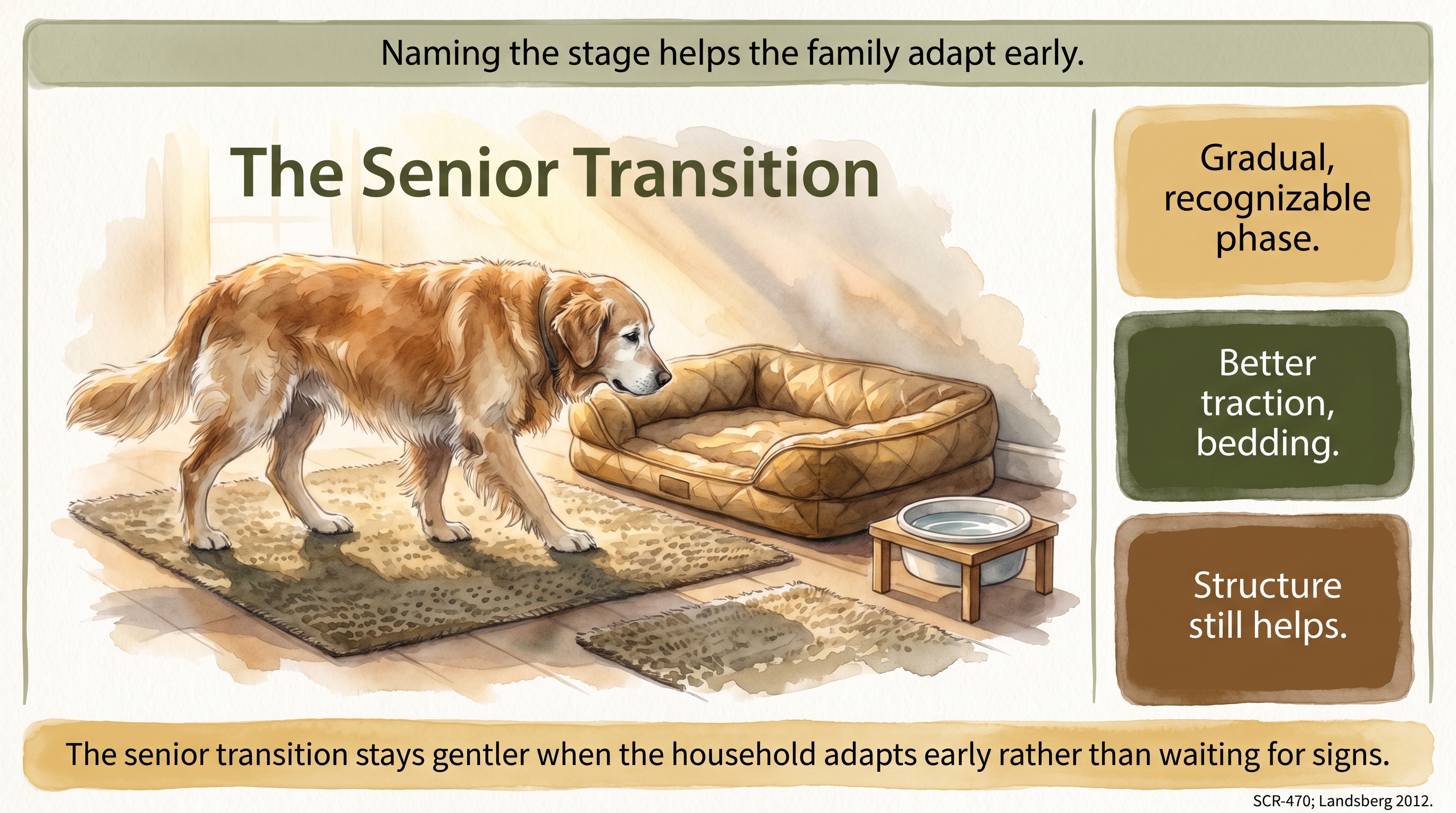
The senior transition stays gentler when the household adapts early rather than waiting for signs.
Key Takeaways
- The senior transition is usually a gradual but recognizable phase in which adulthood is no longer the right map.
- Early practical changes such as better traction, better bedding, and gentler pacing often improve comfort substantially.
- The older dog still benefits from structure and thoughtful adult decision-making rather than from either denial or overindulgence.
- Naming the stage helps families adapt early enough for the transition to stay gentler.
The Evidence
- senior-care guidancedogs
As dogs age, changes in mobility, sleep, metabolism, and disease risk justify practical environmental and care adjustments before advanced decline develops. - sleep and aging literaturedogs
Older dogs show changes in sleep-wake organization and recovery patterns that can alter how daily rhythm needs to be carried.
- JB breeder and family observationGolden Retrievers
There is often a recognizable stage where a dog is not yet fragile but clearly needs more deliberate accommodation than it did in mid-adulthood. - JB household practiceolder family dogs
Families who make bedding, traction, pacing, and routine adjustments earlier often report a warmer and more comfortable senior period than families who resist the stage until the dog is struggling.
No published study directly tests the practical implications of the senior transition for domestic dog raising programs. The application to household dog raising remains an interpretive synthesis rather than a directly tested intervention finding.
SCR References
Sources
- Creevy, K. E., Grady, J., Little, S. E., Moore, G. E., Strickler, B. G., Thompson, S., & Webb, J. A. (2019). 2019 AAHA canine life stage guidelines. Journal of the American Animal Hospital Association, 55(6), 267-290. https://doi.org/10.5326/JAAHA-MS-6999
- American Animal Hospital Association. (2023). 2023 AAHA senior care guidelines for dogs and cats. Journal of the American Animal Hospital Association, 59. https://doi.org/10.5326/JAAHA-MS-7343
- Takeuchi, T., & Harada, E. (2002). Age-related changes in sleep-wake rhythm in dog. Behavioural Brain Research, 136(1), 193-199. https://doi.org/10.1016/S0166-4328(02)00123-7
- Just Behaving program observation disclosure. (2026). Boundary: this internal observation is limited to JB-raised Golden Retrievers whose families continued the JB framework after placement; cohort size, time window, and counting rule are deferred in this revision. Treat as program observation supporting the senior-transition timing and accommodation pattern, not as published external evidence.