The Adolescent Testing Phase Is Not Dominance
Compound evidence detail1 SCR / 2 parts
- Documenteddevelopmental research on adolescent canine behavior and the methodological collapse of the dominance model in dog training
- HeuristicJB application that adolescent boundary-testing is developmental and calls for structured leadership rather than dominance assertion
Once an adolescent dog begins testing boundaries, people around the family start offering an old explanation with remarkable confidence: dominance. He is trying to take over, she thinks she is the boss, and you have to show him who is alpha.
This advice has staying power because it feels emotionally satisfying. The dog became harder, so the problem must be a power struggle. But the dominance frame does not explain normal adolescent household behavior well, and it often points families toward interventions that are harsher than the evidence supports and less useful than calmer alternatives. Observed-JB
JB rejects that frame.
What It Means
Why Dominance Language Sticks
Dominance language survives because it simplifies. It turns messy development into rank politics. A dog pulling harder on leash becomes a challenge for status, a dog ignoring a recall becomes a bid for control, and a dog rushing a door becomes a statement about hierarchy. Documented
Once the family accepts that frame, almost any forceful intervention can be sold as necessary.
The problem is not that social hierarchies never exist in animals. The problem is that everyday domestic-dog adolescence is too easily and too lazily reduced to them.
What the Scientific Revision Changed
The old dominance culture in dog training drew heavily on early wolf-pack interpretations that have since been substantially revised, including by leading figures associated with the original popularization. Documented Modern wolf work and modern dog behavior work do not support the household myth that ordinary family-dog behavior should be read as constant rank contest.
That does not mean dogs never influence one another socially, never negotiate access, or never hold patterns of deference and control. It means the alpha-takeover story is a poor model for reading routine adolescence in pet homes.
An adolescent Golden Retriever who tests a doorway, lunges toward a guest, or ignores a familiar cue is not best understood as a political insurgent. It is better understood as a developing animal with stronger drives, imperfect inhibition, and more confidence in pushing against known boundaries.
What JB Uses Instead
JB uses Structured Leadership.
That phrase can be misunderstood because people hear leadership and smuggle dominance back in through the side door. JB means something else.
Structured Leadership is parental, not rank-obsessed.
It assumes the adult sets the conditions of household life.
It assumes boundaries are real.
It assumes the dog is not a peer.
It does not assume the dog must be conquered.
The parent-child analogy is closer to JB than the alpha-subordinate analogy. The adolescent tests not because it is staging a coup, but because development naturally pushes against edges before maturity settles in.
Why the Distinction Matters in Practice
Dominance-framed advice often leads families toward interventions that look decisive and carry unnecessary relational cost: forced submission, pinning or alpha rolls, coercive physical control meant to prove status, theatrical door or food rituals presented as rank enforcement, and escalating confrontations every time the dog pushes back. Observed-JB
JB does not need any of that to hold a boundary.
The dog can wait at the threshold because the adult blocked the space calmly.
The dog can lose access to the room because the adult removed the privilege calmly.
The dog can be interrupted, redirected, or disengaged from without being turned into an enemy.
That is the practical power of rejecting the dominance story. Once the family stops seeing rank war everywhere, it becomes easier to respond proportionally.
Why Adolescence Feels Like Dominance Even When It Is Not
Adolescence often includes exactly the sorts of behaviors that trigger the dominance interpretation: more resistance to interruption, more social boldness, more insistence around access, more environmental agenda, and less seamless compliance.
These can feel confrontational because they are more forceful than puppy behavior. But forcefulness is not the same as dominance. Developmental push is not the same as a status campaign.
That distinction protects the dog from being punished for normal developmental pressure.
Why It Matters for Your Dog
Families do not merely choose methods. They choose narratives. The narrative determines what they think the dog is doing and therefore what they think the dog deserves.
If the narrative is dominance, the adolescent is likely to be treated as manipulative, status-seeking, and deserving of strong correction.
If the narrative is development plus structure, the same dog is likely to be treated as unfinished, testy, and in need of clear adult boundaries.
JB believes the second story is both more accurate and more humane.
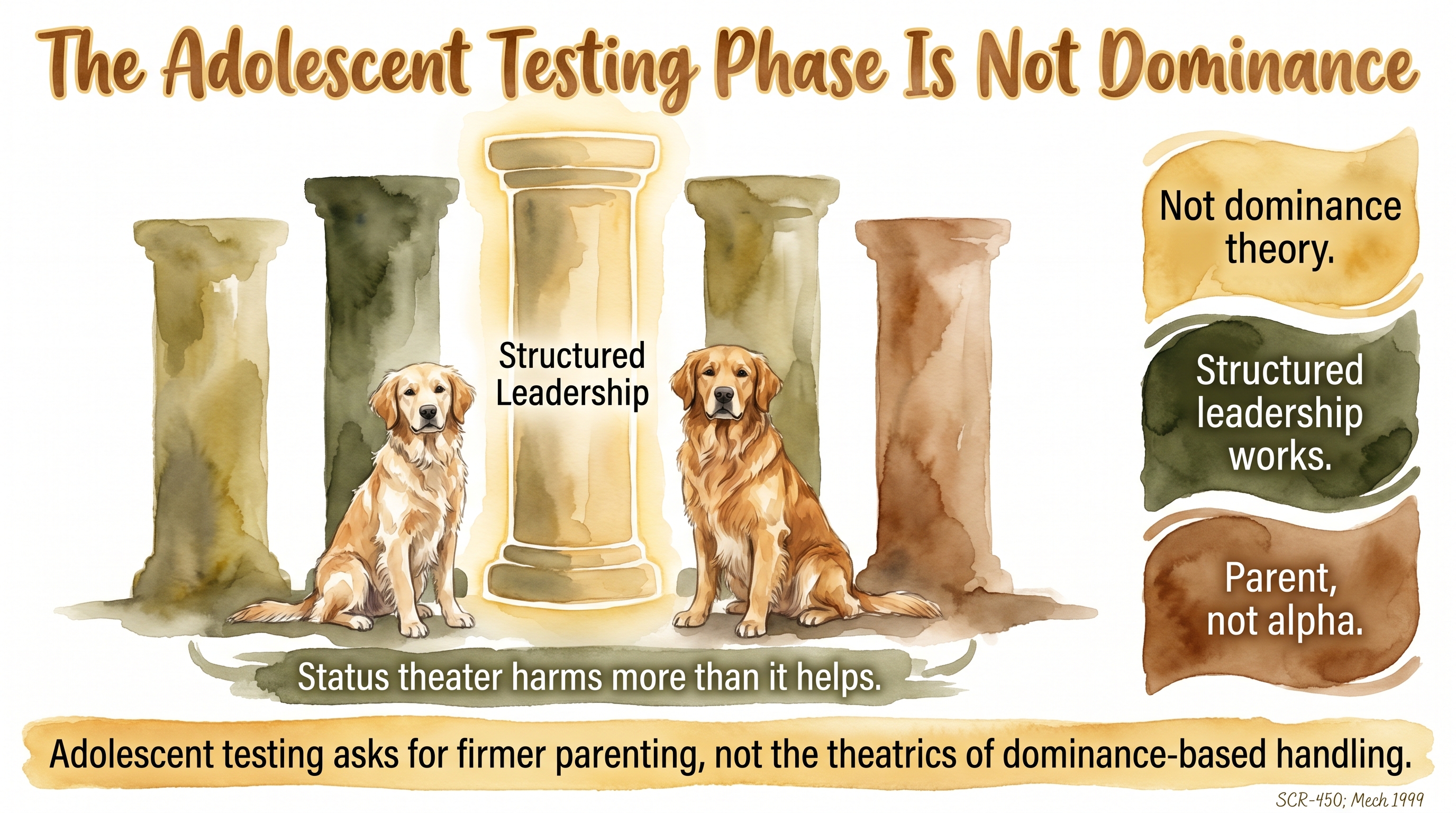
Adolescent testing asks for firmer parenting, not the theatrics of dominance-based handling.
Key Takeaways
- Adolescent testing is not best explained by dominance or alpha theories.
- Modern revisions of wolf and dog behavior science do not support treating routine household adolescence as rank war.
- JB uses structured leadership, not status theater.
- The parent-like model produces clearer and more humane boundaries than the dominance model.
The Evidence
- modern critique of dominance-based dog training languagedomestic dogs and wolves
The early wolf-pack model that fueled household alpha advice has been substantially revised and is not a strong framework for everyday family-dog behavior.
- JB breeder observationGolden Retrievers
The behaviors families label dominance in adolescence are usually better read as developmental testing, increased confidence, and reduced inhibition. - JB household practicefamily dogs
Calm structured leadership holds adolescent boundaries without the relational damage often introduced by rank-based confrontations.
- aversive-method literaturedomestic dogs
Confrontational and aversive methods may suppress behavior while increasing fear, stress, and defensive risk.
No published study directly tests the practical implications of the adolescent testing phase is not dominance for domestic dog raising programs. The application to household dog raising remains an interpretive synthesis rather than a directly tested intervention finding.
SCR References
Sources
- Mech, L. D. (1999). Alpha status, dominance, and division of labor in wolf packs. Canadian Journal of Zoology, 77(8), 1196-1203.
- Bradshaw, J. W., et al. (2015). Pet dogs social learning behavior and behavior problems. Applied Animal Behaviour Science, 123(3), 196-206.
- Rooney, N. J., & Cowan, S. (2011). Training methods and owner-dog interactions. Journal of Veterinary Behavior, 6(3), 170-183.